
Episode 359 – Epstein: Power, Corruption & Media Complicity with Nolan Higdon
Forget partisan theater. Nolan Higdon frames the Jeffrey Epstein scandal as a systemic story of elite power, media complicity, and the networks that operate above the law
For a masterclass in true bipartisanship, look no further than the guest list of Jeffrey Epstein! We all love a good conspiracy story, but it’s often just business as usual for the class in power.
Nolan Higdon – lecturer, media critic, and author of The Gaslight Gazette – is back for a deep analytical dive into the Epstein saga. Moving beyond true-crime sensationalism, they frame the scandal as a stark case study in systemic class power, media complicity, and the mechanisms elite networks use to protect their own.
The discussion hinges on several key points: evidence from released emails shows Epstein’s role as a trans-partisan power broker, connecting figures like Trump and Clinton to finance (Les Wexner) and tech (Bill Gates, Peter Thiel).
The media’s failure to investigate is no accident. (Are we surprised?) It’s a function of class interests acting to manage public perception and manufacture consent. The episode goes on to connect Epstein’s documented interest in spyware and AI to a broader project of militarized surveillance for social control.
Nolan Higdon is a founding member of the Critical Media Literacy Conference of the Americas, Project Censored National Judge, author, and lecturer at Merrill College and the Education Department at University of California, Santa Cruz. Higdon’s areas of concentration include podcasting, digital culture, news media history, propaganda, and critical media literacy. He is the author of The Anatomy of Fake News: A Critical News Literacy Education (2020); Let’s Agree to Disagree: A Critical Thinking Guide to Communication, Conflict Management, and Critical Media Literacy (2022); The Media And Me: A Guide To Critical Media Literacy For Young People (2022); and the forthcoming Surveillance Education: Navigating the conspicuous absence of privacy in schools (Routledge). Higdon is a regular source of expertise for CBS, NBC, The New York Times, and The San Francisco Chronicle.
Find his work on Substack: nolanhigdon.substack.com
Transkripzioa:
Steve Grumbine:
00:00:42
Alright folks, this is Steve with Macro N Cheese. Today’s guest is a returning guest, none other than Nolan Higdon.
Nolan is a founding member of the Critical Media Literacy Conference of the Americas, Project Censored, national judge, author and lecturer at Merrill College and the education department at the University of California, Santa Cruz, USA. His areas of concentration include podcasting, digital culture, news media history, propaganda, and critical media literacy.
All of his work can be found on the Substack, which is at nolanhigdon.substack.com. Please consider giving him a follow there. So without further ado, Nolan Higdon, welcome to the show sir.
Nolan Higdon:
00:01:26
Hey, thank you so much for having me, it’s great to be back.
Steve Grumbine:
00:01:29
Absolutely. Today’s conversation is a little different than the last time, we talked about AI with you last time, and I know AI could come up in this, because AI is kind of very, very relevant to the world that we are being ushered into, through what I consider to be the ultimate class warfare, and I’d like to kind of keep focused on class warfare as we discuss the subject of this conversation, which is Jeff Epstein.
I mean, Jeff Epstein has been both the media darling and the media whipping boy, and the greatest conspiracy ever. And like, you could see it in People magazine as the cult of personality.
You can see it in just about everything that’s out there, from a different angle. It’s a whodunit, it’s a crime mystery, it’s all the guesswork that people like to do on social media.
But you’ve been very meticulous in the way that you, kind of, went through this, and documented, and have actually critically observed the Epstein issue, if you will. And I think it raises a bunch of issues, one of which is that it’s a big club and we’re not in it.
And I think the other one is the obvious, that the media will only cover what’s in the media’s class interest, and the class interest of the media doesn’t necessarily mean educating we the people.
Seems to be that the ownership class of those media outlets has a say-so, and what kind of news we get privy to, and so forth.
I would venture to say we could look at cultural hegemony here, as a force to keeping us in a controlled mindset, to ‘not look too far that way’, but to, kind of, keep our eyes centered right here where they want us. Can you just set the stage?
Let’s talk about Jeff Epstein as the person and who he is- in the context of the world today- and then we can get into the real meat and potatoes of the whole Epstein Files.
Nolan Higdon:
00:03:33
Yeah, and I think the way you describe that is spot on. And I think to, kind of help, it might be worth kind of explaining how I came to even start following the Epstein story.
I think myself- like many people- had sort of faintly heard about Epstein.
There were these reports about his connection to the artist formerly known as Prince Andrew, and that he had gotten this, kind of, so-called sweetheart deal in Florida for sex crimes. And there may have been pictures or relationships between Donald Trump and Bill Clinton.
And I was sort of like, ‘yeah, that’s weird, but wealthy powerful people hang out with people who do bad things’… it didn’t really drive that much interest to me.
But the more people sort of, made these arguments to me about, “Well, what about his relationship with Israel?” or “What about his connection to the Dalton School?” or “What about his connection to the Barr family?”- who was from the intelligence community here in the United States.- I sort of went down these rabbit holes, and kept finding that a lot of these claims had actually been vetted by journalists.
These connections were there, but what they meant really wasn’t known.
All we could really say is, Jeffrey Epstein is connected in one weird way or another to powerful rich people, from wealthy people like Lex Wexner to Donald Trump, Bill Clinton, etc.
But you really couldn’t say more than that, other than there were these accusers who were claiming he had been engaged in sex trafficking, and a court had given him a kind of slap on the hand.
But especially after his suicide was reported- err sorry, his death in jail was reported as a suicide– you had more and more people come forward to question the official narrative. And this is where I think I was probably like most people, kind of like “Wow, you’re telling me this guy is connected to all these places all at once?…That seems pretty insane.”
But I think one of the interesting things about the emails being released– whether it be the ones that have come from his foundation, or ones that have been accessed by journalists and outlets, such as Dropsite News- it is very clear that a lot of this stuff is irrefutable. His connection to powerful figures, that they came to him for advice, these include congresspeople, people in the White House, people in investment firms, people in the intelligence community. You mentioned AI, he was a leading voice and person that people went to about the development of spyware, we know that from emails as well.
We also know that he was openly talking about the crimes he was committing. He estimated that the federal government knew about 20 of the people he had sex trafficked, the children.
And so at this point, the questions have really changed… it’s no longer a question of “Was Jeffrey Epstein connected to all these people?”… The question is now, like “How could one person have his finger in so many pots with so many connections?”
And I think that’s the uncomfortable question the news media really doesn’t want to address, because that’s going to implicate the entire system, that these people in the intelligence community and government were working with Jeffrey Epstein.
And I think even more revealing, another reason why the media avoids this question, is a lot of people in the media are also implicated in these emails, Michael Wolff is probably one of the most famous, but even going back in time, you can read article after article of the New York Times dismissing Epstein questions as baseless conspiracies, Vanity Fair writing glowing profiles of him, and leaving out the sex trafficking claims. ABC reporter Amy Robach claiming she had evidence of these sex crimes, and ABC killed the story.
And so, the media played this critical role all along the way, of saying “Don’t look here, don’t look at the evidence.” And the emails are really starting to indicate that as well.
And so, we have a somewhat clearer picture, but there’s still a lot of unknowns, despite what’s been released thus far.
Steve Grumbine:
00:07:14
When you think about this, like, obviously Trump ran on, “We’re gonna go ahead and expose this list, you better wait, we can’t wait to see this list” and so forth. And then when push comes to shove… I mean, I think Pam Bondi went out there talking about it, a bunch of his minions went out talking about this thing, and then all of a sudden- I guess they had eyes on it- and it was like, “Wait a minute, hold on, let’s back that up… I don’t think we’re gonna go ahead and put this out there now.” They’ve had plenty of time to redact it and do whatever else they might do to it… and I don’t know, I’m speculating, I’ll let you fill in any gaps there. But it is ironic that he trotted that out there, knowing that he could play to this, kind of, weird left-right alliance here, I want to call it the horseshoe here… We’ve got the folks at the ends here, finding common cause in Epstein, because it served various purposes.
What are your thoughts, in terms of why the Trump administration withheld this information, after making such a big to do about releasing it?
Nolan Higdon:
00:08:23
Yeah, so there’s kind of an interesting detail as part of this story. You know, when Trump ran again for President in 2024, he was very clear that he planned on releasing the JFK, RFK and MLK assassination files, and people in his campaign had talked about releasing the Epstein files.
Now, Trump made one statement on Fox News, where he seemed very positive he was going to release the files, but it later on turned out that Fox had edited that clip, and right after Trump said, “Yeah, we’re going to release the Epstein files”, he added a qualifier afterward, “You know, we might have to redact some things”, like he was less willing to double down on the Epstein release. And Fox helped kind of change public perception about that through edits.
But what I think a lot of people who are deep in digital culture don’t understand, they don’t understand how important of a deal the Epstein story is to people online, particularly a lot of people in the MAGA coalition, but also a lot of folks in, like the far Left as well. And this was like a really major story, and we can debate why they do this, but a lot of those folks online did put their faith in Donald Trump to release these files. And I think people in his administration, even believed it was going to happen, and were sort of stunned when they got pushback from Trump.
By then, they had already made these public statements- if folks will remember- like Kash Patel and Pam Bondi had said unequivocally, “We’re going to release the list, we have a list.”
And then once it came time, and Trump had sort of changed his tune, they went into the podcasting space and Kash Patel said, “There’s nothing to see here, there’s nothing going on, there’s nothing to show”… They changed their story.
But by that point, I think the public- left, right and center- had taken an interest for all different reasons. I think far elements of the Right and the Left, saw this as a conspiracy of power that they wanted to expose.
I think a lot of folks in the center, saw this as a political way to kind of hurt Donald Trump, whether or not they believed the Epstein story was kind of secondary… And it really built into a coalition.
And I think one thing- and I know this is something we forget to say about politicians- but we do forget that some of these folks, all these folks are human, and sometimes the human feelings can be touched.
And I’m not saying that any of these Congress people are not acting in bad faith when they decided to release the Epstein files, but I have to imagine some of them were swayed by talking to some of these victims; we can’t, I think, discount that… and that coalition really came together to put pressure on Trump.
Now, to your question about what we’re ultimately going to see. So far it’s really been pretty damning for Democrats… folks like Larry Summers, for example, have had pretty damning reports. Trump is clearly affiliated with Epstein in the emails, but that was really known before, and Trump had talked about it before.
So, I sort of, am with you, that I think ultimately what will come out, are redactions that probably help Trump and MAGA supporters, while exposing as much as possible political enemies and Democrats. And it’s far from perfect, but I think it’s better than where we were at.
I still think some of that information can be useful, as long as it’s not reported in a hyper-partisan way. And that’s been one of the things I’ve been sort of, pressuring in my writing, is we need to get beyond the red versus blue.
I mean, this is really talking about the way power operates.
Steve Grumbine:
00:11:37
You know, and that brings me to the core of what I consider to be this discussion. I don’t believe these elections are producing outcomes, that the American people really are all about.
I believe they are heavily utilized to manufacture consent, for whatever oligarch factions are planning to do, period. Like, whatever that is, whatever the powerful do.
The study that Gilens and Page did from Princeton, back in 2014, showed clearly that public perception has 0.0% impact on public policy. And so, the deeper you go into these kinds of scenarios, people desperately want to have agency, they want to feel like they have some influence or power over anything.
And I think that’s what’s drawn a lot of people to this story, is the idea that, by them caring, suddenly by them caring, that it will somehow or another alter the way the rich and powerful behave about this subject. Maybe there’s some truth to that, but I haven’t seen it, and I think it’s gotten more naked that they don’t really care.
I think we’re finally seeing- in my opinion anyway, at a level that I don’t think any of us probably could have predicted- the lack of care of what public opinion is, the lack of care about what’s in the working class’s best interests, or any of that stuff. I see an oligarchy doing oligarchic things, from Venezuela to the Epstein files, you name it. I don’t see a coherent working class, I see nothing for working people… I see only pain and suffering.
So, when you think about what I just said in light of this- and knowing full well that this isn’t a Left/Right thing, this is a powerful versus the powerless thing– you can see that in the young girls, the kids- as you said in one of your other podcasts, I agree wholeheartedly- that were taken as part of the Epstein experience. I think of the movie Hostel, I think of rich people… What do you do when you have all the money in the world, and all the power in the world and stuff?.. Well, you do whatever you want to do… you skin people alive. I mean, I know it’s a movie and all, but I mean, it wasn’t far-fetched, there was something perversely realistic when I watched that movie Hostel, that made me kind of think of moments like this.
And that’s the only comparison I can put to it, is the idea of rich people- who will never worry about how to pay an electric bill or get a cavity filled, if they ever have one, they’ll steal some poor person’s tooth, and put in their mouth like George Washington days- I mean, at the end of the day, they want for nothing, so the only thing they have, is whatever pleases them, whatever pleasures of the flesh, or whatever it is that someone can do when… What else?.. Who’s going to stop me? Absolute power corrupting absolutely… What are your thoughts on that?
Nolan Higdon:
00:14:44
You know, I think that there’s something to that. I think you can even… we understand this almost on a global scale, right?
Like, there’s a lot of talk right now about the double-tap murders of Venezuelan boats that are supposedly carrying drugs, or whatever the myth is. We don’t hold that same standard for other countries… If other countries do that, us, the wealthy can dictate laws to them. We can put sanctions on them, we can cripple them, we can bomb them.
We don’t have that same accountability for the wealthy, and I think, kind of what you’re describing, happens here on a domestic scale as well. And I think it’s worth kind of noting.
You talk about how recently the curtain has kind of been peeled back. I think the only time that sort of corruption is really exposed in a systemic way is when you get this kind of like intra-elite fighting.
So when the elites aren’t getting along and they go to war with one another, that sort of gives a peek behind the window.
And I think you see that after World War II, particularly in the 1960s, I think there was a lot of fighting about who the United States would be in the world in the 1960s. And that was kind of on naked display. And I think you see it again here in the Trump era.
And I know some people are going to hear that and say, like, “What do you think? Trump is like some representative of the working class?” No, not at all. I think Trump represents more of kind of oligarchy and less of like the corporatism that you see from like say the Democratic Party.
And I think it’s erupted into this elite fighting where oligarchs want to, you know, consume as much as possible for themselves, where corporatists want to create a system of exploitation that lasts much longer and probably has much more of a face of democracy and stability. And I think in terms of how this ends up working electorally is I do think that people still can have an influence.
But one of the things that I think elites have done really well, and this is spoken to in some of the Epstein emails, is folks who actually stand a threat to power are neutralized quite quickly.
In the Epstein emails, you’ll catch them discussing and them could be many people in many circumstances, but discussing how to neutralize negative stories about people they want to protect.
You know, this includes like Steve Bannon saying, “We can protect Epstein on this” and like talking about the ways in which they can manage public perception.
And then conversely, like how you can destroy people, how you can work behind the scenes, whether it be in like a congressional hearing or a debate, to embarrass people on a national stage. And I think we see this time and time again from candidates who do really take a position that that’s against power.
And I don’t mean to endorse any of these people, but go back to like Ross Perot when he was a threat to the two-party system. He was actually polling very high, a real threat to both parties. And then all of a sudden he drops out and about six months later reenters the race.
And he claims that there was, like, this dirt dug up that they were going to use against his daughter. He really indicates it’s from the intelligence community.
Now, I can’t verify any of these claims, but it’s just an example to me of the ways in which people can be neutralized.
Or you look at, like, the Bernie Sanders campaign, all the reporting about how Russia had infiltrated his campaign and how he was a Russian, you know, a bot on the eve of the 2020 Nevada primary. And folks like Washington Post, Jeff Bezos were reporting this.
And I think there is a way to manage the public perception and to distract, misinform, hide stories, character-assassinate people. And in that way, you know, the people often kind of do what you want. I mean, you just mentioned how, in your lifetime, and I agree in my lifetime as well, neither party has really fought for or even given an agenda that serves working people, yet working people are, like, religiously tied to these two parties. If you talk about their party negatively or talk about voting outside of that party, you get real pushback.
People are real, like, firm believers in this. Yes, there are a group of independents, but even those independents end up swaying Democrat or Republican often. They don’t vote, say, third party.
So I think they’ve really managed the public perception. They’ve got some great tools at their disposal.
And I think these are the things that really corrode our democracy as people are pressured into choosing what they call the lesser of two evils. But as I always say, if you go one direction, less evil. Less evil after 40, 50 years, you’ll eventually arrive at evil.
Steve Grumbine:
00:18:57
Yeah. Yeah! I’ve come to believe that within that space that the oligarchs, even though there’s not a single, “This is what our agenda is.
And here’s the one truth, and we all agree, and let’s get it out there.” I do believe that there is enough of that manufacturing consent. And interestingly enough, brings us to our guy, Noam Chomsky.
Noam, who wrote a fantastic book, quite frankly, about manufacturing consent. You know, this is not secret, right? I mean, this is not a secret.
But yet Noam Chomsky is suddenly in the crosshairs because I guess Noam has a secret. Can we talk a minute about Noam Chomsky and kind of his relationship to Epstein and how the big and powerful can stifle even a brain like Chomsky?
Nolan Higdon:
00:19:48
In early 2020s, it was first reported that Chomsky had some relationship with Epstein, but the details weren’t really known. And Chomsky really dismissed it. He basically said, you know, “I barely knew the guy. I met him once because he had was dealing with some, like, financial issues.”
And this had been shortly after Chomsky had left Massachusetts for Arizona.
And I think a lot of people assumed, like, okay, maybe he was getting financial advice, moving from one state to another, it’s, you know, time to plan for retirement, et cetera.
But since the release of some emails, that is a real oversimplification, understatement of their relationship. They were in contact quite frequently, certainly after 2017, because in the emails, Chomsky references that he’s at Arizona State University, which means this is a full decade after the sex crimes of Epstein were known. And a lot of the rumors proliferated about his connections to like intelligence and those in power.
And in fact, in one of the communications, Chomsky sort of talks about how, kind of in a lauding way, kind of how amazed he is that Epstein can get powerful people on the phone that you just kind of bring up. I think it was a representative in Norway that had come up in conversation. Epstein just contacted this person on the spot.
There’s also a letter, we don’t know when the date is where Chomsky writes this really kind of lauding review about his great friend Epstein. And, you know, Chomsky has mostly stayed silent about this. His wife acts as his spokesperson.
She has prior to this, and hasn’t really given many public comments on it. But that’s about the extent of what we know.
But again, yeah, like you point out, for a lot of us, you know, myself included, my whole career, have used Chomsky’s writing to help frame my understanding of power.
It’s really interesting how that person who helped frame my understanding of power is sitting so close to someone who has seemingly or had seemingly unstoppable reach to those in power.
Steve Grumbine:
00:21:41
You know, as we go into this, right, obviously, you know, folks will defend people reflexively.
This is like back to your point about Democrats and Republicans and these people’s identities kind of being tied up into the defense of these oligarchic non-working-class institutions that have private interests that have nothing to do with the people that are swooning over them, kind of like British royalty, speaking of Prince Andrew. I do wonder, as we look on this, what exactly is it?
What is your research shown in terms of the collaboration of the AI movement? Epstein, obviously, we know from Peter Byrne’s work over there at Project Censored about the Militarization of AI and so forth.
But this is a kind of a big deal. Epstein was a bit of a power broker among these elites. And it went beyond just sex trafficking. It went beyond just young girls.
Help me tie those threads together.
Nolan Higdon:
00:22:43
Yeah. I think we can talk about what evidence exists and then sort of the speculation from there.
It’s always been speculated that perhaps Epstein used the predilection of those in power toward children or young women, depending on which story you believe, and, you know, would use catching them in these compromising situations to, say, blackmail them. This was a way those in power could control, like, elected officials.
So that way the public technically has a democracy, but the people they elect are under the control of these folks who can blackmail them. That was always a claim that was made. And it sort of, I guess, is supported, not 100%, but somewhat supported by a lot of the emails which show Epstein being somewhat of what the news media calls an “information collector”. Epstein, someone you could go to to get information.
They never dig deeper to ask where he got that information or why he was trusted or how he was connected to all these agencies. But I think, you know, we can’t fill this gap.
But I think the gap in that story would be, you know, is Epstein working on behalf of the intelligence community?
He definitely was working with governments, including the US government and Israel, and there’s a lot of strong evidence, Russia as well, in the emails I’ve seen. So was he working for these governments and intelligence communities to dig up this dirt?
Was the sex trafficking operation a part of that dirt, or was it just a predilection of his own making that he engaged with other elites? We don’t really know the answer to that, but he did have a distinct interest in technology, particularly spyware.
And a lot of the major spyware that’s used kind of around the globe by governments comes out of Israel. Pegasus is probably the most famous of which. And Epstein was on a, you know, the cutting edge of a lot of this.
And I think it’s important to note that’s why he’s connected to people like Bill Gates and Peter Thiel, these folks who are in the tech industry. When I say connected, I want to be very clear.
Just because, like, Chomsky or Gates or Thiel are connected doesn’t mean they had anything to do with the sex crimes. I’m not trying to excuse their behavior, but I’m just saying, like, we can’t conflate this.
We don’t have evidence to say they’re engaged in that at least yet they did, you know, theoretically know about the sex crimes and still work with this guy. But nonetheless he was really interested in this and he held a lot of conversations with these government officials and tech officials about this.
And one of the critiques, you know, folks like myself had, and you mentioned Peter Byrne, but certainly many others, is that this technology came from the military industrial complex. It’s designed to surveil and collect data and monitor communications. It’s really a tool that was designed to oppress and control populations.
And the commercialization of it was lauded as a way to, you know, get that power out of the hands of government, put it in the hands of private industry. But the Epstein files reveal how close so-called private industry is with these governments.
And where you probably couldn’t get Americans in the 1980s and 1990s to put a government tracker in their pocket, put it in a shiny case with like an Apple logo and a nice like commercial, people are more than willing to use it consistently. And I think Epstein’s a part of that story.
And it’s now developed into the age of so-called AI, which you know, is rapidly being integrated into all aspects of life despite the very fact that study after study shows it can’t do what its biggest boosters claim it can do.
Which begs the question, is this just, you know, a money-making opportunity to create a bubble or there other nefarious means such as, you know, surveillance, data collection, monitoring communication?
Because we do know that elites are very frustrated with some aspects of the Internet, particularly the ways in which communication has allowed people to share information that you know, frustrates elites.
Even some of the stuff about Epstein or you know, we saw this with Israel, for example, Israel’s assault on Gaza and TikTok. So how much of this AI is really private industry kind of boosterism and techno-progressivism?
And how much of it is just a further of the military industrial complex which we have to include private industry as a major part of that.
Steve Grumbine:
00:26:43
So you know, as we’re looking at this, and I mean everybody has a piece of this, right? They can chew on. Hey, AI is destroying the environment. AI is used for slaughtering children in Israel in this open-air experiment, this test lab that high tech is using to prove its products out. But this Epstein element, he’s the center of it all. Or is he just an accidental guy that’s in the midst of things?
How did he become such a focal point in all of this? How did he become the glue between all these disparate elements?
Nolan Higdon:
00:27:22
Unfortunately, you know, we have some indications of it, but it’s a question that our media has really refused to answer.
They’ve sort of basically reduced him to some, like, lucky guy who manipulated his way intelligently through the most powerful halls of human history.
But we know that early on, he went and taught at the Dalton School, where he got hired there by future Attorney General Bill Barr’s father, who had come from the OSS, which was the predecessor to the CIA. And at the Dalton School, it was an elite preparatory school. And there’s no real indication that Epstein had any credentials to be teaching there.
But he did meet very wealthy individuals who he aligned himself with. A short jump from there, he became a financial advisor and worked at investment firms.
That’s where he aligned himself with Les Wexner, who was one of the wealthiest investors. And wouldn’t you know, it was nice enough to give, yes, give for free Epstein this Manhattan housing location where Epstein could live.
And a lot of these future crimes were committed. And from there, you know, it really gets just really more opaque. He, you know, buys this island in the Virgin Islands.
He has this private jet called the Lolita Express. Some of the most powerful and wealthy people, including President Bill Clinton, Donald Trump, who was also a New York-ite. We talked about Prince Andrew.
These folks are coming to him. We don’t know for what. In the case of Clinton, it’s supposedly for altruistic purposes. They were doing charity, you know, for Prince Andrew.
I think it’s very clear at this point, it’s sex crimes. Donald Trump claims it was just kind of a friend association. They were two, like, wealthy, you know, guys.
And then you’ve got folks like Larry Summers and others who. The politicians, they change in office.
But folks like Larry Summers, you know, around in the Clinton administration, the Obama administration, they were handling economic policy, yet they’re going to Epstein for advice. Then we have governments like I mentioned, Israel and Russia, are not just going to him for advice.
They’re actually, in the case of Israel, using Epstein to broker various intelligence deals with countries like Mongolia, for example. We have emails that demonstrate that. And he becomes an advisor also to the tech and finance world from Peter Thiel and Bill Gates.
But what we have are these, either from witness statements or emails, we have these connections, but there’s never been an explanation of how they all tie together.
And in my opinion, the news media seems just way too comfortable to assume that Jeffrey Epstein just made friends. Like he was this gregarious talker who, you know, happened to walk into massive amounts of wealth and knowledge and information.
And people came to him despite a lack of credentials.
And you know, another part of this is the Ghislaine Maxwell part, which is interesting as well, who was found guilty in in court of participating in the sex trafficking.
Her relationship with Epstein has been described in a multitude of ways, from sort of life non-sexual partner to sexual partner, depending on what you believe. But her father, it was widely believed, had worked intelligence for Israel.
It’s never really been a hundred percent confirmed, but when he died, they did give him a state funeral in Israel, which is one of like the highest forms of appreciation they can give someone, especially in that position. And so everywhere you look he seems to always have these connections.
But the news media does not seem interested in determining how these connections were made.
Steve Grumbine:
00:30:44
You know, as I’m looking, obviously you’ve detailed all of this extensively on your Substack. And you know, I don’t want it to be a sensational discussion. That’s not my goal. I’m not looking for sensationalism at all.
But the more I look at this, obviously there’s this tranche that takes us to Israel and do you feel like the girls, the young girls, were a means of deriving bribable material to keep folks in line with some greater cause? I mean, is that kind of the essence here or were they accidental?
Like he ran a, his own little island and such and the pictures were just sort of, you know, to keep him safe? I don’t know. What are your thoughts on that?
I mean, it seems like there is a pretty strong correlation, maybe is not causation, but it sure does look that way. Can you explain that relationship there?
Nolan Higdon:
00:31:41
Well, I can’t really explain it because I mean, I think one of the things that makes it difficult to answer that question is there’s not a lot of transparency on what the relationship is between countries like Israel and the United States.
You know, does Israel act as a proxy state for the United States, for example, that would change how Jeffrey Epstein’s communications would be interpreted. Is Israel kind of like a mostly rogue individual state that sometimes collaborates with the United States?
That would sort of change what these behaviorisms by Jeffrey Epstein indicate.
But I think, you know, one thing that that really is clear is that Epstein was someone who could find dirt on people and possibly destroy their image and also was someone you could go to to protect people’s images as well. And an average person on the street doesn’t have that kind of information.
I mean, this is the kind of information intelligence communities and opposition research seek out. And so the idea that Jeffrey Epstein just sort of stumbles into this is ludicrous. There has to be some other infrastructure he’s dependent upon.
And it seems like the intelligence community is the one that makes the most sense. Now, the documents don’t 100% show that. It would be an exaggeration to say that that’s known.
But at the same time, I think it’s very clear that Epstein behaves in that way and is seen as that way by the folks that use him, like Stacy Plaskett, for example, the representative from the Virgin Islands. She’s trusting Epstein as a source when she’s trying to get dirt on Michael Cohen during his hearing. And she’s texting him in real time.
And, you know, the excuse is, “Well, it’s one of her wealthiest constituents.” That’s true. But do people always text with their wealthiest constituents? Why would you trust this guy?
What is it about him that makes you think he has this like, this insider knowledge? And if you think he has his insider knowledge, why text in real time? Why not get that beforehand and verify it?
These are all indications that it was just sort of assumed Epstein was a trustworthy source and by all these different people, but nobody ever explains why. Where did that come from? Where did he earn that trust in these people’s minds?
And I think something like getting vouched for by the intelligence community or agency, an agency in particular, might help explain that, but we just don’t have enough evidence now.
Intermission:
00:33:58
You are listening to Macro N Cheese, a podcast by Real Progressives. We are a 501c3 nonprofit organization. All donations are tax deductible. Please consider becoming a monthly donor on Patreon, Substack, or our website, realprogressives.org. Now back to the podcast.
Nolan Higdon:
00:34:20
To your other question, though, about whether or not he used this information for self-preservation, it may have been for him and or Ghislaine Maxwell. The Epstein estate is the one that have been sharing some of these emails. They’ve been you know, leaking some of these emails. It’s strongly believed.
And you notice when Donald Trump was kind of like refusing to let the emails come out, which a lot of people thought could be kind of leveraged to help get Ghislaine Maxwell out of jail if she played ball with the government.
That’s when a lot of those leaks happened, like the birthday book and all those things that were damning to Donald Trump. Once Ghislaine Maxwell got moved into Club Fed, this more comfortable prison environment, once he publicly refused to say he wouldn’t pardon her, the leaks stopped from a lot of that stuff.
And I think that’s also interesting to illustrate how some of this power works.
Steve Grumbine:
00:35:05
Okay, so looking at this clear headedly, right, obviously Jeff[rey] Epstein is a sacrificial lamb. Somehow or another, miraculously, he just randomly takes his life under pretty severe, you know, being watched.
And there’s cameras, there’s all kinds of things that just in some miraculous moments, somehow or another the cameras go off, off, and he just suddenly ends up deadening himself here. Right. You know, he was deadened. I don’t know what. It’s too. It’s almost too fantastical to believe. Right. Obviously something happened there, right?
Something. Whether or not he, you know, really died or there was a doppelganger or who knows what the hell happened.
I try not to be too salacious here, but I mean, that was pretty crazy. There was a lot of coinky-dinks that happened to make that even possible.
And I have no idea how he would know that the cameras were off to do it at that time, if that even mattered. I mean, the list is just so ridiculous. It defies… like it doesn’t pass the smell test. Is there anything out there on this?
Nolan Higdon:
00:36:14
Yeah, this is where I think the news media actually did somewhat of a good job.
So, you know, the story you just told has been questioned, you know, ad nauseam, and the government, or sorry, the prison itself has changed its excuse. You know, first it went from like the camera wasn’t facing there to that camera was broken and the tape wasn’t recording. And then it was eventually the tape was recording, but it resets every night. And for one minute every night it doesn’t record.
And when they finally did release the video, which, you know, it does not have that one minute, this is where I think the news media did a good job. First of all, there was a former prisoner at the same prison who said that that’s not even the right floor.
That was confirmed by Julie K. Brown, who’s a reporter who’s been working on this since her days at the Miami Herald, basically since the early 2000s. And then CBS also did a pretty deep dive investigative report. They debunked the camera narrative, the company that makes that camera said there’s no such mechanism where one minute blurts out. And CBS also confirmed that the video we saw was the wrong floor. So we’re kind of back to square one.
We don’t know why we don’t have a video, but we know we don’t have a video. And the reasons the government has given and the prisons have given have been debunked both by people inside the prison and independent journalists.
And I think that feeds to the speculation here of what happened. And even if folks don’t care about the larger story, this is a potential political murder here in a US prison.
That alone should be, like, a reason for investigation. Even if you don’t care about foreign governments and those in power and blah, blah, blah, like, that alone should be a massive story.
But unfortunately, two things. One, there’s so many different parts of the Epstein story.
It’s almost perfectly what the CIA used to call the Mighty Wurlitzer that it’s a hall of mirrors. You don’t know where you’re looking or what you’re looking at or what you’re paying attention to.
So in that sense, it’s difficult to wrap your head around. And also, we live in just such a quick news environment.
I mean, the cameras, Larry Summers, I mean, they’ve been buried under things like Venezuela, MTG stepping down, the shutdown, the election. You know, it moves so fast. And I think we don’t have a news media that really spends enough time kind of doing deep investigative journalism.
A lot of these stories are just kind of passed upon.
Steve Grumbine:
00:38:27
Let me ask you just a crazy question before I go into the next thing.
Do you think that the quote, unquote, “media” being the reporters and so forth, just don’t cover it because the bosses don’t fund it and the overall paper doesn’t want it, or the overall outlet doesn’t want it, or the oligarch knows what’s there? So he says, “Nah, look this way. Don’t look that way.”
I mean, we saw Bezos come out and say the Washington Post wasn’t going to be running any more socialist content or what if content, it was all going to be in praise of capitalism basically, and people were quitting in droves. I’m curious, doesn’t it feel like it’s bigger than just a couple, you know, reporters on a beat deciding not to dig in?
Nolan Higdon:
00:39:12
Absolutely. This is a systemic failure. In defense of the journalists, you know, it’s an industry that’s watched job after job get gutted over the last 20 years.
There’s very few- if you’re someone who really wants to be a journalist and cares about journalism- there’s very few lucrative jobs.
And if you don’t get one, the other option is you’re running around the country making millions of, like, YouTube videos and Substack posts and, you know, fighting with people in their garage who are creating sensationalistic content to get clicks. It’s not a great career. And so you have to, I think, adapt to survive.
And this is one of the funny things about the work I do is, journalists will always kind of confirm my critiques of the industry, off the record, but none of them will ever go on the record because they know it’ll kill their career. So, like, a lot of them will tell me, like, “Yeah, we know, like, we can’t talk critically of Israel. You know, we know that. And so we don’t.”
And I think Dana Bash illustrated this with MTG, right? Like MTG said, like, “The emails show Epstein working on behalf of Israel, so we should investigate that further.”
And Dana Bash is like, “what evidence do you have for that?” It’s like, she just told you- the email. Like, she just told you. Like, that has to be willful ignorance.
I don’t think Dana Bash is, you know, that dim of a bulb. And then, you know, there’s also, you don’t want to anger your employer.
Like, if you’re sitting there at the Washington Post and there’s an opportunity to write a story negatively about, like, Epstein or Amazon’s economic practices, which Jeff Bezos owns, are you going to write that? Or what about his space program?
Or, you know, I mean, are you really going to write those kinds of stories also, even if you’re not at the Washington Post, maybe you know how limited the jobs are. Do you want to anger Jeff Bezos in the Washington Post while you’re at the New York Times? What if you lose your job at the Times?
Now, two of, like, the few options are off the table for you. So I think there’s a lot of negative incentives for journalists.
Another negative incentive, I should say also is, like, you really get rewarded if you cozy up to power. There’s a belief that audiences gravitate toward people they know, like the famous.
So if you can keep a good relationship with the famous and powerful, it can boost your career. Where if you’re doing, like, man on the street interviews, it’s tough to get attention. And so you don’t really want to anger those in power too much.
You might ask the occasional difficult question, so you can check that box once every three years, but you’re not going to continue to do it. And so I think all those negative incentives play a real critical role in helping journalists not ask critical questions.
And the last thing I would kind of say on this point is that if you are a journalist, one of the practices they do is they try and move you to, like, different beats. So you walk into something with a fresh, new perspective. But the problem with that is a lot of journalists don’t study history.
They don’t have historical context. So they come into these stories and they’re shaped by the now, and they miss sort of the past.
And something like the Epstein story, you really have to understand the decades preceding the email’s release to understand the gravity of this situation. Or to give you a better example, like the JFK files.
I can’t tell you how many journalists have had me ripping my hair out the last year because they say, like, well, “Trump finally released the files and we didn’t find out anything new. Yeah, there was no smoking gun.” I’m like, we knew there was gonna be no smoking gun.
But it does illustrate that the CIA was surrounding and surveilling Oswald his entire time in Texas up to the shooting, and that surveillance was going back to D.C. and the head of the CIA. That’s a major bombshell. The CIA can’t say, like, “Oh, this lone nut. We didn’t see this coming.”
Now they have to say, like, “We were all invested in this lone nut in surveilling him, and we missed this.” That’s a huge story. Right? But people who don’t study history don’t know that.
So they look at the files and they don’t see, like, the one memo that says, CIA killed Oswald on this day with a signature. And they’re like, “Oh, we found nothing.”
Steve Grumbine:
00:42:54
It’s just amazing. So, obviously coming back to the now, you know, Marjorie, MTG, I don’t even. I can’t. I know she’s retiring now.
There’s a lot of goodwill for her because she said a couple things like, “Hey, sorry about being a complete asshole for a little bit there. I’m going to retire because I don’t want to create a civil war now that Trump no longer loves me,” kind of thing. Like, what are the optics?
I don’t believe this is about electoralism at all. I think this is about keeping the bodies protected. Maybe they have some junk on her. I don’t know.
But regardless, though, it’s like, go back to Oppenheimer. And I think the movie -I’m not historically astute enough to answer how true or false that movie is- but the way that they tried to screw Oppenheimer when he said, “Wait a minute, wait a minute, hold on. You’re gonna. You’re going to kill all those people in Japan? What’s going on there?” And you had Truman basically saying, “Here’s a tissue.”
And then they spent all that time undermining him and destroying him and so forth. I mean, this is not new, right? Like, I mean, this is, this is not new at all.
I mean, obviously the Internet and AI and things like that are new, but the tactics don’t appear to be new. They appear to be pretty much standard operating procedure.
Nolan Higdon:
00:44:14
Yeah, and it’s, it’s funny you bring up that example because that is really where this kind of art of intelligence gathering and character assassination comes into being.
The so-called Truman Doctrine of 1947 launches these intelligence agencies, most notably the Central Intelligence Agency [CIA], which was supposed to just collect intelligence internationally. It was not supposed to operate on domestic soil. Of course it did.
It was also not supposed to carry out black operations, like basically operations off the books, which it did- covert operations.
And that practice really became normalized from 1940s up until the 1970s when some of it was exposed by the Church Committee and in that time period exposed that, you know, the federal government was paying journalists to write pro-American stories. It was spreading propaganda internationally and domestically.
It was surveilling political activists, particularly peace activists and the civil rights movement and elsewhere, assassinating world leaders that they found problematic for the US government. All these things were released in the 1970s and there wasn’t really a major reform effort.
I mean, the people who headed this, you know, so-called reform were people like Donald Rumsfeld, who just basically found ways to put so-called reformers in, like George H.W. Bush, who saved these agencies.
And we consistently get examples of how these practices have continued, as you point out, including new technology like the Internet, smart devices and AI.
But the public kind of remains with this historical amnesia, acting as if these practices, if they existed, somehow stopped in the 1970s, where all the evidence says the opposite.
And I think again that history is important for understanding something like Epstein, because as I said at the beginning of this recording, the whole Epstein story, if you don’t look at the evidence, sounds completely insane. It sounds like I should have like a corkboard behind me with like a bunch of string and you know, I’m up on coffee.
Yes, but I’m telling you this stuff is verified on my Substack. I try to cite every single claim and note where it’s speculation versus verified evidence. There are still many, many questions left.
But it does fit with the historical trajectory you’re talking about of intelligence agencies being utilized to try and control global and public opinion and where necessary, neutralize perceived enemies.
Steve Grumbine:
00:46:27
Yeah, thank you for taking that question and taking it seriously because it’s the kind of stuff that I think people are really asking about. You know, it’s like, what’s going on here?
One of the things that I want to throw at you, and I’m speculating here, so permission to say out of my wheelhouse, but I think it’s in your wheelhouse.
The Red Scare, obviously, the United States and its intelligence community and Israel and you, all of them have been heads down trying to destroy any kind of semblance of communism, of working-class struggle, of anything that represents people-led, the people being able to rule themselves and have their own kind of agency. And as a result of that, I mean, you go back, I always target the Bolshevik revolution as the alarm clock that woke the world.
But let’s be fair, there’s nothing more anti-oligarchy than communism and the idea of doing away with class and having a dictatorship of the quote, unquote “proletariat.” I mean, Congress just voted with almost all the Democrats voting with them to basically denounce socialism, and, just ridiculous levels of stuff.
But I say that because every time I think about the veneer of democracy that folks, and with all due respect, I recognize I am way more beyond electoralism than most of my guests are. So, you know, if you still believe, that’s your prerogative. But when I think about this, I say to myself, there is no way.
If the people were voting as to release the Epstein files, they’d be released. So it’s clearly not a democracy. If you think about popular democracy. This is not “we the people.”
There’s so many things that show this that, like across the board, how do they maintain control without fear? I genuinely believe every bit of this. Every time you see a clamping down, a rise of fascism, et cetera, it’s a crisis of oligarchic hegemony.
The narrative is slipping. They are losing control of the narrative like they did with Israel. Israel losing its mind.
So Larry Ellison has to buy TikTok because God knows we can’t have the kids watching the brutality of the Israelis “most moral army ever” kind of thing. You know, they can’t have that.
And so at some level, I just think the veneer, what I consider to be straight-up fraudulent, just a big lie of consent manufacturing through elections. Again, this is not to say that I am against elections.
I would love to be able to believe that I could vote and that the will of the people was actually acted upon. But how do they maintain this kind of club where they literally don’t do anything for us?
They have these guys like Epstein running around, ensuring that, you know, again, based on what we’ve just talked about, that they either have dirt on people or what? Keeping everybody in line, keeping everybody to the storyline. How is it that we have not risen up and said. “Hell no” to this?
I mean, people are dying at ridiculous levels for this lie, to keep these lies alive. I mean, the attacks on Venezuela right now, ridiculous! The destruction of Gaza, ridiculous! It livestreamed. Everyone saw it.
And yet it’s like, move along kind of. Yeah.
What? Okay. How do they maintain this? I mean, is it just the… I mean, it just seems way too challenging to not be coordinated.
The amount of disinformation, the amount of ability to say, “These are not the droids you’re looking for,” when you don’t believe your lying eyes. How do they do this, Nolan? I mean, I hate to be a conspiracy theorist, but my God, what do you got here? It just defies logic.
It defies any kind of reasonable explanation other than what I state, at least to me, anyway. Your thoughts?
Nolan Higdon:
00:50:44
Yeah, no, I think it’s a fair critique, and I think something that’s helpful is kind of Mark Blyth, who’s a economics political economy professor at Brown University, he talks about how we’ve lived kind of through these three different eras of capitalism. The sort of laissez faire from the Gilded age to the 1920s, and that system collapsed with the Great Depression.
And then we sort of have the Keynesian economics capitalism from the ’30s up until the ’70s, and that crashes for a multitude of reasons. And then we have this kind of neoliberal capitalism we’ve been living in today, and I would argue is collapsing right now.
And what he points out is in each of those systems, there’s always a bug, right?
Any economic system, and this comes from a lot of other writers as well, but any economic system, you have to attach it to some ideology to justify the fact it’s not delivering on what it promises. Right?
Capitalism, like any other economic system, has always promised that we’re all gonna be better off. We’re gonna be way more prosperous, it’s gonna be equal. We’re gonna have so much opportunity, but it never delivers.
And so that’s where you really have to send an ideology out there and the ideology of capitalism as well.
People are poor, it’s because they, you know, they didn’t work hard enough, or the people are rich, they’re more deserving of it because they must have worked harder. And you also, to exacerbate some of those ideological dispositions, you find convenient scapegoats. Immigrants, always a popular one, right?
Like, “We’re all poor because immigrants are coming here. If we kick the immigrants out, you’re all going to be rich.” That diverts attention away from the wealthy to the poor.
Another favorite, of course, is using war. “Well, you know, we got to band together to not to fight against sort of the ruling class who has all the money, all the power and all the influence, but against Germany or against Italy or against the Soviets. We have to do that immediately.” That can be a convenient distraction.
And then I think we also can’t take away a combo of education and news media, which perpetuate a lot of these narratives. You know, particularly someone like myself, who’s born in the 1980s.
You know, my generation, both as a student and in teaching, major part of our career in terms of history, has been talking about the ways in which far Left ideologies can lead to authoritarian regimes. And you can passively talk about how communism is bad kind of in any environment.
And it’s not that people necessarily say fascism is good, but there’s almost really no serious discourse or education about the ways in which far Right ideologies lead to fascism. That’s a boogeyman that hasn’t been used over the last 40 or 50 years.
I think that’s why you have a public that’s really ignorant about the excesses of capitalism but really fixated on the potential authoritarian excesses of the Left and all that really feeds the oligarchs. That’s what they want.
They want you to believe that the Leftists, the socialists, those are the folks who are going to take down the country while ignoring the real rise and threat of fascism. We celebrate that in victory in World War II, but we don’t talk about it moving forward in this country. Everything is about communism and the Soviet Union, even though it collapsed in 1991.
But the reason why I think the Mark Blyth framework is helpful is because he talks about how each of these systems, eventually, the contradictions arise and the capitalist system can’t maintain. And that’s when the public is able to exert pressure on those in power. Usually that pressure only results in slight changes. Right?
FDR used some democratic socialist measures, but to save capitalism from capitalists, not to put a democratic socialist regime in place. When that came collapsing down, we saw Carter, but mostly Reagan, and then certainly Clinton, Obama and so forth, normalize the utilization of laissez-faire capitalism to dismantle the Keynesian economics that preceded it. And I think we’re in one of those kinds of crossroads right now.
And even though the federal officials are talking about denouncing socialism, socialist policies have never been more popular. And it’s not since the 1950s has it ever been, I think, more openly discussed with, like, [New York City Mayor-elect Zohran] Mamdani and online.
And I think that’s a sign that those in power kind of feel they’re losing their grip on power. And so there’s an opportunity here, but there’s also probably going to be a lot of retribution coming from the oligarchs as well.
Steve Grumbine:
00:54:53
It’s funny you say, I think that’s really important to note that there is an opportunity. There are cracks in the armor. There are moments where we get to see behind the curtain and actually see the system for what it is.
We got a moment or two with COVID where we got to see the fact that they were able to spend money into existence without businesses really functioning at that level all throughout the pandemic. And it’s like, “Wait a minute. Where is the money coming from? We’re broke. What do you mean?
And, oh, you mean to say we actually create our own currency in this nation? Oh, interesting.” And then we’re back to this whole, “We’re, we’re broke.” It’s like, what are you even talking about, man?
And I think back to that moment where Winston in 1984 is doing the whole Newspeak thing. And it’s like one minute’s like, “You know, we’re increasing the chocolate rations to two. You get two of them this month,” or whatever.
And it’s like, “Oh, jolly good, jolly good. They’ve increased it,” when in reality, the month before, it was like four pieces. But it just feels like that.
And for me, and I purposely don’t follow the who’s who of these administrations anymore, I have checked out of name checking all the current events moments because I don’t think it’s relevant. I don’t think it’s important. I think that the real importance is the system.
And don’t take your eyes off the system because they’re going to distract you with a war or they’re going to distract you with a this or that or the other. And elections, to me, have taken on that role as well. “Hey, you know, we can vote away the oligarchy, baby. We can vote capitalism away. Honest, we can.
Power will give up easily at the ballot box. Certainly they’ll do that. You can guarantee it.” And if you can say that with a straight face, I’ll buy you frick, whatever you want.
I’LL buy you a house. There is no way.
There’s no way that if you sit down in a rational moment with silence and just look in the mirror by yourself and try and tell yourself this passes the sniff test. There’s no way. Because power concedes nothing, nothing without a demand. And they have secured themselves with jackbooted police.
You see this with Cop City. You see this with the militarization of the police. You see this in the crackdown of the campuses as activists fought back.
They have been preparing for us to see the veneer drop for a while now. At least that’s my take and I believe it strongly. Even if it’s me synthesizing, you know, related facts, not necessarily a smoking gun.
I feel like I can’t be shaken from that. It’s like, how in the world do you expect me to believe that we are voting our way out of this?
How do you expect me to believe Peter Thiel is going to randomly give up his AI military pursuits and all his weird Lord of the Rings, Christian kind of let me blow the world up in the end of days kind of line of thinking that Peter Byrne greatly just breaks down in spades. How do you get past that? I am curious because you are way more in the know on these things than I am at that level anyway.
Nolan Higdon:
00:58:08
Well, yeah, I think- and this goes back to the propaganda, just like you described it- so much of electoral politics has talked about, “We just got to change the top.”
So, you know, “We just got to get Harris in there. We got to replace Trump.” But as you point out, it’s absolutely absurd.
If Harris or any Democrat was actually going to uplift working-class people, she wouldn’t be getting donations from billionaires. You know, ditto with Donald Trump. So I mean, right there on the surface, it’s already total bs.
And I think this goes back to the education and media system focusing too much on the cult of personality. To your point, it really comes from grassroots organizing and if the electoral portion of it needs to start from the bottom up.
And like we use the FDR example, right?
FDR was one of the richest people on earth and he made, you know, still tepid concessions compared to other countries, but they were huge in terms of American history. But it wasn’t because FDR was just some nice guy. The pressure was massive. The Communist Party was growing in popularity in the ’30s.
The public was making heroes out of criminals like John Dillinger and protecting them in different cities. They were electing communists and socialists in local and state governments.
They were kicking you know, these sort of pro-capitalist folks out. They were having general strikes, shutting down cities like San Francisco.
He saw that the system, the capitalist system as it was, was going to get destroyed and he was willing to give up just enough concessions to try and save it. And that was really what that New Deal coalition was. That’s what it takes.
So yes, having someone at the top who you can pressure is important, but it’s irrelevant if you don’t have an infrastructure on down, both in terms of elected officials and organized people on the ground. And I want to point this out about Mamdani, the good and the bad.
I think Mamdani illustrated some of that in his kind of grassroots approach to New York City, which I think is impressive model that some people may want to copy. But at the same time, he relied on a lot of digital tools and digital communication.
And we have to remember those are also controlled by the oligarchs. And maybe they’re caught off guard once or twice by the ways in which those tools can challenge power.
But as we saw in Israel, Gaza, and we may see in the electoral future, I doubt that’s going to continue.
They’re going to find ways to shut down these tools for being used as social justice, because again, they’re not going to concede power without a huge pressure. They’re not going to let you just post your way to social justice.
And so I think these are the kind of conversations that need to happen at the grassroots rather than once every four years, kind of checking into the good vibes of whatever party you’re told to vote for.
Steve Grumbine:
01:00:37
So that brings me to my last point, and I do appreciate you riding with me this long here.
But you know, when we covered the DNC back in Bernie time, the first Bernie time in Philadelphia, and you got to see maybe for the first time, people really like, I know Obama kind of elicited some of this, but what a failure he was. Or actually he wasn’t a failure. He was absolutely what he was supposed to be.
He sated the oligarchs he served, but everybody thought they were using different social media apps to talk, you know, privately and communicate stealthfully and all this stuff, never thinking twice about who owns the platform and looks at the text going across and everything else. And it was just like this weird awakening that, you know what? We aren’t like in this private little thing.
We’re not, you know, secretly working to build this.
We’re being observed. We are being spied on. We are being checked out and we are being countered at every move we make. Every time we have a little bit of success, they come up with a new way of crushing it. And you saw that when Obama called Bernie into the office. “Hey, you know, parent teacher conference. Come on in the office, buddy.
We got to remind you that you’re not here to win. You’re just here to get those idiots out there to think you’re fighting for them so that they’ll stay engaged so we can keep the ruse alive.”
I mean, that’s my take on that, by the way. I mean, I was knee deep in it. We had people on the ground covering that, like, at the thing. I mean, I…
We have footage of those infiltrators shaking the fence right outside the [Democratic National Committee] DNC We had people sneaking in to hear Bernie’s telling all the delegates, “Guys, go ahead and vote for Hillary. There’ll be no floor battle.”
And, you know, we had the people communicating in text message that the delegates were getting ready to walk out of the convention, all that stuff. But in reality, they knew this stuff, and they were never going to let Bernie Sanders into that space.
And Bernie became sheepdog-in-chief after that to bring people back to the Democratic Party. Like, I mean, he is always trotted out when the Democrats go a little too far in their sycophancy. I mean, I think. What’s his name?
[current House Minority Leader] Hakeem Jeffries, just “So, yeah, we’re not going to go after any of these people. We’re not. We’re not going after them. What do you mean? We’re not going after them.”
And it’s like, no kidding. You don’t say. They’re like the, what is it? The Washington Generals and the Harlem Globetrotters? I mean, it’s really kind of ridiculous.
I’ll let you go out. You know, first of all, speak to that, but then I’ll let you take us out with what you want people to get from this conversation.
Nolan Higdon:
01:03:14
Well, I agree with you mostly on the Bernie Sanders thing. I mean, there-and I may be naive- there may have been a piece of him who thought he could actually win and was trying to win.
But one thing that he always had was a conflict of interest. He caucuses with the Democrats.
They basically have one of those political agreements that they don’t come in and try and run him out of office in Vermont, as long as when he doesn’t win the presidency, he always huddles the votes toward the Democrats. So they have that kind of backroom handshake that always made me kind of suspicious of him, to say the least.
But to your point about the powerful never holding each other accountable, you know, I like to tell it like this: for all the people right now, left, right and center, who are frustrated with the abuses of the Constitution by Donald Trump. You know, one has to wonder if we were a serious country and we were democratically run.
Maybe if we had held Reagan accountable for Iran Contra or Clinton for some of these, like wag the dog wars, George W. Bush for endless war crimes, Obama for the drone strike program and war crimes, you know, Biden for his complicity in Gaza. If we had held all these folks accountable prior, would we be at this moment?
And I think that’s an important lesson that kind of reveals the face of empire. There is, we haven’t really done our job and we continue to elect officials who excuse us away.
I remember Barack Obama came to office on the “Hope and change” message and it was so powerful after the eight dark years of the Bush administration.
And there was hope that he would end these stupid wars which were started on lies, and that he would hold these people accountable so the United States could have some public face around the global community for, you know, saying we don’t torture. Instead, he admitted we tortured and then said, “Yeah, but we can’t look back. We have to look forward.”
And now these people, like George W. Bush is like painting with Ellen and, you know, Cheney’s getting like these state funerals. And yeah, it’s just absolute absurdity of the empire.
And so when people laud these politicians or the system, I just have to sort of throw my hands up and say, “Obviously you’re not paying attention.”
Steve Grumbine:
01:05:10
Absolutely. So with that, tell everyone where they can find more of your work.
Nolan Higdon:
01:05:15
My work is published on a Substack, so it’s nolanhigdon.substack.com. It’s called the Gaslight Gazette.
And I put out a biweekly article of the most recent fake news censorship, ways in which technology is hurting democracy. And then I also put out the occasional opinion editorial.
And I have an ongoing piece on Jeffrey Epstein that I update regularly about new information that comes out there. And all this stuff is hyperlinked. You can go back to the sources. So if you’re interested in learning more, please do subscribe.
Always looking for more subscribers.
Steve Grumbine:
01:05:44
Great, Fantastic. And you work with Project Censored, obviously. That’s how I got to know you even. And you’ve written quite a few books.
I hope folks will take a look for those as well. All right. With that, Nolan, I’m going to go ahead and take us out. Thank you so much for your time, folks. My name is Steve Grumbine.
I’m the host of Macro N Cheese and also the founder of the nonprofit Real Progressives. We are a 501c3 not-for-profit institution that looks for your support.
You know, if you think what we’re doing here is valuable, you think that the macroeconomics and the other geopolitical and historical issues that we bring up and bring light to are valuable, please consider becoming a monthly donor. You can go to patreon.com/realprogressives. You can go to our website, realprogressives.org. Go to the donation page there as well.
And of course we have our own Substack. So please consider becoming a monthly donor, becoming a one-time donor. And we are running an end of year push trying to get some funding in.
Obviously your donations, they’re tax deductible. So there’s a value here for you.
There’s a “What’s in it for you?” there’s a “What’s in it for us?” and that is that we’ve got lots and lots of platforms and other tools that cost money. None of our people get a salary, myself included. But we have lots of services that we do that we need your support for.
Please, please, please consider becoming a donor. With that, on behalf of my guest, Nolan Higdon and myself, Steve Grumbine for the podcast Macro N Cheese, we are out of here.
End Credits:
01:07:25
Production, transcripts, graphics, sound engineering, extras, and show notes for Macro N Cheese are done by our volunteer team at Real Progressives, serving in solidarity with the working class since 2015. To become a donor please go to patreon.com/realprogressives, realprogressives.substack.com, or realprogressives.org.
Gehigarria:
Where There’s Smoke, There’s Fire
December 19, 2025
One of the most revolutionary things we can do right now is speak truth to power. Whenever we see someone speaking truth where the media lies we can see the revolution taking shape.
Smoking looks cool. You consume fire and exhale fumes; that’s just badass. Smoking can make characters memorable, like the caterpillar from Alice in Wonderland. It can even make real people memorable, like Fidel Castro and his iconic cigar. Smoking can help us get through the stress of work, and it can help us relax when we are off. We all know smoking is bad for us, so how can something be both good and bad?
Subjects can only be good or bad in relation to other things. For something to look cool, there must be mundane things to compare it to. For something to be bad for us, there must be things that are good for us. No subject can be understood without looking at what intersects with that subject.
Images leave an impact on how we remember things. Fidel Castro is thought of as a cigar smoker even though he quit smoking in 1985 and never smoked while I was alive. When I hear the word Castro, I think of that picture where he’s holding a cigar and laughing.
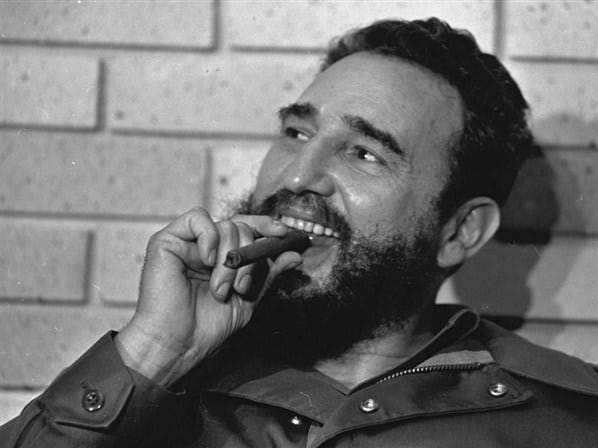
Our brains aren’t computers that save memories like files. We remember key notes, not entire pages. Most people just read news headlines and skip the article. You can manipulate people’s interpretation of events by controlling the language or imagery associated with that event.
We all understand why performers don’t smoke cigarettes in movies anymore: because it’s a bad influence on people, especially kids. Depicting smoking in media can affect society. That’s why Castro quit smoking; he wanted to set a good example for the Cuban people. But this societal control isn’t always used benevolently; it’s often used to obscure historical truths.
Every mainstream media outlet refers to the 1962 nuclear missile crisis as the “Cuban missile crisis.” But the crisis did not start with Cuba; it started when the United States government put Jupiter nuclear missiles in Turkey, next door to the Soviet Union. Placing such destructive weapons so close to their enemy was a clear escalation of Cold War tension. But history books and bourgeois media depict their enemies as the bad guys. So instead of calling it the Turkish or Jupiter missile crisis, they place their enemy’s name in front to make us associate Cuba with nuclear war.
The entire Cold War was taught to us with this bias. The moon landing sounds like a major achievement, and history books make it seem like the space race ended in 1969. But the Soviets had a probe on Venus a year later. Reaching another planet is a far greater achievement than getting to the moon.
There was no nuclear arms race. If it was a race the Soviets would have escalated tensions, but just like in 1962, it was the USA escalating things. Most nuclear weapons were developed by the US, with the Soviets reluctantly catching up. The atom bomb, hydrogen bomb, and MIRV technology are just a few weapons pioneered by the USA that the Soviets would develop years later. Michael Parenti put it best in his famous Yellow Parenti lecture: “There was no nuclear arms race; it was a nuclear arms chase.”
When we only look at a subject by itself, we can only study part of that subject. Observing history as a series of isolated events like the ‘Cuban missile crisis’ won’t show us the full picture. Just fixating on the moon landing won’t give us an understanding of the space race.
Our ideological outlook comes from the loose patchwork of things we’ve learned and how we feel about them; as a result, we often see things from an overly simplistic point of view. That simplistic worldview then reinforces those same ideological interpretations. This feedback loop is a naturally occurring phenomenon. We think of Fidel Castro as a cigar smoker, so we just assume it’s that simple.
That oversimplification is why it seems counterintuitive to see things as both good and bad. Most subjects are made up of multiple parts. Smoke—for example—is not simply gas; it is solid particles dispersed with a gas. Rarely is anything simply all one thing. Smoking cigarettes is bad for your health, but smoking weed gets my creative juices flowing and helps with my autoimmune disease.

Smoke sends signals to our brains. Colored smoke can signal information to others, like the Vatican using white smoke to indicate a new pope has been chosen. Or smoke can take a recognizable shape, like the mushroom clouds left by nuclear detonations. Imagery affects how we remember things, and those memories affect how we feel about things now.
Having a scientific way to interpret and interact with media is essential. That’s why dialectical materialism is so important to learn and implement. Dialectical materialism is needed to understand every aspect of life, not just the big things like capitalism and revolution. Applying dialectics is about dissecting what we’ve learned to make sure we understand the full picture. Once we understand how everything is connected, we can see that Cuba and every socialist country have been the victims of a massive smear campaign that’s over a century old.
Ideology is used as a smokescreen to obscure our understanding of the world around us. We always need to take conscious control over our ideological outlook. When media tells us misinformation, we must always correct it. The revolution doesn’t start with guerilla warfare; it starts by correcting those lies. One of the most revolutionary things we can do right now is speak truth to power.
Whenever we see someone speaking truth where the media lies we can see the revolution taking shape. Each and every one of us can begin to take our place in the revolution, and it starts with loudly declaring what is really happening.
oooooo


joseba says:
Epstein eta Chomsky:
a) Chomsky on Epstein: “a highly valued friend” : r/chomsky
(https://www.reddit.com/r/chomsky/comments/1oxd97j/chomsky_on_epstein_a_highly_valued_friend/)
b) Newly released files shed new light on Chomsky and Epstein relationship | Noam Chomsky : r/CriticalTheory
(https://www.reddit.com/r/CriticalTheory/comments/1qv6amr/newly_released_files_shed_new_light_on_chomsky/)
c) Epstein and the Professors – CounterPunch.org
(https://www.counterpunch.org/2026/02/13/epstein-and-the-professors/)
d) The Chomsky/Epstein Puzzle – CounterPunch.org
(https://www.counterpunch.org/2026/02/06/the-chomsky-epstein-puzzle/)
joseba says:
The Chomsky-Epstein Files: Unravelling a Web of Connections Between a Star Leftist Academic & a Notorious Pedophile
6 Key findings of this investigation:
Right up until his arrest for child sex trafficking, Chomsky was advising Epstein on crisis management, sympathizing with the “horrible way you are being treated in the press and public.”
On multiple occasions, Chomsky expressed his desire to visit Little St. James Island, site of Epstein’s infamous sex crimes.
Chomsky flew on Epstein’s “Lolita Express” jet, stayed at his mansions in Manhattan and Paris, and regularly met him for dinner and other social occasions.
Chomsky quietly met with a host of other highly questionable characters, including Steve Bannon, Woody Allen, and Ehud Barak.
Chomsky considered Epstein his “best friend,” and his closest advisor, and regularly exchanged gifts with the disgraced pedophile.
Chomsky’s relationship with his children broke apart, due in part to their protests over his attempts to name Epstein’s accountant and right-hand man to the board of the family’s trust fund.
Newly released documents have shed light on the unlikely relationship between renowned leftist professor Noam Chomsky and disgraced pedophile Jeffrey Epstein. Analyzing over 3800 emails and texts involving the academic, MintPress News has uncovered a deep, years-long friendship between the two, one where they became “best friends” and each other’s closest confidants. Chomsky flew on Epstein’s notorious “Lolita Express” jet, stayed at his apartments in Manhattan and Paris, and expressed his desire, on multiple occasions, to visit Little St. James Island, the location of many of Epstein’s worst sex crimes.
Years of exchanging gifts and dining together – events that frequently included other highly controversial characters, such as disgraced filmmaker Woody Allen, far-right political strategist Steve Bannon, and former Israeli prime minister, Ehud Barak, turned the pair into the closest of friends. Chomsky became a key figure in Epstein’s attempts at crisis management, sharing his thoughts about strategies to quash and counter what he called “the onslaught of venomous attacks” against him. Meanwhile, Epstein became the star political philosopher’s trusted legal and financial advisor, a fact that would lead to a near collapse in the relationship between Noam and his children.
This is the story of the previously unknown relationship between the man who The New York Times called “the most important intellectual alive” and the world’s most infamous sexual predator.
Noam Chomsky: Jeffrey Epstein’s Crisis Manager
After 36 survivors – some as young as 14 – came forward, billionaire financier Jeffrey Epstein was convicted in 2008 on charges related to child sex crimes. He was, however, given only an 18-month sentence, and served only 13 months in a minimum security prison that he was allowed to leave six days per week. The U.S. attorney who struck this lenient deal reportedly stated that he did so under duress, and was told to “back off,” as Epstein “belonged to intelligence.”
Key to Epstein’s crimes becoming known was the testimony of his victim, Virginia Giuffre. Giuffre alleged that Epstein and his partner Ghislaine Maxwell operated a worldwide sex trafficking operation, where women and girls were kidnapped and forced to have sex with the world’s rich and powerful. This allegedly included royals like Prince Andrew, politicians such as Donald Trump and Bill Clinton, and academics, like Alan Dershowitz. Epstein reportedly made his fortune by keeping copious evidence of their sex crimes and extorting his clients. Previous Epstein Files releases have strongly indicated that Epstein, like Maxwell’s father and family, worked for Israeli intelligence.
The testimony from Giuffre and others sparked worldwide uproar, eventually forcing the U.S. government to act. In 2019, the FBI arrested Epstein, holding him in a high security Manhattan prison. Just weeks later, he was found dead in his cell, under highly suspicious circumstances.
Epstein was aware that the walls were closing in. Months before his arrest, he sent Chomsky a number of panicked emails, desperately asking for guidance on how to squash the widespread demands for his arrest.
On February 23, 2019, he wrote:
“Noam. I’d love your advice on how I handle my putrid press. Its is spiralling out of control. Do I have someone write an oped? Defend myself. Or try to ignore. Realizing that mobs are dangerous!”
“Can use some advice. The press is painting me as a monster. Congress, Senate being fed by plaintiffs. Lawyers only wanting money. I have no skill with the general public or media… Suggestions??” he asked another time.
Chomsky’s suggestion was generally to remain silent, hoping the situation would blow over. “Ive watched the horrible way you are being treated in the press and public. It’s painful to say, but I think the best way to proceed is to ignore it. I’ve had plenty of experience, though of course not on this scale,” he replied, adding that some of his close friends have also gone through the same thing.
“What the vultures dearly want,” he continued, “is a public response, which then provides a public opening for an onslaught of venomous attacks, many from just publicity seekers or cranks of all sorts.”
“Hard to say, but it’s the best advice I can think of,” he concluded, sympathizing with all the “torture and distress” the affair has caused. This is not a reference to the vast numbers of girls and women Epstein trafficked, abused, and raped, but to the mental anguish Epstein himself was going through, as his criminal network was being slowly and very publicly unraveled.
In his emails to Epstein, Chomsky denounced what he described as the “culture of gossip-mongers” destroying his stellar character. “These things have a half-life. The best reaction, I think, is to just stay above the furor, wait it out, go on with what matters.”
On December 29, 2018, Epstein asked his unofficial crisis manager for feedback on an op-ed article he wrote about himself in the third person, which he said he would send to The Washington Post and have published.
The fawning, saccharine piece presented Epstein as a near saint suffering outrageous slanders. As it read:
“The critics are wrong on the facts and the law. They also ignore a fact going to the heart of fundamental fairness: In the decade since paying his debt to society, Jeffrey Epstein has led a life characterized by responsible citizenship, numerous acts of generosity and good deeds. Here are the true key facts: Jeffrey Epstein [is] a successful self-made businessman with no prior criminal history whatsoever.”
It also stated that he “was treated exactly the same (including his time served) as any other state-incarcerated individuals,” for his 2008 conviction, a bizarre claim, considering his lenient sentence and conditions of incarceration.
Despite the fact that this was clearly a sock puppet article (a practice whereby an individual claims to be another entity in order to boost credibility), Chomsky was deeply impressed. “It’s a powerful and convincing statement,” he replied, although he once again advised against drawing even more media attention to the matter:
“Few are willing to think through the arguments and factual details or to try to adjudicate conflicting claims. I’ve seen this happen over and over on other matters… Ugly and bitter as it is, I suspect the best course now is not to stir the pot by raising the issue publicly, opening the door to charges and accusations that can no doubt be answered in the court of logic and fairness — but that’s not the public domain, where innuendo and suspicion and accusation reign.”
Chomsky suggested that, unfortunately, Epstein would simply have to “develop a thick skin” to “fend off whatever ugliness breaks through now and then.” “The great work that you have been doing speaks for itself,” he concluded, without explaining what exactly he was referring to.
Although the emails clearly show the extent to which Epstein trusted Chomsky, his intellect, and his judgment, he did not fully take his advice, and pursued a number of active measures to muddy the waters and improve his public image. One of these was to attempt to produce a documentary film about himself, presenting him in a good light. Epstein went into his Rolodex of influential people, calling in favors to see who would appear on camera endorsing him.
If his texts are to be believed, Chomsky was one of his most enthusiastic backers. “Spoke to Chomsky, he’s all in” he messaged an undisclosed associate in December 2018.
Epstein had leaned on Chomsky’s support previously. In 2017, he asked the professor to write a few paragraphs on why he continued to value his friendship for an article in Forbes magazine, the gist of which, according to Epstein, would be “why people still want his advice after all of his personal travails.” It appears that the article was never published.
Chomsky is often described as an “intellectual rock star,” or an “American Socrates.” The father of modern linguistics, he is more well known for his political work and activism, which has seen him become an icon of the left. First coming to public attention for his opposition to the Vietnam War, he has written in excess of 150 books on politics, social science, and the media.
His first wife, Carol, with whom he had three children, died in 2008. In 2014, he subsequently married Valeria Wasserman, a Brazilian translator 35 years his junior. He suffered a debilitating stroke in 2023, leaving him unable to speak or meaningfully converse. Until his final public appearances, however, he continued to defend Epstein, even after the latter was found dead in his cell.
In 2020, when asked about Epstein’s sex crime convictions, Chomsky was adamant: “There is a principle of Western law, that once a person has served a sentence, he is are the same as everybody else. It seems to be forgotten. Why this obsession but not with more significant characters?” he said, also attempting to deflect, noting that far worse people than Epstein regularly donate to his university, M.I.T.
One of his last interviews was with The Wall Street Journal, who questioned him directly about his connections to the disgraced billionaire. Chomsky was unusually blunt. “That is none of your business. Or anyone’s,” he stated, adding, “I knew him and we met occasionally.”
However, as this investigation will show, that is a self-serving and misleading description of an extremely close relationship forged over many years.
Flying on the Lolita Express, Dreaming of Epstein’s Rape Island
For years, Jeffrey Epstein allowed Chomsky to periodically live a life of extreme luxury, plying him and his wife with gifts, and providing them access to his property, vehicles, and staff.
Emails show that, in May 2016, while he was in New York City for a lecture, Noam met up with Epstein and stayed at his residence. The location in question is very likely to be Epstein’s palatial, seven-floor 51,000 square feet (4,700m²) mansion. A former hospital turned into a single apartment, the property is filled with paintings of naked women and other highly sexualized art, and was where Epstein would traffic and rape his slaves, as well as hold wild sex parties for his powerful guests. Chomsky described it as“that lovely apartment where you once put us up,” indicating he had stayed there previously.
When federal agents raided the property in July 2019, they found a framed photo of Epstein with the Chomskys on a bedside table.
This was not the first time that Chomsky had tasted some of New York’s most luxurious residences, courtesy of Epstein. In 2015, the billionaire booked him into the $1400-per-night Manhattan Suite at the Mark Hotel on the Upper East Side.
And in order to travel in style, he flew aboard Epstein’s private jet, nicknamed the “Lolita Express” – a reference to the child sex crimes widely alleged to have regularly taken place aboard.
Many years ago, internet sleuths combing through the Facebook profile of Valdson Vieira Cotrin – Epstein’s Parisian butler – were shocked to find an image that appeared to show him arm-in-arm with Chomsky. The latest tranche of emails proves this photo to be accurate.
“Dear Jeffrey, We had a wonderful day. Valdson took good care of us. Drove us to the Louvre, went to pick us up, brought us to your wonderful apartment for a delicious meal. We just missed your company,” Valeria wrote, attaching a selfie for him to enjoy.
The property in question was Epstein’s 7,400-square-foot apartment at 22 Avenue Foch in Paris’ exclusive 16th arrondissement, just a stone’s throw away from the Arc de Triomphe.
Other emails show Epstein was offering his other properties to the Chomskys. “You should also feel free to use my Palm Beach house, for just you and [REDACTED]. You will be well looked after. It’s very warm. Anytime this or next month,” he wrote in February 2016. Noam was tempted. “Lovely offer. Don’t think we’re not thinking about it. Hard,” he replied.
Chomsky, however, had his eyes set on an entirely different property of Epstein’s: the one on Little St. James Island. On multiple occasions, he signalled his eagerness to visit what would come to be known as one of the most notorious houses on the planet.
Epstein’s 70-acre private island became world renowned after U.S. Virgin Islands Attorney General Denise George alleged that dozens of girls, some as young as 12-years-old, were imprisoned and raped at the property. The compound, full of occult symbolism, was put up for sale in 2022 in order to pay for a host of lawsuits.
In February 2016, he offered to send the Lolita Express to Boston to pick up the Chomskys, and take them to Little St. James Island. “Can’t tell you how tempting the invitation is. Have to somehow work out the schedule,” Noam replied.
A few months later, Noam was still dreaming of visiting. “Valeria’s always keen on New York. I’m really fantasizing about the Caribbean island,” he told Epstein in July 2016.
Despite all this, there is no indication in the files that any of the Chomskys saw or partook in any sex crimes or illegal activities with Epstein.
Dining With “Dear Friends” and War Criminals
Jeffrey Epstein, needless to say, was a highly politically-connected man. From princes to presidents, the billionaire trafficker was a central figure among the global elite. One of his closest associates was Donald Trump. Previously disclosed files show Epstein describing himself as “Trump’s closest friend,” and claiming that it was he who introduced the president to his wife, Melania.
Trump’s unlikely electoral victory in 2016 sent shockwaves around the world. But through Epstein, Valeria Chomsky saw a way to directly influence U.S. governmental policy, asking her friend to suggest to the new president that her husband should become his policy advisor. “Once you asked me who I would like to see talking to Noam. Here is a guy!” she said, just days after Trump’s November 2016 victory. “Can you arrange it? He could make good use of Noam’s advices,” she added, also stating that she should also be appointed a political analyst in the White House.
While she may have been joking about her own appointment, the idea that Epstein could arrange something like that for her husband was not far-fetched. Epstein, by this time, had already set Noam up with meetings with influential world leaders. In the summer of 2015, he organized a dinner with former Israeli prime minister, Ehud Barak, a man Chomsky had strongly denounced in print. “I hope [REDACTED] and you enjoyed yesterday as much as the Barak’s and I” Epstein wrote to Noam that September.
At the same time as the Barak meeting, Chomsky planned a trip to Israel, a move that would likely have angered many in the Boycott Divestment and Sanctions movement. In October of that year, however, he cancelled the visit. Not because of Israel’s crimes against Palestine, but because Valeria tore a muscle and had to concentrate on recovering.
In 2018, Epstein invited the Chomskys to a small, private dinner party with Barak and Trump strategist Steve Bannon. For many leftists, the idea of sharing a room with an Israeli prime minister, the world’s most notorious pedophile, and an oft-described “fascist” white supremacist thinker would sound like a nightmare.
Chomsky, however, described his regret at missing out on the opportunity due to work commitments, emailing Bannon directly. “My wife Valeria and I were quite disappointed to have missed you the other night, and hope that we can arrange something else before too long. Lots to talk about,” he wrote.
Months later, they personally invited Bannon to his Arizona home. “Jeffrey is a very dear friend, and we look forward to meeting you. Would it be possible for you to come 4pm tomorrow?” Valeria wrote.
Images of the famous leftist intellectual arm-in-arm and laughing with the driving force behind the alt-right and many of Trump’s most racist and punitive policies caused commotion when they were released as part of a previous Epstein Files disclosure.
Flying on the Lolita Express to Attend a “Pedophile Convention”
Chomsky, however, had long been mingling with controversial figures, thanks to his Epstein friendship.
In October 2015, the emails show, he flew from Boston to New York City with Epstein on his private jet in order to attend a soirée at Epstein’s notorious Manhattan town house with the disgraced film director Woody Allen and his wife, Soon-Yi Previn.
Allen’s proclivities, if anything, were even more well-known than Epstein’s. His long-term, high-profile relationship with actress Mia Farrow ended spectacularly in 1992 after their adopted seven-year-old daughter, Dylan, alleged that he had, for some time, been molesting her.
At the same time as this, Allen had been having an affair with another of Farrow’s adopted children, 22-year-old Soon-Yi Previn. Just five years later, Allen married Previn.
Allen was a frequent guest at these Manhattan dinners, noting that Epstein was like “Dracula with young female vampires to serve him.” Epstein left even less to the imagination when discussing his time with Allen, describing their meetings as a “pedophile convention.”
Chomsky was unrepentant about his actions. When asked directly by The Wall Street Journal, he said, “If there was a flight, which I doubt, it would have been from Boston to New York, 30 minutes.” There is now pictorial evidence that Chomsky did indeed fly with the billionaire molester on his plane. On his association with Allen, he replied, “I’m unaware of the principle that requires that I inform you about an evening spent with a great artist.”
“Deep, Sincere, And Everlasting Friendship”
The overwhelming image that emerges from nearly 4000 newly released documents concerning the pair is a deep, years-long friendship between Noam Chomsky and Jeffrey Epstein. The two would exchange jokes, and talk money, politics, medical problems, and legal troubles. Epstein became Chomsky’s closest friend above all others.
“Dear Jeffrey, We count you as our best friend. I mean ‘the’ one. It is always great to see you,” Valeria Chomsky wrote in 2017.
The world-renowned linguist said as much, signing off one note to Epstein with the words: “Like real friendship, deep and sincere and everlasting from both of us, Noam and Valeria.”
The billionaire showered the Chomskys with gifts, such as a food hamper from Carnegie Deli, an iconic New York City Jewish eatery, and a cashmere sweater for Noam’s 87th birthday. On one occasion, Epstein organized a private car to take the couple to the airport.
The Chomskys reciprocated in kind. In 2016, Noam contributed to Epstein’s birthday book. A previous edition of Epstein’s birthday book contained lurid illustrations of him receiving massages from young girls, and a hand-drawn picture of a naked woman from Donald Trump, replete with language that many have taken to be allusions to sex with underage girls.
There is no indication what Chomsky contributed, nor that he ever saw the book, but Epstein was “thrilled and touched by it,” according to an email.
Epstein and the Chomskys met frequently, and, judging by their interactions, greatly enjoyed their time together. As Valeria wrote, “I am very enthusiastic about these meetings.” Another time, she made Epstein promise to “include her in the next photos,” according to an email from Epstein’s executive assistant, Lesley Groff. Prosecutors are currently weighing up charging Groff for her alleged role in Epstein’s sex crimes, which include scheduling massage appointments from women and girls. Groff has denied all wrongdoing.
A sign of how close the relationship became is that Epstein grew notably fond of Valeria’s cooking. One email from Noam notes that she prepared his “favorite dessert” (possibly a passion fruit mousse, judging by other emails discussing her culinary exploits) ahead of his February 2016 visit to their Massachusetts home.
Epstein and Noam shared their deepest feelings and emotions with each other, as well as lighter topics. Epstein sent messages with subject lines such as “thought you might find this amusing.”
In one exchange, the pair even made sexual jokes with each other. Epstein wrote that he thought of Noam and Valeria as if they were “Pluto and its moon.” Chomsky responded, “Who’s Pluto” in this situation, to which Epstein shared a picture of the Disney character of the same name with its ears sticking up. After Chomsky agreed that he did look like the dog, Epstein quipped that “At your age, if anything sticks up, be proud.” “Ouch,” Chomsky replied, to which Epstein said, “Good, it still has feelings as well,” referencing Chomsky’s penis.
By 2017, the in-person meetings between Epstein and the Chomskys reduced in frequency. Not because of the mounting wave of evidence about the New York oligarch’s misdeeds, but because the pair had moved west to take up a teaching position at the University of Arizona. “We will be here [Tucson] and you are very welcome as always. Noam misses talking to you,” Valeria told Epstein in November 2018, just months before his arrest.
Publicly a Leftist Intellectual, Privately an Anti-Feminist Sexual Predator Defender
Chomsky would often talk politics with Epstein, and, while outwardly consistently espousing far-left political positions, some of his private conversations sounded more like the words of conservative figures, such as Jordan Peterson or Ben Shapiro.
He was vociferously critical of #MeToo and the modern feminist movement, describing it as a “hysteria that has developed about abuse of women, which has reached the point that even questioning a charge is a crime worse than murder.”
He vehemently defended his friend Lawrence Krauss, a celebrity scientist with a host of sexual assault and other sexual misconduct charges against him, going back over a decade.
And despite complaining about being called a “neo-Nazi” by “cranks,” he compared feminists asking questions about Krauss to Hitler’s brownshirts and religious zealots. As he wrote:
“Cultures unfortunately can be swept by craziness. Nazism for example. Or the Great Awakening. We’re in one of those phases now. If there’s a charge, it’s true, in fact True. Any response is “mansplaining,” another power play, reinforcing the charge. You’ve seen I’m sure what happened to Lawrence. Full and complete response, amounts to zero. Isn’t even considered. It’s like trying to discuss rationally with religious fanatics.”
He also bitterly attacked Venezuela under socialist presidents, Hugo Chavez and Nicolás Maduro. Chomsky had met Chavez in Venezuela, and publicly praised him, stating “I can see how a better world is being created and can speak to the person who has inspired it.”
With Epstein, though, Chomsky described Venezuela as “a major disaster” brought about by “corruption and incompetence.” He characterized the country as a “completely” top-down bureaucracy and not even “remotely like socialism.”
Trusting Epstein Over His Own Children
Over the years, Epstein became not only Chomsky’s dearest friend, but his closest and most trusted legal and financial advisor. This relationship even damaged the bond with his children, who expressed their alarm at what they called a “dramatic and unexplainable” increase in his spending since his 2014 marriage. “This unexpected outflow is placing your financial future at risk,” they warned.
They also strongly objected to their father’s insistence that Epstein’s personal accountant and close associate, Richard Kahn, be placed on the board of the family trust fund, set up to manage the wealth he had accrued over a life of academia and book publishing – wealth that many in the family had access to.
In July 2017, his three children wrote a joint letter in which they stated, “We beg you once again to meet with us and with the people who set up the Trust, the loan, etc., to clarify these issues,” going so far as to contact a professional mediator to help.
Richard Kahn worked closely with Epstein, managing his finances, investments, payments and other aspects of his life, including affairs at Little St. James Island. A 2021 lawsuit describes him as the “captain” of Epstein’s international sex crime ring, claiming that he, “directed, approved, enabled, and justified millions of dollars in payments that fueled the Epstein Enterprise’s sex trafficking, including payments to women who were forced to have sex with Epstein and/or recruited others to be victimized.” Kahn vehemently denies the charges.
In his later years, Chomsky became somewhat estranged from his children, siding with his wife and Epstein on matters, something that caused great distress to them. “On a personal level, we are heartbroken to feel that we are kept at such a distance from you in your new life,” one of his daughters wrote; “We were thrilled to learn that you had found a new partner, but we were grieved when we began to realize that this meant we are rarely able to see you.”
Chomsky bitterly condemned his children’s behavior, characterizing them as “three multimillionaires” who cared more about the money than his own quality of life. Valeria, meanwhile, compared them to Nazis. The saga took its toll on Noam, who described it as a “painful cloud that I never would have imagined would darken my late years.”
The reason any of this bitter and acrimonious split is known or relevant to the public is that Noam and Valeria Chomsky were forwarding all the messages detailing the affair to Epstein, who advised them at every step of the way. Epstein used his financial and legal contacts, and, at one point, sent Chomsky $270,000 – a sum that was likely simply relating to facilitating the academic move his own funds around.
Throughout the whole affair, the pair were deeply appreciative of Epstein’s expertise. “Once again, redundantly, can’t thank you enough for all of your help and concern,” Noam wrote. Valeria was even more effusive in her praise. “You are a hero, Jeffrey!!!” she said.
Epstein encouraged Noam to cut off his children entirely. One of his last messages suggests that he took his advice. “I wanted the release to acknowledge that they are aware that you’ve decided to leave your entire estate to Valeria,” he wrote.
Manufacturing Age of Consent
The immediate response to the newly-released tranche of Epstein Files from many of Chomsky’s millions of followers was one of disgust and disbelief. “I am heartsick,” wrote Indian intellectual Vijay Prashad, who penned two books with Chomsky. “There is no defense for this, in my view, no context that can explain this outrage… From my side, I am horrified and shocked.”
“Chomsky was a major influence on me and millions of others. He is a seminal figure on the global left. But his consorting with Epstein is unforgivable. A shameful coda to a life dedicated to exposing power and lies,” added British journalist, Matt Kennard.
Even before Epstein’s death in 2019, his relationship with Chomsky was already beginning to raise suspicions. Why was one of the world’s most famous leftist academics so insistent on risking his professional reputation and damaging his relationship with his children, all for Epstein? Chomsky is known as one of the world’s sharpest minds. Yet he dogmatically refused to see the obvious moral danger in associating so closely with a notorious pedophile.
Again, there is no indication in the files that Chomsky was involved in any illegal behavior with Epstein, let alone sex crimes. Nevertheless, his decision to involve Epstein so closely in his life is even more objectionable when compared with the actions of Norman Finkelstein, an academic, disciple, and associate of Chomsky’s. In 2015, when Harvard professor Robert Trivers put Finkelstein and Epstein in contact via email, he responded by calling Epstein a pedophile and told him that he should be put to death for his heinous sex crimes. As he wrote:
“My guess is, if Epstein put your daughter at age 15 in such a position, you wouldn’t publicly describe him as a “friend” and person of “integrity.” In fact, I would hope that you’d promptly throttle both Epstein and [his lawyer Alan] Dershowitz.”
The Chomsky/Epstein relationship is one of profound contradictions. The academic publicly presents himself as an anti-state anarchist, but in private, collaborates with the very embodiment of the so-called “deep state.” And while Chomsky has been one of Israel’s loudest critics, his close friend was an Israeli agent.
The revelations have seriously weakened Chomsky’s standing in public, and his dying years will no doubt be marred by a renewed questioning of both his moral character and his body of work.
Ultimately, then, with his financial clout and know, Epstein may have been able to save Chomsky some cash and provide him with a few days of luxury. But it has cost Chomsky something far more valuable: his reputation.
Watch our breakdown of the Chomsky-Epstein Files with Mnar Adley and Alan MacLeod
Bideoa: https://youtu.be/tI_xUOyJv9w
oooooo