
Mundu multipolarra versus unipolarra
NBE (Nazio Batuen Erakundea) gaindituta, ICC (International Criminal Court) alboratuta, eta Mossad nagusi… aspalditik gainera…
******
Gaza needs us today, now Not tomorrow… Talk about Gaza now!

oooooo
@tobararbulu # mmt@tobararbulu
COUNTERPUNCH: Restoring the Nobel Peace Prize to Its Peace-Promotion Vocation https://dezayasalfred.wordpress.com/2026/01/05/counterpunhc-restoring-the-nobel-peace-prize-to-its-peace-promotion-vocation/

From dezayasalfred.wordpress.com
ooo
COUNTERPUNCH: Restoring the Nobel Peace Prize to Its Peace-Promotion Vocation
January 5, 2025
ALFRED DE ZAYAS: https://www.counterpunch.org/2026/01/05/restoring-the-nobel-peace-prize-to-its-peace-promotion-vocation/
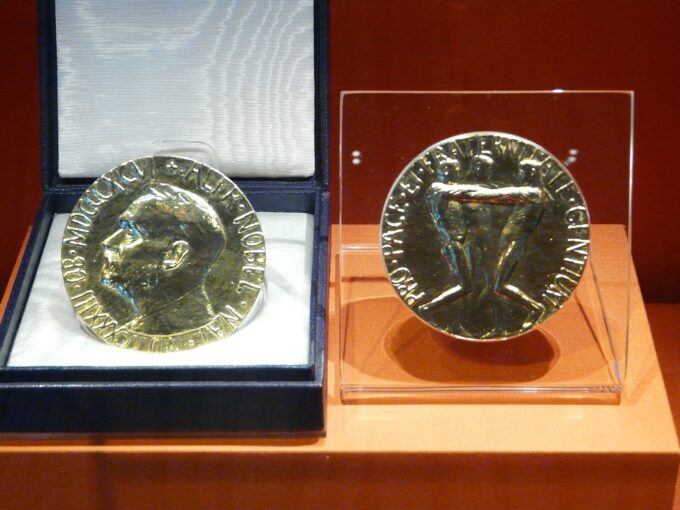
Photograph Source: User:Piotrus – CC BY 3.0
On 27 November 1896 the multi-millionaire Swedish chemist and industrialist Alfred Nobel signed his last will and testament establishing a foundation to honour, among others “champions of peace”, those “who shall have done the most or the best work for creating the brotherhood of nations, for the abolition of or reduction of standing armies, and for the holding and promotion of peace congresses”[1].
Alfred Nobel was a pacifist and his goal was to encourage pacifists worldwide to work for demilitarization, disarmament, a change of paradigm. The idea was picked up by the International Peace Bureau[2] under the motto “disarmament for development”[3].
The first recipient of the Nobel Peace Prize was the Swiss businessman Henri Dunant (1901), who founded the International Committee of the Red Cross. On his way to get a concession from Emperor Napoleon III Henri passed the battlefield of Solferino in North Italy and was horrified to see young soldiers dying and dead with no one to provide any kind of assistance. Out of this trauma he conceived the idea of banning war, and in the meantime making war less savage, hence the rules to limit the suffering of wounded and dead on the field as well as civilians rules now enshrined in the Geneva Conventions and the Hague Conventions of 1899 and 1907, and constituting part of customary international law.
In 1905 the NPP went to the German-Austrian activist Bertha von Suttner (1843-1914), author of the famous book Die Waffen Nieder![4] Lay Down your Arms! Alas, the Nobel Peace Prize would soon be hijacked by politicians and misused to honour persons who did not qualify under Nobel’s will.
Alfred Nobel[5], who died in 1896, must have turned in his grave when the NPP was conferred not upon a peace researcher, activist or campaigner, but on a war-mongering imperialist politician guilty of countless aggressions worldwide, US President Theodore Roosevelt (1906). This set a very bad precedent, because, as we know from Nobel’s correspondence with Bertha von Suttner, the award should not be giving to politicians, but to academics and grass-roots activists engaged in rational action to ban war forever.
Perhaps Alfred Nobel’s ideas are best reflected in the 1945 UN Charter, in particular article 2(3) that commits all States parties to settle differences by peaceful means and article 2(4) that prohibits not only the use of force, but also the threat of the use of force. Alfred Nobel did not just want peace in the sense of the absence of war, but also the absence of structural violence, the positive striving for international understanding, mutual respect, and the will to cooperate in building a better world for everyone. This goal entails good faith, endeavouring to listen to others, trying to get at the root causes of problems, addressing grievances in a timely fashion, and – perhaps most importantly – refraining from artificially creating enemies, deploying the art of diplomacy, preventing strife by avoiding misunderstandings, and, above all, not provoking others by expanding military alliances that are hardly coalitions for “defence” and “collective security” but rather aggressive unions meant to coerce others by military and economic bullying.
NPP procedures
The deadline for nominating candidates for the 2026 award is 31 January 2026. Nominations should be sent by letter addressed to the Nobel Peace Prize Committee, Henrik Ibsens gate 51, 0255 Oslo, Norway. Nominations can also be submitted online or be forwarded by email to postmaster@nobel.no.
Among those with standing to submit nominations are:
+ Parliamentarians, members of national assemblies and national governments (cabinet members/ministers) as well as current heads of state;
+ Judges of the International Court of Justice and of the Permanent Court of Arbitration at The Hague;
+ Members of the Institut de Droit International;
+ University Professors, also emeriti and associate professors of history, social sciences, law, philosophy;
+ Laureates of the NPP, e.g. Adolfo Pérez Esqivel, Oscar Arias, Rigoberta Menchú;
+ Members of the board of organizations that have been awarded the NPP, e.g. the International Peace Bureau, the United Nations.
A valid nomination will be normally confirmed by the Nobel Peace Prize Committee by April.
The best book on the subject is by the late Fredrik Stang Heffermehl (1938-2023)[6], a Norwegian jurist, first secretary-general of the Norwegian Humanist Association, peace activist and expert on the Last Will and Testament of Alfred Nobel. The Real Nobel Peace Prize [7], published in Oslo in 2023 gives the best overview of all laureates and meticulously documents in 405 pages how Alfred Nobel’s intentions have been egregiously violated and the NPP weaponized to support political narratives and even give legitimacy to imperialist attempts at enforced regime change. Heffermehl also established a non-governmental organization called Nobel Peace Prize Watch [8], and a Swedish association called Lay Down Your Arms, which fights against war and armaments, and annually honours a champion for peace.
Good and bad Laureates
Since 1901 the NPP has had a mixed history. Like all human institutions, the Nobel Peace Prize Committee has made good and bad decisions, some very bad.
Among the good choices we can mention
In 1922, the Committee honoured Fridtjof Nansen “for his leading role in the repatriation of prisoners of war, in international relief work and as the League of Nations’ High Commissioner for Refugees.”
In 1931, the prize was conferred on Jane Addams and Nicholas Butler “for their assiduous effort to revive the ideal of peace and to rekindle the spirit of peace in their own nation and in the whole of mankind.”
In 1947, the NPP was awarded to the Quakers, represented by the American Friends Service Committee, “for their pioneering work in the international peace movement compassionate effort to relieve human suffering, thereby promoting the fraternity between nations.”
In 1952, it was given to Albert Schweitzer “for his altruism, reverence for life, and tireless humanitarian work which has helped making the idea of brotherhood between men and nations a living one.”
In 1976, it was given to Betty Williams and Mairead Corrigan “for the courageous efforts in founding a movement to put an end to the violent conflict in Northern Ireland.” Mairead Corrigan receiving the Nobel Peace Prize in 1976.
In 1980, it was given to Adolfo Pérez Esquivel “for being a source of inspiration to repressed people, especially in Latin America.” In 1987, it was given to Óscar Arias “for his work for lasting peace in Central America.”
In 1990, it was given to Mikhail Gorbachev “for the leading role he played in the radical changes in East-West relations.”
In 1997, the NPP went to Jody Williams and the International Campaign to Ban Landmines “for their work for the banning and clearing of anti-personnel mines.”
In 2024, the prize went to Nihon Hidankyo (the Japan Confederation of A- and H Bomb Sufferers Organizations) “for its efforts to achieve a world free of nuclear weapons and for demonstrating through witness testimony that nuclear weapons must never be used again.”
Unfortunately, the prize has also been instrumentalized to support political agendas that are incompatible with peace and reconciliation, and contrary to the letter and spirit of the Will of Alfred Nobel. I call this development an aggressive takeover and hijacking of the NPP by hawks and warmongers, a cognitive dissonant destruction of the object and purpose of the prize.
Among the many embarrassing and politically motivated Nobel Peace Prize laureates are Henry Kissinger (1973), Menachem Begin (1978), Barack Obama (2009), Abiy Ahmed (2019), Maria Ressa and Dmitry Muratov (2021), and Ales Bialiatski (2022).
In 2025, we watched President Donald Trump [9] brazenly campaign for the prize. The Committee did not grant him the coveted honour, but it conferred the 2025 prize to a notorious warmonger, Maria Corina Machado, who campaigns for an illegal military intervention in her own country, Venezuela, so that she can become president and replace Nicolás Maduro.
To achieve this kind of undemocratic regime change, Machado additionally demanded that the US impose more sanctions against her own people, although she knows and it is public record, documented in numerous United Nations reports[10], that these illegal unilateral coercive measures (UCMs) have killed tens of thousands of people. Already in 2019 Professor Jeffrey Sachs and Marc Weisbrot, Director of the Center for Economic and Policy Research in Washington D.C., published a study describing the adverse human rights impacts of UCMs as a form of collective punishment[11], contrary to the UN Charter, customary international law and articles 3, 19 and 20 of the Charter of the Organisation of American States. It is estimated that in the year 2018 alone, 40,000 additional deaths of Venezuelans could be attributed to the UCMs, which affected the most vulnerable in the country, deaths resulting from malnutrition and lack of medicines and medical equipment, scanners, dialysis machines, etc. It is not difficult to understand that if you are diabetic and do not get your insulin on time, you may die. I documented this in my 2018 report to the Human Rights Council[12].
In 2025 the medical journal The Lancet[13] published a study according to which US and EU unilateral coercive measures (wrongly called “sanctions” – the only legal sanctions being those imposed by the UN Security Council, everything else being the “use of force” prohibited in Art. 2(4) of the UN Charter) were causing yearly half a million deaths worldwide. Indeed, UCMs kill[14].
The incompatibility of the political pronouncements of Maria Corina Machado with everything that Alfred Nobel stood for is too glaring to ignore, although the hyper-politicized Nobel Peace Prize Committee tried to justify its choice by praising Machado “for her tireless work promoting democratic rights for the people of Venezuela and for her struggle to achieve a just and peaceful transition from dictatorship to democracy.” Yes, as Orwell suggested in his dystopian novel1984, “War is Peace, freedom is slavery, ignorance is strength”.
Who would qualify for the 2026 Nobel Peace Prize?
Personally, in my capacity as university professor, I have twice nominated the Women’s International League for Peace and Freedom. This year I am again nominating WILPF, and would like to see a worthy laureate in 2026. If not an organization, maybe a tireless human rights defender should be chosen. I strongly endorse Professor Francesca Albanese, the current Special Rapporteur on Human Rights in the Occupied Palestine Territories and an eloquent advocate for peace and self-determination. Indeed, the timely realization of the right of self-determination is an effective conflict-prevention strategy. The Palestinian People – and the world – would have been spared much suffering if the UN had ensured that a Palestine State would emerge at the same time that Israel was accepted into UN membership. We should have both States in the UN, not only Israel. Alas, the UN is also guilty of applying double-standards, and this has negatively impacted its authority and credibility, as I document in my human rights trilogy.[15]
I encourage CounterPunch readers to submit their nominations of deserving candidates before 31 January 2026. Among my own proposals would be the Geneva International Peace Research Institue[16], the International Human Rights Association of American Minorities[17] IHRAAM, the AEDIDH[18]— Spanish Society for International Human Rights Law, a pro-active peace campaigner and author of numerous peace studies and of the Declaración de Santiago de Compostela[19]. I have had the honour to serve in the boards of these organizations for many years. I would also propose UNESCO; the Fundación Cultura de Paz[20], Madrid…
What individuals would merit the honour in 2026, in 2027, in 2028? Surely Navi Pillay, former UN High Commissioner for Human Rights, Amy Goodman (Democracy Now), Prof. Richard Falk, Prof. Jeffrey Sachs, Prof. John Mearsheimer, Prof. Noam Chomsky, Prof. Glenn Diesen, Prof. Karl Albrecht Schachtschneider, Prof. Georgios Katrougalos, Jan Öberg, Denis Halliday, Hans-Christof von Sponeck, Julian Assange. One of the persons I truly admire is the brilliant pianist and conductor Daniel Barenboim, who set an immense humanistic example by using music for reconciliation, notably by founding the West Eastern Divan Orchestra[21], made up of Israeli and Arab musicians.
Conclusion
There is no doubt that the NPP has been instrumentalized in a manner contrary to the last will and testament of Alfred Nobel. Not without merit is the complaint brought by Julian Assange before Swedish courts in December 2025[22].
It is a fact that intelligence services have penetrated all fields of human activity and that institutions created to defend our rights have been put in the service of political interests. In my book The Human Rights Industry I document how the Office of the UN High Commissioner for Human Rights, the Human Rights Council, the International Criminal Court, the International Atomic Energy Agency, the Organization for the Prohibition of Chemical Weapons have all been politicized and weaponized. Again, we must ask Juvenal’s question Quis custodiet Ipsos custodes – who will guard over the guardians? (6th satire, verses 347-48) What can we do when the institutions that should protect us actually serve interests other than those laid down in their terms of reference. Only WE can be the guardians[23].
Therefore, let us write to the Nobel Peace Prize Committee and demand that the NPP be awarded only and exclusively to those who truly work for peace and reconciliation in the sense of the UN Charter and the UNESCO Constitution[24] which reminds us that “since wars begin in the minds of men, it is in the minds of men that the defences of peace must be constructed.”
Notes.
[1] https://www.nobelprize.org/ceremonies/streams-during-nobel-week-2025/
[2] https://ipb.org/
[3] https://news.un.org/en/story/2014/09/477072
[4] https://suttneruni.at/de/universitaet/bertha-von-suttner/die-waffen-nieder
[5] https://www.biography.com/inventors/a45977855/alfred-nobel
oooooo
#WATCH Jeffrey Sachs Blasts US Power Grab Over Venezuela, Maduro Capture at Historic UN Meeting 
US military interventions in foreign countries since WWII (incomplete list):
 Iran: 1946
 China: 1946 – 1949
 Greece: 1947 – 1949
 Italy: 1948
 Philippines: 1948 – 1954
 Korea: 1950 – 1953
Iran: 1953
 Vietnam: 1954
 Guatemala: 1954
 Lebanon: 1958
 Panama: 1958
 Haiti: 1959
 Congo: 1960
Vietnam: 1960 – 1964
 Cuba: 1961
Cuba: 1962
 Laos: 1962
 Ecuador: 1963
Panama: 1964
 Brazil: 1964
Vietnam: 1965 – 1975
 Indonesia: 1965
Congo: 1965
 Dominican Republic: 1965
Laos: 1965 – 1973
 Ghana: 1966
Guatemala: 1966 – 1967
 Cambodia: 1969 – 1975
 Oman: 1970
Laos: 1971 – 1973
 Chile: 1973
Cambodia: 1975
 Angola: 1976 – 1992
Iran: 1980
 Libya: 1981
 El Salvador: 1981 – 1992
 Nicaragua: 1981 – 1990
Lebanon: 1982 – 1984
 Grenada: 1983
 Honduras: 1983 – 1989
Iran: 1984
Libya: 1986
 Bolivia: 1986
Iran: 1987 – 1988
Libya: 1989
Philippines: 1989
Panama: 1989 – 1990
 Liberia: 1990
 Iraq: 1990 – 1991
Iraq: 1991 – 2003
Haiti: 1991
 Somalia: 1992 – 1994
Yugoslavia: 1992 – 1994
 Bosnia: 1993 – 1995
Haiti: 1994 – 1996
 Croatia: 1995
Zaire (Congo): 1996 – 1997
Liberia: 1997
 Sudan: 1998
 Afghanistan: 1998
Iraq: 1998
Yugoslavia: 1999
 Macedonia: 2001
Afghanistan: 2001
Iraq: 2003
Iraq: 2003-present
Haiti: 2004
 Syria: 2011-present
 Ukraine: 2014-present
 Venezuela: 2026
The UN Security Council witnessed a rare, explosive intervention as economist Jeffrey Sachs delivered a sweeping warning on Venezuela. Speaking during an emergency session, Sachs framed the crisis as a test of international law itself, not leadership politics. He traced decades of U.S. regime-change actions, questioned the legality of force and sanctions, and warned of catastrophic consequences if UN rules collapse in a nuclear age.
Since 1947, United States foreign policy has repeatedly employed force, covert action, and political manipulation to bring about regime change in other countries. This is a matter of carefully documented historical record. In her book Covert Regime Change (2018), political scientist Lindsey O’Rourke documents 70 attempted US regime-change operations between 1947 and 1989 alone.
These practices did not end with the Cold War. Since 1989, major United States regime-change operations undertaken without authorization by the Security Council have included, among the most consequential: Iraq (2003), Libya (2011), Syria (from 2011), Honduras (2009), Ukraine (2014), and Venezuela (from 2002 onward).
The methods employed are well established and well documented. They include open warfare; covert intelligence operations; instigation of unrest; support for armed groups; manipulation of mass and social media; bribery of military and civilian officials; targeted assassinations; false-flag operations; and economic warfare aimed at collapsing civilian life.
These measures are illegal under the UN Charter, and they typically result is ongoing violence, lethal conflict, political instability, and deep suffering of the civilian population.
The case of Venezuela
The recent United States record with respect to Venezuela is clear.
In April 2002, the United States knew of and approved an attempted coup against the Venezuelan government.
In the 2010s, the United States funded civil society groups actively engaged in anti-government protests, notably in 2014. When the government cracked down on the protests, the US followed with a series of sanctions. In 2015, President Barrack Obama declared Venezuela to be “an unusual and extraordinary threat to the national security and foreign policy of the United States.”
In 2017, at a dinner with Latin American leaders on the margins of the UN General Assembly, President Trump openly discussed the option of the US invading Venezuela to overthrow the government.
During 2017 to 2020, the US imposed sweeping sanctions on the state oil company. Oil production fell by 75 percent from 2016 to 2020, and real GDP per capita (PPP) declined by 62 percent. The UN General Assembly has repeatedly voted overwhelmingly against such unilateral coercive measures. Under international law, only the Security Council has the authority to impose such sanctions.
On 23 January 2019, the United States unilaterally recognized Juan Guaidó as “interim president” of Venezuela and on 28 January 2019 froze approximately $7 billion of Venezuelan sovereign assets held abroad and gave Guaidó authority over certain assets.
These actions form part of a continuous United States regime-change effort spanning more than two decades.
Recent United States global escalation
In the past year, the United States has carried out bombing operations in seven countries, none of which were authorized by the Security Council and none of which were undertaken in lawful self-defense under the Charter. The targeted countries include Iran, Iraq, Nigeria, Somalia, Syria, Yemen, and now Venezuela.
In the past month, President Trump has issued direct threats against at least six UN member states, including Colombia, Denmark, Iran, Mexico, Nigeria and of course Venezuela. These threats are summarized in Annex I to this statement.
What is at stake today
Members of the Council are not called upon to judge Nicolás Maduro.
They are not called upon to assess whether the recent United States attack and ongoing naval quarantine of Venezuela result in freedom or in subjugation.
Members of the Council are called upon to defend international law, and specifically the United Nations Charter.
The realist school of international relations, articulated most brilliantly by John Mearsheimer, accurately describes the condition of international anarchy as “the tragedy of great power politics.” Realism is therefore a description of geopolitics, not a solution for peace. Its own conclusion is that international anarchy leads to tragedy.
In the aftermath of World War I, the League of Nations was created to end the tragedy through the application of international law. Yet the world’s leading nations failed to defend international law in the 1930s, leading to renewed global war.
The United Nations emerged from that catastrophe as humanity’s second great effort to place international law above anarchy. In the words of the Charter, the UN was created “to save succeeding generations from the scourge of war, which twice in our lifetime has brought untold sorrow to mankind.”
Given that we are in the nuclear age, failure cannot be repeated. Humanity would perish. There would be no third chance.
Measures required of the Security Council
To fulfill its responsibilities under the Charter, the Security Council should immediately affirm the following actions:
The United States shall immediately cease and desist from all explicit and implicit threats or use of force against Venezuela.
The United States shall terminate its naval quarantine and all related coercive military measures undertaken in the absence of authorization by the Security Council.
The United States shall immediately withdraw its military forces from within and along the perimeter of Venezuela, including intelligence, naval, air, and other forward-deployed assets positioned for coercive purposes.
Venezuela shall adhere to the UN Charter and to the human rights protected in the Universal Declaration of Human Rights.
The Secretary-General shall immediately appoint a Special Envoy, mandated to engage relevant Venezuelan and international stakeholders and to report back to the Security Council within fourteen days with recommendations consistent with the Charter of the United Nations, and the Security Council shall remain urgently seized of this matter.
All Member States shall refrain from unilateral threats, coercive measures, or armed actions undertaken outside the authority of the Security Council, in strict conformity with the Charter.
In Closing
Mr. President, Distinguished Members, Peace and the survival of humanity depend on whether the United Nations Charter remains a living instrument of international law or is allowed to wither into irrelevance.
That is the choice before this Council today.
Thank you.
Bideoa: https://x.com/i/status/2008318032532107520
(8:04 m)
oooooo
Saul Staniforth@SaulStaniforth
“In the past year the US has carried out bombing operations in 7 countries, none of which were authorised by the UN security council and none of which were undertaken in lawful self defence under the charter”
Jeffrey Sachs addressing the UN security council this afternoon
Bideoa: https://x.com/i/status/2008200413057855830
oooooo
Last night, Israeli occupation forces raided the home of Palestinian journalist Inas Ikhlawi in Ithna, west of Hebron, and abducted her.
Her brother, Raafat Ikhlawi, said the soldiers broke down the family’s doors in the early hours, kidnapped his sister in a brutal manner, and dragged her out without a headscarf or warm clothing.
After persistent pleading, the family was allowed to give her a coat. Her current whereabouts and the reasons for her abduction remain unknown.

oooooo
There is no respite for the children in #Gaza.
UNRWA continues to stand with them and support them with education, protection, and psychosocial care amid war and displacement.
Children need this right now.
They cannot be forced to wait.

oooooo

 “How many times has the United States been the initiator of armed conflicts in various regions of the world? Has it solved a single problem? In Afghanistan, Iraq, and Libya, there is no peace, no democracy, not even basic civil peace or stability—none of the things the United States supposedly sought to achieve.” – President Putin
Bideoa: https://x.com/i/status/2008134789082087636
oooooo
This Palestinian girl celebrated her birthday amid rubble in Gaza, where Israel’s genocidal war has destroyed or damaged most of the enclave’s residential buildings.
Bideoa: https://x.com/i/status/2008248381701824837
oooooo
This song needs to be famous.
Long Live Palestine 
Bideoa: https://x.com/i/status/2008296605179384100
(1.970)
oooooo
Furkan Gözükara @FurkanGozukara
A well known famous Jewish doctor saying it was same 5 years ago when he was in Gaza. It was just slower compared to now. Full genodice.
Bideoa: https://x.com/i/status/2008296348852916539
oooooo
Heroes, every single one of them.
Aipamena
Warfare Analysis@warfareanalysis
urt. 3
 Today, 230 male and female doctors graduated in Gaza.
Bideoa: https://x.com/i/status/2007516201942167854
oooooo
Vladimir Putin News@vladimirputiniu
World Must Stand With Venezuela
Russian FM Lavrov .

oooooo
 President Vladimir Putin:
“If someone decides to destroy Russia, then we have the legal right to respond.
Yes, it will be a global catastrophe for the mankind.
But, as a citizen of Russia, I want to ask: Why do we NEED such a world, if Russia is not in it?“
Bideoa: https://x.com/i/status/2008280804778975664
oooooo
Russia at the UN: The assault on Venezuela shattered hopes that, under Trump, the U.S. would move away from neocolonialism and hegemonic ambitions.

Bideoa: https://x.com/i/status/2008346917525422239
oooooo


Pink Floyd co-founder Roger Waters backs Venezuela and its elected president Nicolás Maduro:
“VENEZUELA IS A SOVEREIGN NATION AND SHOULD BE LEFT ALONE BY THE GRINGO BULLIES OF THE NORTH.”
Bideoa: https://x.com/i/status/2008285518971150418
oooooo
Jeffrey Sachs outlines the historical record of U.S. regime change operations since 1947.
Venezuela wasn’t a ‘threat’, it was a target. funded unrest, crushing sanctions, then the lie of ‘national security’
Regime change is not a theory, it’s a U.S. policy.
Bideoa: https://x.com/i/status/2008204248480411954
oooooo
Mr Anees Al-Dunia Al-Astal abducted by Israel for 765 days.

oooooo
Jeffrey Sachs: U.S. Attacks Venezuela & Kidnaps President Maduro
– My talk with Prof. Jeffrey Sachs has more than 1 million views within the first 48 hours. Make sure to watch and share!
Bideoa: https://x.com/i/status/2008172150750949804
(38:09 m)
oooooo
Israel bombs Lebanon on Mondays and Thursdays.
Israel bombs Syria on Wednesdays.
Israel bombs Palestine the rest of the week.
Only Israel can bomb 3 countries and still be perceived as the victim.
Bideoa: https://x.com/i/status/2008225461571043809
oooooo

This isn’t a movie set, this is real life, this is Palestine 
Bideoa: https://x.com/i/status/2008186264391221717
oooooo
I asked the Foreign Secretary whether it would be legal if a foreign power accused the British Prime Minister of breaking its domestic laws, bombed the UK, killed dozens of British citizens and abducted the PM and his wife in the middle of the night.
She refused to answer.
Bideoa: https://x.com/i/status/2008304960807858655
oooooo
El Secretario General de la ONU @antonioguterres expresa su preocupación por la suspensión de la ayuda de varias ONG internacionales en territorio Palestino ocupado por parte de Israel. Exige que sea revocada. La ayuda humanitaria y su bloqueo pone en riesgo los frágiles avances.

oooooo
Palestine Children’s Relief Fund raised $801k after Ariana Grande shared the donation link on Instagram.


oooooo
Do you agree with tennis legend Martina Navratilova’s statement?

oooooo
Saul Staniforth@SaulStaniforth
“When force is used to control resources.. we are faced with a logic that harks back to the worst practices of colonialism.. [if the US’s actions] are tolerated.. the message sent.. is a devastating one.. that the law is optional & force is the true arbiter of intl relations“
Bideoa: https://x.com/i/status/2008233651851718805
oooooo
Heavily armed Israeli occupation forces stormed the home of activist Nour Farrag, abducting her and forcibly disappearing her. Farrag is a mother of three—her children were left traumatized, crying uncontrollably after their mother was taken from them.

oooooo
Russia will continue to sell oil to India.
Russia is not afraid of America.

oooooo
On his first day in office, Zohran Mamdani revived the Mayor’s Office to Protect Tenants and intervened in a major slumlord bankruptcy case on tenants’ behalf. Mamdani and his team are showing the country what real economic justice looks like.
Bideoa: https://x.com/i/status/2008323879349936190
oooooo
Maldives said, “Israelis are not welcome in our country until the genоcide in Gaza stops”


oooooo
EXCLUSIVE – WYOMING STAR: When Power Kidnaps the Law: The Abduction of Nicolás Maduro and the Death of International Order

ooo
EXCLUSIVE – WYOMING STAR: When Power Kidnaps the Law: The Abduction of Nicolás Maduro and the Death of International Order
Published January 6, 2026
Link to original article: https://wyomingstarnews.org/2026/01/06/exclusive-when-power-kidnaps-the-law-the-abduction-of-nicolas-maduro-and-the-death-of-international-order/
President Donald Trump listens to a question during a news conference at Mar-a-Lago on January 3, 2026, in Palm Beach, Florida, as Secretary of State Marco Rubio watches. Source: AP
On 3 January 2026, American special forces swept through Caracas, seized Venezuelan president Nicolás Maduro and his wife Cilia Flores and whisked them aboard a US vessel. Hours later President Donald Trump appeared at Mar a Lago to announce that Washington would “run the country” and ensure Venezuela’s oil riches were “used properly.”
Maduro and Flores, bandaged, bruised and flanked by US marshals, made their first appearance in a New York courtroom this week. Through an interpreter, Maduro told Judge Alvin Hellerstein:
“I was captured at my home in Caracas, Venezuela … I am still president of my country … I am a decent man.”
Both he and Flores pleaded not guilty to narcotics and weapons charges and signalled their intention to challenge their detention. Their lawyers said the pair were kidnapped, demanded consular access and promised motions attacking the indictment and the manner of their seizure.
Trump, for his part, declared:
“We’re in charge,” and warned interim Venezuelan leader Delcy Rodríguez that she would pay a “very big price” if she defied him.
The images of a foreign head of state shackled and transported across international borders jarred many observers, but the lawfulness of the operation has been hotly contested. The administration has claimed it merely executed a law enforcement action against a drug lord. Critics argue that, far from upholding the rule of law, the United States has torn the post 1945 legal order asunder.
To understand what this moment, in which power appears to be overtaking law, could mean for the future of the global order, The Wyoming Star reviewed the relevant legal framework and spoke with leading international law scholars and foreign policy experts.
What the law says
Article 2(4) of the United Nations Charter declares:
All Members shall refrain in their international relations from the threat or use of force against the territorial integrity or political independence of any state.
Under Article 51, force is justified only when a state is exercising its inherent right of self defence against an armed attack and must be reported to the Security Council. The Organization of American States (OAS) goes even further.
Articles 19 and 21 of the OAS Charter prohibit any state from intervening in the internal or external affairs of another, bar “armed force … or any other form of interference”, and affirm that a state’s territory is inviolable: it may not be the object of military occupation or “other measures of force” by another state.
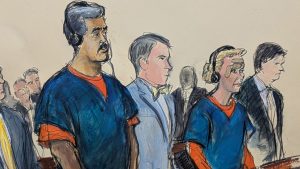
In this courtroom sketch, Venezuelan President Nicolas Maduro, left, and his wife, Cilia Flores, second from right, appear in Manhattan federal court with their defense attorneys Mark Donnelly, second from left, and Andres Sanchez, Monday, January 5, 2026, in New York. Source: AP
International law also accords absolute immunity to sitting heads of state, heads of government and foreign ministers. As the International Court of Justice explained in the Arrest Warrant case, immunities are not personal favours but essential to ensure officials perform their duties on behalf of their states.
The Court concluded there is no exception to these immunities, even for those suspected of grave crimes. Scholars summarise the rule succinctly:
“Under customary international law, ‘head of state’ immunity provides absolute immunity to sitting heads of state, heads of government, and foreign ministers.”
“International vandalism”: Alfred Maurice de Zayas’s verdict
Alfred Maurice de Zayas, a Cuban American jurist and former UN Independent Expert on international order, is unsparing.
“The kidnapping of a head of state is an international crime,” he said, adding that it violates Article 2(4) of the UN Charter, the sovereignty principle in Articles 1 and 2, the OAS Charter’s non intervention clauses, and the head of state immunities of customary law.
“It entails civilizational retrogression. It is yet another example of the contempt that Trump has for international law, the UN Charter and civilisation itself. Trump sees himself as a Roman emperor – legibus solutus – above all law.”
De Zayas has stressed that Trump is following a trail blazed by previous US presidents.
“His predecessors got away with major violations of international law … Ronald Reagan bombarded Grenada, George HW Bush bombarded Panama and tried Manuel Noriega, Bill Clinton bombarded Yugoslavia and destroyed the Chinese embassy, George W. Bush and the ‘coalition of the willing’ bombarded Iraq and killed an estimated one million people – in total impunity. Back in 2020 Trump kidnapped the Venezuelan diplomat Alex Saab and had him tried by a court without jurisdiction.”
This culture of impunity, he argues, has been tolerated by America’s allies, creating the conditions for today’s abuses. Asked what precedent such an abduction sets, de Zayas returned to the role of the international community.
“The UN is blocked through the US veto – which has protected even the genocide being committed by Israel on the Palestinians. Thus, forget the UN. States must act on their own …
They should take concrete measures to ‘sanction’ the US by stopping all purchases of weapons from the US, F 16, F 35, Boeing, Lockheed Martin, Raytheon, stop buying US automobiles and other export items. Regional organisations like BRICS could and should coordinate the international ‘pushback’.”
For de Zayas, this episode is not about Trump alone.
“Donald Trump is not setting any new precedent – Bill Clinton did as much damage to international order as George W. Bush and even our ‘saint’ Barack Obama, who orchestrated the coup against [Ukraine’s former] President Victor Yanukovich …
It is up to us to reaffirm the values of the UN Charter and the commitment to peace through negotiation.”
The US, he contends, is violating not only international law but its own Constitution; yet politicians offer only lip service to the rule of law.
“Nothing new under the sun”: Samuel Moyn on the absence of precedent
Samuel Moyn, a legal historian at Yale Law School, agrees that Trump’s operation is unlawful, but cautions against overstating its novelty.
“Every act is different and new, but what is not new in the world of great powers [is] that [they] treat rules as discretionary,” he notes.
Trump is not setting a precedent so much as illustrating a longstanding problem. The episode, Moyn argues, is another reminder that the United States has never truly subjected the presidency to the rule of law in foreign affairs.
The proper response, in his view, is to develop mechanisms, domestically and internationally, to hold future presidents accountable. Without such reforms, the next crisis will unfold much the same way.
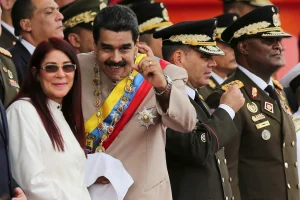
Venezuela’s Nicolas Maduro and his wife, Cilia Flores, attend an Army Day celebrations at Fuerte Tiuna, in Caracas on June 24, 2017. Source: AP
“Manifestly illegal”: Philippe Sands on the danger of contagion
For Philippe Sands, professor of law at University College London and counsel in numerous cases before international courts, the abduction is an assault on the legal order itself.
“The action against Venezuela is manifestly illegal under international law, and cannot plausibly or by any reasonable standard be characterised as a law enforcement action,” he said.
The consequences, Sands warned, could be far reaching:
“One need only to think of Nicaragua, Afghanistan and Libya … to imagine what the consequences might be, and the encouragement it will surely give to others to act with such brazen disregard for the international legal norms that bind us all.”
More worrying, Sands observed, is the silence of allies such as Britain.
“Having lived through the catastrophe and criminality of the Iraq war in 2003, which Mr Trump himself has condemned, I would hope that Keir Starmer sticks to the principles of legality to which he says he is so firmly committed.”
The abduction, he added, is “a terrible precedent, one that opens the door to seizure of resources by other countries, and undermines the authority of the US in the world.”
Precedents and patterns
The alarm of these scholars is rooted in history. In December 1989, US forces invaded Panama and captured General Manuel Noriega, a sitting head of state who had been indicted in US courts for drug trafficking. Legal scholars criticised the operation then for ignoring the self defence requirement and for violating Panama’s sovereignty.
Washington claimed that Noriega’s trafficking and threats to American lives justified the invasion. Thirty five years later, it has dusted off similar justifications for Maduro’s seizure.
The pattern stretches back further. US interventions in Iran (1953), Guatemala (1954), Chile (1973) and Iraq (2003) all circumvented collective security norms.
The United States has repeatedly used humanitarian, anti drug or pro democracy rhetoric to justify unilateral action. Yet none of these rationales appear in the Charter’s limited exceptions to the prohibition on force.
A wider geopolitical play

CIA Director John Ratcliffe, Secretary of State Marco Rubio and Secretary of War Pete Hegseth listen as President Donald Trump addresses the media during a news conference held on January 3, in Palm Beach, Florida. Source: Getty Images
The timing of the raid underscores its geopolitical dimension. Earlier in the week, Trump met Israeli Prime Minister Benjamin Netanyahu and threatened to “knock [Iran] down” if it rebuilt its missile or nuclear programmes.
Within hours of Maduro’s abduction, Israeli politician Yair Lapid warned Tehran to “pay close attention to what is happening in Venezuela.”
Trump’s strategic doctrine, outlined in his 2025 National Security Strategy, resurrects the Monroe Doctrine in modern garb.
The document declares that, after years of neglect, the United States will “reassert and enforce” its dominance in the Western Hemisphere and that rival powers will be repelled. The attack on Venezuela, a major oil producer and ally of Iran and Russia, appears to be the first enforcement action.
Analysts worry that redeploying military resources to the Caribbean (aircraft carriers, destroyers, special operations forces) will overstretch the Pentagon at a moment when China’s military is expanding and tensions over Taiwan are rising.
The silence of allies and the future of the UN
Perhaps most striking has been the muted response from Washington’s traditional allies. Britain’s government, now led by Keir Starmer’s Labour Party, has largely avoided direct criticism. Sands laments that silence and urges adherence to the principles of legality.
Within the United States, Congress has also abdicated its constitutional role. Despite the Constitution’s requirement that war be declared by Congress, the legislature was neither consulted nor asked to authorise the operation. Some lawmakers muttered about the War Powers Resolution, but party loyalty and fear of appearing “soft” on drugs or immigration muted dissent.
The United Nations, too, has been largely paralysed. Any attempt by the Security Council to censure the United States would run into a US veto.
To sum up? The empire fights back
The seizure of Nicolás Maduro may be unique in its audacity, but it follows a century long pattern of American interventions that treat international rules as optional.
Alfred Maurice de Zayas calls it “international vandalism” and urges a global boycott of US arms and goods to reassert legal norms. Samuel Moyn reminds us that the episode is part of a long history of presidential impunity that will continue unless domestic laws change. Philippe Sands warns that the action is “manifestly illegal” and will embolden other powers to seize what they desire.
Whatever happens in the Manhattan courtroom, the precedent has been set. If the abduction of a head of state becomes the new normal, the prohibition on force in Article 2(4) and the very idea of sovereign equality may soon be consigned to history.
The United States, once the architect of the UN system, now appears to be presiding over its demise. For a world already beset by geopolitical rivalry, environmental crises and economic inequality, tearing up the rules of international order is an invitation to chaos.
The Maduro abduction is a test of which future we choose.
oooooo
Geure herriari, Euskal Herriari dagokionez, hona hemen gure apustu bakarra:
We Basques do need a real Basque independent State in the Western Pyrenees, just a democratic lay or secular state, with all the formal characteristics of any independent State: Central Bank, Treasury, proper currency1, out of the European Distopia and faraway from NATO, being a BRICS partner…
Euskal Herriaren independentzia eta Mikel Torka
eta
Esadazu arren, zer da gu euskaldunok egiten ari garena eta zer egingo dugun
gehi
MTM: Zipriztinak (2), 2025: Warren Mosler
(Pinturak: Mikel Torka)
Gehigarriak:
MTM klase borrokarik gabe, kontabilitate hutsa da
1 This way, our new Basque government will have infinite money to deal with. (Gogoratzekoa: Moneta jaulkitzaileko kasu guztietan, Gobernuak infinitu diru dauka.)


