
Mundu multipolarra versus unipolarra
NBE (Nazio Batuen Erakundea) gaindituta, ICC (NAPE) (International Criminal Court) alboratuta, eta Mossad nagusi… aspalditik gainera…
******
Stop saying history will judge them, judge Israel now. With ICC judges.
******
ICC (international Criminal Court) NAPE (Nazioarteko Arlo Penaleko Epaitegia)
International Criminal Court judges refuse to be bow to Trump’s sanctions as he tries to exempt Israeli and American officials from the rule of law: “We are not going to be intimidated.”

******
Gaza was the blueprint that Israel designed for all its wars to come.
Bomb schools. Bomb hospitals. Bomb the sick. Bomb the elderly. Bomb children.
Then lie.

oooooo
Mearsheimer, con la claridad que duele: “Matamos a 38 millones de seres humanos. Treinta y ocho millones. La ruina que hemos extendido por Oriente Medio es de una magnitud que quita el aliento. Piensa en Irak destruido, en el estrangulamiento económico que aplicamos a Venezuela, a Cuba, a Irán… Usamos nuestra fuerza financiera como arma para condenar a pueblos enteros al hambre, al dolor, a la desesperación, esperando que esa agonía los haga levantarse contra sus gobiernos. Ese es el castigo inmenso que infligimos. Y después de todo eso… ¿cómo podría alguien seguir llamando “noble” a Estados Unidos?”
#Mearsheimer #Antiimperialismo #YanquiAsesino #SancionesAsesinas #38Millones

oooooo
Tucker Carlson: “Benjamin Netanyahu has personally threatened me and at least two members of my family.”
Bideoa: https://x.com/i/status/2031037343864414608
oooooo
BREAKING: Turkish President Erdogan:
Israel is trying to completely undermine the path toward a two-state solution by taking advantage of the international community’s attention shifting away from Gaza to other issues.
Through the unlawful and expansionist policies it has pursued since the declaration signed on October 10, the Netanyahu government has once again shown that it does not want peace and is not in favor of a solution
Bideoa: https://x.com/i/status/2031067155714781456
oooooo
 Shocking confession!
Former U.S. Secretary of State Antony Blinken:
“Israel tried to pressure Barack Obama into bombing Iran, saying: ‘We will bomb Iran with or without you.’
Obama resisted.
But Donald Trump gave in to the same tactic — because the records of Jeffrey Epstein were in their hands.”
Bideoa: https://x.com/i/status/2031012449948770333
oooooo
NEW: The Israeli military unlawfully used white phosphorus over homes on March 3, 2026, in the Lebanese town of Yohmor. The use of white phosphorus over residential areas is extremely alarming and will have dire consequences for civilians.
Read more: https://bit.ly/4bdqxDt

oooooo
The US will blow up most of Iran, but will destroy nothing – Scott Ritter
Iran has prepared for this. They are not down. They have inflicted more damage to the US military than any country ever, after WW2.
Bideoa:: https://x.com/i/status/2030920677968974247
oooooo

Prof. Marandi: “I may not survive this war but this monstrous thug Hegseth will not succeed.”
Bideoa: https://x.com/i/status/2030686125816189289
oooooo
TMJ News Network@tmjnewsnetwork
“We’re going to lose this war.” Scott Ritter joins TMJ News for an analysis of the U.S.-Israeli war on Iran as the conflict widens and as U.S. military resources experience significant depletion.
 Watch on YouTube:

Bideoa: https://youtu.be/L1qiy8a_B1o
(37:06 m)
ooo
The U.S. is Walking into an Iran TRAP: Scott Ritter
(https://www.youtube.com/watch?v=L1qiy8a_B1o&t=2s)
What is the public not being told about the U.S. and Israel’s war on Iran? Former U.S. Marine Corps Intelligence Officer and UN weapons inspector Scott Ritter joins TMJ News to discuss the military realities behind the headlines. From missile interceptor shortages and Israeli censorship to the possibility of economic shockwaves if the conflict drags on, Ritter explains why he believes the war is entering a far more dangerous phase than many in Washington are willing to admit.
00:00 On the Ground Realities
08:54 US Missiles Running Out
15:56 Iran’s Defense Remains Intact
21:43 How Bad is Israel Getting Hit?
26:28 Moral Red Lines Crossed
31:10 US Ground Invasion?
Transkripzioa:
1. kapitulua: On the Ground Realities
0:00
So, this war has no moral justification.
0:03
But that’s not the only reason why we’re going to lose it. Because sometimes the bad guys do fight and win a war. We’re going to lose it because we’re stupid.
0:10
We’re going to lose it because we didn’t plan right. Or we’re going to lose it because we’re going to run out of ammunition and the Iranians aren’t.
0:16
We’re going to lose this because the Iranian missiles are going to be striking targets throughout the Middle East and there will be no defense against it. We’re going to lose it because everybody who thought the United
0:24
States was a superpower that could defend them is going to wake up and realize the United States is a liar and can’t defend anybody. Even the Israelis are going to realize this sooner rather
0:32
than later as their precious Hifa Tel Aviv gets turned into the modern incarnation of Gaza, leveled by the
0:40
Iranians as punishment for what they’ve done to Iran.
0:44
And welcome to another episode on TMJ’s political current podcast. Over the past week, the US and Israel have dramatically escalated their war on
0:53
Iran. A war that started with the targeting of a girl school that killed 180 young school children has escalated
1:01
ever since with the most recent being air strikes on Iranian oil storage facilities. Now, officials in Washington are already saying that the US and
1:10
Israel are winning and that Iran’s capabilities have been destroyed. But military analysts, including my guest today, Scott Ritter, former UN weapons
1:18
inspector and former US Marine Corps intelligence officer, says that’s an absolute and complete lie. He’s going to
1:26
help me break down exactly what’s happening behind the scenes militarily,
1:30
strategically, and economically, and why the victory narrative that the US and Israel are already pedalling couldn’t be further from the truth.
1:48
Mr. Ritter, thank you again for joining us on TMJ News. It’s wonderful to have you on. Thanks for coming. Thank you very much for having me.
1:56
Of course. And I I actually want to start off with a question I know that many Americans have right now. And and frankly, it’s it’s one that’s very
2:03
reminiscent of the Vietnam War when the American government was convincing its people that, you know, everything is
2:11
great. we are doing fantastic. We’re we’re winning. But, you know, little did Americans know that actually things were not going great and they weren’t going great at all with the war on Iran. Now,
2:21
we’re seeing similar rhetoric coming out from American leadership, specifically Trump, really saying we are doing amazing. The American military is
2:29
performing fantastically and we are winning. Would you say Trump’s words right now are any reflection of what’s
2:36
happening on the ground or are we looking at another incoming monumental mess? Well, it’s both to be honest. I mean,
2:45
um, let’s just reflect on the harsh truth about what’s happening. The United States military is one of the most
2:52
lethal militaries in the world. We have some of the most capable military equipment operated by some of the most uh, proficient military professionals.
3:01
And we are inflicting huge damage on Iran. I mean the you know this isn’t uh you know child’s play here. This is
3:10
nationending damage. Um cruel damage. Um nothing to do with
3:18
military uh objectives. This is literally verging on the edge of genocidal um actions against the Iranian people. Um,
3:29
and so you can’t dismiss that. You can be against the United States. You can be against um what their military is doing,
3:37
but don’t for one second minimize the absolute horror that’s being inflicted on Iran by the American and the Israeli
3:45
militaries. These are two modern militaries, very capable and able to um
3:51
unleash unprecedented violence. So,
3:58
um, we we have to respect that reality because that’s the reality the Iranian people are living in right now. Um,
4:06
and this underscores the absolute failure of the United States and Israel and what they’re trying to achieve
4:13
because they thought they could break the back of the Iranian government and the Iranian people. They could break the
4:20
spirit of the Iranian people. uh no understanding whatsoever of the reality of the Islamic Republic of Iran or the
4:29
Iranian nation, the role that Islam plays amongst the faithful of Iran who constitute the vast majority of the
4:37
nation. Um to assassinate the supreme leader uh is indicative of just how ignorant the planners of this conflict
4:45
were. um in the belief that an Islamic republic again I’m not
4:53
Islamic and then I’m not Muslim so forgive me if I say things that insult people I don’t mean to respect your
5:00
faith I respect people who adhere to the faith and therefore I find it shocking
5:07
that anybody would believe that the murder of a human being because Ali Ham
5:14
at the end of the day was a human king um would somehow shake the faith of the
5:21
nation? No. Because he functioned as the supreme leader.
5:29
Um it just shows an ignorance of Islam. It shows an ignorance of faith. It shows an ignorance of Iran to believe that by
5:38
murdering one man, you would somehow get them to abandon their faith. It also shows an ignorance of Iran as a nation.
5:46
It is an Islamic republic which means it’s a constitutional republic. And the idea that the supreme leader uh was
5:55
somehow this uh singularity, this dictatorship of one and if you kill it,
6:01
everything goes away. What we’re seeing is no, the constitution kicks in. We saw the formation of a three-person council.
6:09
uh the president, the head of the judiciary and somebody appointed a senior um ayatollah appointed by the guardian council who by the constitution
6:18
governs uh in the role of supreme leader until a new supreme leader is picked by the assembly of experts as required by
6:25
the Iranian constitution. So the notion that by bombing Iran, by blowing things
6:31
up, that we could a shake the faith of the Iranian people in their religion,
6:39
and b uh that the Iranian constitution, which has been in place for 47 years,
6:46
would suddenly go away. That it we didn’t even understand that it existed.
6:50
I mean, that’s the amazing part of of this. We’re shocked. the the plants are shocked that where’s this resilience coming from? You might want to study
6:58
your enemy before you go to war against them. I mean, I’m coming I come from a a background. Um, where’s the where are the people in uniform saying,
7:08
“No, this is illegal. No, these targets shouldn’t be bombed. No, what are we doing? And where are the American people? We should be in the streets
7:17
screaming, “Oh, we’ll come to the streets sooner or later when the price of gas goes through the roof and our” and suddenly we’re like, “Oh my god,
7:24
this hurt.” And then and suddenly then we’ll wake up and say, “You shouldn’t have done this.” But not for the reasons I’m citing. Because American people
7:32
collectively aren’t shedding tears for the Iranian people. American people collectively seem to be very okay with the fact that we’re murdering thousands
7:41
of Iranians that we’re destroying centuries of culture. I mean, the these targets being hit aren’t just, you know,
7:49
the empty buildings of governance, but we’re blowing up culturally important facilities. We’re destroying, you know,
7:56
millennia of uh of history um because we have no respect for anything. no respect for anything, let alone human life. Um,
8:09
we’re going to lose this war, and we should lose this war. When I say we, the United States and Israel, this is not a
8:16
war worth fighting. Um, this is not a war for any just outcome. Uh, this is a murderous, illegal war of aggression,
8:25
the greatest war crime in history. Iran did nothing wrong. Iran did everything right. And it’s the war criminals that
8:33
reside in Israel and the United States that have brought this war to the world.
8:37
And I think that the world is going to wake up one morning sometime soon and
8:44
realize that there is a price to pay for sitting back and doing nothing while evil moves forward with its horrible plans.
Yeah. And you know, you mentioned that the US essentially is not going to win this war. Many are saying obviously that
9:01
this is a war of attrition. Iran is wearing down American resources. Some estimates had been saying that the US will run out of missiles and missile interceptors within a week to 10 days.
9:11
Some have put that at, you know, a little bit longer, possibly weeks.
9:15
Obviously, we know Peak Hegsith has, you know, come out and denied this saying,
9:19
“No, we have, and I quote, no shortage of munitions.” But military analysts are are really questioning that and whether
9:26
it’s true and whether the US is prepared uh and able to at this point carry this on for several weeks and potentially into months. Is this really the case?
9:35
And if if it is the case that the US is eventually sooner or later going to run out, what will happen once that happens?
9:45
This is this is actually one of the easiest questions to answer because the United States doesn’t
9:52
have when it comes to military production um a classified um defense
9:58
budget. We have budgeted for the acquisition of various classes of missiles that can be used to intercept
10:06
ballistic missiles. We know how much money Congress has allocated to the various defense contractors and we know how many munitions have been purchased.
10:16
We also know how many have been sold to various client states around the world and how many have been retained by the
10:23
United States in either operational duty or in stockpile. These are known. So now
10:30
we compare and contrast the known with other somewhat known because there now this is where the the numbers get dicey.
10:40
Just how many interceptors were fired by Israel during operation two promise one,
10:46
two promise 2, two promise 3. And the answer is a whole bunch. And how many were fired by the United States during
10:53
this period of time? The answer is a whole bunch. Um, but they won’t give us the exact numbers because the moment you give us those numbers, reality kicks in
11:02
because we know how many were built and we know how many were continuing to build and we know that there hasn’t been a major allocation of resources to
11:11
expand the defense industrial base uh to to to the extent that it can rapidly overcome the deficit.
11:19
um we’re running out of missiles and at the at the current expenditure rate um we’re
11:27
going to run out of missiles really soon. Um sooner than people think in terms of certain classes of missiles. Uh
11:35
for instance, the THAAD missile, very expensive to build, very expensive.
11:40
We’re just blowing through them like you wouldn’t believe. The good news with THAAD is that the Iranians have destroyed uh most of the THAAD acquisition radars, which means that the
11:48
THAAD can’t be shot. So maybe whatever THAADs we haven’t shot won’t get fired because we can’t fire them because we don’t have the radars. Then we could uh
11:56
deceive ourselves into thinking that we have capability that we do not. I mean,
12:00
the the reason why Pete Hexth is lying to the American public right now is because Pete Hgsth allowed the United States to go to war when everybody
12:09
planning this war said, “We have an ammunition problem.” I mean, this was known right up front that we if we don’t
12:16
crush the Iranian government quickly and get the them overthrown, um, two things are going to happen.
12:24
They’re going to keep firing missiles because they will not run out of missiles and we’re going to run out of interceptors which means that eventually they’re going to be firing missiles and
12:33
we have nothing to defend against. And that’s the direction we’re heading right now. Donald Trump and Pete Cadetth have been deceiving themselves about, you
12:41
know, the the you ramifications to Iran of us blowing up empty buildings because that’s all we’re
12:48
blowing up. That’s the other point that needs to be made here. We’re blowing up a lot of stuff in Iran.
12:54
but it’s empty. The Iranian government is in survival mode. Uh they’re seeking to survive a war that they’ve been
13:01
preparing for for 20 years and they are dispersed. We may get lucky and get one here and one there and one here and one
13:08
there, but they have, you know, they have duplication built in. They’re resilient. And we may get lucky and get
13:16
some of them, but we’re not going to get all of them. They’ve been spending 20 years going underground. They’ve broken their country into 12 autonomous military districts that are designed to
13:24
function in a self-sufficient way um with, you know, no need for central direction. Uh
13:32
this was all known, all known. I mean, I knew it. And I would imagine that
13:39
there’s some people at the uh CIA whose job was to know this. There was people at the Defense Intelligence A whose job was to know this. But the United States
13:49
has allowed our intelligence system to become politicized. The job of an intelligence officer is to tell his or her boss not what they want to hear, but
13:57
what the facts are. And then that boss has to take those facts and make decisions, informed decisions. They may make decisions that the intelligence
14:04
officer disagrees with. It’s okay. I’m not a decision maker. My job is just simply to tell you what the truth is,
14:11
you know. Um, but what’s happened now is that intelligence officers aren’t allowed to tell the truth.
14:17
They collect the data and then their mid-level management says, “Well, I want to get promoted in the next promotion cycle and I know that the boss has told
14:24
my boss that we need to prove that this that and the other thing is happening.”
14:28
And so they massage the data. Anybody wants to get promoted doesn’t tell the truth. They massage the data. They lie to themselves. They leave little cutouts and caveats. They have special language
14:37
they can use to say, “Well, we didn’t say it was 100%.
14:40
We said that there maybe might, maybe not, blah blah, whatever. They could blow through. They’re lying. The Iranians are not evil. Their government
14:49
is not evil. It’s a government maybe we don’t understand because we’re ignorant. They’re not pursuing nuclear weapons.
14:54
They are trying to live in peaceful harmony with their neighbors and the world. And we made a decision together with Israel to eradicate them, to murder
15:02
them, to slaughter them. So this war has no moral justification.
15:06
But that’s not the only reason why we’re going to lose it. Because sometimes the bad guys do fight and win a war. We’re going to lose it because we’re stupid.
15:15
We’re going to lose it because we didn’t plan right. We’re going to lose it because we’re going to run out of ammunition and the Iranians aren’t.
15:21
We’re going to lose this because the Iranian missiles are going to be striking targets throughout the Middle East and there will be no defense against it. We’re going to lose it because everybody who thought the United
15:29
States was a superpower that could defend them is going to wake up and realize the United States is a liar and can’t defend anybody. Even the Israelis
15:36
are going to realize this sooner rather than later. as their precious Hifa in Tel Aviv gets turned into the modern
15:43
incarnation of Gaza um leveled by the Iranians as punishment for what they’ve done to Iran. We’re
15:51
going to lose this war because we don’t have the ability to defend ourselves.
And you know, in terms of just before I get to the next question, but you were mentioning moral justification. It’s true. There’s absolutely no moral justification, but it’s really comical
16:05
to see American leadership try to create that. And we’ve seen astonishing claims coming out recently
16:13
really to justify whatever moral justification there is. And you know,
16:17
we’ve seen Trump say something as as crazy as, you know, Iranians chop kids heads off or they cut women in half. I
16:26
mean this that that’s I’m I’m not sure where that’s coming from, but even the American public is just like even we know that’s not true. Or there was I
16:34
forget which official it was, but you know saying just openly saying the quiet part out loud that we should take Iran’s oil because the terrorists don’t deserve
16:41
to have control of it. So it’s almost as if there’s a desperation to create this moral justification. And I’m not sure if the American public is seeing through it, but I I I certainly hope they are.
16:53
My next question though, when you were talking about capabilities, I’ve, you know, seen some mainstream reports in the past week of US strikes having
17:00
significantly diminished Iran’s immediate ability to launch large-scale retaliatory strikes. And this is interesting because, you know, Trump
17:07
17 minutu eta 7 segundo
said that their missiles are gone, their missile launchers are gone, you know,
17:11
their capabilities are gone. And it’s interesting because the the same evening there was an NBC live broadcast that
17:18
actually showed live an Iranian missile penetrating through the Iron Dome and hitting Tel Aviv. So this is happening as the US is claiming Iran’s
17:26
capabilities are are are gone. So what what is the reality of how much of an impact US strikes have actually had on
17:35
17 minutu eta 35 segundo
Iran’s ability to respond? Has it diminished it? And to what degree?
17:42
You might remember uh I mean maybe not because I’m going to age myself. I always get in trouble. I I I used to
17:49
speak at colleges and um and and if I spoke to a college in 1998, I would say, “Now remember back to the Gulf War,
17:57
Desert Storm.” And they’d go, “Oh yeah,
17:59
I was uh I was in middle school then. I can remember that a little bit.” But now when I say, “Now think back to the Gulf War.” They’re like, “No, sorry, dude.”
18:07
Yeah, that would be me.
18:10
And then if I but if I say you might remember you know the American invasion of uh of Iraq in 2003 you know it used to be people go oh yeah
18:18
no but now they’re like no I’m uh no wasn’t even born then um but
18:27
we there was a guy we we mocked the minister of information that called him Baghdad Bob and Baghdad Bob would get up there and and give his little thing
18:36
everything’s good that we’re holding on were doing well. And there was a report,
18:41
you know, that the American tanks had broken through. There are no American tanks. And while he’s speaking on the other side of the river, American tanks
18:49
were driving by, you know, and you’re just like, dude, do yourself a favor, zip the lip, and go because, you know,
18:57
this is Donald Trump and Pete Hexith are the modern-day equivalent of Baghdad Pop. They’re liars. Straight up liars
19:05
spewing propaganda. no facts to back them up. I mean, you know, Heg Seth is juiced up on something. I mean, this,
19:17
you know, Yeah. Okay, great. 315 pounds,
19:20
Pete. Good job. Good job. Um, but that has nothing to do with your job as a defense secretary. He’s not a secretary
19:27
of war legally. Um, and at some point in time, you’ve got to remove the caffeine
19:34
and testosterone from that which generates your vocabulary and engage the brain. You know, you can’t just sit
19:40
there and give us, you know, these these these these these words that are meant to sound we are the most lethal oriented
19:50
fighting force on the earth. We deliver lethality with beastiality with and it’s like dude shut up because it it’s not
19:59
true. I mean you’re just murdering people. I mean you’re just bragging about murdering people and you’re not accomplishing that which you because you
20:06
don’t even understand what you’re trying to accomplish. Again Pete heath is what happens when you lie to stupid people.
20:14
When you lie to stupid people they believe the lie and then they start repeating the lie and magnifying the lie. Hex says wouldn’t know the truth
20:22
hit him in the face. And it’s hitting him in the face right now because every time he opens his mouth, he’s proven wrong. I mean, yes, of course, Pete,
20:30
we’re blowing up empty buildings. Go give yourself a medal. Hand medals out to everybody if that makes you happy.
20:36
But we’re not winning the war. And again, we don’t have any adult leadership in Washington DC. We
20:44
have this nation that’s literally functioning outside of the rule of law.
20:48
It doesn’t function constitutionally. I mean, I I’ve never been more embarrassed to be an American than today to look at how my country functions because the the
20:56
Constitution is meaningless. You can do whatever you want. We don’t care. And the president himself has said, “I’m a dictator. I don’t believe in law. I don’t believe in the rule of law. I believe in my own individual morality.”
21:06
So, the United States functions as a illegitimate dictatorship that’s gone insane. Now, I’m not advocating for
21:13
violence, but this has to stop. And only the American people can stop it. I mean, that’s the
21:21
sad truth. Only we can stop it. And we’re asleep at the will.
21:25
Why are we in the streets right now? Our president murdered 170 school children. And now he’s blaming the Iranians for that.
21:35
Yeah.
21:35
And the American people are okay with this. We’re silent. We’re doing nothing. Sitting. And you know, another thing, you know,
tying into what you just mentioned, we do hear as well that Israel is heavily censoring what’s actually truly unfolding there in terms of the effect of Iranian strikes.
21:53
Even journalists on air have admitted, I think probably mistakenly, that Israel is not allowing them to even show with a camera the extent of the damage,
22:03
including their own civilians. Even their own civilians have gotten arrested for attempting to, you know, take videos and share online. But do we know how bad
22:11
Israel has been getting hit? And one other, you know, thing that many have been saying is could it be potentially that Netanyahu his most recent statement
22:20
saying we have a surprise for Iran? And many are tying that to the potential use of nukes. Does that have anything to do with whether Israel is actually getting
22:28
hit hard and they’re just not admitting it?
Look, before this war started, the um there was unsourced um
22:40
stories that Israel put the United States on notice, that if you’re going to go to war against Iran, you have to finish
22:47
this war. Uh that Israel can absorb 700 hits, but after that, it gets too
22:54
painful for Israel. Um and that seems to equate to reality. It’s one of the reasons why the conflict was paused in
23:02
January because everybody realized that we’re getting ready to start something we can’t finish and Iran’s just going to pummel Israel. Um, the Israelis
23:11
committed to a course of action that was premised on the concept if you killed the Supreme Leader and you killed enough Iranian officials, the government would
23:19
collapse and people would rise up in the streets. Well, people have risen up in the streets every night. millions of Iranians come out and demonstrate in the streets in support of the uh of the
23:28
Iranian government. There is no opportunity at all for any popular uprising or anything like that. So,
23:35
Israel lost. Now, the next prediction was that um the United States would uh
23:41
be able to suppress uh Iran’s ballistic missile launch capability. I actually thought that that might be a chance. Um
23:50
I don’t know because I’m a military professional and I went, “Wait a minute. We got we got some good resources here.
23:54
We’ve got uh good intelligence collection. Um if I was doing this, I think I could come up with a plan. I think I could do
24:03
it. I think I could actually do this. Um because it’s we’re pretty good. Turns out we’re pretty bad. Um that because
24:11
we’re not doing intelligence. We’re doing guesswork. We when we start off our campaign by blowing up a school and killing 170. Remember, this wasn’t done
24:19
late in the war where the fog of war is there and uncertainty. This was done on day one. We’re supposed to come in with the best targets we have, with the best
24:28
intelligence we have. And we blew up a school and killed 17. And that’s when I realized we lost this war because if there’s going to be any chance of
24:36
winning this war, we have to suppress Iran’s ability to launch. There’s no way I thought we were going to go to war against Iran and not and not be
24:45
professional about it. It’s shocking to me that, you know, we could have done this with the lack of preparation
24:52
because all we’re doing is blowing up empty buildings. That’s it. We’re not blowing up anything of note. And just look at the stupidity of this. We’re
25:02
actually publishing imagery bragging about blowing up helicopters and airplanes. They’re painted on the ground.
25:11
On the ground. I mean,
25:15
this is embarrassing. This is humiliating. This is disgusting.
25:20
We can’t take ourselves seriously anymore because at some point in time,
25:24
the squadron intelligence officer when he comes back and looks at the strike tape has to send a message up saying,
25:28
“We’re blowing up paintings. You’re blowing up paint on the ground. Why are we putting my pilots at risk flying in
25:36
there to blow up paint on the ground? We have to do a better job than this. You think the Iranians are actually going to leave all their high-v value missile production equipment in this facility so
25:45
that a week into the war I can fly in and blow it up? Are you stupid? Now, if you told me we had a missile facility evacuation site, I say that might be
25:54
worth putting bombs on. But if you’re telling me we’re just bombing things to bomb things, because that’s what we’re doing right now. We’re just blowing up
26:01
empty buildings. That’s the stage of the war we’re in. Meanwhile, the Iranians are striking everything. It hurts.
26:07
They’re leveling Israel. Iran promised that they would uh turn Tel Aviv upside down.
26:13
And that’s what they’re doing in a systemic way every night, neighborhood by neighborhood by neighborhood by
26:20
neighborhood. And the more Israel does that,
26:24what do you think the Iranian targeting people are? Because the Iranians have morality. I know you saw that with their president coming out and trying to talk
about, you know, hey, we’re sorry. We I mean, they truly are sorry. They don’t want to be doing this. They don’t want to be striking their neighbors. They truly are sorry. But now you got the
26:41
IRGC sitting there going, “They blew up our oil storage. It’s in the sewers and it’s burning our city down.
26:53
And you want me to sit here and be moral?
26:57
No. Israel has to pay a price collectively. We can’t be sending signals anymore. We have to be leveling
27:07
the entire country the way we promised we would. And it’s forcing the Iranians to cross over that moral
27:14
sort of a moral red line here because the Iranians have always been very very careful about targeting civilians and
27:21
bringing harm to civilians. But at some point in time, you know, the the notion of collective punishment becomes a reality. Um especially when Israel is
27:31
doing horrible things to to and it’s going to get worse. They’re going to start taking out desalinization plants. They already did in Kashim Island.
27:37
They’re going to they’re going to do their best to uh generate a humanitarian crisis because that’s the next step right now. We couldn’t beat the
27:45
government. So the goal now is to collapse society to bring about you know famine to bring about you know plagues to bring about you know just starvation.
27:58
Um yeah, really their Gaza playbook essentially. Basically what they were doing in Gaza. Yeah, but on a on a grander scale,
28:07
28 minutu eta 7 segundo
genocide of the of the Iranian nation.
28:09
Um and that’s the next that’s the next level that we’re going. You can see it with the targeting right now. And at some point in time, um military pilots
28:16
just have to say no, no, no, no. It’s not what we do. There is no legality in this. This is not proportional. And I’m
28:26
just here to tell every pilot right now because I’ve been there and done that. If you live, and I hope you do,
28:34
someday you’re going to be a 64 year old man with bad knees and you know, you’re paying the price of life. But this is
28:44
the time when you’re supposed to sit back and reflect on the value you’ve brought to the world. What have I done to make the world a better place? You
28:52
look at your children. Did I raise them properly? Do they have kids of their own that passed on to the generations and all that?
29:00
You guys are condemned to look in the mirror and forever know that you are murderous sons of that you didn’t bring anything good to this
29:08
world. All you did is bring death and destruction. And at the moment when you could have stood up and done something to stop it, you did nothing and you
29:16
continued to go. And this will haunt you for the rest of your life. I promise you. I guarantee it. Every single one of
29:24
you will be haunted by this. You think you’re doing something good now. You’re not. And if you don’t do something to stop this, if you don’t take action to say no, when you look in the mirror,
29:36
you’re just going to see evil staring back. And you’re going to know that when you die, and you will die, we all die.
29:41
You’re going to hell, not heaven. If you do, in fact, believe it or God. I’m just being straight up honest with these people. This is going to haunt you
29:48
forever. What you’re doing today will haunt you forever because you are murdering people. You aren’t doing the right thing here. You are murder. And I
29:57
say this because I know the Amaria shelter was bombed by us during the first during the Desert Storm. We
30:05
thought it was a legitimate target. I can honestly say that. I’m one of the people that signed off saying we’ve detected Mark1 14 activity, which is a special encrypted radio phone linked
30:13
only to the presidential um communications. We believe that they were operating Scud Command and Control out of this facility.
30:22
And we did the homework. We tried to do the homework looking for anything that would suggest that it was anything other than that.
30:30
But we made the decision to drop two bombs on that facility.
30:33
And we ended up murdering over 400 women and children. And you know,
30:42
it haunts you forever. That’s the point I’m trying to make to these people. It haunts you forever. And unless you do something,
30:49
unless you do something to make up for that, unless you try to stop a war, you try to stop wars and tried to prevent that scenario from happening again,
31:00
you’re just going to spend the rest of your life being confronted with the evil that you did and the fact that you did nothing to stop that evil.
31:09
And you know, speaking of of stopping words, one other conversation that we’re seeing, and I’m curious to know if you think it’s even a possibility, but talks
of potential ground invasion um by by US troops. And you know, interestingly, one
31:24
one clip that has gone very viral is Iran’s foreign minister, Arachi, saying how really Iran is waiting for them. Do
31:32
you see that happening? I mean, it it would be even to me with with no military experience, nothing. Just even thinking that a ground invasion could
31:40
happen is a terrible idea because you could make the argument that the US could have air superiority over Iran,
31:47
but land superiority is something that even someone with no military experience knows will not go well whatsoever. And
31:54
it would really be risking the lives of thousands of US troops. Um, you know,
31:59
you’re speaking about pilots and, you know, whatnot. Are American troops ready to go into a war on the ground knowing
32:06
what the outcome of this could be for them?
32:09
No, the good news is we can’t do it. I mean, it’s just the good news. Pete Hexith can sit there and, you know, take his testosterone and, you know, um, go
32:18
lift weights and then come out and stare in the mirror at his chiseled Christian crusader crossbearing chest and say, “We
32:25
can do this.” But even the generals that lie to themselves will say, “We can’t do this.” It will take hundreds of thousands of troops that we don’t have.
32:36
We literally don’t have them. Um, it would take logistical sustainability factors that we no longer possess. And
32:44
it would take a a geopolitical reality that has long since passed. We deployed 750,000 troops
32:53
into the Gulf during Desert Storm. But we did so because the Iraqis didn’t oppose our position of the troops. We
33:02
landed at ports that were not under attack. We landed at airports that weren’t under attack. We were able to assemble without any opposition and then
33:10
move up to the battlefront and and shape our forces without being takian
33:22
drones and missiles. There’s no place in the Middle East Iran can’t strike, and they’ve proven that point. There’s no port they can’t shut down. And how do we
33:30
get in? I mean, we’d have to go through the straight or mov
33:38
in in in uh in Israel, move them to Jordan, and then assemble them in western Iraq, uh build a logistics base
33:46
in western Iraq, which would be hit by Iranian missiles, and then seek to project power through Iraq while the Iraqi people weren’t sitting there letting this happen.
33:55
No.
33:57
Saudi Arabia. We we land in uh in western Saudi Arabia um on the same coast that Mecca Medina is. So the Saudis will never object to that.
34:06
There’s no they’ve never once objected to hundreds of thousands of Americans landing on the soil of Mecca Medina.
34:12
Then we’re supposed to build up and then what? We go through Kuwait into Iran. Um gosh, the Iran the the Iraqis tried that once. You sort of punch into a vase and
34:20
then you punch into this empty bag and then you get trapped, sucked in and you die. And I’ve talked about this till I’m blew in the face. And I’ll say it again,
34:27
but I, you know, because it people need to understand war doesn’t just happen.
34:32
It just doesn’t just happen. It is an art. It is a science. You have to be prepared to do this. Now, today, we’re not trained to do any of that. Nothing.
34:41
We’re going to pull the one unit that could do that, 82nd Airborne, Light Infantry, and we’re going to send them against Iran. I don’t mean to laugh, but I’m sorry,
34:50
paratroopers. You ain’t that good.
34:52
You’re really not that good. You can bench press 315 pounds, but you sure as hell can’t fight the Iranians on the ground in Iran. They will wipe you out
35:00
to a man because you’ve got no sustainability. Where’s your heavy weapons? Where’s your reinforcement?
35:05
What happens when you parachute in all you tough guys at bench press 315 pounds because Pete head says that that’s the motto we want and you run out of
35:13
ammunition and now you’re in the middle of Iran out of ammunition and the Iran are coming out of the woodwork. You’re
35:20
going to die. Maybe they take you prisoner because they are after all humane. So they might take you prisoner.
35:25
They might not though because you’ve been blowing up their homes, killing their mothers, killing their sisters,
35:28
killing their brothers, killing their cousins. They might just shoot you on the spot. That’s what will happen if we send ground forces in there. We have no
35:35
chance whatsoever to defeat the Iranians at all. They’ve been preparing for this fight for 20 years. For 20 years, they’ve been preparing for this fight.
35:43
So there will be no ground forces going.
35:45
That’s just Donald Trump and Pete Hagsth snorting cocaine, smoking dope, or whatever, you know, psychotropic drug they’re taking to fantasize this this
35:55
war game that they’re playing in their heads. We will not send ground troops into because we can’t.
36:02
Well, Mr. Ritter, thank you again for joining us on TMJ. It was wonderful to have you on like always.
36:08
Well, you’ve got my blood pressure up early in the morning. We’ll see. But thank you. Thank you very much for having me. It’s an important It’s an important conversation that needs to be had.
36:17
Absolutely. Thank you so much. Thank you.
36:20
If you like what you see here on TMJ News, don’t forget to like and share and subscribe to our channel for more interviews. You can also subscribe to our weekly newsletter, The TMJ Insider,
36:30
for access to all our reporting articles, interviews, and a special take from our editor-inchief. TMJ is a grassroots independent media outlet. You
36:40
36 minutu eta 40 segundo
can find ways to support us as well as all the links to our work in the caption below. Thank you so much for joining us today and I hope to see you next time.
oooooo
COUNTERPUNCH: What and Whom to Believe (or How to Cope with Disillusionment)

ooo
COUNTERPUNCH: What and Whom to Believe (or How to Cope with Disillusionment)
February 3, 2022
What do we believe? Whom can we believe and why? Is trust gratuitous or earned? Experience and “common sense” (that ever-so-rare attribute) may help us address these questions. But wait … how reliable are our evaluation tools? Even our rules of logic and rationality will fail us when the information supplied is false, incomplete or skewed.
Over millennia philosophers have pursued their quest for meaning, truth and justice, aware of the limitations imposed by the availability of empirical data and the psychological and societal constraints of one’s culture, heritage and local environment. Whether we like it or not, we are children of our generation, and our language, social environment and education condition us to believe certain things and not others. It takes a certain temerity to jump over one’s shadow and to attempt thinking outside the box, test our own premises and consider extraneous perspectives. Are we sure that we ourselves are true and honest? Do we ever test our premises? Do we practice what we preach? Do we have good reason to trust the morals and intellectual honesty of our leaders?
Admittedly, human existence does not depend on philosophical reflection – live first, then philosophize — primum vivere, deinde philosophari (Cicero in a letter to his son Marcus). Undoubtedly, however, our perception of the spirituality of the universe and our conscious participation in the emotional landscape of our civilization can be immensely enriched by developing an awareness of our own selves – nosce te ipsum (the Delphian γνῶθι σεαυτόν), of our instincts and inclinations, preferences, prejudices. Such awareness puts the cosmos in context and facilitates our understanding of chronologies, relationships, cause and effect. Life is so much more exciting when we connect with our own consciences, when we are free to evaluate persons and events and make our own minds about things, rather than just joining bandwagons, echoing others, participating in “groupthink”.
Growing up means advancing from naïveté to critical judgment, keeping an open mind, questioning more, discarding old canards, acknowledging that we have been mistaken here and there, recognizing incongruities and rejecting cognitive dissonance.
Greek and Roman philosophers Socrates, Plato, Aristotle, Zeno, Cicero, Horace, Seneca, Juvenal — among others – endeavoured to fathom the human psyche, our fears and beliefs. They also appreciated the wisdom of keeping a certain distance from people and events, recognizing the importance of cool judgment, remaining impervious to surprise or disappointment. Indeed, a certain detachment and equanimity are sure values – they called it “nil admirari”.
Don’t get me wrong. None of these philosophers were nihilists – on the contrary, they recognized that it is crucial for the human being to have a set of beliefs and reference points. Especially young people need to believe – even temporarily – in fantasies. Young people cannot and should not be “detached” but should instead go from surprise to surprise. Indeed, there is an added value to surprise — and young people should not be deprived of it. After all, they do need role models and should not be prematurely sceptical, blasé or cynical. Youth should feel the rush of adrenalin that goes with enthusiasm, the excitement of discovery, the euphoria of falling in love, the infatuation with infatuation, the illusion of heroism that buoys the heart and enriches imagination. Youth has a right to be in awe of Olympic achievements and individual achievers, should endeavour to imitate them, not be afraid of asking questions, testing established customs, making personal experiences — both good and bad — and most importantly, they should believe in something!
While lessons learned confirm the Roman maxim nil admirari, this kind of stoicism is really something for post-adolescents. Only those who have experienced highs and lows can afford the temerity of questioning everything and believing only in what is properly substantiated.
As we grow older we gradually evolve from innocence and credulity to a measure of realism and resignation. When we are 20 we are full of optimism and purposefully look for heroes, halls of fame, iconographies of courage, virtuous causes … By the time we are 30, we begin to shed some illusions and honour fewer heroes. By the time we reach 40 we realize that most of our heroes were hardly knights in shining armour and that even they had their negative facets. By the time we are 50 we start asking ourselves why we ever thought that a given author or politician deserved our admiration, why were we so receptive to caricatures in the media and history books? Why we trusted the Zeitgeist and embraced the commercial and geopolitical propaganda served to us every day by the corporate media. By the time we make 60 we know that we have been programmed to believe in some politicians (and look down on others), manipulated to accept historical icons and certain convenient socio-economic myths (like the invisible hand of the market). By the time we are 70 we have come to terms with the fact that we have been lied to for most of our lives — resigned to the fact that previous generations have gone through a similar process of indoctrination and disenchantment — as probably will be the fate of succeeding generations.
And if we ever survive to 80 or 90 — we may look back at the world and smile at it all in taciturn equanimity, aware that each generation must make its own experiences and arrive at its own value judgments, conscious that there is good in the bad and bad in the good, that we all have the “right to be wrong”, that it is wise to forgive others – and ourselves – that vicarious living and “virtual reality” are only forms of escapism. Instead, for as long as we are alive, we owe it to ourselves, our families and friends to remain optimistic.
If we have no more heroes, if we no longer believe in Camelot, let us at least continue to admire the exuberant beauty of the universe, the splendour of our fauna and flora, the elegance of the Vanessa Atalanta butterfly, the ephemeral poetry of sunrise and sunset, the metaphysical truth of Bach and Beethoven! There is plenty to believe in!
Alfred de Zayas is a law professor at the Geneva School of Diplomacy and served as a UN Independent Expert on International Order 2012-18. He is the author of twelve books including “Building a Just World Order” (2021) “Countering Mainstream Narratives” 2022, and “The Human Rights Industry” (Clarity Press, 2021).
oooooo
June 1, 2016
Comments on TTIP – arbitration courts – an assault on democracy and the state of law
TTIP – arbitration courts – an assault on democracy and the state of law


 oooooo
https://www.naiz.eus/es/2024/20240312/el-no-de-hego-euskal-herria-a-la-otan-sigue-aun-resonando
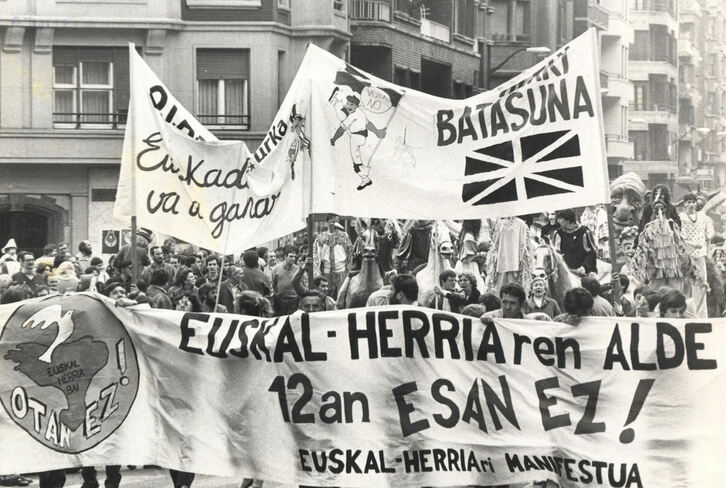 Movilización organizada por el Manifiesto en Defensa de la Soberanía Vasca en vísperas del referéndum. (EGIN)
El «no» se impuso en Hego Euskal Herria con el 60% en el referéndum sobre la permanencia del Estado español en la Organización del Tratado del Atlántico Norte (OTAN) celebrado el 12 de marzo de 1986, con porcentajes de voto negativo que fueron del 68,2% en Gipuzkoa, 64,2% en Bizkaia, 59,5% en Araba y 52,7% en Nafarroa. En la edición de ‘Egin’ del día siguiente se destacaba que en las zonas euskaldunes el rechazo fue abrumador.
Fue la excepción, al igual que Catalunya y Canarias, donde la oposición a la Alianza Atlántica se impuso, mientras el Gobierno del PSOE cosechaba un triunfo del 56,85% frente al 43,15% con el 6,54% de papeletas en blanco. «Lo que cuenta es que este resultado es bueno para España porque se ha ratificado la permanencia y participación en Europa. Este es un signo de que avanzamos hacia la modernidad y la democracia», manifestó el lehendakari José Antonio Ardanza, obviando la victoria del «no» en Hego Euskal Herria.
Para cuando se convocó la consulta, el Estado español llevaba cuatro años en el seno de la alianza militar nacida del Tratado de Wastington de 1949, ya que el Gobierno de la UCD dirigido por Leopoldo Calvo Sotelo rubricó la adhesión el 10 de diciembre de 1981, que se hizo efectiva el 30 de mayo de 1982, antes de la victoria del PSOE en las elecciones generales del 28 de octubre de aquel año.
En la votación que se realizó en el Congreso y el Senado, los grupos de derecha, incluido el PNV, apoyaron la incorporación, mientras que PSOE, PCE, PSA y la mayor parte del grupo mixto lo hizo en contra, tal y como recordó GARA en un reportaje publicado al cumplirse 36 años del referendo.
Felipe González prometió durante aquella campaña que iba a convocar un plebiscito. El «no» del PSOE se transformó cuatro años después en un «sí», apartando un lema empleado por el partido en aquellos años: «OTAN de entrada no». En el convocatoria del referendo, desde la oposición se acusó al Ejecutivo de proponer una pregunta poco clara.
En su viraje hacia el «sí», en el discurso sobre el Estado de la Nación de octubre de 1984, Felipe González presentó el Decálogo de Paz y Seguridad, que estableció las directrices que se deberían ratificar en referendo, que incluían que la participación en la Alianza no conllevaría su incorporación a la estructura militar integrada, así como que se mantendría la prohibición de instalar, almacenar o introducir armas nucleares.
«Si en 1981 el PSOE defendía que España debía colaborar con el equilibrio internacional no ingresando en la OTAN, en 1984 argumentaba que debía hacerlo permaneciendo en ella; si en 1981 alegaba que la OTAN legitimaba las dictaduras portuguesa, griega y turca, en 1984 afirmaba que la OTAN reunía países democráticos», resaltaba el informe ‘Treinta preguntas sobre la OTAN. Treinta años después del referéndum’, elaborado por el Centre Delàs d’Estudis per la Pau de Barcelona, para precisar de qué forma se habían incumplido las condiciones de aquella consulta y qué suponía continuar en la Alianza.
Iniciativas populares
Dos fueron las iniciativas populares más importantes a favor del «no» en Euskal Herria. Por un lado, el Manifiesto en Defensa de la Soberanía Vasca, firmado por mujeres y hombres de la Ribera, que denunciaba «la carrera armamentística, la entrada del Estado español en la OTAN y las gravísimas repercusiones para Euskal Herria en general y nuestra Ribera en concreto: centrales nucleares, polígono de tiro, mili obligatoria y en cualquier país de la OTAN». «Decir no a la OTAN es decir sí a Euskadi», era uno de los lemas del manifiesto.
Por otro lado, estaba la Plataforma contra la OTAN, que reunía a grupos y personas de izquierda y movimientos populares. Otro agente que se implicó fue el Colectivo por la Paz y el Desarme, sin olvidar que también fueron muy activos en aquella campaña organizaciones del movimiento juvenil, ecologistas o feministas, además de la mayoría de los sindicatos y profesionales de la salud.

A pie de urna, donde actuaba como interventor, el entonces miembro de la Mesa Nacional de Herri Batasuna Iñaki Ruiz de Pinedo expresaba su íntima convicción de que «dentro de esta batalla vamos a demostrar cómo el pueblo vasco va a ser campeón en la lucha por la paz». Desde Bilbo, Xabier Arzalluz, presidente del PNV, admitió que tenía la impresión de que iba a ganar el «no» y que la abstención iba a ser grande. Quien votó «no», así lo confesó a los medios de comunicación, fue Nicolás Redondo, secretario general de UGT.
El exlehendakari Carlos Garaikoetxea, enfrentado al sector oficial del PNV y que había anunciado su voto negativo, manifestó que «si la idea de quienes van al alineamiento en un bloque militar es defender su seguridad nacional y sus fronteras, yo me pregunto qué seguridad nacional y qué fronteras defendemos los vascos y si éstas son las que separan a unos vascos de otros».
Otra de las cuestiones que estaba en el candelero era el llamamiento de dirigentes jeltzales a votar en euskara. Para Kepa Aulestia, secretario general de Euskadiko Ezkerra, la campaña era «una bilbainada».
Confirmado el triunfo del «no», la fiesta se trasladó al pabellón de La Casilla, en Bilbo. En el acto, según informó ‘Egin’, las más de mil botellas de champán previstas por HB se quedaron cortas viendo el entusiasmo de los reunidos. En el otro extremo, el ambiente de desolación imperaba en el edificio Granada, sede del PNV en la Gran Vía bilbaina.
Al conocer los resultados en la delegación del Ejecutivo de Lakua, Xabier Arzalluz destacó el carácter de «castigo» del voto mayoritariamente negativo en Hego Euskal Herria, pero se mostró temeroso de cómo entenderían esos datos en Europa. «Esto no nos favorece», dijo el emblemático burukide. A su vez, Ramón Jáuregui, delegado del Gobierno español en la CAV, sostuvo que «el triunfo del ‘no’ en Euskadi y Catalunya responde a esa cierta radicalidad política que existe en ambas comunidades».
oooooo
Geure herriari, Euskal Herriari dagokionez, hona hemen gure apustu bakarra:
We Basques do need a real Basque independent State in the Western Pyrenees, just a democratic lay or secular state, with all the formal characteristics of any independent State: Central Bank, Treasury,
proper currency1, out of the European Distopia and faraway from NATO, being a BRICS partner…
Euskal Herriaren independentzia eta Mikel Torka
eta
Esadazu arren, zer da gu euskaldunok egiten ari garena eta zer egingo dugun
gehi
MTM: Zipriztinak (2), 2025: Warren Mosler
(Pinturak: Mikel Torka)
Gehigarriak:
MTM klase borrokarik gabe, kontabilitate hutsa
Anthony Anastosi: Estatu dirua, Klase borroka
1This way, our new Basque government will have infinite money to deal with. (Gogoratzekoa: Moneta jaulkitzaileko kasu guztietan, Gobernuak infinitu diru dauka.)


