
Episode 326 – AI in the Sky: Modern Warfare with Peter Byrne
Peter Byrne of Project Censored’s Military AI Watch series, talks about the deadly connection between technology, capitalism, and militarization.
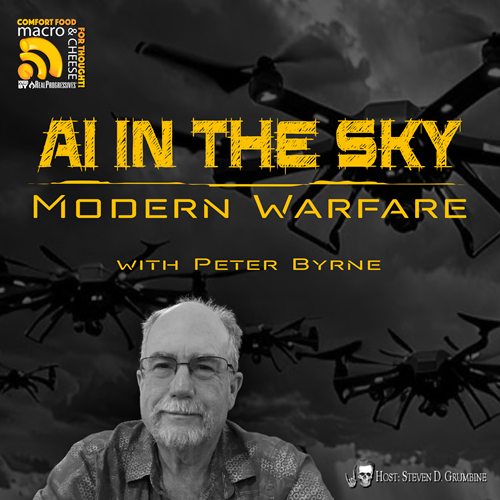
Episode 326 – AI in the Sky: Modern Warfare with Peter Byrne
Peter Byrne of Project Censored’s Military AI Watch series, talks about the deadly connection between technology, capitalism, and militarization.
The past year has seen lots of discussion of the ‘human’ nature of AI. Programs like ChatGPT were writing poetry, engaging in debates, and roasting users with witty retorts. Educators have been facing more serious concerns as they navigate a world in which students no longer need to learn to do their own research, writing, or thinking. But the militarization of AI makes these other activities seem like Donkey Kong.
Investigative journalist Peter Byrne joins Steve to talk about the treacherous relationship between technology, capitalism, and militarization. They discuss how companies like Palantir, funded by figures such as Peter Thiel, have leveraged vast amounts of capital—often government-funded—to develop this militarized AI. In other words, venture capitalists and tech startups are shaping modern warfare.
Peter draws historical parallels, explaining that the automation of warfare is not a new phenomenon but has evolved significantly since the days of analog computers in World War II. It only increases its destructive capabilities by unthinkable magnitudes.
We would do well to remember that machine learning models are incapable of achieving true intelligence. They reflect the ideology and interests of those who are responsible for them.
Peter Byrne is an award-winning investigative science reporter who has long uncovered corruption at the nexus of science and industry. Now, in partnership with Project Censored, Byrne has launched Military AI Watch, a groundbreaking ten-part series that will run monthly on Project Censored’s website.
https://www.projectcensored.org/military-ai-watch/
Transkripzioa:
Steve Grumbine:
00:00:43
All right, folks, this is Steve with Macro N Cheese. It’s been a bit, but we have been talking about AI [artificial intelligence] nonstop.
We’ve looked at it in schools. We have looked at it in terms of education and students using it and plagiarizing. We’ve looked at it in marketing. We’ve looked at it in all different facets. But today we’re going to go down a darker lane.
Today we’re going to look at AI in the military space, in the surveillance space. And we’re going to talk about some things that maybe are pretty uncomfortable for people, things you need to really get your mind wrapped around.
And one of the things that jumped out at me right up front was you got to have an expert that understands these things. You got to have people that are really digging into it because otherwise it just flies right past you. And I’ll introduce my guest momentarily.
But what I’m hoping is that people understand that our government is doing a lot of things in our name. They’re working with private industry that’s got a very different goal in mind than what we maybe would as citizens, as people who supposedly vote for things which, you know where I stand on that? Placebo 101.
And so with us going into this, I have asked my guest Peter Byrne, who is a Northern California based journalist who combines investigative reporting with science writing.
And in 2017, Peter’s 11-part series and the Point Raise Light Busted Breast Cancer, Money and the Media won the top science writing award from the American Association for the Advancement of Science.
He’s received national, regional and local recognition for investigative work, writing style and in-depth profiles of politicians, grifters, grafters and artists. And more to the point, he’s a part of our friends at Project Censored.
And what he has done is he has started to create a 10-part series, I believe it is, on the military use of AI and what I’m going to do is bring up Military AI Watch here, the dangerous militarization of AI and the profiteering behind it with my guest, Peter Byrne. Peter, welcome to the show, sir.
Peter Byrne:
00:02:51
Oh, thanks for having me, Steve.
Steve Grumbine:
00:02:53
Absolutely. I really appreciate you doing this. This is a very serious subject.
I triple guarantee most people are unaware of and if they are aware of it, somehow or another they filed it under don’t think about or I’ll lose my lunch. Tell me a little bit about your 10-part series Military AI Watch.
Peter Byrne:
00:03:12
Most people think about artificial intelligence, think about ChatGPT, how they can do their homework and how they can use it in their business to parse consumer patterns and things like that.
Most people don’t realize that artificial intelligence is a huge movement in the US military these days, primarily led by the US but also in China and other militaries around the world. But the thing about it is that artificial intelligence, it is not actually intelligence.
The computerization of warfare, the automation of warfare actually before computers were invented, has been around since before the catapult. People engaged in battle have always hired scientists like Archimedes to invent weapons of war that had automatic capacities.
But what we have in World War II particularly is the advent of the use of analog computers such as were embedded in bomb sites for the B17s that were dropping bombs on Europe and Japan.
Those were basically analog computers, and they had an automatic capacity to drop the bombs when they assessed that the cloud conditions were right, et cetera, et cetera.
During that time, MIT and other universities were putting a lot of effort using federal funds to create automatic weapons systems that after the war really took off. And one of the people that was involved in that was this polymath, Norbert Wiener, who was a child genius. He did quantum mechanics.
He was a revolutionary in pioneering computation. He could do biology.
And he wrote a book in the 1950s called Cybernetics: Or Control and Communication in the Animal and the Machine, which basically laid out the information type of science that informs computation and how computers talk to one another today.
I was just looking at this this morning, preparing for our talk and he wrote in Cybernetics, “We’ve decided to call the entire field of control and communication theory, whether in the machine or in the animal, by the name of cybernetics, which we form from the Greek word for steersman.”
When we think of cyberspace and cybernetics today, we pretty much, I think, believe that it just relates to computer programs and apps and the ability to use the Internet. But it’s actually much more than that. It’s about control, it’s about social control. Norbert Wiener wrote this immensely popular book back in the 50s.
In those days people didn’t read on screens, they read newspapers and books in print. Arguably, they were more intelligent because they were less stupefied by social media at the time. It brought to the forefront a lot of moral questions that Wiener later addressed in a book called God & Golem, Inc.,
in which he likened the advent of automated warfare, which is the early form of what we call artificial intelligence, to the mythological golem figure in the Jewish tradition, which the golem is a creature created in the form of a human from mud and clay.
And when you insert a piece of paper with the Word of God called a “shem” into the mouth of the golem, you can control the golem and it’s very strong, and you can send it into battle, you can get it to do your homework, whatever, but if the piece of paper falls out, it goes berserk and it starts destroying everything.
And he used that as a metaphor for how he saw the use of computation and artificial intelligence in warfare, in that it’s not the Word of God that has been inserted into the military apparatus and it has gone berserk.
And so my research, which has been going on for several years, has dealt a lot with primary research into government and military technical papers and all sorts of writings, including philosophical writings.
I just got this new great book called the Eye of War: Military Perception from the Telescope to the Drone by Antoine Bousquet, a European scholar who’s done a great dive into these issues. But in the beginning of his book, he’s got this little preface that says, “You see, control can never be a means to any practical end.
It can never be a means to anything, but more control, like junk.” And the quote is from William S. Burroughs, Naked Lunch. So that drew me right into the book. It’s very well written.
So a lot of scholars and academics have been dealing with the issues of artificial intelligence and warfare by remote control very strongly since the invasions of Iraq and Afghanistan, when the United States started to use drones and Hellfire missiles from the Predator drones that were billed as precision type of warfare, when in fact it wasn’t. They were able to target individuals, but the individuals were often children or people on their way to work or whatever. We know the story.
So what I wanted to do was to look into the science of military AI in the context of money. And my first piece, which came out three weeks ago, is called One Ring to Rule Them All.
And the reason it was called that was because one of the first Silicon Valley startups to go into the military AI realm is Palantir, which is named after the seeing stone in the Lord of the Rings, where the dark evil lord Sauron could look into this lens, like stone crystal, and see where his enemies were and then locate them and slay them.
And interestingly enough, Peter Thiel, who funded and operates Palantir, seems to identify with the dark lord Sauron, not with the hobbits that were trying to overthrow the evil orcs in the East. Now let’s remember that Lord of the Rings was written by [J. R. R.] Tolkien basically as a hysterical response to the rise of Bolsheviks in Russia, right?
And so the orcs were completely evil proletarian slaves.
And so actually you could turn that around and look at the orcs as being the good guys and the hobbits as being the middle-class burghers who just wanted to promote capitalism.
But in the case of Peter Thiel, we have to acknowledge that he’s identifying with the Dark Lord ability to cast what Antoine Bousquet and others call the “martial gaze”.
And the martial gaze is a terrifying basilisk-type of laser-like gaze at the world that threatens destruction upon all objects, including living objects that come within its field of vision. So what we have within advent of Palantir is the cyberization of the martial gaze. Palantir is a program that sits on top of vast troves of data.
It was founded by Thiel with a $30 billion investment. Thiel, by the way, was one of the founders of PayPal, along with Elon Musk. My friend calls him Ellen.
He doesn’t know that his other people call him Elon. Right? I like Ellen. And they’re not programmers, they’re not scientists, they’re not cybernetics experts, they’re salespeople and venture capitalists.
Right? They’re predators. So he starts Palantir and the program that was invented by other people that he hired, they’re called Gotham and Foundry and they have other names, they’re good programs. They are able to sit on top of vast amounts of data and see patterns in a user-friendly type of way.
So the first contracts that Palantir had were with the CIA, which was one of its major funders, and with Homeland Securities, now known as ICE.
It was instrumental in taking data that was streaming from surveillance towers on the border and from all the other electronic ways that Homeland Security and the CIA monitor people in the world and detect patterns. Are there useful patterns? Well, if you want to control people by terrifying them or by arresting them in secret or in public? Yes.
Palantir was originally a private company, and it remained so until 2020 when it went public, which meant that for the first time, it had to file annual reports with the Securities and Exchange Commission, which are public, and they are bound to reveal elements of their financial dealings and their operations. And you can also find out a lot about their mechanisms by looking at patent databases, which is a trove of wonderful information.
And along the way, Thiel, who, by the way, to digress for a second, was the mentor for James David [JD] Vance. He basically created him as a political force, and he was one of the first funders of Trump, and he has immense influence in the current regime.
Thiel hired this weirdo philosopher named Alexander Karp to be the front the CEO of Palantir.
He apparently studied with [philosopher, Jurgen] Habermas in Frankfurt School, calls himself a progressive, and he’s actually one of the most reactionary figures that’s ever walked on the earth.
He recently came out with a book about technology that has gotten all sorts of glowing reviews in the Washington Post and elsewhere, in which he says that, as I say in my article, he says basically that “China is our enemy. We have to destroy China, and anybody that is expressing un-American sentiments is going to find themselves in the crosshairs.”
So you’ve got this whole faux philosophical background invented by Thiel and Karp, who have this concept called the “network state“, where they’re going to eventually do away with democracy, do away with the vote for women and inferior biological entities, and create these fortresses on islands out at sea or in the desert in the southwest, in which there will be no laws and regulations about how to operate corporations. It’s this fascist libertarian evolution of a seed that was planted in the actual origin of the Internet and of artificial intelligence itself.
Because, as Yasha Levine wrote in his great 2008 book Surveillance Valley: [The Secret Military History of the Internet], Google was not born from a couple of students that wanted to do good in their world. It was funded from the very beginning by the National Security State. And it’s claimed to be doing no evil was actually revelatory of that.
It’s doing the opposite.
This whole little ethos in the beginning around the Internet and Cybernetics a la 70s versions, was emanating from Sausalito in the Bay Area, where Stuart Brandon and a few other people invented this cyber entity called The Well, which was basically just a chat where you could go and talk to your friends online. I used to use it. It was fun. And they had this whole quasi-hippie libertarian philosophy that was backing it.
But the powers that be were looking at it from a completely different point of view, and they were weaponizing it from the very beginning and have been doing so.
So you have these kind of hippie libertarians given philosophical cover to the Imperial War Machine, adopting Artificial Intelligence and the Internet and the command-and-control systems, events by social media and other communicatory devices, including the New York Times, you have them glomming onto this as a way to extend the martial gaze to the whole planet.
And these ruthless, amoral venture capitalists like Thiel and Karp and Musk and Reid Hoffman and others were able to incorporate these startups and attract vast amounts of venture capital that was basically catalyzed by investments from the CIA and the Department of War. Some people call it the Department of Defense. I call it by its real name, which it used to have.
Steve Grumbine:
00:15:14
Uh huh.
Peter Byrne:
00:15:15
And by the time Palantir went public in 2020, it had billions of dollars in contracts with military and intelligence agencies in the United States, in Europe and in some places in Southeast Asia. It had contracts with corporations such as Coca-Cola.
But most of its applications were put to military intelligence migration patterns, spotting martial gaze type of activities. So Thiel goes public with Palantir in 2020. And when you look at the SEC reports, a very interesting pattern actually reveals itself.
You don’t need software to see it. They’ve never paid any federal income taxes.
And their business model, which is being replicated by other Thiel companies and other startups in the military AI spectrum, their business model is to over promise, to attract vast amounts of venture capital, to go into the hole so they don’t have to pay taxes because they can say they’re operating at a loss and then go back to the venture capitalists and say, “You have all these sunk costs. We have these government contracts, give us some more money.” They give them some more money. So it’s this kind of Ponzi scheme in reverse. Right?
Steve Grumbine:
00:16:28
Right.
Peter Byrne:
00:16:29
By the time Thiel goes public, he’s gotten a little bad press because some investigative reporters got the contract that he had with the Los Angeles Police Department to do predictive policing, which wasn’t working out very well, as you may imagine. And so he hired people to be at his board, like a former Wall Street Journal reporter and military people, people from the NSA.
And then he created ethics committees full of sellouts that would lend their name to do such a thing, and attempted to sway public opinion into the notion that Palantir was engaged in protecting the public good, when actually it’s engaged in the opposite. So what you have happen is Palantir has these very competent pattern-recognition programs to put on top of huge data sets.
Because when the National Security Agency is scooping up probably every telephone call and tweet in the world, they’ve got vast amounts of data stored. They can’t parse it in real time, but you can use the Palantir software to sit on top of a database and go through and find what you want.
If you want to find. Steve and Peter are tweeting to each other or DM-ing to each other about say overthrowing capitalist system, they’ll come up with that.
But they needed what they call kinetic delivery vehicles, which is they needed drones, missiles, submarines, and surface ships, and airplanes that can act autonomously, that don’t require humans to man them or to woman them.
So Thiel funded this new corporation called Anduril, which is named after the sword that is called the Flame of the West in the Lord of the Rings, another Lord of the Rings thing.
It’s also got an entity called Mithril Capital, named after a Lord of the Rings saying, and then JD Vance has Narya Capital, which is another thing from the Lord of the Rings. These guys are just like soaring all over the place.
But Anduril, which is run by another young Sauron-type figure called Palmer Luckey, who made his first billion selling virtual goggles to Facebook. Meta. [Wow.] Anduril hired a lot of scientists based in Southern California to create relatively cheap weapons that can operate autonomously in warfare.
And that’s exactly what they have been doing.
So the mantra that’s being put out there by the Silicon Valley AI militarists is that they can do it cheaper and quicker and more efficiently, “it” being war, which means killing masses of people because war is not against troops anymore, it’s against populations, [Gaza] that they can do it more efficiently than the traditional military-industrial “so called” complex, which went from being 55 corporations in 1960 to five corporations today. The so called “primes”: Lockheed Martin, Northrop Grumman, Boeing, et cetera.
If you want to look at who gets like the most funding of any company in the United States, it’s Lockheed Martin. It’s something like $160 billion a year, it’s just an amazing amount of money.
And with that they buy politicians, and they basically make the foreign policy of the United States. They’re huge. Compared to Palantir, Lockheed Martin is completely global. It’s got hundreds of thousands of employees.
Palantir’s got just a few thousand.
And yet Palantir’s market value in the Wall Street arena is greater than Lockheed Martin’s because people are speculating that this is the future of warfare.
And that means that the wet dream of the militarists and the venture capitalists is they can sit behind their computers in Palo Alto or in Arlington, Virginia, and conduct warfare remotely all over the globe, that they will be able to have what they call a Joint Awareness All Domain Command and Control system, or a JDAC2, that is connected to hundreds of thousands of sensors in the land and the air and the seas, in space, and can take all this streaming electrons and photons and collocate them into a battlespace picture that can be visualized on a screen and user friendly enough so that whether the commanders are a human or possibly AIs, because that’s the direction it’s going in, they can order weapons of destruction to be initiated against tanks or buildings or children tens of thousands of miles away.
Steve Grumbine:
00:20:56
Skynet, huh?
Peter Byrne:
00:20:58
This is like where Palantir and Anduril, Lockheed Martin and Raytheon and the rest of them, they’ve been out-flexed technologically by these younger startups, but they have their own venture capital arms.
And so they’re investing in Palantir and Anduril and hundreds of other startups that are salivating on getting into this market, you know, internationally.
And the way venture capital works, of course, is that they’ll throw tens of millions of dollars at a hundred companies, and if one of them sticks and goes public and advances their initial investment by a factor of ten or a hundred, then they’re happy. They’re gamblers.
So you’ve got venture capitalists united with governmental entities and with the big primes that are attempting to cheapen and transform the machinery of war into a completely automated JDAC2. And the problem is that it can’t work. And it can’t work for a number of reasons.
First of all, it’s supposed to be run by machine learning, which is basically chat. Machine learning isn’t intelligent.
The neural nets are predictive machines that they’re trained on, the common crawl, on Reddit, on Wikipedia, on the digital garbage of the Internet.
OpenAI’s bots cannot scrape data from government or corporations or scientific institutions if those institutions don’t want their data scraped, and most of them don’t these days. They’re just full of a lot of memes and opinions, misnomers and garbage. That’s why they hallucinate. They basically are trained to come up with an answer.
But if the data doesn’t give them sufficient information to make a rational, cogent, coherent statement, they’ll just say anything that has some predictive value in terms of how they operate.
And the way that they operate is that they break words and concepts and images into small pieces and then try to reconstruct the images and words and objects by putting together the small pieces and predicting their proximity in phase space, which is this kind of multidimensional place that computers and physics operates, right? And those are called tokens, the bits are called tokens. So they’re just predicting the proximity of one token to another set of tokens.
It’s not working. OpenAI, which is hugely invested in military intelligence these days, has a real problem because it’s reached the limits.
There’s tons of papers that will reveal, including by industry itself, that the chats have reached the limit of efficacy of the knowledge bases and their ability to parse them and to come up with meaningful statements. Now, large language models can be very good if they’re trained on small, narrow data sets.
They’ve done some good work in feeding millions of mammograms to large language models.
And then the models can predict anomalies in the X-rays that may have pathological significance, although they actually really don’t do it better than the humans at this point, although they’re trying to make it do that. But we have a phenomenon in computer science called “Garbage in, garbage out.”
If you put in bad data, you’re going to get an incorrect incoherent answer. So with the mammograms, it’s pretty limited type of thing. You can put in lots of data and so you’ll have something you can work with.
Or if you’re a target consultant trying to figure out consumer patterns, you can probably pretty easily figure out who’s going to buy what at what hour of the day and then arrange your displays accordingly. But that’s narrow. That’s a very targeted algorithmic process.
It is not even remotely what is called “artificial general intelligence” or beyond that, “super-intelligence.” Artificial general intelligence is supposed to be able to answer any question about anything at any time. And that will never happen because I want to go back to cybernetics for a second with in the 50s there was a British cybernetician computer scientist, early one, his name was Ross Ashby. Ashby’s Law of Requisite Variety, which is kind of cool sounding, and what it means is very simple.
If you want to control a system that has a number of degrees of freedom, which just means that it can move from point A to point B to point D to point 2005 or it can only move to point 2, it can only go from A to B, then it has two points, two degrees of freedom. If you can go to A to 2000, it has 2000 degrees of freedom.
So if you want to control it though your mechanism, like your bomb site or your digital computer, as it turns out now has to have as many degrees of freedom as the system is trying to control, because otherwise it can’t predict anything. And that’s impossible. You cannot create a control mechanism that can predict the real world.
You can take little slices of it and you can make predictions that have some degree of probability that X will happen at time Y. But you’re not going to be able to predict what people are going to do in the long run.
You’re not going to be able to predict how markets are going to behave because you can’t mirror it.
Unfortunately, the military venture capitalist establishment is selling this notion that you can mirror it, and they’ve been selling that notion for a long time. It’s gone through a lot of iterations. They were trying to do the same thing in Vietnam, and along the way they do a lot of damage.
For example, right now, Palantir and Anduril and other military AI startups and larger companies are deeply invested with Elbit Systems, which is the Israeli kind of Lockheed version of Lockheed, in using AI weapons in Gaza and in the West Bank.
Intermission:
00:26:31
You are listening to Macro N Cheese, a podcast by Real Progressives. We are a 501c3 nonprofit organization. All donations are tax deductible. Please consider becoming a monthly donor on Patreon, Substack, or our website, realprogressives.org. Now back to the podcast.
Peter Byrne:
00:26:54
The programs which were uncovered and publicized by those wonderfully brave Israeli and Palestinian journalists, they uncovered the existence of these AI programs called Lavender and Gospel and Where’s Daddy? Where’s Daddy? is like the most evil one of all.
It basically tries to figure out when a suspect, you know, Hamas suspect, which could be anybody, goes home and is welcomed home by his children, and then they bomb the house and they kill the entire family. They do this repeatedly.
Steve Grumbine:
00:27:23
Jesus Christ.
Peter Byrne:
00:27:24
Now, these programs are based on Palantir, Anduril, and other types of classified programs that claim to be able to successfully figure out who’s going to be an enemy in the future or who’s been an enemy or who is an enemy right now and then annihilate them by blowing up entire city blocks. It doesn’t work
well. I mean, the people in Palestine who are bravely resisting, despite their leadership being a bit out to lunch, they’re not going anywhere short of extermination, which certainly seems to be one of the primary directives of the Israeli state at this point, of the Zionist entity, which is to ethically cleanse and exterminate and commit a genocide in the entire population of Palestine and create a Riviera-type situation in the Greater Israel, which can take over control of the Middle Eastern economy from Iran and from the United States, Europe, Japan and China. It’s a pipe dream that they have of universal command and control.
We were talking earlier about, you know, in the 60s and 70s, students in America were admiring the Chinese Communist revolution and Mao’s Little Red Book and all that sort of thing. One of the things about this aim of imperialism, I think Mao encapsulated it very well. He said, “Imperialists make trouble and fail.
They make trouble again, they fail again. They make trouble and then they fail.”
And it’s true. They engage in these wars, either proxy wars, like what we’re doing right now [with Ukraine], the war with Russia and the Ukraine, or subsidizing the expansion of Greater Israel and US investment throughout the Middle East.
Now, with the complicity of the Saudi Arabian and United Arab Emirates monarchies, who incidentally are also heavily invested in military AI in the United States, this pipe dream of control comes up against a form of resistance which is flesh.
Now, will the US-Israeli entity successfully exterminate the Palestinians and go on to exterminate the Iranians and keep turning its martial gaze inward in America to arrest and exterminate people that it doesn’t like, which it’s already starting to do? At what point will people throw a spoke into the wheel and say, “We’ve had enough?”
At what point will people say, “I’m not going to watch these screens anymore. I’m not going to let social media tell me what to do.
I’m going to get out into the street and flip the bird to your cameras and then rip them off the telephone poles.” It’s going to take that. I don’t think we’ll be able to sit around and wait for Bernie Sanders and AOC to do it. Bless their hearts.
You know, they don’t have what it takes. They don’t have the gumption. They don’t have the ideological background.
Steve Grumbine:
00:29:57
They’re controlled opposition.
Peter Byrne:
00:29:59
They’re the controlled opposition, you know? [Absolutely.]
And I mean, I’m sure they’re sincere and, you know, fine, but we’re facing a situation right now where the martial gaze is staring outward from the bedroom of the White House with this blonde golem that was activated by this nasty father who’s trying to get revenge on his dad by destroying the world and has been able to surround himself by sycophants and fascists who have absolutely no moral bearing whatsoever. This martial gaze is now staring outwards and inwards and the American public, not to mention the whole world, is confused by this.
I mean, we keep talking about Nazi Germany and those correlations are certainly accurate, but that was a while ago. And as Aime Cesaire said, “You know, fascism doesn’t just come overnight. It seeps into us from the very walls and from the fabric of our societies.”
It’s been going on for a long time. America is a settler colonial entity, as is Israel.
So fascism is basically built in and legitimized by our very constitution which considered women and people of color not to be human enough to vote, et cetera, et cetera. So where do we take a stand against the martial gaze that is now being automated in such a way that it acts at light speed?
Because one of the biggest dangers of this whole development of the JDAC2 is that it also includes the Nuclear Command and Control System, the so called NC3 [NC2].
Now we already know that Nuclear Command and Control Systems, which have been automated since the 1950s, since the very beginning, and there’s been any number of close calls caused by computer glitches. We should be thankful that we’re still here. Those were relatively simple analog type of systems.
They weren’t these JDAC2 type of systems which are trying to connect tens of thousands of sensors using satellite images drawn, transmitted from outer space using sonar types of patterns transmitted from autonomous submarines and these Saildrone artificially intelligent solar powered surfboards that are all over the oceans now, transmitting military and intelligence information back to Alameda and elsewhere. The more complex the JDAC2 becomes, the less able its inventors, Dr. Frankensteins, are able to be able to control it or even to program it to do what they want it to do.
And the more complex it becomes, the more fragile it is, the more easily it can tip over.
Because as a complex adaptive system, all those systems famously have tipping points. It’s like a pile of sand. At a certain point, if you keep adding to the top, it’s going to start deconstructing and flattening out.
I think that’s what’s happening here.
Because in the next version of Military AI Watch that I’ll be reporting on, which is about the Stargate fiasco, how World War III will be fought inside data centers, which is an interesting concept to think about.
We see how the whole thing is unraveling to the extent that the General Accounting Office and various federal auditors that examined the efficacy of Department of War spending are coming out now. In April, the GAO came out and said basically, “The JDAC2 doesn’t work. It won’t work. It’s not helpful.” Now that’s kind of the small print, right?
There’s no headlines in the New York Times or the Washington Post or the Wall Street Journal saying “Oh, the General Accounting Office says that automated warfare won’t work.” That’s why you have to go to Project Censored I guess to find out. But that’s truth.
I mean the government itself knows that it won’t work and they don’t care because it’s all about money. And that’s something that Military AI Watch is focused on. We try to combine a scientific and technical analysis with the flow of money.
When you get to the money, it’s not hard to figure that the only way that it’s going to stop flowing into the system is if it doesn’t have any wars to fight.
So its avatars like JD Vance and God knows who else in the fascist regime today united with characters like Eric Schmidt, the former CEO of Google who along with Henry Kissinger wrote a book called the Age of AI a few years ago, the late war criminal Henry Kissinger in which they said, “If we don’t take over China, invade China and destroy its industrial base, we’re all going to be speaking Chinese”, that sort of thing. Eric Schmidt is one of the most tendentious war hounds in America today and he’s a Democrat, right?
He supported Biden and Kamala and all the rest of them because there’s no difference between the two sides of the war coin, you know, so you’ve got this system that has an agency of its own, it’s a golem and it doesn’t have the shem in its mouth anymore with the word of God. It’s gone berserk. But it’s got a lot of power and it has a built-in complex adaptive system, self-organizing agenda that humans are not a part of.
I mean we’re a part of it, but we’re not in control of it.
In fact, the illusion that humans have any control over the military industrialization and the martial gaze of the globe would be amusing if it wasn’t so pathetic and horrible. We’re not in control. It’s in control of us.
It funds our politicians. It casts its gaze in Gaza and sends Hellfire missiles where it wants and each one of those missiles cost $4 million. So, without hot wars, the military industrial complex as we know it disintegrates.
And the newcomers on the block, these startups run by the PayPal mafia which would not exist without government subsidies.
Steve Grumbine:
00:35:29
Amen.
Peter Byrne:
00:35:30
I mean certainly SpaceX wouldn’t certainly.
Steve Grumbine:
00:35:33
It’s all public money they’re getting, just slurping it up for their own, you know, oligarchic intent.
Peter Byrne:
00:35:39
Look at Bezos. I mean, Bezos has this space program which is also competing for military contracts.
But what most people don’t understand is the depth to which Amazon, through its Amazon Web Services, is embedded in military AI activities. It had a $9 billion contract to create the cloud system for the intelligence agencies, mostly the CIA, back in 2019.
And it was killed by Trump because he didn’t like the Washington Post, which is also owned by Bezos, who owns Amazon.
But things evolved and now Microsoft and Oracle and Amazon are sharing a $10 billion plus contract to create a series of cloud systems for the military intelligence complex. And where this actually is quite interesting is as I described before, you’ve got this wet dream of having a JDAC2 which is all seeing martial gaze.
This basilisk can see everything in the world and that can automatically destroy enemies that is programmed to perceive as bad without humans having to even be a part of the decision matrix.
Because humans made the decision when they invented it. They’re not necessarily needed to be in the loop when the trigger is pulled, you know. That’s the dream, but the reality is capitalism.
Steve Grumbine:
00:36:54
Peter Byrne:
00:36:55
Under capitalism you have a concept called vendor lock[-in].
And that means that the various armed services, the Army, the Air Force, the Navy and then the intelligence agencies, they all have their favorite vendors. The Air Force has Lockheed, Navy has Northrop Grumman, et cetera.
These are huge companies and also smaller companies with whom they’ve been working for years.
And of course, the person that gives them the contract one year, retires from the Pentagon the next year and then is on the board of directors or is an executive of the same company they were giving contracts to the following year. It’s a big revolving door. I call it a “cluster of bucks”, if you know what I mean.
So what you’ve got under development right now is each one of those services is contracted to different sets of corporations to make their own proprietary battlespace manipulation, AI-driven, all-encompassing, all-controlling programs. But they don’t speak to each other, they’re stove piped. The program that Lockheed is making doesn’t talk to the program that Raytheon is making.
And you can go to their websites and they’ll have these fantastic little marketing videos about these JDAC2 related all-domain programs that they’re making to control military activities all over the world.
And you’ve got women and men of color sitting in front of computer banks watching so-called terrorists 10,000 miles away be blown up automatically by programs that are looking to see if they’re wearing hijabs or carrying buckets that might be full of water. It could also be full of gunpowder or whatever. You know, it’s crazy. The good news is they don’t talk to each other.
So their wet dream of having a universal eye isn’t going to work. The bad news is that each of them is going to be thinking that theirs is better and fine and they’re going to be acting on it.
And then you’ve got a Nuclear Command and Control System in it that’s going to pick up on glitches and on mistakes and on real time activities and say, ‘Oh, we need to launch a tactical nuke to destroy this AI chip factory in Shanghai.” And part of the horror of this developing situation is that under Biden, but also starting with Obama, two things happened.
One, they decided to revitalize the entire nuclear triad, which means that the B-52 bombers and the Minuteman missiles and the nuclear submarines were getting old. B-52 bombers are like 70 years old and they’re still targeting, you know, Moscow and the rest for potential nuclear annihilation.
But they’re big lumbering monsters. By the time they got anywhere near there, they would be shot down by hyperglide missiles [hypersonic glide missiles]. I mean they’re not actually very efficacious anymore.
So the idea that the Democrats have been promoting even more than the Republicans over the years is to spend I think upwards now $6 trillion on revitalizing and revamping and modernizing the nuclear triad. To that extent, they’re now wanting to put Sentinel missiles to replace all the Minuteman missiles in Nevada, Wyoming, Montana, Idaho area.
They had to do an environmental impact statement about doing it. It’s 6,000 pages long. I read a lot of it. God help me.
And the funny thing about it is they go on and on and on about how they’re going to save like the red-legged frog from the construction activities.
But there’s not a single word about the actual use of the arsenal that they’re putting there, which is to destroy millions of people by launching missiles.
But also it acts as an attraction in that if we were in a tense situation with China or Russia who do have nuclear missiles, they might want to do a first strike on the nuclear missiles in the United States, which is going to damage the environment to say the least, right?
Steve Grumbine:
00:40:44
Oh yeah.
Peter Byrne:
00:40:45
That’s not anywhere near a subject that’s talked about in the environmental impact statement, which I think actually means that it would be good for a lawsuit because it’s breaking the law by not talking about that. But that’s another story.
So anyway, they’re modernizing that and at the same time, and this happened under Biden, who is an evil warmonger, they basically are saying they’re reversing themselves because of the advent of nuclear winter.
You know, when it was determined scientifically that even a small nuclear war would affect climate of the United States by shading sunlight due to the carbonization soot in the atmosphere from fires caused by nuclear weapons, it would then cause the temperature to go down below zero for like two years and destroy agriculture and most life forms on Earth. And it’s still a real thing and hasn’t gone away.
If anything, the science has gotten more predictive and accurate about it, although it’s being ignored by the mainstream media and the Pentagon for the most part, which is a whole story I could talk about in a related issue.
However, they decided that, “Well, if we have a huge all-out total nuclear war, not only will it blow us all up, but it will actually freeze us to death.”
So we need to revitalize the concept of limited nuclear war, which is something that Kissinger actually was talking about in the 1950s when he was a scholar at Harvard University working for the Department of War. He was a big advocate of limited nuclear warfare.
Then it went away because they thought the powers that be decided it was too destabilizing and frankly there wasn’t enough money into it. There’s much more money to prepare for total war than limited nuclear war.
But now it’s back because there’s all sorts of methods of delivery, hyperglide missiles, satellites and whatever, that the possibility of blowing up central Tehran with a nuclear bomb roughly the size of the bombs that were dropped on Hiroshima and Nagasaki is definitely on the table. I mean, the B-52s are still there. The cruise missiles can deliver them very efficiently and a freak like Trump would certainly do it.
I mean, one of the first things he ever said when he was running for office was, “We have these nuclear weapons, why don’t we use them?” And so I’m definitely afraid of that. But if they use limited nuclear weapons, who will object?
I don’t think Russia or China are going to object to this point unless they’re used against them. You know, this whole concept of deterrence is total BS.
I mean, deterrence is actually basically just an excuse to figure out how to strike your enemy first.
Steve Grumbine:
00:43:04
Capital accumulation too, let’s not forget that. I mean, that Is, you had it right.
The capitalist mode is to accumulate as much capital, and the only way they can do that is what? To continue having reasons to create war machines [You] said it well…
Peter Byrne:
00:43:16
I think it was Stalin that said, “Every once in a while, they take a sword to the Gordian Knot caused by all the intricacies of capitalism.”
And you see that now because wars generally emerge out of trade wars. And years after the disintegration of the Soviet Union, the United States military turned towards terrorist enemies.
They created terrorist enemies in Afghanistan and Iraq that then they could finance the war machine to go and wreak havoc on those populations.
But after they were defeated, in order to cause so much damage that it was no longer profitable, they decided that the newest enemy is China. Especially emanating from Silicon Valley, this huge war chorus going on about ruining the industrial base of China.
And that is something that has caused the Chinese great concern because, yeah, they have some nuclear weapons and they have some nuclear missiles, and some of those missiles can reach to the United States and elsewhere. But they had a policy of no first use, which meant that they kept the warheads separate from the missile delivery vehicles.
And that meant that it would take days actually to insert the warheads on the missiles and then fire them, thereby diffusing the kind of emotional and political turmoil that goes around flashpoints. The United States has never had that. The United States is like, “Launch on warning.”
You get, like, literally, like, it can be launched within 15 minutes of a decision, and you can’t recall them, you know?
China is so freaked out by the US posturing around Taiwan, which is all about controlling the world’s best chip factory, which is Taiwan Semiconductor. It makes the most advanced AI chips in the world. And everybody wants to control that economy.
But the military posturing the United States has been doing around Taiwanese ocean areas and, in the public, you know, sending Nancy Pelosi there and antagonizing them, et cetera, has caused the Chinese now to abandon apparently the strategy they had of no first use. They’re apparently putting the warheads onto the missiles now. So diplomacy is out of the question these days.
I mean, ever since the disintegration of the Soviet Union, you know, and going back in history with the advent of nuclear winter and the huge publicity that that got, Ronald Reagan, who was a genocidal monster of his own right, actually did the right thing. I mean, he entered into a series of nuclear disarmament treaties that are actually efficacious.
They worked to a degree, you know, and now they’ve been abandoned. Ever since Obama, the United States government has made any effort to negotiate meaningful arms control treaties for nuclear weapons with countries that have them. There’s nine that have them. Right? Including Israel.
And so now the defenestration of the nuclear disarmament treaties, which are just not even a matter for consideration by the current United States government, whether it’s Democrat or Republican, combined with the ability to use small nuclear weapons guided by artificially intelligent programs inserted into delivery vehicles that can operate on their own, which means they don’t have to be connected to the electromagnetic spectrum, which can be jammed and throw them off. That means that war is imminent and the military AI is causal of that. Anyway, I’ve been talking a lot.
Steve Grumbine:
00:46:34
You have. And I wanted to let you go because the story is just more important than me trying to interject there. I really wanted to let you go.
Everything that you’ve said so far kind of touches a nerve in my body because first of all, I didn’t realize the tie into Tolkien and all that stuff with the anti-Soviet stuff, the freak out. I mean, I know the whole world shook in 1917, right? Everybody overreacted when they saw the Bolsheviks.
And I’m spending all my time reading about how they did it, because I’d like to figure it out.
Because at this point in time, to your point, until we stop, you know, playing games and we start realizing those cameras are not there for our protection, we’re going to sit here and valorize police forces that are there to protect capital and more in particular, protect these kinds of endeavors.
Peter Byrne:
00:47:20
You know, traditionally in the American body, politics has worshiped our troops. Bring the troops home and all that. Yep, soldiers are valiant.
Well, actually, in the world today, the troops of the imperialist countries pretty much sit behind vast arrays of machinery, killing innocent people or people they just don’t like from afar. They’re cowards.
Steve Grumbine:
00:47:40
Yes.
Peter Byrne:
00:47:41
And the people that have courage actually are the insurgents. I mean, you don’t necessarily have to agree with their objectives, but they’re the ones that are showing us the way of fighting back.
They’re learning how to hide. They’re learning how to spoof these algorithms.
They’re learning how to put their lives on the line to defeat the most monstrous Moloch that has ever existed, and which is dooming us all if we do not put the Word of God, as it were. And I’m an atheist, but let’s put the Word of God back into its mouth.
Steve Grumbine:
00:48:09
Yeah. You know what? You nailed it. Every time we talk about AI obviously, you know, AI in and of itself consumes so much energy.
Peter Byrne:
00:48:18
Oh.
Steve Grumbine:
00:48:19
I mean, somebody jokingly said, “Every time you do a search on AI, you kill a pond somewhere.”
Peter Byrne:
00:48:23
Yeah.
Steve Grumbine:
00:48:24
Um, but you do, right? And reality is that wherever you go, there’s AI.
And even in your workplace, for those people that work in jobs that are at a desk, a lot of the stuff you’re being asked to do involves some sort of Copilot or some sort of other AI application. You’re looking around, these things are burning up the environment like crazy.
And we’re getting to a point where the opportunity to not use AI is passing us by. It’s almost too late in some ways, that work is being redefined by what AI can do in the workplace.
And if we don’t think for a minute that that will serve long term to replace workers, and it’s class war, okay? It is not an endeavor that will benefit the working class. It is there to replace the working class, to eliminate the working class.
Everything you’re seeing with the military industrial complex is about large capital accumulation. And, you know, the people dying and stuff like that are just a cost to make money at this point. I don’t even think they give a shit.
I mean, some of them may have that ideological proclivity that says, “We just need to annihilate all these people.”
It sounds like Peter Thiel is the kind of sick son of a bitch that, you know, given the people he keeps company with, probably relishes the opportunity to kill a few people that he sees as undeserving of life. But that said, this is happening in the name of democracy, which, I mean, let’s be fair.
If you believe right now that you can go out and vote your way out of this, what we just talked about, you are dealing in fairy tale. You’re literally dealing in tooth fairy nonsense. I can’t be more emphatic about this.
Peter Byrne:
00:49:53
This is the point, Steve, that I’m trying to, as you, is trying to get across here for people to see for themselves, is that we live in a plutocracy. We do not live in a democracy. A real democracy would be socialist.
You know, where you have grassroots bodies making political decisions that percolated up instead of the reverse. We live in a rule of plutocratic militarists. I mean, Rome Burning had nothing on what’s going on here.
And as far as the environment goes, my next story on Stargate Fiasco details almost 6,000 data centers in the world right now, most of them owned by big American corporations that even have them in China.
And these are using up so much electricity and water for cooling because they have to have massive amounts of water, that they’re exacerbating global heating by a huge factor.
And so you’ve got Trump announcing this Stargate thing the day after his inauguration, standing in there with Zuckerberg, Ellison and the guy from SoftBank, Mr. Son, talking about how they’re going to supercharge building data centers.
Trump’s family has all these investments in data center venture capitalist organizations and entities in the Middle East that are investing in this.
I mean, this whole notion that Stargate is going to re-industrialize America and bring us back into a working-class paradise where everybody can go into a factory is being promoted, but it’s complete nonsense. For one thing, the Secretary of Commerce quoted the other day saying, “Oh yeah, we’re going to re-industrialize America. We’ll have millions and millions of people sitting around putting tiny little screws into iPhones.”
Like that’s work that we want to do?
I mean, a lot of the people that lost their industrial jobs in the United States went on and got jobs in finance and services. I mean, they’re actually have already moved on. So what kind of industry do you want here? There’s still plenty of industry here.
Most of it’s war industry. But we have a disappointment here because the working class here is not stepping up, in my opinion. You look at the automotive workers, you know.
Steve Grumbine:
00:51:57
Yeah, yeah, no, 100%. Listen, I want to put an exclamation point on everything you said and get us closed out here, because this is super important.
Number one, I hope I can have you back for future installments because this is just an unfolding story that you’ve done so much work on, number one.
But number two, for the people out there who follow our podcast that know that we focus on the intersection of modern monetary theory and class struggle, just know this. The public funding that is going to these industries is not coming from your tax dollar.
You’re lied into this false belief that you are funding these things. Just know that they know that.
And they are purposely financing these major, major corporations, creating new billionaires from public money that they simultaneously tell you, the government which creates all money is telling you, “We don’t have any money for health care. We don’t have any money for education. We don’t have any money to provide for the needy, much less provide citizens benefits for all.”
In fact, we just demonize immigrants and we do all the fascist, bootlicking kind of things that they did in Nazi Germany by creating scapegoats and all the while we’re under the belief that we can’t afford to do nice things. While we’re privatizing NASA and we’re privatizing the public space, we are literally giving away the keys to the kingdom.
Any semblance of democracy that you ever held in your head, you should literally just take some Listerine or whatever, gargle and spit that lie out of your mouth. No matter how many “source the votes.” No matter how many of these things. You need to understand that we’ve evolved to a new point.
A point where you slept through the other two. We all slept through, let’s be fair. We would be in a different place.
But we are at a point now where it is no longer your mom and dad’s apple pie and baseball and whatever. That’s the lie they’re trying to sell you. That’s the Pleasantville they’re trying to sell you.
The reality is what my guest Peter Byrne and his entire 10-part series on AI in the military is uncovering. And this is just but one element of the evil that is being done in the name of democracy, in the name of the red, white and blue.
I’m telling you folks, stop with the child’s stories to each other. Grow up, Peter Pan. Count Chocula.
It is time to look the devil in the eye and stop acting like people are just going to somehow or another vote this away. It’s not going to be voted away. You must organize, you must become militant, and you must get into the streets.
It is not something, we have to build parallel structures, parallel power somehow or another that doesn’t rise and fall every election cycle. Because these things what we’re talking about right here, it’s being designed to keep us in line at home too.
Peter Byrne:
00:54:44
Huey Long said, you know that one of the first American populists in the 1930s, he said when as fascism was arising in Europe, he said, “When fascism comes to America, it will come wrapped in the American flag.”
Steve Grumbine:
00:54:55
You got it. Patriotism, baby. All right, listen, Peter, I want to thank you for this. We can go on for hours. I love everything. I mean, I don’t love it, I hate it.
Peter Byrne:
00:55:03
Steve Grumbine:
00:55:04
I hate everything you said just now. I literally hate this podcast. No, but it is so important, right? Everything you just said is a wakeup call if people choose to hear it.
Instead of, namby-pamby “Well you know we just got to give a few more progressives to” stop. Just stop. It’s like stop.
Peter Byrne:
00:55:22
Cancer doesn’t cure itself.
Steve Grumbine:
00:55:25
No, no, it does not.
Peter Byrne:
00:55:28
Steve Grumbine:
00:55:30
All right. With that Peter, where can we find more of your work? Obviously, it’s at projectsensored.org under the Military AI and I think it’s.
We can put the link in the show notes so if you’re interested, look for it there. But it’s projectcensored.org/military-AI-watch/. And of course you can go to Peter’s own website. And Peter, where can we find that website?
Peter Byrne:
00:55:55
I hate to say, Google search engine my name Peter Byrne reporter. My website will come up is peterbyrne.info and another story you might like there.
It’s a lot of environmental reporting and stuff. But there’s one I did recently on how the United States used sarin gas and Laos in 1970, which I think people might find interesting.
Steve Grumbine:
00:56:13
Wow, that’s more evil to pile on the pile of evil, huh?
Peter Byrne:
00:56:17
Well, I’m really looking, I was really looking for some optimism here and I do have a lot of optimism, I really do. Because human beings have been around for millions of years and life has been around for billions of years and this is just a transitory phase.
So obviously full of a lot of pain and angst and horror. But you know, I believe that life will survive. It may not be human life, but life will survive.
Steve Grumbine:
00:56:39
Well, I’m going to try and find a positive in that, my friend. It’s tough to find that way as a father of children, man.
Peter Byrne:
00:56:46
Well, look at it from the point of view of cyanobacteria or roaches.
Steve Grumbine:
00:56:49
Isn’t that how it all began? Are we going back to the primitive? I mean, that’s what it feels like. Don’t let my laughter fool you.
I’m very dismayed by this discussion, but in a way that hopefully will motivate even myself to do more. Peter, thank you so much for your time. My name is Steve Grumbine. I am the host of Macro N Cheese.
Macaron Cheese is a part of Real Progressives which is a 501c3 not for profit organization. We literally live and die by your donations. Please consider becoming a member of our Patreon. It is patreon.com/real progressives.
And you can go to our website realprogressives.org in the dropdown menu. There is a donate there and you can also go to our Substack which is substack.com/realprogressives. Please go there. Consider becoming a monthly donor.
No amount is too small. I see a lot of folks that put out a lot of content, have a lot of people following them. We need your love too.
We do an awful lot of work beyond just the podcast and it only happens because of our donors. So we love you. We thank you. We ask you to become more involved with that. Peter, thank you so much for your time.
And on behalf of Macro N Cheese and Real Progressives, we are out of here.
End Credits:
00:58:12
Production, transcripts, graphics, sound engineering, extras, and show notes for Macro N Cheese are done by our volunteer team at Real Progressives, serving in solidarity with the working class since 2015. To become a donor please go to patreon.com/realprogressives, realprogressives.substack.com, or realprogressives.org.
oooooo
MILITARY AI: THE HYPE &THE HORROR (w/Peter Byrne)
(https://www.youtube.com/watch?v=qKBVKhXmWo4)
Our good friends at Project Censored are hosting a ten-part exposé by award-winning journalist Peter Byrne on the militarization of AI. In this video, Peter discusses his findings. I guarantee you’ll be astonished by the absurdity, greed, mendacity, and planetary risk posed by these products. I was—and I write about this stuff. Peter even answered a question I’ve had for a long time, namely: what is it with these techbros and Lord of the Rings? If Dr. Strangelove and the sheep from Farmville went to hell and had a baby, it would look like military AI.
Transkripzioa:
0:02
[Music]
0:07
What was the It’s such an important topic and I think it’s hard for people
0:12
to grasp. What What was the in inspiration for uh you and Project
0:17
Censored to team up on this? Well, I’ve been looking into uh military
0:23
AI for for a while. Um, and what I was learning was really
0:31
disturbing because it wasn’t being reflected in the mainstream media. There’s been some reporting
0:37
about, oh, we’re going to have lots of satellites sending hair follicle back pictures for
0:46
analyzing by machine learning and all that. But I don’t think people are
0:51
really aware of one how deeply the military and Silicon Valley are embedded
0:58
in trying to transform the military into an artificial intelligence run
1:05
organization where they can take human beings out of the decisional loops and
1:11
two how ridiculous that is from a technological and scientific point of view. it’s not going to happen the way
1:17
that they envision it happening, which we can get into and describe for any number of reasons. Doesn’t mean that
1:24
they’re not causing a great deal of harm along the way. I mean, they’re using Gaza and the Ukraine as testing grounds
1:29
for all sorts of AI enabled weapons. They have a a techno wet dream that
1:37
they’re going to be able to create what they call a joint all awareness demand
1:42
command uh domain command and control system where they can create a battle
1:47
space picture on screens that will unite electrons and photons streaming in
1:55
from tens of thousands of sensors on the land, the sea, the air, and in outer
2:01
space. that will then be able to be quickly
2:06
parsed by machine learning which is the latest iteration of artificial intelligence. AI has been around for a
2:12
long time but this is its most current right and probably most powerful form anyway they have this vision that
2:19
they’re going to be able to control the entire globe by using AIs to analyze in
2:25
nanoseconds what it would take humans days to look at. And of course since
2:31
this is all happening really rapidly the requirement for action is also rapid. My
2:36
newest article uh is um called the Stargate Fiasco which is about data centers and the the
2:44
subhead on it is World War II will take place in data centers which is something right I I I got to that and and well I
2:51
mean let’s maybe take them in sequence. First of all, what the hell is it with
2:59
Lord of the Rings and the technology of of death? I mean, I was never honestly
3:06
in college, I I couldn’t quite get the books. Uh, but I know a lot of people
3:12
did. The movies are nice, but geez, you have Palunteer, which is uh both lynical
3:20
uh uh both uh cynical and lethal. You have uh Anderil which is also I guess
3:28
isn’t that a Tolken derived? Yeah actually I I find the movies to be horrifying and appalling as I find the
3:33
books to be horrifying and appalling. I mean I liked them when I was a a teenager although I was fairly
3:38
uninformed at the time but consequently you know uh Tolken was a vicious
3:44
anti-communist and he wrote those as a diet tribe against bulsheism rising up in the east and you have all these
3:50
middle class hobbits that are going to go save the world. Right? So Peter Teal who uh famously is against democracy and
3:58
against letting women vote and all sorts of you know um anti-devel uh concepts
4:05
like that. When he created Palunteer back in 2003 using CIA
4:12
investment money through INQEL which is the CIA investment arm in Silicon Valley. He named it after the seing
4:19
stone in the Lord of the Rings. But the seing stone is primarily used by the dark lord Saurin to locate and destroy
4:24
his enemies and which is a company he created a few years later which is more
4:30
of um delivers the kinetic punch as it were. It it it uh uses the targeting
4:37
information given to it by Palanteer to kill people explosively. And uh in
4:42
Tolken talk is the flame of the sort of the flame of the west. So, he’s got this Tolken talk all over it. And JD Vance,
4:50
who is basically Teal’s apprentice, now apparently the vice
4:55
president of the United States, uh, also has a investment firm called Naria
5:02
Capital, which is a Tolken word. And, um, most of Teal’s investment vehicles
5:08
are named after Tolken things like Myithil, which is a kind of white metal you’ll find in that. So they have this
5:14
mythology that you know maybe on the from the outside it appears to be kind of cute and charming but it’s not. But
5:21
it’s profoundly militant and reactionary and it
5:26
basically is is pushing the idea that we have to have total control like that
5:31
joint all awareness domain command and control system that Palunteer is definitely part of anderil is definitely part of and JDB is pushing you know it’s
5:40
like reminds me of that Leonard Cohen song you know about I’ve seen the future and it is murder right you know and it’s
5:46
murder yeah you know one of the things one of the reasons why I think a series like yours is important is it’s really
5:52
hard I think for even intelligent followers of the news to calibrate
5:58
uh or navigate among the sort of BS component of what these guys are saying
6:04
and doing and the very real threat. I mean, I remember Palmer Lucky, who’s I
6:10
guess the CEO of Anderrell, who’s a young, very young tech bro. Uh there was
6:16
a piece about him, I think was wired where he or Business Insider where he said his AI weapons would quote give us
6:23
the ability to swiftly win any war. And the reporter uh you know, reporter
6:29
asked, well, would it be like the atomic bomb in World War II? He said, well, you know, we don’t know what it is. We have
6:35
ideas. Uh so I mean on the one hand that sounds like BS. Um and on the other you
6:44
know they say oh well this is going to make war impossible is another thing he says which we know has never been the
6:50
case with any new con new new technology that was supposed to make no they they sell these products based on the need to
6:56
actually have wars because if we didn’t have wars they couldn’t sell them. Right. Right. And so what I guess I’m
7:03
trying to get at is and what I’m getting so far from the series is the extent to
7:10
which this stuff has taken root is causing realworld harm whether it’s
7:17
through you know AI’s use of uh fossil fuels and natural
7:22
resources and through the invasion of privacy. the fact that this thing is
7:28
really in its own way metastasized to an extent that I think a lot of people
7:33
don’t know. All of this to me is is tremendously important before we even
7:40
start getting into the implications for the future. What do you think? Well, one of the reasons that I started this and I
7:46
went to Project Censored. been working them with them off and on for years, but um they’re one of the only places that
7:53
has the guts to actually publicize this because there’s so much hype around this. I mean, Palanteer and Anderil, but
8:01
also and uh Mark Andre and and Musk and the rest of them, they have incredibly powerful PR machines and and political
8:08
lobbying machines. And you know, your standard corporate media isn’t going to go up against that at all. So when
8:14
people write about it, actually probably most of the writing about the tech that’s actually worth reading if any of
8:20
it is is is in Substacks. The New York Times is just completely ridiculous on the whole thing and bought off. But the
8:27
Substacks is probably 90% dominated by industry propaganda. And there’s a few like Gary Marcus who’s actually a
8:34
computer scientist and an AI expert. um his his Substack is consistently critical of of of the of the hype and
8:42
and he knows how to unravel it technically, which is is really good. But what I’m doing, which nobody else is
8:48
doing that I know of, is combining some understanding of the science and technology and and and how fragile it
8:56
is, powerful, but but only within a limited, you know, context. Certainly
9:01
not super intelligent, certainly not generally intelligent. combining that with looking at the financial structures
9:08
of how this is being put forward because you know if you read the SEC reports the
9:15
the annual reports of Palenter which went public in 2020 you learn what I published in the
9:22
first article in the military a watch series which is called one ring to rule them all. You learn that Palanteer has
9:29
never paid federal taxes. It basically has run at an operating
9:35
deficit for its entire life until recently, which it then filled up with
9:41
venture capital and then because it was running at a deficit, it could say that it
9:47
wasn’t making any profit and it didn’t have to pay any taxes even though more than half of its income was coming from
9:54
the Central Intelligence Agency, Homeland Security, ICE, various militaries around the world, you know,
10:01
Um, so when we look at what we can about the finances, what we see is a big Ponzi
10:07
scheme kind of in reverse going on here. I mean, with Palunteer, they hired uh Teal hired this
10:16
this ridiculous figure, Alex Karp is the CEO. He’s been there since the beginning and he’s got this like wiry hair and
10:22
claims to be a a student of the Marxist Jordan Habermas, right? Which he he’s
10:28
anything but that. and right he’s among other things uh you know the whole
10:34
question of the idea of the posthuman comes up right and that kind of thing where you’re really not viewing humanity
10:42
in the ways we’ve come to understand well and you know that’s an interesting question because in some ways you know I
10:49
mean this is part of my brain right this this cell phone this computer I mean
10:55
we’re kind of like as Donna Heroay the the the wonderful echo feminist philosopher for, you know, was written
11:01
repeatedly. You know, we’re already cyborgs. Sure. You know, we’ve been cyborgs since we picked up the first
11:07
rock and used it as a as a hatchet, right? But it’s getting a little bit out of hand as we go along. And so what we
11:15
what we have here is we have some really cynical billionaires in Silicon Valley.
11:21
Karp just wrote this horrible book about how um we have to wipe out China before
11:27
it wipes out us because otherwise it will get AI and we’ll all be speaking Chinese, you know. Um Eric Schmidt, the
11:33
former Google CEO, combined with Henry Kissinger a couple years ago to write a tendentious book called The Age of AI,
11:40
which basically says the same thing. We have to like put everything we can into AI weapons, otherwise we’re going to be
11:46
wiped out by our enemies. So they create enemies, you know, and this is a Democrat Republican thing. There’s very
11:52
little uh difference between how the Democrats and the Republicans have been approaching this. I mean, military AI
11:58
was really pumped up by the the Biden administration and and people like Jake Sullivan, his national security adviser
12:04
on the way out the door was like applauding Palunteer and Anderil. So the first piece that I wrote goes into the
12:10
finances of Palunteer and Anderil and and how that uh works is as a basic kind
12:15
of shell game and uh takes a look at their their technology. Now I have to
12:22
say that you know a pounder data uh data parsing program like Gotham or or
12:30
Foundry or that’s some of the trade names they have sits on top of massive amounts of data given to it by like say
12:37
the ICE or the department of of war. I don’t call it the department of defense it’s department of war. Uh and then it
12:43
finds patterns. It um is not thinking it’s not intelligent.
12:50
It’s simply a glorified search engine that happens to work really well because the algorithms are are pretty keen. But
12:57
it doesn’t mean that it works in the real world because it’s false positive rate is huge. Palanteer has been justly
13:05
found guilty of o over the last two decades of generating false positives
13:11
for especially around the border because it has these uh uh programs that that watch the borders with through
13:17
television eyes and alert the military and the police when they believe that somebody is coming across that they
13:24
don’t like. um they they uh are they’re constantly programmed
13:30
with the kind of social biases that that you get off the internet because what people need to understand about machine
13:35
learning, you know, the the newest iteration of of AI, you know, the chats and all that, those are trained on
13:43
massive amounts of um web data, mostly the common crawl, Wikipedia, Reddit, uh
13:49
organizations that are collections of opinions and political bias and and what I called digital garbage. So your your
13:56
average chat is is thicker than a brick, you know, mentally. I mean, it is trained on on the absolute detreatus of
14:04
our of our of our culture and it’s it’s not actually doing anything more than predicting what syllable comes next
14:11
after, you know, a certain syllable has been asked, right? I’ve compared it to
14:17
and I’m sure others too to extremely sophisticated type ahead functions that
14:22
you may have when you’re uh keying in a website. It offers suggestions for you.
14:27
That’s basically as you say predict I stay away from that as much as possible because
14:33
you know Apple and the rest of them are trying to insinuate AI everywhere and some people may think that that’s
14:39
convenient but actually the reason it’s being done is because all that information every time you use an AI whether it’s on on your search engine or
14:46
wherever you’re feeding back into their training data you know they’re using
14:51
Absolutely. And and the other piece of it that I you know I imagine you were driving at is that this this in the best
14:58
case scenario is highly flawed and it’s never in the best case scenario. It’s flawed because humans are flawed and
15:04
then it’s flawed because of incomplete. You know you mention Apple and others. Uh my latest laptop has so-called Apple
15:13
intelligence which I haven’t gotten around to turning off yet. I should. It likes to summarize my texts and my kids
15:20
were kidding me about signal and saying that you know uh you know maybe I got a
15:28
message from Pete Hegsth you the secretary of defense and didn’t know it and it summarized my daughter’s
15:34
communications by saying uh Pete Hagsth sent you a memo
15:40
now you know uh and then again uh when she when my daughter asked me who had
15:47
been at my at my last birthday party sent me another message. Pete Hegsth was
15:52
at your last birthday party. Now, it’s funny, but then you think about this uh
15:58
guiding uh a thermonuclear missile. Yeah. Well, that’s that’s the horror of
16:05
it because this joint all awareness domain command and control system I’m talking about includes the NC3, which is
16:10
the nuclear command and control system as well. You know, these these large language models famously were labeled by
16:18
Emily Bender and and some other critics a few years ago and a famous paper as stochcastic parrots. Stochastic parrots
16:26
and which is what they are. They’re paring back a random analysis of of their training data. Uh which includes
16:32
obviously what your daughter was saying now because they scooped it up and didn’t ask her for it. So you’ve got
16:38
utter stupidity coming out of one end of it. Although I will say that for certain very narrow tasks it can be useful. Sure
16:45
it can be useful in in if you feed it um say mammograms it can it can come up to
16:51
par with a diagnostic level of skill pretty close to a human if that means
16:57
anything. It still has to be although even that has a limited lifestyle. I read a medical paper where uh among uh
17:04
radiology no was it radiologists or um who are the guys I’m blanking on the
17:09
word who study uh tumors pathologists they were saying they were saying that
17:16
increasing reliance on AI means that the quality of the AI data and of course replicated across every field including
17:23
I military h the data gets worse and worse the more AI starts feeding itself
17:29
instead feed. Yeah, it feeds back into itself. You’ve got a tremendous problem now with AI pollution on the internet.
17:35
So, as it digested the internet and started um answering queries of people,
17:40
it was uh flowed back into the internet thereby
17:46
reinforcing the the biases that had come, you know. So, not only is it stupid, but it hallucinates, it
17:52
confabulates constantly. And this is, you know, I I recently in my newest piece, which is about data centers in
17:58
the military intelligence, I referenced some uh general accounting offices um uh
18:04
reports of of this month in which they’re basically saying that this joint all awareness command and control system
18:10
is bunk. It won’t work. It can’t work. And yet, why are we putting billions and billions of dollars into it? We’re
18:16
putting billions and billions of dollars into it because we have Silicon Valley now romping around in the quarter corner
18:22
corridors of the Pentagon and and the White House. Now, they’ve always been there. It’s just there more right now,
18:27
you know. Um so there’s no um and and
18:33
and this is where we get into uh you know since we started getting into the sort of worm or robberose uh you know uh
18:42
you know eating its own tail on the global scale. This is where
18:47
we get into what you mentioned earlier, which is that we could see the more that
18:53
uh the uh the uh execution of commands
18:58
is switched to these so-called intelligences in cloud service, which by
19:04
the way, I can’t imagine any security threat from a military point of view worse than that, but uh the more likely
19:13
it becomes that as you were saying, two combatants could be inside the same data
19:20
server or at least inside the same data as a data center, the same farm, right?
19:27
And they in effect this could be like a uh a split personality inside uh well,
19:35
you’ve got these huge uh data server farms, data centers. There’s about 5,000
19:42
of them or so in the world. They’re mostly owned by uh Oracle, Amazon Web
19:48
Services, Meta um and and the and the major social media and internet
19:53
companies. Amazon Web Services is beyond evil. I mean, I have to tell you that it
20:00
not only has a huge contract with the CIA to run all of its cloud, it’s
20:06
running a joint war fighter cloud in conjunction with Microsoft and I think
20:11
Oracle. Um, right now these are the contract starts out at $10 billion. And
20:18
so what they need is they need these server farms to run to to hold these
20:23
advanced NVIDIA AI chips. And those chips require tremendous amounts of electricity and
20:30
tremendous amount of cooling water. So there’s, as you’ll see from my articles, I make lots of links to studies showing
20:36
the the absolute uh degradation of of the ecology and environment by these
20:41
server farms. It’s just amazing. Um it’s it’s just, you know, whatever happened to climate change, we’re not talking
20:47
about it anymore. This is worsening it exponentially, you know. Right. And you
20:54
know you talk about uh in addition to that and that’s a critical part of it
21:00
and you actually have people saying well well these uh artificial intelligence
21:06
systems will solve climate change. Yeah. That’s the crazy part. Yeah. Right. The magical thinking. Uh they can’t solve it
21:13
because the answer has not appeared on the internet anywhere. Right. Except unless actually I’m sorry I take that
21:20
back. The answer has appeared. It’s getting off of fossil fuels, right? Well, maybe if you ask your chat, it’ll
21:26
do that. But it turns out that every time you ask your chat like a question, uh, it just to answer, you know, with a
21:33
lasagna recipe is enough energy to heat your house for a month. I mean, it’s just right now the Meta and Open AI are
21:43
starting to ask their consumers not to be polite to their chats because it’s using up too much electricity. Right.
21:50
Yeah. Sam Alman recently of Open AI said uh just using the word please was
21:55
costing them $10 million a month or something. Uh and I don’t care what they’re what they pay. I care about the
22:02
environment. But uh there’s something else I wanted to point out. There’s so many ways we could go with this, Peter,
22:07
but you know, you mentioned that uh Biden directed the departments of
22:12
defense and energy before he left to quote lease federal sites where the private sector can build frontier AI
22:19
infrastructure at speed and scale to host gigawatt scale AI centers. This was
22:24
from a president who claimed that climate change was was a priority of his
22:32
uh climate. Even more appal appalling, you quote defense scoop uh a
22:38
publication. Uh now I used to be an IT person as a systems designer and and uh
22:47
supervisor and a data analysis and all that stuff and many years ago.
22:53
So that part of me which is like is mostly dormant, thank God, uh was
22:58
traumatized to read this sentence that the Pentagon quote operates a complex
23:04
information network uh environment comprised of more than 15,000 unclassified and classified and cloud
23:11
environments around the globe managed in a federated decentralized way by a host of different combatant command services
23:17
agencies and field intelligence activities. If there’s one thing they taught us and and drumed into us, it was
23:25
that complexity is disastrous. That the more
23:31
nodes or or links in a system, the more chances for failure. You take 15,000
23:39
multiply by all the possible combinations and all the failure points within them. As you say, cyber security
23:45
is an oxymoron. This is like a giant digital Rube Goldberg machine powered by
23:52
nuclear weapons. It’s just Well, yeah. The thing with machine learning, too, it’s incredibly easy to hack and spoof.
23:58
I mean, if you get a a pixel, if you put like a little band-aid on a stop sign, it thinks it’s an elephant, right? I
24:05
mean, that’s the classic case. But, you know, uh to think that these things have
24:10
that we’re not hacking other people’s military AI systems that we’re not hacking ours is ridiculous. And I think
24:15
that’s one of the reasons that the Pentagon decided to withdraw from the 15,000 data centers uh and clouds that
24:23
it had in service and try to concentrate it all into data centers run by mostly by Amazon Web Services which is and
24:31
Microsoft they’re the big ones. It’s uh Microsoft Azour. They they seem to have like a tremendous um number of they
24:39
dominate probably most of the the cloud systems in the military data centers. Now, that second article I wrote is
24:46
called the Stargate Fiasco because people heard about Stargate. And if you read the New York Times, you think it
24:52
was this wonderful investment opportunity. But if you read if you read the Financial Times, which I do because
24:59
that’s where the ruling class talks about the way it really is with the money, right?
25:05
Um, you see, not only is is that just a bunch of of hype and fluff, but it’s a
25:12
money-making scheme by a bunch of conmen, which includes above all Trump and and his family members, the the
25:19
Kushners. The uh Soft Bank deal is supposed to be financed by I mean the
25:24
the Stargate deal is supposed to be financed by Soft Bank, which is this this ridiculous investment bank based in
25:31
in Japan that that made a few billion on a good investment some years ago and has been trying to replicate that ever since
25:37
by making bad investments. And so they they’ve invested a lot in Open AI. And Open AI is is probably going to go down.
25:44
I imagine my bet is that Microsoft will just scoop it up and eat it. um because Microsoft already owns a lot of it and
25:51
Open AAI’s expense is vastly greater than its revenue because of the cost of
25:56
the data centers. People are not paying Open AI what it cost to actually use it.
26:01
So you’ve got Thrive Capital which is owned by
26:07
Trump’s son-in-law’s brother Josh Kushner hugely invested in um open AI.
26:14
Now you’ve got a lot of sovereign wealth funds like from Saudi Arabia and the
26:21
United Arab Emirates putting billions of dollars into uh um uh Stargate and into
26:29
data centers generally because those are militarist
26:34
monarchies that have a a vested interest in being able to access the kind of
26:40
military AI programs that you have in a data center to use it against their enemies, right? So, this this whole idea
26:46
of you’ve got one country that’s using Amazon Web Services and another country that’s using say the the Oracle cloud,
26:52
but they’re running in the same data centers, which are all over the world. If those two countries go to war with
26:58
each other, the war actually, at least digitally, will be taking place inside the same data center
27:04
complex. Now, undoubtedly humans will actually spill the blood and that’s how the war will end. Because, you know,
27:10
some of these idiots are talking about, well, you know, maybe in a a few decades we’ll be able to just say to our
27:16
enemies, we have this technology and we can dominate you if we unleash it. And the proposed enemy will go, “Oh, you’re
27:23
right. I capitulate here. You can have all my resources.” That was lucky. That
27:29
was Pomerucky of Ander’s argument. But yeah, they said that about drones and
27:35
now now the ants are a lot the Houthies are using drones to paralyze. Well,
27:40
that’s the ridiculous thing about drones and all the rest of these so-called autonomous weapons is that you can jam
27:46
them. They rely on being able to use the electronic mag electromagnetic spectrum
27:51
this and the and the 5G cell spectrum and they’re like super easy to jam. So
27:57
in the Ukraine now, you’ve got most of the drones uh trailing like these super
28:02
thin spiderweb thin wires behind them because their radio signals are a
28:08
million times easier to jam than it is to protect against them. It’s a rub girl type of operation for
28:15
sure. You said it. Absolutely. And and uh you also explain to me if you would
28:21
uh briefly uh the Danish political scientist Henrik Hul argues that
28:28
substitute quote substituting human vision in uh decisionmaking with this
28:33
system this meta system or whatever you want to call it leads to a multi-dimensional
28:39
devisualization a blinding quote algorithmic fog of war. I think he’s
28:45
saying, but correct me if I’m wrong, that you have all these
28:50
um stochcastic parrots, to use that term, and Polly does not want a cracker
28:57
in this case because it’s not allowed. You have all these parrots sort of inter
29:02
bouncing off each other uh like a uh like a um I don’t know like a a a pong
29:11
table with nobody running it. And uh and
29:16
that is he’s basically saying there’s no coherence anymore. It’s just a a chaos.
29:23
Well, Polly wants a drone, right? I mean that his his um essay which is really
29:30
good. It’s linked to in in the story is is part of a a whole kind of
29:36
philosophical take by a number of scholars that have been looking at this in a really profound way. Um and I link
29:43
to them also in my in my pieces. But the the idea is that the military has always
29:49
tried to weaponize visualization. Mhm. Back in I think I think the 17th
29:55
century, they used camera obscuras to the sunlight from a harbor would come
30:01
into a dark room and and and they could make a map uh and then put mines in the
30:06
harbor and then track where the mines were. and and that’s evolved, you know,
30:12
through World Wars one and two, which were high-tech wars into the present day where the wet dream is to have um a
30:19
complete visualization of the battle space that you can thereby control. But as as this Dutch scholar is saying,
30:25
that’s actually taking away the the ability to see what’s really there because it is too complex. It is it is a
30:34
a manufactured image that is selecting only certain aspects to be
30:40
revealed and it gives us the illusion of power. Right? So when you’ve got these
30:48
soldiers in these shipping containers at Creech Air Station in Nevada who’ve been
30:54
running these Reaper drones and Hellfire missiles, killing people in Iraq and Afghanistan for years, a lot of them
31:02
would go crazy and and have to, you know, leave after a few months because they’re killing people at a distance.
31:07
But they’re killing the wrong people. Not that there’s any right people to kill in those cases, you know, but
31:12
they’re killing a lot of women and children and so-called collateral damage because the imageries are
31:20
confounding. And the whole point of a lot of this is not only do we not need military AI
31:28
to fight these wars, I mean this this whole kind of mantra that people that support it say, “Yeah, we need we can
31:35
have it if we take if we keep humans in the loop. If we keep humans in the loop about deciding who to kill, right? Like
31:41
Well, humans being in the loop. Yeah. The humans being in the loop doesn’t have a good track record when it comes
31:46
to war, does it? Well, not only that, you have to decide where’s the human in the loop. They’re talking about the human in the loop being there at the
31:52
moment the trigger is pulled. But actually, the human in the is in the loop or not the minute that the the
31:58
machine is designed, right? So increasingly the entire idea of human
32:04
machine teaming so-called is to take the humans out of the loop. In fact they’re designing uh AI devices now at the
32:11
University of Maryland that can assess if its human partner is having a psychotic breakdown and needs to be
32:17
removed from the kill chain as they say the kill chain. Right. Right. Right. So
32:22
you’ve you’ve got um this concentration of critics that will say, “Well, we got
32:28
to keep the human in the loop.” But they’re not saying, “Well, why why do we need these wars to start with?” I mean, that’s the crazy thing. We’re
32:34
manufacturing all its enemies. Why are we like trying to go to war with China right now? China seems to be doing it
32:39
best not to have a war. I mean it’s a you know state capitalist quasi fascist social
32:46
controlling you know entity but it actually seems to be a lot more intelligent than we are in that it’s not
32:54
eager to start hurling nuclear weapons around with limited nuclear warfare like Biden and Obama said into into play.
33:02
Right. Right. and uh you know the uh the not to uh step on your punchline but the
33:10
piece on the Stargate project I mean I I love your conclusion to it. You describe it as a blip in the ongoing evolution of
33:18
a blind AI watch maker this international internet of military
33:24
things. In other words, this is just kind of oluding onto itself with ever more
33:30
complexity and then it starts and emerging system and the way that systems
33:36
thinkers you and computer scientists used to talk about that it just starts to like uh you know act without you know
33:45
without understanding randomly. I mean that’s how I take it and these lethal autonomous weapons socalled in you know
33:52
in every every dimension of our existence and then you call it a massive
33:57
fractal a complex system of self-organizing pattern replicating
34:03
weapons. In other words, just as with nuclear war and chemical warfare and god knows how many other technologies before
34:10
that, instead of applying our intelligence as you say to figuring out why the hell we fight these stupid
34:15
things called wars, we are uh making it
34:21
not only easier but almost uh easier to become accidental. We still have those
34:28
nuclear weapons too. Well, as we well know, we almost had massive total nuclear war on several occasions due to
34:35
computer glitches that were miraculously caught by by humans. you know, um the
34:43
um fragility of of the whole system is something that most people that are
34:48
involved in in making it happen understand, but they don’t seem to care
34:55
and they never question. Well, why don’t we enter into uh treaty negotiations
35:01
with China and Russia and whoever else we fear in the markets because that all boils down to economics to um not only
35:10
uh uh limit or or get rid of nuclear weapons but to get rid of these
35:15
AI military applications and there has been some effort towards doing that but it keeps being taken over by industry. I
35:23
mean, Google and Palanteer and the rest of them pretty much go into any of these international conferences and and
35:29
dominate it and people like suck up to them because they’re billionaires. Human beings like to suck up to billionaires
35:34
for some reason, you know. Um, but it is kind of a doomsday
35:40
machine and it is, as I say, a golem. And the thing about the golem, which
35:45
comes from, you know, the Jewish tradition, is that you create this this
35:50
creature out of mud and clay that can do your bidding. But in order to command it, you have to put the word of God, the
35:57
shem, into the mouth of the golem. But if the shem falls out, then
36:03
the golem goes berserk. And it has its own agency. And I suggest that that’s exactly what’s going on now. I mean,
36:09
we’re not waiting for the singularity. The singularity has already happened. Men have been dominated by machines for
36:15
a long time and we’re giving up a lot of our own agency and and and ethical and and moral stances because we have
36:24
forgotten that there are paths to peace. We can make peace with China. We can make peace with with
36:31
Mexico now Canada. I mean these are easy things to do relative to going to war.
36:38
But war is how the ruling classes under capitalism and imperialism break things
36:43
up so they can start over again when they get to impasses. It’s really scary right now in that trade wars are usually
36:48
the precursors to world wars. It happened in World War I with people debate uh uh agitating over who owned
36:56
what colony in Africa and it happened in World War II with the Japanese being locked out of the fossil fuel chains and
37:03
having to go their own way. So, um, right now we the the, uh, Golem has gone
37:08
berserk and the insane people are in charge even more than normal.
37:14
And the missing part of that singularity you’re talking about, which some people will think of as Skynet in the in the
37:22
Terminator movies, is uh, that its arms are economic, right? So, that’s the part
37:28
we didn’t understand. It’s the billionaires telling us that’s the way. It’s not Arnold Schwarzenegger with a
37:34
metal uh exoskeleton. It’s it’s a billionaire’s money are the arms and legs of the and
37:41
they own newspapers. I mean, Bezos owns the Washington Post, right? Which gave like glory to to Carbidius uh book about
37:48
AI and and it’s not even worth reading anymore at all if it ever
37:54
was. It’s our media is become the enemy. And so, you know, there is a lot of fake
38:00
news. I mean, the Republicans very cynically take things that are actually true and then twist them to their own
38:06
purposes, you know, like we have to have more freedom of speech and and so they get in power and they take away everybody’s freedom of speech, right? I
38:12
mean, you know, it’s the same tweedle dumb tweeted D thing going on here. But
38:18
I guess the main point I’m trying to get here is that people need to take a harder look at AI. So, by focusing on
38:23
military AI, I’m trying to show where it’s at its most weak. I mean, you may think it’s convenient to ask Alexa to go
38:29
turn on the lights in your room, but Alexa is also watching you and feeding back all your movements and your
38:35
proclivities and taste to Amazon, which is definitely one of the nastiest
38:41
corporations that has ever walked the earth. Agreed. A unequivocally agreed.
38:47
And unfortunately, we’ll have to leave it there. Except just imagine Amazon piloting your, you know,
38:55
B-52s and directing ICBMs and you have a glimpse of the future these people are
39:01
building for us. Is that right? Yeah, but this time there’s no refunds.
39:07
I can’t get a refund from Amazon anymore anyway. I’m sorry. Oh, I don’t want to buy from them anymore. And any rate,
39:12
Peter Burn the uh uh this is a great series. Again, it can be found at
39:18
projectensor.org. Military Awatch AI watch, excuse me. Uh the dangerous
39:25
militarization of AI and the profitering behind it. Check it out. It’s super important. Watch out if you Google it.
39:32
If you put in military AI watch, it’ll come up. But before you get there, it’ll actually try to sell you a bunch of
39:37
military AI watches. Well, that’s really funny. My recommendation go to
39:44
projectensor.org and you’ll find it there and leave the search engines aside alto together. So Peter burn thanks for
39:51
writing it. Thanks for this great ongoing work and thanks for coming on the program. Thank you.
39:57
We depend on your support here at the zero hour. So please give whatever you
40:03
can at any of the links you see on your screen. Thanks so much.
oooooo


