
Episode 368 – Socialism Unmade: Confronting Five Centuries of Capital with Ali Kadri
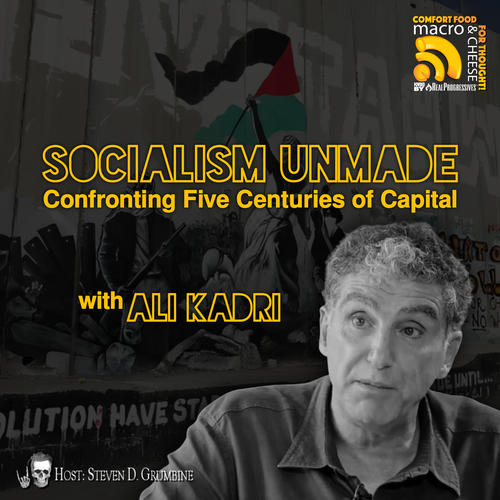
Steve talks with Dr. Ali Kadri, visiting Professor at Sun Yat-sen University. His acaemic work focuses on the political economy of development, imperialism, and the Arab world. He is the author of several important books, including The Unmaking of Arab Socialism.
“…Some are dancing, some are drowning, but in the end everybody’s going to go under.”
Dr. Ali Kadri (Sun Yat-sen University), author of the Unmaking of Arab Socialism1, joins Steve to talk about imperialism, development, and why the Arab world keeps getting put through the capitalist meat grinder. Ali argues that capitalism isn’t just markets and greed. It’s a destructive social relationship. Once you look at it that way, many of the world’s mysteries stop being mysterious: war, austerity, pollution, and mass deaths aren’t accidents that occasionally happen to capitalism. They are outcomes to be monetized.
The conversation moves to imperialism as capitalism in its concentrated, caffeinated, and brutal form, especially under finance-dominance. Ali describes genocide as both direct (bombs, occupation, ethnic cleansing) and structural (avoidable hunger, disease, debt-driven collapse). He frames the destruction of Arab socialist and anti-colonial projects as strategic for empire: control of oil, geography, and the political threat of regional solidarity.
They talk about MMT’s explanation of currency and how the dollar functions as a lever. Ali sees the dollar as power, representing control over global resources and labor. Debt dependence becomes a kind of colonization by spreadsheet.
“If the dollar stops for a minute or for a month or so, then we have people going hungry. And so this is a form of colonization, a form of death by the dollar.”
They close by pulling democracy down from the clouds. Steve suggests bourgeois elections merely deliver a reshuffling of managers for the same system, and Ali produces a simple metaphor: a multiple-choice exam. The choices have been pre-loaded. And in elections, the result is still class rule.
Dr. Ali Kadri is a Visiting Professor at Sun Yat-sen University. He has previously held senior roles at the National University of Singapore and the London School of Economics. His academic work focuses on the political economy of development, imperialism, and the Arab world. He is the author of several important books, including The Accumulation of Waste: A Political Economy of Systemic Destruction; China’s Path to Development: Against Neoliberalism; and The Unmaking of Arab Socialism.
Transkripzioa:
Steve Grumbine:
00:00:43
All right, folks, this is Steve with Macro N Cheese.
I have the pleasure of speaking with a gentleman who I tried to reach out to a year ago, and life just didn’t work out for us. It just was a tough time.
And here we are a year later, and I think that it’s probably better that we waited a year because there’s so much more important things to discuss at this point in time. It’s always important, but, like, nothing better than the present. Right?
And so my guest’s name is Dr. Ali Kadri and he currently teaches at Sun Yat-sen University. His work focuses on imperialism and development, and we are going to talk about that today. His book, The Unmaking of Arab Socialism.
It’s really, really important to the conversation here, but not the totality of what we’ll be discussing. Obviously, with the current regime in the United States, a lot of focus has been placed on what appears to be the uptick of fascism.
But a lot of the stuff that is going on today has its roots in history of US imperialism, US interest abroad, and capitalism as a whole.
And what I want to do today is dig into the tools of empire and how those tools have been used to compromise Arab nations and have been used to terrorize the Global South, where that leaves us today, including some of the imperialist elements that are going on today within Iran even. It’s very important for us to understand the world in which we live.
And the methodological way of understanding that world is not going to be found reading your official news from the governments and so forth. You need to be able to have an understanding of historical and dialectical materialism, which I think Dr. Kadri really, really seems to place his focus on.
So with that, let me bring on my guests Dr. Ali Kadri. Welcome to the show, sir.
Ali Kadri:
00:02:47
Thank you for inviting me.
Steve Grumbine:
00:02:48
Absolutely. I appreciate.
And going forward, I’m just going to refer to you as Ali because, you know, we’re talking and I appreciate you letting me become a little less formal with that. [Yeah] We at Real Progressives, poorly named at this point, we have shifted or changed our focus so radically over the years.
We’ve been an organization now for about 10 years and started during the Bernie Sanders Part 1 movement. And we have just followed the facts where they take us, and it has continued to push us leftward.
And we’ve really shifted some of our focus away from just a pure Modern Monetary Theory podcast and organization to really understanding the depths and the stranglehold that capital has on the world today and understanding the relationships that capital breeds. And, and that’s led us obviously to Marxism and it’s led us to historical and dialectical materialism.
And while we’re new at this, I don’t know of any other way to really understand the world properly. And your work was recommended to us by Jason Hickel when we talked about Gaza and Fadhel Kaboub, who has been on this program many times.
Both of them have been on this program many times. Lastly, had the opportunity to speak with a comrade of yours in Gabriel Rockhill, and we cannot wait to release that. That’s coming out shortly.
By the time this comes out, you will have already heard that podcast. So with that, Dr. Kadri, Ali, can you explain to me just the basics of what capitalism is and what it has done to the world?
That gives us the framework for how we view the things that we view today, the situations, the relationships. How does capital taint our view of everything?
Ali Kadri:
00:04:38
Oh yes. So capital is essentially a social relationship. Capital is a thing, but everything has a subject.
And when we want to study things on their own, they don’t tell us much because they don’t speak. And we need a subject that is related to the thing that made the thing.
And when we look at the situation of the world today, we see a world that is in dire straits, a planet socially decrepit, socially suffering. And we also see a nature that is socially suffering. Most reports say that within 50 to 100 years or something, if we continue on the same path, if we’re still governed by the same social relationship which is capital, we will end up not having the same basis for social and natural reproduction that we have today. So the planet is on a path of self destruction when governed by the relationship of capital. And the relationship of capital is a simple relationship.
Relationships could be friendly, relationship could be amicable, whatever. But the capital relationship is a contradictory relationship.
It’s a relationship that says there is a small group of people, a class that are the personification of a class, that expropriate the wealth that is being produced, which is the social wealth. The issue with capitalism is that wealth is not only the useful things that we see that we use and every day, like spoon or a pen, or something like that, for capital wealth is also so venomous as a relationship that it capitalizes, it turns out of death, out of the death of nature of man.
It commodifies everything, it makes everything into something whose purpose is to sell rather than to be used. And if it produces pollution, it sells the pollution. If it produces war, deaths and war, human deaths and war, it sells the deaths and war.
And it so progressed since 1500. This is sort of circa 1500, around the time when a capital relationship took hold and production relations change.
And what we mean by production relations could mean many things. But essentially we are making things not to use, but to sell, to sell for the purpose of profit.
And so since that time, since 1500, when we started making things to sell for the purpose of profit, that when that production, well, that’s also the relationship change from making things for use prior to capitalism, to making things just to sell, irrespective of use.
And even if we use things, for instance, we all breathe the pollution that is around, but we end up paying for the pollution that is around, either directly through taxes on pollutants, or indirectly through medical bills, etc. And, or so as the world deteriorates, we end up paying so much more as a result of the environmental degeneration of the planet.
So it is a holistic process, an auto-reinforcing process that creates destruction and benefits from the destruction, because the destroyed things themselves, the destroyed lives, the destroyed nature, they are sellable.
And when there is more sale and more commodification, and so on, this relationship which actually is personified in the persons of capitalists, they end up making much more money as a result of the scale and the scope with which the commodification process proceeds.
And we’ve arrived at a point in the history of the planet where it is very difficult to argue that we have a progressive civilization in capitalism anymore.
Because when we take stock of what has occurred since 1500, when we take stock of the death toll in colonial wars, in some estimates between 1500 and 1900, 400 million people perished in colonial wars and nearly half a billion2 perished this century unnecessarily through wars, hunger, and disease which are socially inflicted. Nearly a billion people have perished and also nature has perished.
This is the phenomenon, this is what we experience, what we see out there, the broader picture, which is the reality that we live in, and in light of this reality that is governed by a social relationship, by a seminal social relationship that dominates all other social relationships. Because when things are made for profit, the law of profit necessitates that the rate of profit rises.
And that when the rate of profit has to rise, then the costs have to be reduced all the time.
And the costs get reduced not simply because somebody goes out on the market and he’s shrewd enough to bargain for some cheaper resources, but because there is a class power taking shape in institutions and frames of thought and so on, that pushes towards the cheapening of labor and resources.
And the cheapening is done through wars and severe austerity, especially in the developing world, especially in the third world, where, you know, if you need to cut costs and if you need to take anything from the ground, there are people who live above the ground. And you’re going to negotiate with people to take it.
And what happens is the capitalists, they’ll just indulge themselves in the process of murdering the people who are above the ground in order to lessen their negotiating power.
And still one discovers that it’s not just because we’ve dared to take the cheap copper or the cheap nickel or whatever, because we have destroyed the peoples, the national people, who live above the ground and lessen their negotiating power so that they can set lower prices.
The process of war itself, and the process of austerity itself requires agents, waged workers, waged NGOs and waged educational institutions and armies that are wage workers that use machines to mow down and to basically destroy the humans that are above the ground. And so the destruction of the humans who live above the ground becomes an industry.
And in the process of the chain of industries that the stages that go to making a final product, the first product becomes not the extraction of the natural resources in the grounds, but the extraction of the lives of people that are above the grounds. And this is an area that has been overlooked for a long time. One focus is on oil. Oil is the reason for the war, or something like that.
But oil doesn’t come in outer space where people don’t live somewhere and we take spaceships and take it. It comes from places where people live.
And people must negotiate the price of their resources in order to have better lives when they extract it, and so on. So what happens is the first process of production becomes the extraction of the lives of the people that live there.
The very lives of the people that live above the ground become commodified. And the death of these lives becomes a commodity that is produced through the industry of war deaths in war, human deaths in war.
When we take war or produce through the industry of imposing severe austerity on the peoples of the developing world.
And so if we think of any commodity in its final stage, like an iPhone or something, the first stages of the production of any commodity is a war that has extracted lives before it has extracted the commodity. So the capital relationship, it like any definition, it is lacking. When I start with it is definitions are by definition lacking because you know, they miss so much of the bigger picture. The other side of the capital relationship is the dividing of the masses of the world.
So if it is a social relationship, if it is a social relationship, it is an abstract relationship, but it is a real relationship, because it is like friendship. It’s not tangible, we’re not going to fear friendship, but it exists.
People enter into the institutions of friendship, of education, of learning and some things like that. But they’re also social relationships are relationships of power. Are power relationship associated with classes?
And because they are associated with people, they’re associated with ideas, the power of ideas and the raw power of brute force.
So this social relationship, which is about the expropriation of socially produced wealth, is going to hold concomitantly with the fact that it can divide people, it can make people dislike or hate each other and butcher each other on the basis of whatever identity, whatever thing. And the more people are divided, the stronger is the capital relationship.
And so when we say that capitalism, like its predecessor, the pre-capitalist forms of production, modes of production, when we look at it, we see that it is a class system. There are wealthy people and a huge mass of poor people now in the case.
And so the numbers income or wealth indicators, they’ll tell us that some people have much and some have nothing.
But the reason for that is it’s because the dividedness of the working classes on whatever concocted identity or other attribute takes place, the stronger the dividedness, the stronger is the wealth divide and the income divide. So the capital relationship in its broadest term is this idea that some class have to expropriate the socially produced wealth.
But they do so, and they’re successful only because it creates a chimera that there is no alternative to its mode of life.
And it imposes symbolic notions such as scarcity and so on, to pit people against each other in an endless war of inter-working-class war that in a sense reproduces in a stronger shape the capital relationship that is in control of all the relationships.
And to be sure, this is not too abstract, because to expropriate the socially produced wealth has a very specific numeric indicator, which is the profit rate. And this profit rate as a rate, it’s synonymous to the growth rate, to the economic growth rate, when distribution is taken into account.
So when the rates are positive, time and again when the growth rates are positive, that means the levels of production are exponentially increased. And if the levels of production are exponentially increased, then the consumption of inputs that make this production possible– the land, the people, the resources,
the labor, so on- the consumption of these inputs has to basically be metabolized at a higher rate.
Be consumed in production at a higher rate. So as to produce a higher profit rate. This is the equation that holds the system together.
All this has to be understood in light of the fact that we are producing much death and much death of man and much death of nature– together, we call this man and nature. Together we call them social nature, where man is subject and object in nature, subject and object of capital, but subject in nature.
All this must be re-understood in light of the fact that capital gains so much out of the destruction of man and nature.
It commodifies the destruction of man and nature. So if it makes money out of war. If it makes money out of severe austerity that causes hunger, that causes unemployment and social ills, and so on.
All of this is going to feed into a process where not only the production of useful goods is rising, but the production of the death of man and nature is rising. The levels – the level must be rising exponentially to abide by the law of profit. Which means that we need to cut costs. By cutting costs, we cut lives.
And then we have a cycle which is degenerative, which has so far resulted- because we have to explain the conditions of the planet socially and naturally at which point we are today- in light of some relationship that governs the path of planetary development. And that relationship is the capital relationship. I hope I made myself clear.
Because many people, you know, they think that realization of a commodity, that commodity is sold for a price and consumed is when they buy it from the market. But they’re paying for many other commodities that they don’t realize that they’re paying for. And they’re paying for it with shorter life expectancies for everyone. But more so for the poor, of course, because when the planet degenerates, there is a social life expectancy always relative to the existing times.
Why relative to the existing times? Because time is qualitative. Every point in time refers to a social condition that is different from the conditions prior to it.
And if it is different socially from the condition that is prior to it, it is qualitatively different.
So chronological time has not really much of an interface with the qualitative social changes that occur in society. Because in chronological time, things are homogeneous.
We go 1, 2, 3, 4, so on, and there is no meaning to chronological time unless we take into consideration that time has shifts qualitatively and it is comparable to the previous periods. Takes a lot of calculation. And one must introduce arbitrary measures into the measurements of the differences between one stage in time and another.
The issue is that when we say it’s cutting life expectancy, it’s cutting life expectancy with respect to the specific life expectancy that could be experienced at this time, at this point in time- the now- relative to that point in time, and the development of the productive forces, the development of technology and know-how and human interference and so forth at this specific time.
For instance, the example is prior to capitalism, when natural causes were the principal cause of death, life expectancy everywhere was, you know, in the 30 years or something of the sort. But now life expectancy could be over 90.
And some places we do experience life expectancy, but prior to capitalism, we couldn’t do anything to improve life expectancy in relation to the existing capacities that we had then. We had no technology and so on.
But now we do have technology, but that technology is used to reduce the life expectancy relative to what could be lived.
And the reduction of life expectancy relative to what could be lived is imposed by the relationship of capital for the sake of expropriating the national wealth, for the sake of profits.
And because in the end, if society pays much more in medical costs and so on to support itself, and it does so in a shorter lifespan over the longer period, it’s going to leave much more of the social product to capital than it does for itself. It is a grotesque system, capitalism. We know that it has resulted in the sort of catastrophe that the world is in now.
And if we think about it as a civilizational advance, it is not at all a civilizational advance. Because a civilization, by definition, is about the accumulation of material and spiritual wealth.
If we think of the material wealth that we have produced, much of it is the death of the planet and foreshortened death of man, and so much of that it eclipses all the good things that it has created, all the useful things that it has created, and liaison with the fact that there’s so much destruction of man and nature.
There must be a thought, a cultural development, a frame of thought that is responsible for the reproduction of the negative cycle, the fact that things go from bad to worse on a planetary scale. And this is not about measuring things. Yet it’s about something we all experience and see and know about.
We could measure whether the planet is going to survive 50 years or 100 years doesn’t matter. The 50 years doesn’t matter. We know that it’s just a pedantic approach to things.
Because the monolithic picture, the gigantic picture, is that the world is nearing an abyss, nearing a point of no return.
And so far as the death of man and nature are concerned, and it is this big picture, you know, it’s like the elephant in the room here that is completely forgotten when it’s spoken of, it’s spoken of without the subject, we don’t know who done it. We know that we are social.
And if we are social, we enter into social relationships to make our lives. And we enter into social relationships that are capitalist relationships.
That means we must make things to sell rather than who cares about what kind of use it is. And as a matter of fact, we end up consuming more things that are of disuse to us over the long term than the things that are of use to us.
And so the very thing that is called “consumption” is really the consumption of death and disease and pollution. And these are things that we are going to consume. In the closed system that we are in, nothing we produce doesn’t get consumed.
And if capital commodifies everything, if it totalizes all social relationships, if it commodifies everything, then we are going to be consuming everything. And in this closed system, we will end up consuming all the debris and consuming all the wars and consuming all the death from the wars and so on.
The subject that is missing in the mainstream and conventional thought, they miss the subject. And the subject is not a guy who did things. Whether we put this guy X or guy Y.
If the social relationship that exists, which is the history of thought and the history of culture and the power of the class in which people are born into a class system which, and the class reproduces itself. I, as a member of the working class, what is a class for me? It is for me to, for me as a class to, along with others like me, to reproduce my way of life in better shape if I can. I relate to me and to others. And I relate to the capitalist class. And I relate to nature, because I must work with nature. This is a class.
And the class that is in power, that’s the capitalist class which adheres to the relationship capital. And it personifies the thought of capital. And. And the thought of capital is the thought of a thing.
It is the thought of a commodity, because the commodity governs the whole process of social reproduction. Because if it doesn’t sell, there’s a crisis and everybody is unemployed and so on. So that’s the fetishism of the commodity.
The fetishism of the commodity is a real thing. It is not just a psychological thing. People starve and die because of the cycle of the commodity.
And in that sense, what we have is a situation where this world, which is governed by a commodity and the capitalist class adopts the reason of the commodity and becomes a commodity and becomes a thing. So they are not people, they are things, they think like a thing.
The thing which is the commodity, which is a self-expanding value, I need to sell at any cost because I must maintain a certain average rate of profit and so forth in a globally competitive market.
And so the point is, in such a system which is taking us like we are all riding on a raft down the river which is going to go over the waterfall very soon, some are dancing, some are drowning, but in the end everybody’s going to go under. It is the subject, it is the failure to see that it doesn’t matter if it’s X or Y. These are social relationships.
They are embodied institutions and they govern the way things happen. They order the way things happen. And the way they have ordered things so far is they’ve taken the planet to the genus.
Steve Grumbine:
00:26:35
Very good. I appreciate you taking me through that. I want to pivot slightly to the concept of imperialism. Obviously, a lot has been written about imperialism.
Unfortunately, I see in academia people questioning whether in fact the United States is an empire and whether or not capitalism even exists… Ah, hello? Yes, it clearly does, but there’s a semantic debate within academia to distract people from what is in front of their face.
And when I think of imperialism and, and I look at the Arab countries, in particular Gaza, and watching what occurred there and watching the systematic demolishing, if you will, of Arab culture and Arab lives as a result of this. I think people genuinely don’t understand imperialism. And you do understand imperialism. [I hope so…]
I’m very interested based on what you just said about capitalism and the way that it eats itself and the way that it destroys the system. It doesn’t matter about the individuals and Donald Trump or this or that or the other. It really is a system that creates this stuff.
Help me understand the relationship between imperialism and capitalism and its impact on the Arab world.
Ali Kadri:
00:27:54
If we look at the history of capital and there are imperialisms before the present phase of imperialism, but the present imperialism now is a historical thing, is according to Lenin it started in the early 20th century. And that is when finance commandeered the modus operandi, the way capital works.
So instead of industrial capital getting hold of things and expanding, it’s finance. And finance is about money creating money and the cycle of money.
Creating money is a fast cycle, it’s a high-frequency cycle and detached from the real economic and industrial activity. And then it imposes the rate of profits that it is making out of fictitious capital, out of money-created money onto the real economy.
So if I create so much money, I need guarantees that money. I have a full base in the economy. So what I do is I accelerate or deepen the rate of exploitation.
So imperialism is a sort of a capital relationship that has taken some amphetamines, lots of caffeine or something like this. It’s a hyper case. It’s a concentrated and hyper-case of the capital relationship.
And so the capital relationship is about the expropriation of socially produced wealth.
Intermission:
00:29:15
You are listening to Macro N Cheese, a podcast by Real Progressives. We are a 501c3 nonprofit organization. All donations are tax deductible. Please consider becoming a monthly donor on Patreon, Substack, or our website, realprogressives.org. Now back to the podcast.
Ali Kadri:
00:29:38
This is an accelerated process. So the latest phase of imperialism is the stage in history where finance has commanded things.
But it existed before, but it was commanded by a different class other than the financial class. Now if we look at the capital, we can understand them, we can use them [inaudible] interchangeably, capital and imperialism, as I said, it’s just more concentrated capital. Imperialism is more concentrated.
So if we look at the history of imperialism or capitalism, we see that it has always been based on genocides, either direct genocides or structural genocides. If, when we are speaking now, there isn’t a genocide, the genocide in Gaza is still ongoing, at slower rate, but still ongoing.
But we are witnessing a horrific death toll in Sudan and a horrific death toll elsewhere.
There is another horrific structural genocide, a structural genocide the ones that we don’t see, the ones where we do have the wherewithal and the means to alleviate the suffering of many people in hunger and so forth. But we don’t do anything and we inflict a tremendous death toll on many people daily because of that. And this is the structural genocide.
So genocide, either in structural form or in direct form, is not alien to capital. It is embedded in capital.
And more so than any other phase in history, and differently from any other phase in history because capital is governed indirectly by the commodity, by the fetish of the commodity. So society doesn’t really control fate. It is a thing that society has created that controls it.
And that thing, the commodity that society has created which controls the fate tends to expand at a higher speed when that commodity is death, the death of nature or the death of man. So if the commodity, which is useful, which was thought of as useful in the old days, governs the plight of society it’s useful, it has…
It’s going to cut cost, but there’s something useful that’s going to come out of it. But if the death of man and nature are the commodities that are governing the process of social reproduction, then we have something which everybody should see, that death governs life under capitalism. And so imperialism is just this stage of history where the financial class is going to intensify the genocides, they intensify the structural genocides and the direct genocides in order to achieve higher rates. By structural genocide. I mean if we come to for instance to 4 or 5, I don’t recall exactly, there’s a child under 10 that is unnecessarily dying from hunger at this very moment. But that’s in the thousands every day.
And so there is built into the system is this process where relationship of capital which is led by the commodity as self-expanding value. And that commodity is a fetish that mesmerizes the minds of capitalists and hypnotized is them into becoming things themselves.
Things that don’t feel, that don’t have a sense and it’s not sentient. They don’t have the morality of people. They have the morality of things. And the morality of things is amorality.
It doesn’t have a sense of justice and a sense of right and wrong and so on. So we have a system of capitalism, is that so the genocide is not an aberration of the system.
The genocide is the basic process is the main base that produces capital and the capital relationship and it governs through the higher rate of premature death which is genocide, killing, a premature death of man and nature.
Now in the Arab world, which is a significant part of the developing world of the third world in the post-colonial era with pan-Arabism and Arab socialism and so forth, there was just like the rest of the developing world. There were policies that lifted many people from poverty and raised the levels of production, raised development of the productive forces.
And we had like illiteracy of 90%, 95% and you have 90 or 95% in the two decades of the post-independence period. At that time the Arab world was…
And it’s not by coincidence that Che Guevara, for instance, says when Nasser was the president of Egypt, we take our orders from Cairo and the [inaudible] on Nasser was a pillar in the [inaudible]. So the Arab world, it ties the African continent and the Asian continent together. And that’s where the bulk of the international proletariat is.
So the destruction of the Arab world is pivotal to capital and to imperialism for two reasons. For that reason and for the fact that it has a huge supply of oil.
And a huge supply of oil is going to require, as I said earlier, the extraction of oil require the extractions of the lives of people that lived above the oil. And so what we see is not an aberration, but actually a continuation. And in this case, the Zionist settler state of Israel is the bridgehead.
It’s spearhead. It is the front guard of capitalism. In fact, early documents preceded the rise of the position of the state of Israel in the Arab world.
The Zionist leaders argued that “We will safeguard Western civilization,” and Yiddish folk who said, “The Jews are almost white and they’ll serve us well in that part of the world.” That sort of language despicable was hated before the assertion that a state should be created in the Arab world as settler state.
So we have all that in mind. And then of course it was Palestine splits the Arab world in half between the Western and it splits Asia from Africa as well.
It doesn’t split just the other world, it splits Asia from Africa. It’s the bridge you have.
And it is a case of continued aggression against people who were poorly armed because the level wouldn’t come out of from under the colonialist yoke. You come out with nothing. It becomes a story of a musket against the bow and arrow. So the Arabs held the bow and arrow.
And the result is such that I read some figures on the result from the War on Terror in this region since 2000. It has resulted in some 4 or 5 million deaths so far. So the death rate is huge.
And of course, if one considers the dislocation rate, the depopulation rate and so on, because the wars also combine severe austerity policy, I always recall.
I guess people will say that “There isn’t an imperialism,” or something, that at one point, around the 2007, 2008 crisis, Bernanke I think, he lowered the interest rate and the equity market wasn’t performing that well.
Institutional funds went to the commodity market and as a result of that, the price of commodities began to rise because the commodity market couldn’t absorb all these huge funds that are coming to speculate on the few commodities there are. And so the price of wheat, I think, grows three folds, three times. And there was for some countries where much of the income goes on buying food.
I think in Egypt, I read the article that says that people were scared that there’s going to be scarcity in bread. And there were scuffles before bakeries at the time, and some were injured or died as a result of the scuffles.
So basically banking lowers the interest rate. Some people get hungry and die.
So imperialism is really an international system, a universal system where the command is the command of the financial and financial class does its best to maintain its privileges and its profit rates.
Steve Grumbine:
00:38:18
Okay, so with that in mind, what is the role of the US dollar in this system that the finance capital leverages?
One of the things I read previously, which goes along lines of our understanding here at the podcast of Modern Monetary Theory, the sovereignty of currency, the ownership of the currency and knowing that states produce their own currency.
And when you think of the United States and its hegemony throughout the world leveraging the dollar, it has used that to great precision to maintain its control. Though that is cracking as we speak. We see some signs of a multipolar world growing out of it. But let’s be fair.
Much of this is a direct result of the ability to enforce through military means, through war, through control, through debt.
What is your understanding and how do you see the relationship between what has happened in the Arab world and our understanding of capital through the use of dollar hegemony throughout the world?
Ali Kadri:
00:39:26
The dollar hegemonizes the whole world, not just the Arab world.
And the Arab world is a severe case of dependency on the dollar there because of the indebtedness of many states which don’t have the fiscal and external trade position that allows them the leeway to cover their expenses.
So in states that are indebted and have to borrow every month additional money to service their debts, and there isn’t a socialist, some emerging ideology that’s going to fight the dominance of the dollar. There aren’t any political organizations radical enough and committed to the fight against imperialism.
And so this implicates the consciousness of the masses.
The masses realize that they live mouth to mouth, day to day because of the disbursement of some additional dollar cash that is going to basically service the debt to maintain the stability of the national currency so that there isn’t inflation and they could buy the same amount of food tomorrow, the same amount of money. And that implicates, in the absence of alternative ideologies and alternative radical organization, that implicates.
But the fact that there’s a social circumstance, this social circumstance of dependency on American friends that is going to implicate the social consciousness of the Arab masses. And this is one of the biggest… I think it is a serious problem and study about the rise of consciousness.
Now, as to the dollar, you know, money is the ultimate fetish. And that fetish is a symbol that is created by class power about any diffuse by all of your calls like this with class power for a specific reason.
There is an order in the rationale for creating the dollar as a symbol of power. If it is based on power, then the extension of power and the retrenching of power re-establishes the dollar.
So in a sense, when we look at the collateral affair, money, it is power and not power in the absolute and all in the abstract. Power over resources, power over the planet, hegemonizing the planet. So essentially money is borrowing…
So if you lend somebody money, they have to go work for a few hours and then pay you back, or for a few days, or for a few months, pay you back.
Now, if you control the planet, if you hegemonize the planet, if you have power over them and you control and hegemonize the planet, then you can actually take the work and resources of all the planet.
In the future, if that area shrinks, if China rises and Russia closes upon itself and Brazil starts trading directly in its currency with China, and so on and so forth. There is a lesser space to hegemonize. There is a lesser power of the United States. And therefore there is a weaker dollar.
Now, when you issue the dollar, you issue debt.
But if you have enough power as collateral, power over commodities, power over people, power over the future of the labor of people and all that, because that’s what hegemony means, then no matter how many dollars you receive, you guarantee a future hold on resources and labor that is going to pay back the debt that you have received. Now, with the rise of China and so on, there is the power. The hegemony over the globe is less and less for the United States.
And therefore the aggression is heightened. There is a higher aggression. And the Arab world has also this inertia from the past.
In an inertia of wars and calamities, it has experienced reverse development. It went from bad to worse. All the indicators of the Arab world.
Africa also, but to a lesser extent, because the Arab world had, in the post-war period, had developed its collective forces to the point of some states having autonomy and sovereignty over food and over manufacturing capacity and so on.
So you have a world that is fragmenting, that is dividing and that is dependent on rent for its day-to-day sustenance, such that it has this inertia to carry forth with more wars and more austerity.
And in the absence of revolutionary consciousness, the forms of resistance don’t always result in victories that incrementally accumulate along with the international plight of the struggles of the proletariat into something sustainable. It has people who are resisting because resistance is natural to people who are oppressed. They must resist this, by definition they’re going to live from day to day, so they have to resist.
But when the program that charts the resistance path is not radical enough to target the capital relationship, which is synonymous with the private property relationship, then the end result would be a compromise that benefits more the aggressors than the working classes of the Arab world. There is a crisis of ideology, of revolutionary ideology in the Arab world. Also everywhere.
But it is just not confined to the Arab world here than in any other place around the planet. But there is a crisis of revolutionary ideology. There is a crisis of adopting the socialist alternative to develop.
And there’s also a crisis of the level of sacrifice required to overturn things.
Part of the reason, of course, is not just military power of the United States stationed everywhere around the world and could potentially decimate anyone. Part of the reason, is also just as important, is the fact that there is a dilution of revolutionary thought.
You mentioned comrade Gabriel Rockhill and he talks about the role of Western Marxism and he talks about the role of Western institutions and corrupting Marx, in short, and making sure that it aborts revolutionary thought.
And this is not only confined to the Western hemisphere, also in the South, because the North has the luxury of producing intellectual work and so on. It implicates and it inflicts the damage on the South as well.
So you have many of the intellectuals that borrow from the Northern Marxist, Western Marxist sources of thought. They tend to also thin down the level of sacrifice that is necessary to overturn things.
But still, in the Arab world there are many forms of resistance. Some are socialist in nature, some are Islamist, but open-minded Islamist, but whole Islam is quite heterogeneous.
And so you have open-minded Islam that confronts imperialism in all cases.
A class cannot be detached from its cultural guise and form because in the end, class is the traditions and history and knowledge that is encapsulated in the social culture of people and so on. It’s natural for every society to enroll its large resistance in some cultural and traditional form.
And Islam is and Arabism are the forms and the traditions of the working classes in this area. One in Latin America it would be Farabundo Marti, so on. So when imperialism is such is the weight of history.
It is the accumulated power of five centuries of victories of the Western Hemisphere, five centuries of the victory of the civilization of capital and the power of capital. So the historical surplus value and surplus value is a relation. It’s a relation of expropriation value.
By the finishing observation of expropriation, value is the atom of the capital relationship. The capital relationship is an application as a magnification of the value relationship.
And the value relationship is about the contradiction between use value and exchange value, private exchange value and use value, which is usefully social, social. And this contradiction is what needs to be understood. And the process is very difficult. The process of resistance is very… There is resistance.
And just to make a long story short, the one backs in light.
When we faced with the wake of history, that is the wake that Western civilization, America knew we need to gather all the forces in a national liberation war, because it is still a national liberation. We are colonized not by soldiers on the ground, but by the dollar.
If the dollar stops for a minute or for a month or so, then we have people going hungry. And so this is a form of colonization, a form of death by the dollars.
And so we need to gather all the forces, all the different forces to fight this megalith, this huge power, which is the American power, its cultural and military power. And that requires a mobilization of all the forces that are opposed to it. And then resistance, as I said, is natural.
We’re going to have resistance all the time. It’s not going to die out.
But the point is to set resistance on the right path and to set the bar of the level of sacrifice required for change to overturn things at a higher level.
Because what is required to turn things is not just the resistance in the developing world and in the Arab world, but also mobilizing the forces that are going to back this agenda in the Northern Hemisphere.
Steve Grumbine:
00:49:26
You know, it brings to mind, and I want to take us out on this. One of the larger concerns is that there is not a revolutionary thought going on.
Much of that Western Marxism has clipped that away, clipped away class struggle. And many of the people trying to buff the edges off of capitalism and they believe in electoral systems that are not there for us.
They are institutions of the hegemon. They are institutions of the elite.
You know, Gilens and Page at Princeton in 2014 did a study that showed that the desires of working-class people have a statistical near zero impact on any legislation whatsoever.
Which has brought me to a point where I believe that the electoral system within this capitalist system within, in particular within the United States, I can’t speak to the rest of the world, but within the United States it is like a closed loop that takes you back to the same demon that was killing you before. And none of the things that we’re talking about seem to change at the ballot box.
And without a revolutionary spirit, without people organizing outside of that process, none of this is going to change.
It’s going to be a whole lot of slapping people on the back and saying, “Nice job, we gave it the good try” and so forth like somehow or another, by divorcing class struggle and divorcing history of the revolutionary party, a Leninist revolutionary party, things of that nature, that we are basically walking in circles. And nothing will fundamentally change except the continuation of capital domination.
Can you speak to the very essence of democracy within a capitalist society and whether or not the theory of revolution and a revolutionary movement needs to occur in order to address this?
Ali Kadri:
00:51:26
Yes.
When I wanted to explain how voting and democracies work and things like that, because I used to teach a first-year course, early on, and that was associated with 300 students. And the way to correct exams was to give the multiple-choice questions and they get to vote between 1 and 2 or 3, 4, 5, whatever.
But let’s say 1 and 2. And then what I have put into their hands as a teacher, the textbook, what has put in, is going to basically come out on paper.
So they’re going to vote for one or two. And one or two are practically the same. Just to say what went into their hands, went into the paper.
So the democratic process, democracy is a form of governance. It’s a form of power. It’s how power is exercised through democracy. And the power is also ideological power.
So when we have blinded people into a binary choice between A and B because of what we’ve indoctrinated people with. And that’s what we’re going to get in the end.
Thought is going to be transcribed on paper and the thought is corrupt, then the result is going to be corrupt, and the thought is unnecessarily corrupt because the people who create the thought and indoctrinate people make sure that the only thought that goes into people’s heads is the choices that are going to make them worse off while there is not… A philosopher would say that by drilling in the idea that “There is no alternative.” So this is what we see.
There is basically ideas. Ideas and thought are not abstract. They are also materialist forms. They are based in materialist reality.
And materialist reality and thought are one and the same. So what we have is thought, thought that we’ve sold in people’s minds.
So as a form of power exercise, democracy becomes the class that is valid, exercises power through the democratic channel. But democracy as such becomes bourgeois democracy.
It’s democracy for the people who could produce the thought, make people believe in the thought that they produce, and then get them to do what they want. But the fact is that there is also proletarian democracy. A democracy that says that there is no such thing as scarcity.
Scarcity is an imposed symbol of power by the capitalist class. And we need to take back what we’ve produced. We produce everything, so we need to keep everything. And that’s what the working class does.
It produces everything and it should keep everything. The working class is actually society. Society is just the working class. But it has to have a revolutionary potential.
Because let’s say we have a worker whose potential is to imprison another worker, like a police officer. And that class and the likes is just a personification of capital. It has no revolutionary potential.
It might earn a wage, but its wage is part of the rent that is shared by the capitalist class.
The working class, on the other hand, is the majority that’s going to survive in better shape and form day after day, if it is unified and struggles and it demolishes the symbols of capital, the fetishes of capitalism. It questions everything.
Now, from what I know is the far Right also questions, plays on the disquietness in the spirit of the working, that they don’t trust politics and so forth. But at the same time, the far Right is capital incorporated.
It’s capital incorporated because it splits the working class on the basis of race and it becomes capital incorporated.
Because the reproduction of the capital class gains a higher speed as a result of the war of one inter class war between working people on the basis of race or color or ethnicity or something like that. So the very act of death becomes the commodity from which capital earns the most.
Because the rate of profit as a result of the death is highest, because it shortens life. And that’s been used before. The half-truth about fascism is always there. “I am for the worker, but I’m only for a specific type of worker.
And if that specific type of worker demolishes and murders another worker, all the best for me, because the very act of murder is the industry I want to see and the industry from which you’re going to make money.” Aside from the other industries of cars and people, the industry of death is the biggest industry ever happened.
And so a way to basically rework in the minds of the imagination of the working class a distorted view in the developing world the very idea of democracy, sometimes because it’s used by the imperialists, because there is a cultural- the war also takes a cultural form. Peoples, they are loath to this voting-booth democracy because they see that no matter who comes into office in the United States is going to be another warmonger. But that doesn’t mean there isn’t any discussion.
And a consensus that is generated because it’s very easy to generate a consensus from people who are suffering from the same, from the wrath of the same imperious cause and the wrath of its policies. We see it in many forms.
And also because the colonial settler state of Israel is the last colony on the planet, the last colonizing force on the planet. It is present and it’s present in actual form.
And so people to not only experience the abstract but real pressure of imperialism, but they also experience it directly through the military bombardments and the genocide and so forth. So a consensus could be easily reached that an anti-imperialist position is the foremost democratic practice. And it’s popular democracy.
It is the democracy of the working class.
So democracy has to be qualified by the joint term, “bourgeois democracy,” “working-class democracy,” that it shouldn’t be left in the abstract because like freedom, that means nothing in the abstract.
Steve Grumbine:
00:57:45
Very good. Dr. Kadri, Ali, I really appreciate your time today. This has been incredible.
I would love to have you back on because there’s so much more I want to ask you about, but we are out of time. Can I ask you if there was one thing you’d like to leave our listeners with, what might you leave them with?
What would be an important thing that maybe we didn’t cover or perhaps even a point of emphasis for what we did?
Ali Kadri:
00:58:10
Yes.
Just one thing which amazes me, something which befuddles me, and that is why is there something so obvious like planetary, social and natural degeneration, and yet no one asks who done it? And if they do say who done it, they always pinpoint to a guy or one person as if they personify history.
Why is there such personification of history when history is really impersonal? It is this social process was wholly impersonal and objectives, we are born into it. It’s that existed there before us and yet no one sees that.
And that’s a question I’m breathing into at this very moment. I’m hoping to find an answer. I think everybody tried and didn’t. And I’ll be one of those too. That’s what I’m doing now. Thanks for the invite.
Steve Grumbine:
00:59:02
Very good. Absolutely. I really mean this from the bottom of my heart.
I really hope now that we’ve established contact, that I can have you on again because you’re a beautiful mind. I really appreciate the time you gave us here. It means a lot. It means an awful lot. And I want to say this also.
There’s a tall barrier to understanding some of this theory. It’s said in jargon. It’s written in very academic ways that average working-class people may find difficult to access.
And I’m hoping that we serve as a bridge between academia and the working-class people that do listen to our podcast.
And perhaps even for those academics that don’t really relate to Marxism or don’t relate to the struggle here, perhaps they may modify their worldview as well. So with that, thank you Dr. Kadri, for joining me today.
Folks, my name is Steve Grumbine. I am the host of the podcast Macro N Cheese and also the founder of the nonprofit Real Progressives. We are a 501c3 non for-profit institution that survives literally on your donations. We are all volunteer, so it pays to keep us going.
And we’re small, but we think our mission is mighty. So if you think that there’s value in what we’re doing, please consider becoming a monthly donor. You can go to patreon.com/realprogressives.
You can also go to our Substack Real Progressives. And you can also go to our website realprogressives.org and become a donor there as well.
We will be updating our website and our bookstore with Dr. Kadri’s books. Please consider getting them, they’re very good. And please listen to as many of his lectures and Q&As that you can find on YouTube and podcast.
He is an amazing resource and with that, Dr. Kadri, thank you again for joining me today. And on behalf of the podcast Macro N Cheese and the nonprofit Real Progressives, we are out of here.
End Credits:
01:01:07
Production, transcripts, graphics, sound engineering, extras, and show notes for Macro N Cheese are done by our volunteer team at Real Progressives, serving in solidarity with the working class since 2015. To become a donor please go to patreon.com/realprogressives, realprogressives.substack.com, or realprogressives.org.
oooooo
Gehigarriak:
Trumpism as the American Thatcherism
August 12, 2025
Some call it Trumpism, a shorthand for this moment, just as Thatcherism and Reaganism personified the neoliberal onslaught of the 80s. But this isn’t just about one man. It never is.
ooo
Trumpism as the American Thatcherism
August 12, 2025
Does the tired spectacle of electoral politics make your eyes roll? The carefully staged Truman Show where citizens are duped into believing their participation matters? The US is a masterclass in manufacturing consent, a well-choreographed farce where politicians prattle on about solving problems they have no intention or ability to fix. The performative outrage, the catered sit-ins, the hollow filibusters (looking at you, Cory Booker), the grotesque photo-ops of kneeling politicians in kente cloth (that infamous act of cultural cosplay by Pelosi and Co.) – it’s all theater. It is designed to keep us distracted and yapping about manufactured crises while ignoring the atrocities unfolding around us: the funding of an ongoing genocide, the Zionist project’s land grabs, Israel’s near-completion of its ‘final solution’ to the ‘Palestinian Question.’ Indeed, the examples are global, from debt slavery and forced privatization of water in Africa to funding state terror in Latin America.
And at the center of the current circus stands Donald Trump – not as an aberration, but as the logical conclusion of a decades-long capitalist project. Some call it Trumpism, a shorthand for this moment, just as Thatcherism and Reaganism personified the neoliberal onslaught of the 80s. But this isn’t just about one man. It never is. It’s about the system that produced him – a system in its death throes, lashing out with increasing desperation.
The Unitary Executive and the Ratchet Effect
Trump’s presidency didn’t emerge from nowhere. It was the inevitable result of the bipartisan neoliberal ratchet where each administration, whether draped in progressive platitudes or right-wing bluster, pushed policy further toward corporate oligarchy. Obama expanded the surveillance state and deported more immigrants than any president before him. Bush bailed out Wall Street while working-class families lost their homes. Clinton dismantled welfare and turbocharged mass incarceration. And Trump? He just says the quiet part out loud.
His brand of authoritarianism – racist, xenophobic, and anti-labor in practice but faux-populist in rhetoric – mirrored Thatcher’s union-busting and Reagan’s war on the poor. As David Harvey, the Marxist geographer, put it: “Capitalism never solves its crises. It just moves them around.” And under Trump, exacerbated crises have landed squarely on the backs of workers: wages are stagnating, rents are skyrocketing, and the executive branch is amassing frightening new powers.
The Myth of Inevitability and the Reality of Revolt
Marx and Engels once wrote that socialism was inevitable; capitalism’s contradictions would eventually force its collapse. But later Marxists, like Antonio Gramsci, warned against blind faith in historical destiny. “The old world is dying, and the new world struggles to be born,” Gramsci wrote from his fascist prison cell. “Now is the time of monsters.”
And what are Trump, von der Leyen, Starmer, Macron, Milei if not the monsters of this dying order? They preside over a world where the cost of living strangles workers, where entire generations are locked out of homeownership, where healthcare is a privilege, and where genocide is funded without hesitation. The Palestinian struggle lays bare the hypocrisy of Western “democracy” – the same politicians who kneeled for photo ops with Black Lives Matter went on to send billions to Israel’s war machine.
Rupture
Revolutions occur when people are pushed past the brink. When rent consumes 80% of a paycheck. When a single hospital bill means financial ruin. When parents skip meals so their kids can eat. Trumpism – like Thatcherism and Reaganism before it – is accelerating that process.
The ruling class knows the tide is turning. That’s why they’re militarizing police, criminalizing protest, and tightening their grip on power. But as Rosa Luxemburg warned: “Bourgeois society faces a choice – socialism or barbarism.” We’re already living the barbarism: in food lines that stretch for miles, in cops murdering with impunity, in bombs dropping on refugee camps.
The question isn’t if the working class will rise, but when. Because history doesn’t belong to the billionaires, the politicians, or the media hacks who spin their lies. It belongs to the rank-and-file workers – the ones who keep the world running while the exaggerated decadence of the elites reaches new heights of absurdity. Trumpism is just another name for a collapsing system. And when it falls, it will be at the hands of the people – not by voting but by seizing control of a world that is theirs to rebuild.
oooooo
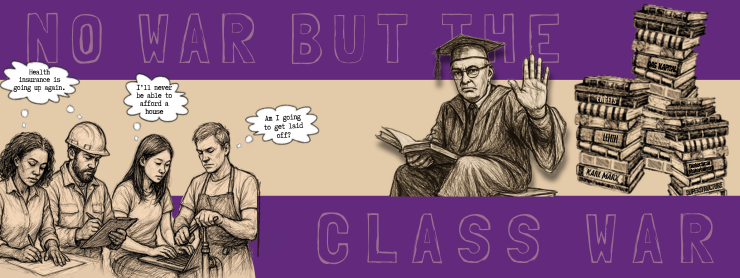
The High Intellectual Barrier to Socialist Consciousness
September 14, 2025
If socialism is to be a mass movement, it must speak in the language of those it seeks to organize.
(In Gramsci eta kontrairaultza)
oooooo
1 Ikus The Unmaking of Arab Sozialism: https://library.oapen.org/bitstream/handle/20.500.12657/30666/644214.pdf?sequence=1&isAllowed=y.
2 1 amerikat bilioi= mila europar milioi.


