
January 26, 2026
Gaza. Le conseil de sécurité de l’ONU contre le droit international
(https://orientxxi.info/Gaza-Le-conseil-de-securite-de-l-ONU-contre-le-droit-international)
ONU contre le droit international
Prof. Rafaelle Maison, Paris
La tentative d’effacer le droit applicable en Palestine se prolonge dans la résolution 2803 du Conseil de sécurité. Adoptée le 17 novembre 2025 par 13 voix favorables, en dépit des abstentions russe et chinoise, ce texte est contraire au droit international. En conséquence, les États membres des Nations unies ne devraient participer ni à la « force internationale » ni au « conseil de paix » prévus par l’organe politique de l’ONU.

Washington, le 29 septembre 2025. Le président états-unien Donald Trump et le premier ministre israélien Benyamin Nétanyahou examinent le plan de paix pour Gaza, lors d’une réunion bilatérale dans le Bureau ovale.
Daniel Torok / Photo officielle de la Maison Blanche / Flickr
Orient XXI
Gaza. Le conseil de sécurité de l’ONU contre le droit international
1:01 / 16:49
Washington, le 29 septembre 2025. Le président états-unien Donald Trump et le premier ministre israélien Benyamin Nétanyahou examinent le plan de paix pour Gaza, lors d’une réunion bilatérale dans le Bureau ovale.
Daniel Torok / Photo officielle de la Maison Blanche / Flickr
Conférence de San Remo. Une base légale à la création d’un État juif en Palestine ?
En 2024, la Cour internationale de justice (CIJ) a considéré qu’Israël, ayant violé des normes impératives de droit international (normes dites de jus cogens1), devait, sans négociation, se retirer du territoire palestinien occupé, démanteler les colonies, et réparer tous les dommages causés par son occupation illicite. La CIJ a aussi rappelé que tous les États devaient prendre des mesures aux fins de forcer Israël à ce retrait et de prévenir le génocide de Gaza. Le retrait d’Israël, attendu pour septembre 2025 selon la résolution de l’Assemblée générale du 18 septembre 2024, ne s’est pas produit, et rares sont les États ayant adopté le comportement qui était exigé d’eux face au génocide de Gaza.
À l’inverse, une initiative diplomatique franco-saoudienne a cherché à convaincre de revenir aux méthodes éculées de la négociation, en soutenant l’émergence d’un État de Palestine diminué : c’était la déclaration de New York, endossée par l’Assemblée générale le 10 septembre 2025. En marge de cette Assemblée générale, le président états-unien présentait son plan pour Gaza. La première étape, la seule acceptée par les groupes combattants palestiniens, a conduit à un cessez-le-feu — non respecté par Israël —, à la libération des Israéliens détenus à Gaza et de plusieurs centaines de prisonniers palestiniens détenus par Israël. Ces derniers, comme les dépouilles des Palestiniens restituées, ont confirmé l’infliction de sévices particulièrement choquants.
Alors que le plan Trump était approuvé par de nombreux États lors de la conférence de Charm El-Cheikh du 13 octobre 2025, les États arabes ou musulmans sollicités pour participer à la force internationale envisagée demandaient qu’un mandat de l’ONU vienne autoriser cette participation. C’est pourquoi les États-Unis ont saisi le Conseil de sécurité de leur plan, alors même qu’ils avaient, pendant plus de deux ans, empêché cet organe de réagir au génocide de Gaza, en utilisant leur veto de manière récurrente.
Le Conseil de sécurité ne dit pas le droit
Est-ce à dire que la résolution 2803 où le Conseil « fait sien » le plan Trump, qui y est annexé, efface et remplace le droit international applicable ? En réalité, le Conseil de sécurité n’a pas pour fonction de dire le droit international. Selon la Charte des Nations unies, il est responsable du maintien de la paix et de la sécurité internationale (article 24) et exerce ses pouvoirs selon les chapitres VI et VII. Sur la base du chapitre VII, il peut décider de mesures s’imposant aux États et, le cas échéant, autoriser l’emploi de la force pour réagir à une situation de crise grave. Il agit par des résolutions spécifiques, dans des situations données, dans l’objectif de maintenir ou de restaurer la paix. Il ne légifère pas plus qu’il ne tranche, en droit, des différends. De plus, le Conseil ne peut pas adopter n’importe quelle décision, dans n’importe quelle situation, et il doit « agir conformément aux buts et principes des Nations unies » (article 24 §2).
Abonnez-vous gratuitement à la lettre d’information hebdomadaire d’Orient XXI
Haut du formulaire
Bas du formulaire
La question du contrôle du Conseil de sécurité, c’est-à-dire du contrôle de la légalité de ses résolutions, a été au centre de l’attention internationale, notamment à partir des résolutions adoptées contre la Libye à la suite de l’attentat de Lockerbie en 19882. Elle a été discutée devant des juges variés s’agissant de la situation dans l’ex-Yougoslavie (Tribunal pénal pour l’ex-Yougoslavie), de la lutte contre le terrorisme (Cour de justice de l’Union européenne), de l’intervention en Irak de 2003 (Cour européenne des droits de l’homme). S’il reste difficile de faire contrôler cette légalité, les juristes savent que ce n’est pas impossible. Dans un monde idéal, l’Assemblée générale pourrait par exemple saisir la CIJ afin qu’elle examine la conformité de la résolution 2803 à son propre avis de 2024. Mais l’année 2025 nous a appris qu’il ne fallait pas trop attendre de l’Assemblée générale.
Mettre en évidence l’absence de respect des normes impératives du droit international par le Conseil de sécurité est simple : s’agissant de la Palestine, ce droit vient tout juste d’être rappelé par l’organe judiciaire principal des Nations Unies qu’est la CIJ. C’est également utile : les États ne sont nullement tenus de contribuer au plan d’occupation de Gaza soutenu par le Conseil de sécurité, la résolution ne faisant que les y « autoriser » ou le leur « demander ». Ils pourraient vouloir éviter de contribuer directement à la violation de ces normes impératives par l’envoi de contingents à Gaza. Cette illicéité imprégnerait aussi toute l’activité économique espérée par Trump et ses proches : les contrats et accords passés en ce sens devraient être considérés comme nuls, et les entreprises y contribuant devraient être boycottées. Au Conseil de sécurité, la Russie a explicitement évoqué cette illicéité et mis en garde les États ayant voté pour le texte3.
Une force d’occupation
La résolution autorise tout d’abord les États à déployer des contingents à Gaza. Ceci, en soi, n’est pas inédit, le Conseil ayant régulièrement, depuis 1991 et la première intervention états-unienne en Irak, recouru à ce procédé d’autorisation d’emploi de la force donnée à des États. Soulignons que ce procédé n’est pas celui des opérations de maintien de la paix, où des casques bleus sont déployés, sous l’autorité de l’ONU, sans avoir pour mandat de recourir à la force. Ici, il n’est pas question d’une opération de maintien de la paix, et c’est bien ce qui semble avoir dissuadé nombre d’États de participer directement à la « force internationale de stabilisation » autorisée par le Conseil. De quoi est-il donc question ?
Il s’agit principalement de réaliser ce que l’armée israélienne n’a pu accomplir : assurer « la démilitarisation de la bande de Gaza, y compris en procédant à la destruction des infrastructures militaires, terroristes et offensives et en empêchant qu’elles soient rebâties, ainsi qu’en veillant à la mise hors service définitive des armes des groupes armés non étatiques ». Il est question de désarmer les groupes palestiniens combattants donc et, selon les termes du plan Trump annexé à la résolution, de « déradicaliser Gaza ». Cette mission, qui exige l’emploi de la force dès lors que les groupes palestiniens n’ont pas accepté de rendre les armes, doit être réalisée « en consultation étroite » avec l’Égypte et Israël. La force internationale de stabilisation doit en conséquence être considérée comme une force d’occupation associée à Israël. Or, on l’a dit, le contrôle du territoire palestinien par Israël a été tenu pour gravement illicite par la CIJ, car portant atteinte au droit impératif du peuple palestinien à disposer de lui-même. Contrairement à ce qu’a demandé la même CIJ, la résolution permettrait à Israël de ne pas se retirer.
Une occupation qui ne dit pas son nom
Le contrôle de Gaza est nécessaire pour mettre en place une sorte de gouvernement (« une administration transitoire »), sous l’autorité d’un Conseil de paix, qui serait selon nous, mieux dénommé « conseil d’occupation et de spoliation ». C’est le deuxième aspect essentiel de la résolution. Ce conseil aurait pour vocation d’« œuvrer à la reconstruction de Gaza et à l’exécution des programmes de relèvement économique ». À cette fin, le Conseil de sécurité dote l’instance d’une « personnalité juridique internationale » lui permettant de conclure tous accords ou contrats. La Banque mondiale, une institution dominée par les États-Unis, est invitée à faciliter les financements du programme. Dans le langage non euphémisé du document Trump annexé à la résolution, le plan de relèvement économique
sera élaboré par un groupe d’experts ayant contribué à la naissance de villes prodigieuses parmi les plus modernes et prospères du Proche-Orient. Nombre de projets d’investissement intéressants et d’idées de développement prometteuses émanant de groupes internationaux animés de bonnes intentions seront examinés, le but étant d’élaborer un cadre régissant à la fois les questions de sécurité et les questions de gouvernance qui soit à même d’attirer et de faciliter des investissements générateurs d’emploi, de débouchés et d’espoir pour la future Gaza.
Afin de réaliser ce plan, correspondant globalement à celui de la « Riviera » annoncé par Trump au début de l’année 2025, le conseil pourra « accomplir toute tâche jugée nécessaire ». Si la résolution n’évoque jamais la question de l’exploitation des ressources naturelles, notamment maritimes, le blanc-seing donné permet de conclure des contrats à cette fin. Ce projet est contraire au droit du peuple palestinien de disposer de lui-même dans ses dimensions économiques, incluant ses choix propres de développement et la souveraineté permanente sur ses ressources naturelles. Les Palestiniens sont relégués à un « comité à caractère technocratique et apolitique … chargé d’expédier les affaires courantes du territoire »…
Soutenez Orient XXI
Orient XXI est un média indépendant, en libre accès et sans publicité.
Vous pouvez nous soutenir en faisant un don défiscalisé.
Certes, l’administration est dite « transitoire », mais les perspectives d’autodétermination que la résolution a dû intégrer sont plus que distantes, et encore conditionnées. Ainsi, le conseil œuvrera jusqu’à ce que l’Autorité palestinienne ait « scrupuleusement exécuté son programme de réformes et que la reconstruction de Gaza ait progressé ». Alors, seulement, « les conditions seront peut-être (sic) réunies pour que s’ouvre un chemin crédible vers l’autodétermination palestinienne et la création d’un État souverain ». Qui en décidera ? Washington instaurerait alors un « dialogue entre Israël et les Palestiniens pour qu’ils conviennent d’un horizon politique au service d’une coexistence pacifique et prospère ». L’horizon envisagé est lointain, flou, contraint et, à vrai dire, inaccessible. La référence à un État palestinien est une parfaite illusion. Si le blanc-seing est accordé par le Conseil de sécurité jusqu’en décembre 2027, sans contrôle de l’ONU (points 8 et 10 de la résolution), le système pourrait être prolongé.
Nouveau mandat sur la Palestine ?
Nombre de commentateurs ont analysé cette résolution comme autorisant un « nouveau mandat » sur Gaza. Mais, au moins, le régime des mandats institué par la Société des Nations, ou le régime des territoires non autonomes de l’ONU4, prévoyaient, en théorie du moins, une administration dans l’intérêt des populations locales. Ici, le pouvoir est attribué nommément à un président états-unien qui ne masque pas ses intérêts personnels et dont le gendre, Jared Kushner, a été présenté comme le principal investisseur à Gaza par un autre homme d’affaires, l’envoyé spécial de Trump, Steve Witkoff. Certes, la résolution affirme que ce sont des « États membres » qui siégeront au conseil. Mais le plan Trump annexé est beaucoup plus clair : le conseil « sera dirigé et présidé par le président Donald J. Trump », les autres membres « y compris des chefs d’État, seront annoncés ultérieurement, l’ancien premier ministre Tony Blair en faisant partie ». Le pouvoir est donc donné à un groupe de personnes entendant tirer des profits personnels de l’opération, et ceci est inédit. L’intérêt du peuple palestinien n’est, par ailleurs, jamais mentionné dans la résolution, le « relèvement économique » ne semblant pas le concerner, tandis qu’aucune redistribution des profits attendus n’est envisagée. Le plan Trump évoque quant à lui « une gouvernance moderne et efficace à même de servir la population de Gaza »… et « d’attirer les investissements ».
Par-delà l’occupation prolongée, le dispositif permet donc la spoliation du peuple palestinien, au profit d’une élite impérialiste états-unienne décomplexée. Ainsi, les accords et contrats conclus par le conseil d’occupation pourront être considérés comme invalides : un traité contraire au jus cogens doit être tenu pour nul selon le droit international (article 53 de la Convention de Vienne de 1969 sur le droit des traités). Les accords qui seraient adoptés par l’Union européenne pourraient, par exemple, être contestés devant ses juridictions, comme le furent ceux conclus avec le Maroc pour l’exploitation des ressources du Sahara occidental. La grande majorité des groupes palestiniens et des ONG palestiniennes a d’ailleurs ouvertement dénoncé la résolution 2803 ; seul le Fatah de Mahmoud Abbas, dont la représentativité est largement contestée, l’a acceptée.
L’oubli du génocide
Pour exercer ses pouvoirs relevant du chapitre VII de la Charte des Nations unies, le Conseil de sécurité doit qualifier une situation de crise grave (menace contre la paix, rupture de la paix, acte d’agression selon l’article 39). Comment la résolution 2803 appréhende-t-elle la situation à Gaza ? Alors même que nous sommes en présence d’un génocide qui se prolonge, rien n’en transparait dans le préambule de la résolution. Il est simplement indiqué que « la situation dans la bande de Gaza menace la paix régionale et la sécurité des États voisins »… Or, dans des résolutions antérieures adoptées en situation génocidaire, et autorisant les États à employer la force, le Conseil se réfère normalement à la situation humanitaire. Il n’en est rien ici. Il ne s’agit évidemment pas, comme précédemment, d’un mandat visant à « protéger les civils en danger »5.
Ainsi, le Conseil de sécurité confère à ceux qui ont détruit Gaza, le pouvoir de « stabiliser », désarmer, et développer cet espace. Le principe de responsabilité pour génocide est totalement éludé. La résolution permet la poursuite du génocide, sans même insister sur la situation de la population de Gaza, sauf à exiger sa « déradicalisation » ; à cet égard, elle est également contraire à la norme impérative de jus cogens interdisant le génocide. Elle pourrait permettre d’en effacer certaines preuves.
Le peuple palestinien de Gaza y est décrit comme un ensemble de « personnes », « libres de s’en aller et libres de revenir » ou comme des « habitants » encouragés à rester, auxquels sera « offerte » la « possibilité de reconstruire Gaza en mieux » (plan Trump, point 12 ; résolution point 4 b.4.) car Gaza sera « rebâtie pour le bien de ses habitants » (plan Trump, point 2). Dans « la nouvelle Gaza », les Palestiniens ne sont pas un peuple, tout au plus une population, ils ne sont pas acteurs. Mais ils ne sont pas non plus victimes d’un génocide, même s’ils « n’ont que trop souffert » (plan Trump, point 2).
La résolution du Conseil de sécurité comprend, il est vrai, un volet humanitaire ; ses termes sont toutefois très inquiétants. Car si le Conseil « souligne qu’il importe d’assurer une reprise complète de l’aide humanitaire (…) par l’entremise des organisations coopérant à cette fin, dont l’Organisation des Nations unies », cette reprise peut être conditionnée. Ainsi, elle est assurée « en concertation avec le Conseil de paix » et ne devra pas « être détournée pas des groupes armés ». Cette dernière formule renvoie aux accusations israéliennes contre le Hamas plus qu’à l’accaparement de l’aide par les milices soutenues par Israël. Ainsi, la fin du siège n’est pas exigée. Donald Trump pourra parfaitement relayer les exigences d’Israël : le droit à l’assistance, et l’exigence de permettre intégralement le passage de l’aide humanitaire, rappelés par la CIJ en 2024 et 2025 ne sont pas garantis.
Pressions et chantage
Il faut finalement insister sur les conditions d’adoption de la résolution et du plan Trump qu’elle fait sien. Le Conseil de sécurité affirme d’emblée que « les parties » ont accepté ce plan. Or, cette affirmation est fausse : il est bien connu que les groupes armés palestiniens auxquels le plan a été présenté ne l’ont pas soutenu dans son intégralité. L’acceptation, inexistante, ne peut donc justifier le caractère exorbitant de la résolution. Pire, il est aussi connu que le plan Trump, pour sa première phase, a été accepté sous les menaces habituelles du président états-unien : « Un enfer comme personne n’en a jamais vu s’abattra sur le Hamas », a-t-il ainsi déclaré6. Or, un accord conclu sous la contrainte immédiate n’est pas valide en droit international (Convention de Vienne sur le droit des traités, articles 51 et 52 : la contrainte est une autre cause de nullité des traités) ; c’est probablement pourquoi le Conseil de sécurité doit déformer le réel en insistant sur « l’accord des parties ».
Les conditions d’adoption de la résolution elles-mêmes sont stupéfiantes, par-delà les promesses probablement faites, par-delà les pressions exercées sur certains des États ayant voté la résolution, tel l’Algérie. Les représentants des États-Unis aux Nations unies ont fait échec au texte alternatif présenté par la Russie en menaçant la population palestinienne. Le représentant Mike Waltz affirma explicitement que « voter contre ce projet de résolution, c’est voter pour la reprise de la guerre ». Au regard de l’implication des États-Unis dans le génocide de Gaza, il s’agit d’une menace grave, la résolution étant d’ailleurs cyniquement présentée comme le moyen de sauver les enfants de Gaza. Quelle valeur peut avoir un texte adopté sous la menace de génocide ?
1. Conférence de San Remo. Une base légale à la création d’un État juif en Palestine ?
2. 21 décembre 1988, un Boeing 747 du vol 103 de la Pan Am Airways reliant Londres à New York explose en plein vol et retombe sur la ville écossaise de Lockerbie. L’attentat fait 270 victimes. En 2003, le défunt président libyen Mouammar Kadhafi accepte d’assumer la responsabilité de l’attaque tout en affirmant ne pas en être à l’origine, et verse des indemnités aux familles des victime
3. Par exemple, pour le représentant russe, la résolution « n’est pas sans rappeler les pratiques coloniales et le mandat sur la Palestine (..) qui ne tenaient absolument pas compte des opinions des Palestiniens »… Il conclut que les membres du Conseil « ne pourront pas dire que nous ne les avons pas prévenus », procès-verbal de la séance d’adoption de la résolution, doc. S/PV.10046, pp. 17 et 18. La position de la Chine est similaire
4. Article 22 du Pacte de la Société des Nations : « le bien-être et le développement de ces peuples forment une mission sacrée de civilisation… ». Bien sûr, le mandat sur la Palestine (1922) est spécifique en ce qu’il intègre la déclaration Balfour. Pour une analyse critique, voir notamment Rashid Khalidi, The hundred years’ war on Palestine, Profile Books Ltd, 2020, not. pp. 34-39. … L’article 73 de la Charte des Nations Unies prévoit aussi, s’agissant des « territoires non autonomes », « la primauté des intérêts des habitants de ces territoires ».
5. Voir par exemple la résolution 929 (1994) autorisant le déploiement « force Turquoise ». Elle considère que « l’ampleur de la crise humanitaire au Rwanda constitue une menace à la paix et à la sécurité dans la région » (préambule) et définit le mandat de la force comme « visant à contribuer, de manière impartiale, à la sécurité et à la protection des personnes déplacées, des réfugiés et des civils en danger au Rwanda » (point 2).
6. Callum Sutherland, Time, 3 octobre 2025.
oooooo
January 26, 2026
Trump’s Board of Peace: Can one man reshape global order? | RT panel discussion
(43: 58 m)
oooooo
January 27, 2026
Genocide Memorial Day 2026: Geneva
(https://dezayasalfred.wordpress.com/2026/01/27/genocide-memorial-day-2026-geneva/)
Pax et Iustitia. Peace and Justice in Palestine requires the full implementation of the three Advisory Opinions of the International Court of Justice concerning Palestine, the practical enforcement of the UN Charter in the Middle East, and follow-up to the recommendations of UN Special Rapporteur on Palestine, Professor Francesca Albanese.
The so-called “Board of Peace” is an Orwellian construct intended to perpetuate the subjugation of the Palestinian People and the denial of their right of self-determination as stipulated in Article 1 of the International Covenant on Civil and Political Rights.
Let us not participate in Trump’s peace charade, in the deliberate destruction of language, in the distortion of reality and history through fake news, fake history and fake law.
China and Russia abstained from UN SC Resolution 2803 of 17 November 2025. They should had vetoed it as an aberration. Instead, they should have insisted on the enforcement of the Orders of the International Court of Justice in South Africa v. Israel Case Nr. 192. They should have called for international cooperation in securing the arrest and trial of Benjamin Netanyahu, his former minister of war Gallant and all those participating in the ongoing genocide against the Palestinians.
Trump’s “Board” has nothing to do with sustainable peace, or with any kind of justice — but with subjugation, racism, Apartheid, ethnic cleansing. A better denomination would be “Board for Genocide Management” or Board for the normalization of genocide.
Everyone who participates in the “Board” becomes complicit in the dismantement of international law and morals, in an assault on civilization instead.
This revolt against the international rule of law has precedents. The 2003 invasion of Iraq by the US and its “coalition of the willing” was an illegal war, as stated by the then Secretary General Kofi Annan. This fed into a “culture of impunity” which continued with the destruction of Libya in 2011 by Obama, Sarkozy and their NATO associates, the ethnic cleansing of the native Armenians of Nagorno Karabakh — the suppression of the right of self-determination worldwide.
For more than 80 years the Palestinian people have been deprived of their right of self-determination, they have been defamed, demonized, called “terrorists”. The role of perpetrator and victim have been reversed.
Just as Publius Tacitus observed in chapter 42 of his book Agricola — Proprium humani ingenii est, odisse quem laeseris. It is a principle of human nature to hate those whom we have injured. Yes, in order to justify to ourselves the atrocities committed agaisnt the Palestinians, we reverse the roles of victim and perpetrator, we repeat it ad nauseam, until we ourselves believe it.
We are living in the Orwellian dystopia where “War is Peace”, “Freedom is slavery”.
If Trump wants to “make america great again” — he should first start by attempting to “make america respected again”, by making america a country that strives for justice domestically and internationally. He could start by reviving the legacy of Eleanor Roosevelt and the spirituality of the Universal Declaration of Human Rights.
IHRC would like to kindly invite you the fifth annual Genocide Memorial Day event in Geneva at the Université Ouvrière de Genève (UOG) on Saturday 26th January 2026 from 6pm to 22pm. The theme of this year’s event is related to Gaza in Palestine and the genocide that has been taking place in Gaza for the past two years. The speakers will answer the question “Gaza: How did we get there?” They will bring their analysis on how did we get to a situation where a genocide occurred in Gaza and is still on going. Where there is a harsh blockade and where all essential requirements for living have been blocked by the Israelis. The speakers will be long time local Geneva based Palestinian activist and lawyer Ms. Rania Madi, Anti-Zionist Israeli historian based in the UK, Professor Ilan Pappé, Professor and jurist in international law, Professor Rafaëlle Maison based in France, Professor Raphaël Porteilla based in France, has conducted research on the apartheid in South Africa and has also researched the phenomena of apartheid in Palestine. French Professor and Dr. Christophe Oberlin who has worked on the field in Gaza as surgeon. The moderator will be former UN Special Rapporteur, Alfred de Zayas. The event will be conducted mostly in French with one speaker speaking in English. There will be a question-and-answer session.
oooooo
Adolfo Pérez Esquivel, 1980 Nobel Peace Laureate and honorary president of the Peace and Justice Service (SERPAJ), sent a letter to Secretary-General Antonio Guterres asking for UN intervention on behalf of Nicolas Maduro.
oooooo
The present proposal for a “Board of Peace” makes you think of Orwell’s 1984 world: War is Peace, Freedom is Slavery, Ignorance is Strength. Pure cognitive dissonance.
oooooo
Nobody should join Trump’s fake board of peace. No one wants a Pax Americana and even less a Pax Israelis. Both would be imperialistic and neo-colonial. The only path to peace in the Middle East goes through United Nations multilateral action.
oooooo
We are witnessing a corporate coup d’état against international law — a hijacking, a hostile take-over,
cognitive dissonanceoo
oooooo
The concept of “Board of Peace” is not only misleading, it is Orwellian. What this Board really is — is a Board of Supremacy, a Board for Neocolonialism. Call it a Colonisation Board, an Apartheid Board, a Genocide-Management Board.
oooooo
Security Council Resolution 2803 on Trump’s “Master Plan” should have been vetoed by China and Russia. It was a strategic mistake to abstain, because it further weakens the UN Charter and the authority and credibility of the UN.
oooooo
Gaza. Le conseil de sécurité de l’ONU contre le droit international

oooooo
Trump’s Board of Peace: Can one man reshape global order? | RT panel discussion


Bruce Springsteen – Streets Of Minneapolis (Official Audio)
(https://www.youtube.com/watch?v=wWKSoxG1K7w&t=10s)
Lyrics:
Through the winter’s ice and cold
Down Nicollet Avenue
A city aflame fought fire and ice
‘Neath an occupier’s boots
King Trump’s private army from the DHS
Guns belted to their coats
Came to Minneapolis to enforce the law
Or so their story goes
Against smoke and rubber bullets
By the dawn’s early light Citizens stood for justice
Their voices ringing through the night
And there were bloody footprints
Where mercy should have stood
And two dead left to die on snow-filled streets
Alex Pretti and Renee Good
Oh our Minneapolis, I hear your voice
Singing through the bloody mist
We’ll take our stand for this land
And the stranger in our midst
Here in our home they killed and roamed
In the winter of ’26
We’ll remember the names of those who died
On the streets of Minneapolis
Trump’s federal thugs beat up on
His face and his chest
Then we heard the gunshots
And Alex Pretti lay in the snow, dead
Their claim was self defense, sir
Just don’t believe your eyes
It’s our blood and bones
And these whistles and phones
Against Miller and Noem’s dirty lies
Oh our Minneapolis,
I hear your voice
Crying through the bloody mist
We’ll remember the names of those who died
On the streets of Minneapolis
Now they say they’re here to uphold the law
But they trample on our rights
If your skin is black or brown my friend
You can be questioned or deported on sight
In chants of ICE out now
Our city’s heart and soul persists
Through broken glass and bloody tears
On the streets of Minneapolis
Oh our Minneapolis, I hear your voice
Singing through the bloody mist
Here in our home they killed and roamed In the winter of ’26
We’ll take our stand for this land And the stranger in our midst
We’ll remember the names of those who died
On the streets of Minneapolis
We’ll remember the names of those who died
On the streets of Minneapolis
oooooo
Yeah, he’s the Boss.
Bruce Springsteen – Streets Of Minneapolis (Official Audio)
https://youtu.be/wWKSoxG1K7w?si=zqevvjJePkNnVcHz via

oooooo
Ritter’s Rant 072: Missile Defense
Jan 27, 2026
Ritter’s Rant 072: Missile Defense
(https://scottritter.substack.com/p/ritters-rant-072-missile-defense)
Missile Defense provides a false sense of security that manifests itself in bad decision making by leaders who think there won’t be consequences to their actions.
Jan 27, 2026
Transkripzioa:
Hello and welcome to this edition of Ritter’s Rant. Today we’re going to be talking about air defense or missile defense. It’s sort of the same thing because they use similar weapons. You know, right now in Ukraine, we have a situation where the Ukrainian military has depleted its air defense systems. They’re out of missiles, basically.
And nations are saying they’re just not going to provide them. For instance, Germany said, we’re not providing any more air defense missiles, Patriot missiles to Ukraine because we’re out of them. And it’s the same holds true. There’s just a finite amount of Patriot missiles. And
The intensity of the air war over Ukraine being waged by Russia is such that the air defense systems that have been provided to Ukraine can’t keep pace. I mean, this is the reality of missile math. It’s always been this way. One of the reasons why the anti-ballistic missile treaty was signed in 1972 was because of
the horrific expenses associated with trying to build missile defenses capable of matching the threat from missiles. And it was determined that the best way to eliminate the threat of missiles is to ensure that both sides would be destroyed if missiles were ever used, enter mutually assured destruction. But unfortunately,
the mythology of the perfect defense has always captured the imagination of politicians. One can only think of the Maginot Line that the French built to keep the Germans out, but that didn’t work because the Germans just went around it. We can look at Iron Dome, the Israeli missile defense system that failed egregiously in the face of a
concerted Iranian ballistic missile attack. We can look at conceptual things, a strategic defense initiative, Star Wars of Ronald Reagan. It just didn’t work. Straight up didn’t work. And yet we never were able to let go of this. And we continued to pour hundreds of billions of dollars into the concept of missile defense.
Today we have 40 plus missiles in Greeley Air Force Base in Alaska that don’t work. They just don’t work. And we know they don’t work. But because we were committed to the concept of missile defense, we went ahead and developed these missiles and put them in the ground. And now we have people who, you know,
operate on the pretense that they could work, but they won’t work because they don’t work. The tests were falsified. I mean, this is the other thing we wanted so much that we end up lying to ourselves about the efficacy, about the efficiency, you the operational viability of these of these weapons, but they don’t work.
The offense will always defeat a defense. That’s just the way it is. And now we have Donald Trump risking America’s geopolitical status, willing to throw away decades old treaty relationships with our European partners because He wants Greenland so he can put in the Golden Dome missile defense, another missile defense concept that just won’t work, can’t work,
will never work. The technology is unproven. We can’t afford to build these things. And it just creates a false sense of security that actually puts us further at risk. And this is really getting to where I want to go. Today, we have the United States pouring into the Middle East.
dozens of batteries of Patriot missiles and FAD missiles. These are interceptors designed to shoot down Iranian missiles. And the idea is that by putting these systems in place, we somehow secure ourselves from the threat of Iran’s ballistic missiles, thereby empowering us to launch an attack against Iran, to do punishment on Iran,
and not receive the punishment from Iran. But here’s the catch. They don’t work. And we know they don’t work. They don’t work to the degree necessary to defend both American installations, Israeli installations, and Middle East oil production facilities from the threat of Iranian, a concerted, concentrated Iranian ballistic missile attack. You know, For some reasons,
politicians are unable to accept the reality that these missile defense systems that we put so much effort into building don’t provide the security that we want them to provide. And if we were able to accept that, then we’d adjust how we interface with the rest of the world.
Maybe we wouldn’t be so aggressive because we recognize that there will be consequences to our aggression, consequences that would accrue when nations capable of striking back do strike back. Look at Ukraine again. We come around full circle. Ukraine believed that they could hide underneath a shield of missile defense
capabilities provided to it by the West and thereby would be able to launch attacks against Russia, inflicting damage on Russia, harm on Russia. trying to achieve an outcome that was, you know, contingent upon the the collapse of confidence in the Russian government, by Russian society, by the Russian military because of these attacks.
But all Ukraine did is open itself up to a counterattack by the Russians, where the Russians, you know, destroyed the Ukrainian air defense systems, leaving Ukraine defenseless in the face of, you know, a continued onslaught by Russia to punish Ukraine for that which it has done.
Hopefully there are people in the United States that are looking at the Ukrainian scenario and looking at the past scenario that was played out in Israel. I need to remind people that it was Israeli Prime Minister Benjamin Netanyahu who picked up the phone at the end of the 12-day war with Iran and begged the United
States to intervene to bring this war to an end because Israel’s missile defense system, the Iron Dome, couldn’t stop the Iranian missiles. And Israel was starting to feel pain, real pain. And now we have people in the United States talking about potentially attacking Iran, trying to punish Iran, to bring down the Iranian regime.
But in order to do this, they need to ensure that Iran doesn’t bring down global order this is what’s at risk this isn’t just about hundreds if not thousands of american bodies coming home in body bags killed by iranian missiles raining down on military bases that will be defenseless because the patriot fad systems simply
don’t work this isn’t about the damage that would be done to our ally israel damage that could be fatal in terms of Israel’s viability as a modern nation state. This is about the world economy. This is about Iran ensuring that no oil would be produced from Azerbaijan oil fields, from Saudi Arabian oil fields, from Kuwaiti oil fields,
from United Arab Emirati oil fields, from any oil and gas fields in the Middle East. Because if we do attack Iran, This would be an existential conflict for Iran, a fight for their literal survival. The goals and objectives of an American-Israeli attack would be regime change, to topple the regime.
And if this is indeed what is happening, then there’s no reason for the Iranians to hold back. The best bet for survival is to tell the world, to tell the region, we will bring you all down with us. Why? Because there’s no air defense system, no missile defense system capable of stopping the Iranian missiles from hitting
their targets once a war starts. Missile defense. Think about it, guys. It’s a very important topic. Anyways, this has been my rant. The next time an idea crosses my mind, I’ll be sure to let you know.
oooooo
Getting it Wrong on Russia (the footnote)
ooo
Getting it Wrong on Russia (the footnote)
I did a little digging into my criticism of Seymour Hersh’s article, Putin’s Long War. Here’s what I found.
Jan 26, 2026
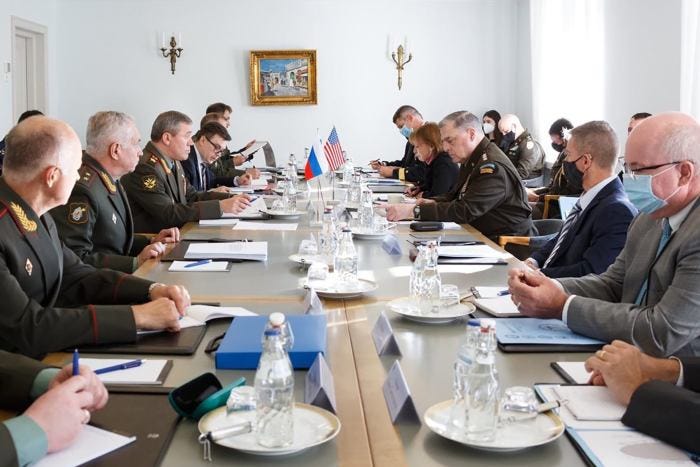
General Valery Gerasimov (left) meets with General Mark Milley (right) in Helsinki, September 22, 2021
“I no longer have an army. My tanks and armored vehicles are junk, my artillery barrels worn out. My supplies intermittent. My sergeants and mid-grade officers dead, and my rank and file ex-convicts.”
This is the quote that set off alarm bells in my head.
I’ve been a friend (and fan) of Seymour Hersh for more than a quarter century.
He and I do not always agree on the major issues of the day.
Russia is one such issue where our opinions part company.
This is not necessarily a bad thing—we are both men with strongly held positions that we ostensibly arrived at through hard work involving fact-based analysis.
I’ll be the first to admit that, with the exception of Iraq and WMD, I do not have access to the totality of the information spectrum on the issues I analyze.
For this reason I am always open to the possibility that others—especially an award-winning Pulitzer-prize winning investigative journalist like Seymour Hersh—might have put their eyes on data that I had not been able to access, or which I ignored or otherwise failed to give the proper credence.
“I have been reporting on tensions between Washington and Moscow for decades,” Hersh writes in his article, “and have known about intermittent soldier-to-soldier relations between senior American and Russian generals, but I have never been permitted by a source to quote a senior Russian general on a sensitive subject before.”
If we parse this statement out, we are left with the fact that Hersh’s source is either directly familiar with the content of the “soldier-to-soldier” connectivity between the United States and Russia, or has participated in such conversations himself.
General Valery Gerasimov has been the Chief of Staff of the Russian Armed Forces since 2012. His initial “soldier-to-soldier” connectivity in that role began in 2014, when he began a dialogue with then US Chief of Staff Martin E. Dempsey. Gerasimov continued this dialogue with Dempsey’s replacement, Joseph Dunford, and Dunford’s successor, General Mark A. Milley.
These talks never delved into the realm of politics, but were limited strictly to matters of a military nature. By way of example, the Office of the Chairman of the Joint Chiefs of Staff described one such meeting between Milley and Gerasimov, held on September 22, 2021 in Helsinki, Finland, as “a continuation of talks aimed at improving military leadership communication between the two nations for the purposes of risk reduction and operational de-confliction.”
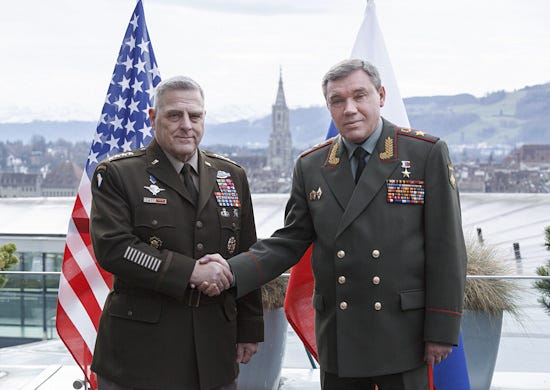
General Milley (left) shakes hands with General Gerasimov (right) in Bern, Switzerland, December 18, 2019
That was General Milley’s last face-to-face meeting with General Gerasimov. The two spoke by phone on February18, 2022, six days before Russia invaded Ukraine, and again on May 19, 2022, where they “discussed several security-related issues of concern and agreed to keep the lines of communication open,” according to a Joint Staff spokesperson.
General Milley’s last reported conversation with General Gerasimov took place on October 24, 2022, and focused on urgent security issues, including the possibility of nuclear war. Both leaders agreed to maintain open communication lines and, in keeping with past practice, agreed to keep specific details private.
General Milley was replaced by General Charles Q. Brown Jr., who held his only recorded phone call with General Gerasimov on November 27, 2024, to discuss the Ukraine conflict. The call was intended to manage escalation risks after Russia launched a “Oreshnik” intermediate-range ballistic missile at Dnipro, Ukraine, on November 21. Brown was replaced by Admiral Christopher Grady after being relived by President Trump in February 2025, and General Dan Caine took the reins as Chairman in April 2025.
Neither Grady nor Caine had any recorded conversations with General Gerasimov.
The Russian paramilitary Wagner Group, led by Yevgeny Prigozhin, began widely recruiting prisoners for the Ukraine war in early July 2022, . The Russian Ministry of Defense started its own formal prisoner recruitment campaign in October 2022. The first Russian military prisoner recruits had not reached the Ukrainian front by the time General Milley held his final call with General Gerasimov.
This means the only official “soldier-to-soldier” conversation that took place between Gerasimov and an American counterpart where the subject of Russian prisoners in the Russian military could have been raised was the one held with General Brown on November 27, 2024.
At that time, Russia was advancing on all fronts, liberating Kursk from Ukrainian forces and pressing Ukraine hard around Pokrovsk. There would have been zero basis for General Gerasimov to have made the kind of comment quoted by Seymour Hersh.
In short, there is no data whatsoever to sustain any of the politicized posturing which Seymour Hersh attributes to the Russian military “(i.e., “restless senior military command.”)
Instead, we find Hersh’s analysis poisoned by his own personal animosity toward Russian President Putin (Hersh’s comment in his article about Putin’s “willingness to kill to stay in power” mirrors comments he made to a colleague when questioned about his latest article on Russia, where he accuses Putin of murdering his opposition.)
I’m not saying Seymour Hersh made up this quote.
I am saying the quote, as presented, could never have been made by General Gerasimov to an American counterpart—the kind of “soldier-to-soldier” interaction Hersh alludes to in his article.
And the old Seymour Hersh would have known that to be the case.
But just to be sure, I reached out to my own “trusted source”, someone with years of direct experience at the highest levels of the Russian Ministry of Defense and Russian General Staff, a source which, in the intelligence business, would be rated A (Reliable; no doubt about authenticity, trustworthiness, or competency, proven to have direct, reliable access to the information) 1 (Confirmed; Verified by other independent, reliable sources.)
This source noted that Russia has a long history of military-to-military contacts, and did not rule out the possibility of such contacts taking place away from the public eye when it came to the United States and Russia.
But such talks never occur on a personal basis, but always are approved by the Supreme Commander in Chief (i.e., President Putin) and the Russian political leadership. This source emphasized that the Chief of the General Staff was not an independent actor in foreign policy. This is the case regarding General Gerasimov, whose job it is to fight and win a war, nothing else.
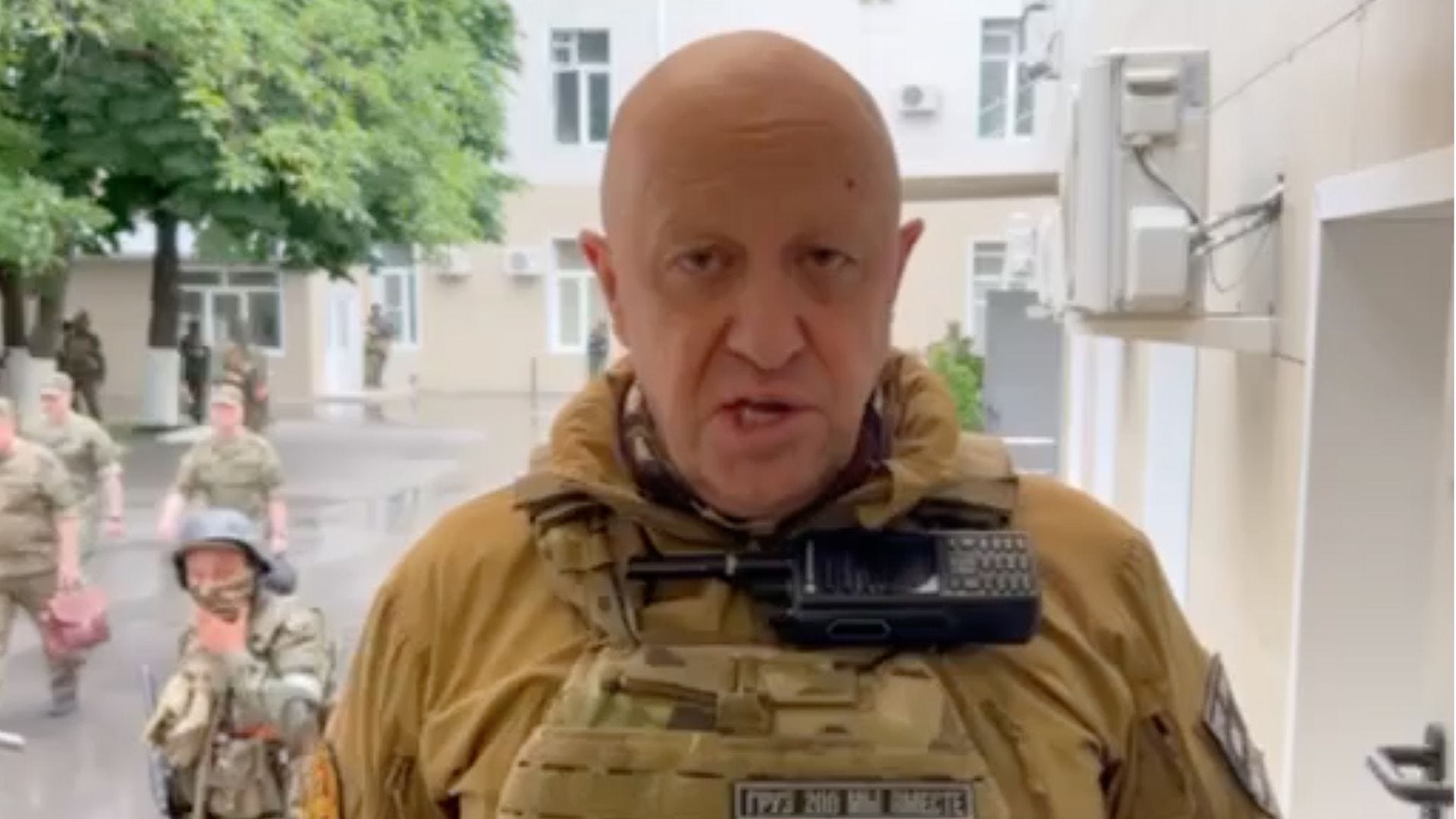
Yevgeny Prigozhin, the former head of Wagner Group
The source noted that there is the possibility, indeed probability, of “intrigues and shady politicians” surrounding the Russian Army, naming the former head of the Wagner Group, Yevgeny Prigozhin, as one such example. But this game is not one that Russian military officers play—especially General Gerasimov.
The source assesses that this quote, if indeed it was ever uttered, came from “intrigues within the political system” of Russia, from the remnants of the pro-Western political elite that emerged in the 1990’s during the time of Boris Yeltsin, and continued to thrive in the early years of the Putin presidency. This element, linked to banking and global transnational financial capital, plays a large role in influencing the so-called “peace party” that has emerged in the aftermath of the Anchorage Summit this past August.
This “peace party”, the source believes, is in close contacts with US government officials, especially those affiliated with the CIA and non-governmental vectors of soft power. There is no doubt in this source’s mind that Seymour Hersh has been played the fool by these forces, promoting themes conducive to the fantasy of regime change in Russia.
Something Seymour Hersh himself actively supports.
Manufactured quotes and a not-so-hidden political agenda are not the trademarks of a journalist, especially one with the pedigree of Seymour Hersh.
But this is what he has become, and it is therefore necessary to call him out.
oooooo
Ritter’s Rant 073: To Be or Not to Be
Ritter’s Rant 073: To Be or Not to Be
The dysfunction of the Trump administration is on display when it comes to the South Korean Nuclear Sub deal.
Transkripzioa:
Hello and welcome to this episode of Ritter’s Rant. To be or not to be? No, I haven’t gone Shakespearean on you, not yet. But it’s an apt phrase when we are talking about what’s transpiring today between the United States and South Korea, in particular about, you know,
this joint nuclear submarine acquisition plan that was conceived last November in a deal between the South Korean president and the American president, Donald Trump, a deal that had as its genesis, you know, trade disagreements. Donald Trump had slapped a 25 percent tariff on South Korean goods
And then part of the deal that lowered the tariff from 25% to 15% was this arrangement where South Korea would invest $350 billion into the United States, including $150 billion. in the ship building. But not just any ships, you see, because Donald Trump also agreed with the South Korean president that South Korea
was going to enter the Nuclear Submarine Club. It’s something South Korea always has been aspiring to recently, you know, because it’s the Cool Boys Club. You know, we have AUKUS, Australia, United Kingdom, United States, where Australia got to join the Cool Boys Club by dumping a French submarine for American nuclear submarines. Now, these submarines don’t exist.
The Australians don’t have them. And there’s some question as to whether they’ll ever have them. But, you know, it’s just typical of how the United States operates with its core allies, where we promise something that becomes very difficult to deliver. uh, down the road because we’re not really serious about it. We’re in for the optics.
We’re in for the headlines. We’re in for, you know, the, the perception as opposed to the reality. And I think South Korea has fallen into this same trap. I mean, it was obvious that there was a problem early on when Donald Trump said, you know, they’re going to build these submarines in Philadelphia, uh,
the Philadelphia shipyard in the South Korean president. I think we’re going to build it sort of a hundred percent here at home. Um, But the $150 billion that was supposed to be invested in American shipbuilding, a large amount of that’s supposed to go to building up the Philadelphia shipyards
capabilities so they can produce Donald Trump’s South Korean nuclear submarines. So we had a problem there. But there’s other issues as well. You know, one of which is where does South Korea get this money? You know, the South Korean president does have to work through his parliament. There has to be budgets allocated. Money has to be approved.
And it’s just not happening to the speed which Donald Trump wants it to happen to his trade representative wants it to happen. And we saw this play out this week. Eldridge Colby, the undersecretary or deputy undersecretary for policy in the Department of Defense or Department of War, depending on whose lexicon you’re operating off of,
he traveled to South Korea to have these discussions with this core ally. South Korea is listed as one of our better allies here. They talked about a number of things. They talked about how if there was a war involving North Korea, the United States would transfer command and control of the war from American
leadership to South Korean leadership early on, that the South Koreans will play… major role in nuclear war planning so that if the war did go nuclear, South Korea would have a say on what nuclear weapons were used, what targets were hit, et cetera. So they discussed this.
I just want to point out that it’s still in the discussion phase. No real, nothing real has really happened here beyond creating planning groups, et cetera. The United States still controls the war powers capability, the command and control capability and total control over its nuclear arsenal. But they also talk about these nuclear submarines. And again,
the United States reiterated how it was willing to help the South Koreans on issues such as uranium enrichment. I mean, how are they going to build and manufacture the fuel to be used for these if these are going to be 100 percent South Korean submarines? Fuel reprocessing, what happens when the fuel cells need to be replaced?
South Korea owns these things. How do they reprocess them? These are technologies that the United States has that need to be shared with South Korea, so they discussed sharing them. But then it got down to the brass tacks about the submarine itself. You know, as the Admiral and Commander of the U.S. Pacific Police said, you know,
The submarine is still in the nascent phase now. I had to go look up that word just to make sure that I understood what it means. Very preliminary, as in it doesn’t exist. And this is the case. You know, the the South Korean shipping company, Hanwha, has purchased the Philadelphia shipyard in 2024, I think,
for a price of one hundred million dollars. And they’ve promised a $5 billion renovation of the shipyard. In fact, they’re looking to buy land to expand the shipyard to do the kind of shipbuilding that Donald Trump wants. One of the things that they plan on building, they’re going to produce frigates for the U.S. Navy.
But they also are talking about producing these nuclear submarines. But no investments have been made into the kind of infrastructure upgrades that are required. This shipyard, as it currently exists, cannot be involved in nuclear ship production. There’s a whole host of safety issues, technologies, reconfiguration of the workspace, again, when dealing with nuclear reactors, etc.,
that haven’t been done. And it’s not going to happen overnight. These are things that could take more than a decade to happen, if at all, if the funding is ever there. The deal is for South Korea to produce at least four, maybe more, nuclear submarines by the mid-1930s. But they’re nowhere near on track to do this.
You know, people need to understand that, that realistically speaking, this just isn’t going to happen, especially since none of the money has been released from South Korea, which now brings us back to the original issue here. This was always a trade deal. This is always Donald Trump, you know,
talking about I lowered tariffs from 25 percent to 15 percent. so that you, South Korea, could invest $350 billion into the American economy. So I, Donald Trump, could stand for the American people and said, I made you $350 billion, part of his multi-trillion dollar economic expansion, except that money hasn’t been invested. It’s still in South Korea.
It’s not coming this way. The South Koreans have a lot of issues, one of which is that they’re waiting for the United States Supreme Court to come down on a ruling on the legality of Donald Trump’s tariff policy. So nothing’s happened. So what did the U.S. Trade Representative do?
He’s chastised the South Koreans and Donald Trump immediately threatened to put the 25% tariff back on. I would imagine that if you did that, that sort of ends the nuclear submarine program, ends the concept of South Korean investment, brings everything back to square one. Now, they’re trying to sort things out.
Donald Trump says, we’ll hold off on that. We’re going to work things out. But my point is a lot of people got really excited when Eldridge Colby went to South Korea and talked about nuclear submarines. And a lot of people started moving pieces on a map, talking about how the South Koreans had nuclear submarines. They could,
with their long patrol capability, extend and interdict Chinese shipping lanes the same way they did with Australian nuclear submarines that don’t exist and talked about how they could do long range patrolling, interdicting. And suddenly we have American back power
projection into the Pacific, controlling the Chinese ships. It doesn’t exist. It’s theoretical.
And given Donald Trump’s proclivities for slapping tariffs on anybody who doesn’t agree with them, probably won’t exist. To be or not to be? The South Korean nuclear submarine? My guess is not to be. Anyways, that’s my rant. The next time a thought crosses my mind, I’ll be sure to let you know. Thanks.
oooooo
Geure herriari, Euskal Herriari dagokionez, hona hemen gure apustu bakarra:
We Basques do need a real Basque independent State in the Western Pyrenees, just a democratic lay or secular state, with all the formal characteristics of any independent State: Central Bank, Treasury, proper currency1, out of the European Distopia and faraway from NATO, being a BRICS partner…
Euskal Herriaren independentzia eta Mikel Torka
eta
Esadazu arren, zer da gu euskaldunok egiten ari garena eta zer egingo dugun
gehi
MTM: Zipriztinak (2), 2025: Warren Mosler
(Pinturak: Mikel Torka)
Gehigarriak:
MTM klase borrokarik gabe, kontabilitate hutsa
Anthony Anastosi: Estatu dirua, Klase borroka
oooooo
1 This way, our new Basque government will have infinite money to deal with. (Gogoratzekoa: Moneta jaulkitzaileko kasu guztietan, Gobernuak infinitu diru dauka.)


