
Mundu multipolarra versus unipolarra
NBE (Nazio Batuen Erakundea) gaindituta, ICC (NAPE) (International Criminal Court) alboratuta, eta Mossad nagusi… aspalditik gainera…
******
Stop saying history will judge them, judge Israel now. With ICC judges.
******
ICC (international Criminal Court) NAPE (Nazioarteko Arlo Penaleko Epaitegia)
International Criminal Court judges refuse to be bow to Trump’s sanctions as he tries to exempt Israeli and American officials from the rule of law: “We are not going to be intimidated.”

******
Native Americans pay tribute to Renee Nicole Good, murdered by Trump’s militia ICE
Bideoa: https://x.com/i/status/2010596168204714114
oooooo
Native American@_nativeamerica
I don’t know why this hasn’t received more publicity, but this fifty-foot sculpture was unveiled recently in South Dakota.

oooooo
erabiltzaileari erantzuten
The show-trial of President Nicolas Maduro is partly Kafkaesque, partly Monty Python. No civilized court should ever adjudicate over a case if jurisdiction is fundamentally flawed by an international kidnapping and murder
oooooo
More and more Trump’s abstruse statements make me think of Caligula. I have taught history at various universities and cannot think of any other President as weird — and dangerous — as Trump. Even Ted Roosevelt’s “gunboat diplomacy” was less crazy.
oooooo
erabiltzaileari erantzuten
BDS against the US would mean selling off US Treasury bonds, not buying any more US Treasury bonds, recaling orders and not buying F-16 and F-35 planes, no Boeing, Lockheed-Martin, Raytheon. Most importantly: total stop in sales of rare earths to the US.
oooooo
An international push-back campaign must be organized to counter Trump’s daily violations of international law. BDS should target US industry and finances, imports and exports: boycott, divest, sanction.
oooooo
erabiltzaileari erantzuten
The US predator actions in Venezuela will backfire. We are creating enemies worldwide, isolating ourselves from supply chains. The process of de-dollarization is advancing. Fewer and fewer people are doing business in dollars
oooooo
The billionaire vulture capitalists that run the show in Washington D.C. do not have the interests of the American people in mind — much less the interests of the Venezuelan people.
oooooo
erabiltzaileari erantzuten
Steinmeier urged efforts to prevent “the world from turning into a den of robbers, where the most unscrupulous take whatever they want, where regions or entire countries are treated as the property of a few great powers.”
ooooo
@tobararbulu # mmt@tobararbulu
Albares propone una “alianza mundial” por el multilateralismo en plena inestabilidad internacional vía @elnacionalcat_e

oooooo
In 1937 Winston Churchill said about Palestinians. I don’t agree that a dog in a manger has final rights to the manger, even if he was there long before. I don’t admit that a wrong was done to American red Indians or Black people of Australia. Because a higher-grade race has come in & took their place. Prime Minister Yitzhak Shamir called them grasshoppers who could be crushed.
Bideoa: https://x.com/i/status/2011694438829982130
(Arundhaty Roy, 2002)
oooooo

 Robert Kennedy Jr. LANZA EXPLOSIVAS REVELACIONES:
“La CIA utilizó a la USAID como fachada para financiar el golpe de Estado en Ucrania en 2014 (Cuando Obama) para provocar disturbios en Ucrania“
“Estos disturbios respaldados por la CIA desencadenaron un golpe de Estado que derrocó al gobierno neutral y democráticamente elegido de Ucrania“.
“Apenas un mes antes del golpe, una llamada filtrada entre Victoria Nuland y el embajador de Estados Unidos en Ucrania expuso que ella ya había elegido personalmente al nuevo gabinete del país“.
“Han elegido al nuevo gobierno un mes antes de que el antiguo sea derrocado“.
 Mientras tanto, nos dicen que este conflicto “no fue provocado”. ESCUCHE A RFK Jr. LANZAR BOMBAS DE VERDADES

Bideoa: https://x.com/i/status/2011901072286367933
oooooo
I was at a Birmingham screening of this extremely powerful film on Saturday. From the outset, most of the audience was in tears, with good reason.
It isn’t ‘based on’ or ‘inspired by’ true events. It is a true story.
A 5-year old girl surrounded by dead bodies in a car.
A 5-year old pleading with Palestine Red Crescent (PRC) rescuers over the phone to save her.
A 5-year old they have to lie to because the Israelis have killed her rescuers.
A 5-year old who knows she’s going to die.
A 5-year old whose tiny body is discovered in a vehicle mangled by tank shells and riddled with 355 bullets.
Audio recordings of the PRCS with #HindRajab are live.
That’s what makes the film even more intense and heart wrenching. In the West, every one knows the name Anne Frank.
A Dutch Jewish teenager who died in a Nazi concentration camp in 1945.
We leant about her at school, largely because of the diary she kept.
But that was 81 years ago. Will the name Hind Rajab be taught in our schools?
Will our children be taught how this little girl was wilfully murdered by a military Britain trains, arms, finances and excuses?
Will our children be taught that Hind’s homeland is occupied by Anne’s people because of what Europeans did to European Jews?
Today, every child in Europe should know the name Hind Rajab, more than they know Anne Frank.


oooooo
Quote of the Day by Anne Frank: ‘In the long run, the sharpest weapon of all is a kind and gentle spirit’
SECTIONS
Global DeskLast Updated: Jan 12, 2026,
Synopsis
Anne Frank, a Jewish teenager in hiding during the Holocaust, documented her experiences in a diary filled with remarkable clarity and emotional intelligence. Despite the constant fear and confinement, her writings reveal an unwavering belief in humanity’s moral strength. Her words, surviving her tragic death, continue to inspire with a message of kindness as a powerful force.

Anne Frank’s AI sketch.
Despite her all-too-brief life, Annelies “Anne” Frank remains one of the most enduring voices of the 20th century. A teenager forced into hiding during the Holocaust, Anne became the human face of an unspeakable tragedy through the pages of her diary, written not as a historical document, but as the honest reflections of a young girl trying to make sense of a cruel world.
Anne and her family spent more than two years concealed in the “Secret Annex” in Amsterdam, a space that has since become one of the world’s most visited memorial sites. In confinement, under constant fear of discovery, Anne wrote with remarkable clarity, wit and emotional intelligence. She described herself as a “chatterbox,” often sounding like any other teenager, even as history closed in around her.
Anne never lived to see her 16th birthday. She died in a Nazi concentration camp, one among nearly six million Jews murdered during the Holocaust. Yet her words survived—carrying with them not hatred or vengeance, but an unwavering belief in the moral strength of humanity.
Meaning of the Quote
Written during one of the darkest chapters of human history, this line captures Anne Frank’s extraordinary optimism. At a time when violence, cruelty, and injustice defined daily life, she believed that kindness was not weakness but strength.
Anne’s “weapon” was not force or anger, but compassion—an inner resilience that refused to be destroyed by fear. The quote suggests that while hatred may dominate moments in history, it is empathy, decency, and moral courage that endure over time. For Anne, kindness was an act of quiet resista ..
Decades later, her words continue to resonate, reminding the world that even in the face of overwhelming darkness, a gentle spirit can leave a lasting mark—one stronger than any form of violence.
About Anne Frank and The Diary of a Young Girl
The Holocaust remains one of the darkest chapters in human history, documented through countless books and accounts. Among them, The Diary of a Young Girl stands apart for its honesty and emotional clarity. Written by Anne Frank, a 13-year-old Jewish girl in hiding, the diary offers a deeply personal view of life under Nazi persecution.
Anne began writing her diary on June 12, 1942, after receiving it as a birthday gift. The entries end abruptly on August 1, 1944, shortly before she and her family were arrested. Through her words, Anne records the fear, confinement, and daily struggles of living in hiding in Amsterdam after fleeing Nazi Germany.
What makes Anne’s writing remarkable is her ability to remain observant, thoughtful, and hopeful despite constant danger. She writes with the curiosity of a teenager, slowly growing aware of the hatred and violence surrounding her. Her reflections reveal both the innocence of youth and a striking emotional maturity shaped by war and intolerance.
Anne and her family were eventually captured and deported to concentration camps. She died before her 16th birthday. Her father, Otto Frank, the only family member to survive, later published her diary in 1947.
Today, The Diary of a Young Girl is regarded as one of the most important firsthand accounts of World War II, translated into more than 60 languages and read by millions worldwide. Anne Frank’s voice continues to remind readers of the human cost of hatred—and the enduring strength of hope.
ooooo
Breaking: Spain plans to ban Israeli tourists from entering the country over genocide in Gaza.
oooooo
Jeffrey sachs: “United States is no longer a constitutional order, because it runs by decree. And we happen to have a psychologically unstable leader..”
“It’s on the verge of attacking Iran again. it’s [Iran] not Venezuela. it has hypersonic missiles, and it has many other things. it’s extremely dangerous…”
Bideoa: https://x.com/i/status/2011795833327616074
oooooo
Censored Humans@CensoredHumans
President of Colombia Gustavo Petro:
“Diplomacy has failed in Gaza.”
“I call on nations to bring their armies and resources together to defend Palestine.”
“We’ve had enough words.”

oooooo
One of the most devastating moments from the film- The voice of Hind Rajab. The film, a contender for the Oscar uses actual conversations between the Red Crescent and five year old Hind in her last moments
Bideoa: https://x.com/i/status/2011808755986677826
oooooo
Uncommon Sense@Uncommonsince76
Judge Napolitano- “Is it pretty well understood that the Mossad, and the CIA are behind all this chaos (in Iran)?”
Bideoa: https://x.com/i/status/2011911021099667874
oooooo

oooooo
Vladimir Putin to a German businessman, asking in English:
“You’re representing the Federal Republic of Germany… Speak German! Why English? Think about your sovereignty.”
Bideoa: https://x.com/i/status/2012048436720517272
oooooo
El académico geopolítico, economista, analista de políticas públicas estadounidense y profesor de la Universidad de Columbia. Jeffrey Sachs, lo DICE alto y claro:
Informa LA VERDAD al Parlamento Europeo sobre las causas del conflicto entre Rusia y Ucrania.
Lo que los políticos belicistas y los grandes medios de comunicación NO quieren que escuches ni sepas.
“Cada vez que los medios de comunicación tradicionales o un político afirman que algo “no fue provocado”, es una mentira total“.
“Esto ni siquiera incluye algunas de las actividades más grotescas en las que está bien documentado que Ucrania está involucrada“.
ESCUCHEN
Bideoa: https://x.com/i/status/2012258637075419626
oooooo
@tobararbulu # mmt@tobararbulu
Reflections on a War
Reflections on a War
Thirty-five years ago, the world woke up to find the United States at war with Iraq. It was a war that set in motion changes that still reverberate globally to this day.
Jan 17, 2026

On the back side of the house
Where it wears no paint to the weather
And so shows most its age,
Suddenly blue jays rage
And flash in blue feather.
In January 1991 the United States led a coalition of the willing, operating under the mandate of a United Nations Chapter VII resolution, to war against Iraq. In August of 1990, Iraq had invaded and occupied the sovereign state of Kuwait, an act of aggression that operated in flagrant violation of the law.
The Cold War that had dominated the globe since the end of the Second World War was winding down, and the international community was on the cusp of major geopolitical changes that could and would reshape the world order. The United States, which was emerging from the detritus of the Cold War as the world’s sole remaining superpower, found itself at a crossroads of history.
It is late in an afternoon
More grey with snow to fall
Than white with fallen snow
When it is blue jay and crow
Or no bird at all.
The Middle East had, up until that time, been managed the so-called “Carter Doctrine”, a Cold War-era policy implemented by President Jimmy Carter in 1980 following the Soviet Invasion of Afghanistan. The “Carter Doctrine” held that the United States would use military force, if necessary, to defend its national interests in the Persian Gulf, which primarily centered on the deterrence of Soviet expansion.
As a young Officer of Marines stationed in 29 Palms, California, I spent the better part of the summer of 1985 updating the intelligence annex to the Operations Plan for an amphibious landing Iran in response to a Soviet invasion. I was assigned to the 7th Marine Amphibious Brigade, the Marine ground combat component of the Rapid Deployment Force, the tip of the spear of the “Carter Doctrine”—if America was going to war in the Middle East, the 7th MAB would be leading the way.
So someone heeds from within
This flurry of bird war,
And rising from her chair
A little bent over with care
Not to scatter on the floor
The war plan that the United States was implementing against Iraq in 1991 was a modification of the one that I had updated back in 1985. But the difference was instead of fighting against the Soviet Union, we found ourselves in common cause as the Soviets helped push through the UN Security Council resolution authorizing military force against Iraq. Such cooperation was unthinkable during the Cold War, doubly so since the resolution targeted a Soviet client state.
Today Americans look back on Operation Desert Storm, the name given this war, as an historical curiosity. The events leading up to the war, and the war itself, became lost in the jumble of events that followed, including 9/11 and the US-led invasion and occupation of Iraq. But none of those events would have happened had it not been for Operation Desert Storm.
The sewing in her lap
Comes to the window to see.
At sight of her dim face
The birds all cease for a space
And cling close in a tree.
I was involved in the planning for Marine ground combat operations before the start of the war. This was the first major military action to be fought by the armed forces of the United States since the Vietnam War, some two decades prior. Most if not all the senior officers involved on the American side during Desert Storm were veterans of the Vietnam conflict, and they carried the ghosts of that war with them.
There was real concern over casualties. The First Marine Division had ordered 10,000 body bags, and the US Army’s Fifth Corps ordered another 10,000. When the war concluded, some 43 days after the air war began on the night of January 16/17, and 100 hours after the US initiated its ground offensive to liberate Kuwait, the concerns over casualties turned out to be much ado about nothing—less than 450 coalition soldiers lost their lives in Desert Storm.
And one says to the rest
“We must just watch our chance
And escape one by one—
Though the fight is no more done
Than the war is in France.”
Around 22,000 Iraqi soldiers lost their lives during Operation Desert Storm, along with 2,300 civilians. It was a one-sided war, and yet when the fighting stopped, the results were far less than the total victory anticipated by the US and its allies. In October 1990, a few months before the first bombs began falling on Iraq, then-President George Herbert Walker Bush had declared Iraqi President Saddam Hussein to be the Middle East equivalent of Adolf Hitler for the crime of invading and occupying Kuwait, adding the Iraqi dictator would suffer “Nuremburg-like retribution” for his crimes (a reference to the post-war trials of the senior Nazi leadership at Nuremburg.
But Saddam did not go gently into that good night. Rather, he resisted US-led efforts to dismantle Iraq by supported Shi’a uprisings in the south of Iraq, and Kurdish uprisings in the north. Instead of collapsing, the government of Iraq appeared to thrive, feeding off the controversy created when the United Nations authorized international specialists to carry out inspections of Iraq intended to disarm Iraq of its weapons of destruction.
Than the war is in France!
She thinks of a winter camp
Where soldiers for France are made.
She draws down the window shade
And it glows with an early lamp.
I participated in Operation Desert Storm as a member of the intelligence staff of the US Commander, General Norman Schwarzkopf. I was deeply involved in the hunt for Iraqi mobile SCUD missiles, and when the war ended this experience got me an invitation to join the United Nations as a weapons inspector searching for missiles and other weapons of mass destruction in Iraq.
The inspection process was linked to the continuation of economic sanctions that had been imposed on Iraq since the time of its invasion of Kuwait in August 1991. One problem facing the UN weapons inspectors was that the United States, trapped by its own pre-conflict posturing of Saddam Hussein as a modern-day Adolf Hitler, was now fully committed to a policy of regime change, for the simple fact that anyone modelled after Adolf Hitler could be allowed to continue to govern. Weapons inspection, rather than being a legitimate tool of disarmament, instead became a tool for the continuation of sanctions until which time Saddam Hussein stepped down from his presidency.
On that old side of the house
The uneven sheds stretch back
Shed behind shed in train
Like cars that long have lain
Dead on a side track.
Operation Desert Storm had a well-defined beginning—January 16/17, 1991. But it did not have a similarly well delineated conclusion. This led to the US turning its back on the concept of a new world order based upon genuine multipolar cooperation, and to resume expanding its role as the global hegemon.
By the end of Desert Storm, the US had rejected yielding the global stage to a new multipolar order, instead continuing and expanding upon its status as the world’s supreme military and economic power. “Pride goes before destruction, and a haughty spirit before a fall,” notes Proverbs 16:18. Within eight months of the formal end of Operation Desert Storm the Soviet Union collapsed. There were no more checks and balances available to the international community to hold back US power.
Emboldened by its decisive victory in Operation Desert Storm and liberated by the untimely dissolution of its principle global geopolitical opponent, the United States embarked on a three-decade campaign designed to impose its will on the world, and the Middle East in particular. There is a direct cause-and-effect relationship between the US’ prosecution of Saddam Hussein and Iraq, and the gradual decline of US power and prestige that came with pursuing ghosts on the ground in Iraq.
This decline was manifest during the term of President Bill Clinton, and all other Presidents that followed. And it can all be attributed to the unfinished business that was triggered by the collapse of multipolarity as a concept. Everything that followed—9/11, the invasion and occupation of Iraq, the War in Afghanistan, and covert regime change operations in Libya and Syria—all have their roots in Desert Storm, a war which began 35 years ago and never really ended.
(The poem that interspaces the paragraphs of this article is entitled “War Thoughts at Home.” It was written by Robert Frost in January 1918, and only recently discovered.)
Note: Back in September 2025 I began publishing a new book on my experiences in Desert Storm and as a UN weapons inspector entitle “The SCUD Hunters.” By October 20, 2025 I had published five chapters. I paused publishing the book as I wrestled with putting the rest of the book behind a paywall (i.e., for subscribers only.) However, the tremendous outpouring of support that has taken place since I went public about being “de-banked” has convinced me to keep publishing the book without a paywall. I will resume publishing a chapter a week starting January 19, 2026.
oooooo
Back to the Future
Back to the Future
Maybe the only way to reset US-Russian relations is to go back to the Cold War and start all over again.
Jan 16, 2026

Donald Trump twice ran for President on a platform which included his desire to make normalizing relations with Russia a top priority. “Wouldn’t it be nice if we got along with Russia?” Trump famously said during his 2016 Presidential campaign. “I have a very good relationship with President Putin,” Trump said in September 2024.
But things didn’t work out as planned. “There’s never been a president as tough on Russia as I have been,”, Trump said in July 2018, reflecting the reality of his administrations Russian policy—stringent economic sanctions and military support for Ukraine topping the list of his accomplishments vis-à-vis Moscow.
“I’ve always had a very good relationship with Vladimir Putin of Russia, but something has happened to him,” Trump declared in May 2025. “He has gone absolutely CRAZY! I’ve always said that he wants ALL of Ukraine, not just a piece of it, and maybe that’s proving to be right, but if he does, it will lead to the downfall of Russia!”
The yin and the yang of Trump’s on again, off again bromance with Russian President Vladimir Putin has created confusion in the ranks of Trump watchers for some time now.
But the reality is even Trump doesn’t know what he wants with Russia, because his statements aren’t derived from any personal commitment to either Russia or its leader regarding the betterment of relations, but rather are symptomatic of a man (Trump) who has a history of saying anything, not matter how far-fetched, unrealistic and fact challenged, in order to get what he (Trump) wants.
Trump isn’t looking to have a genuine friendship with either Putin or Russia, but rather to have Putin, as the leader of Russia, to do Trump’s bidding.
In short, Trump wants a US-Russian relationship that sustains the decades-long goal of the United States since the Cold War ended in 1991 to keep Russia weak and completely subordinated to the will of the United States.
In this, Trump is no different that Bill Clinton, George W. Bush, Barack Obama, and Joe Biden—all former Presidents who pursued policies deigned to weaken and subjugate Russia and—perhaps most importantly—to undermine and diminish the ability of Vladimir Putin to function as President of Russia.
There are two things all of these leaders have in common when it comes to Russia. First and foremost is the belief that the United States won the Cold War, which creates a psychological profile of a defeated Russia that helps shape a consistent policy prerogative that places the US in a superior roll when envisioning any US-Russian relationship.
Second is the undying bitterness and resentment toward Russian President Vladimir Putin for playing along with the script as written by the American victors, opting instead to raise Russia to its feet, and instill it with national pride that postures Russia as the equal to the United States.
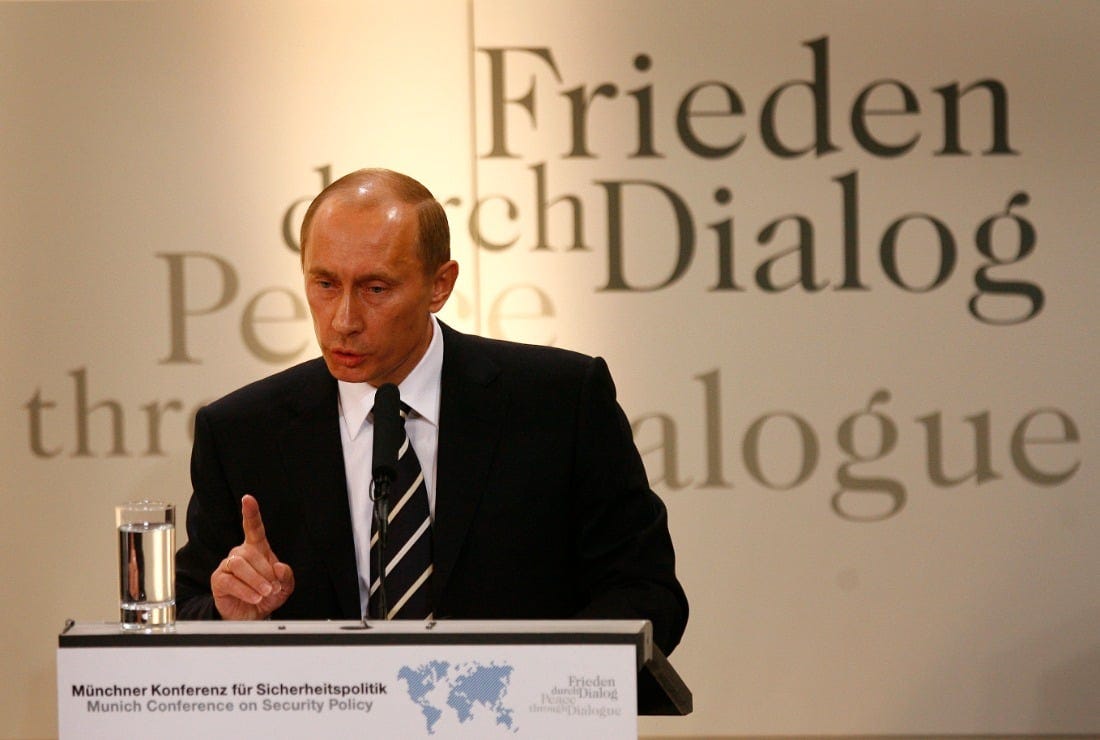
Russian President Putin addresses the Munich Security Conference in 2007
Putin’s famous declaration of independence, delivered at the Munich Security Conference in 2007, sent shock waves through an American establishment elite thoroughly infected with Russophobia, and who expected Putin to resume the role played by Russia’s first President, Boris Yeltsin, by prostrating himself at the feet of the American victor and Russia’s true savior.
The 2009 “reset” of relations orchestrated by Barack Obama was little more than a regime change operation disguised as diplomacy, where the US sought to replace Vladimir Putin with Dmitri Medvedev in hopes that Medvedev would prove to be more compliant. Dmitri Medvedev’s current X account is proof positive that the Obama administration did not have a good read on the former Russian President, or Russia as a whole.
Russia will never willingly return to the conditions that created the debacle of the 1990’s.
Russia will never again subordinate its national pride, culture, security and history to the whims of the West.
And yet this is precisely what Donald Trump is seeking today. It is literally “my way or the highway”, and the “highway” Trump speaks of is an off-ramp to hell.
Trump’s policy towards Russia has never significantly detoured from the strategic course that had been in place since the Cold War ended.
Keeping Russia weak by promoting the independence of Ukraine, and encouraging Ukrainian integration into western economic and military relationships, has been a consistent theme since 1991, and very much remains in effect today.
And controlling Russia’s economy—and, through this vector, its very existence—is the core component of Trump’s Russia policy. The goal of Trump’s sanctions policy is to “collapse” the Russian economy, which means to collapse Russian society and with it Russia’s political system.
The economic relationship Trump envisions with a post-conflict Russia is like that which he promotes with Ukraine—heavy American involvement in core businesses as a means of exerting control overt the policies of the relevant economic “partners.”
With Ukraine, this is called “security guarantees.”
With Russia, its simply economic surrender.
The “Spirit of Alaska” which has been promoted by both Russian and American officials since the summit meeting this past August between Trump and Putin is nothing more than a subterfuge, and wolf in sheep’s clothing that disguises the true policy objectives of the Trump administration when it comes to Russia.
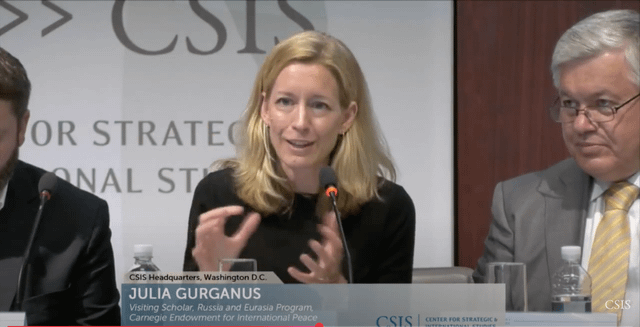
Julia Gurganus, former senior CIA Russia analyst
It’s a little known fact that Julia Gurganus, a former senior CIA Russia analyst who, back in 2016-17, served as the National Intelligence Officer for Russia and Eurasian Affairs and, in this role, was responsible for overseeing the production of a controversial Intelligence Community Assessment (ICA) that claimed Russia colluded with Donald Trump to steal the 2016 Presidential election, was on Air Force One as Trump flew to Alaska.
The mission of this infamous Russophobe wasn’t to brief the President on the possibilities for better relations between the US and Russia, but rather how the President could use the Alaska Summit to box President Putin in and create the possibility of collapsing the Russian government in the process.
Gurganus was on Air Force One thanks to the intervention of her boss, CIA Director John Radcliff. Radcliff had gone out of his way to whitewash Gurganus’ past sins, declassifying a report in May 2025 that cleared Gurganus of all wrongdoing regarding the 2017 ICA (unfortunately for Gurganus, Director of National Intelligence Tulsi Gabbard carried out a more detailed and honest investigation that found Gurganus culpable, resulting in her security clearances being terminated along with her employment at CIA. But this came after the Air Force One briefing.)
Gurganus’ job wasn’t to help coach Preisent Trump through the political machinations of normalizing relations with the Russian President.
It couldn’t be, for the simple fact that she worked for John Radcliff, and his job was to strategically defeat Russia and bring down the government of Vladimir Putin.
That was the mission he was given by President Trump.
Radcliff and his paramilitary operatives from the CIA’s Special Activities Group had been working hand in glove with the Ukrainian intelligence services and special forces to plan and execute strategic strikes deep inside Russia. They were closely involved in “Operation Spiderweb”, the Ukrainian drone attack on Russian strategic bombers carried out in June 2025. And the CIA publicly flaunted its role in facilitating Ukrainian drone attacks on Russian oil refining infrastructure.
But the biggest “tell” that the CIA and Trump were not interested in peace with Russia, but rather were using the search for a peaceful solution to the Russian-Ukrainian conflict as a cover for regime change inside Russia, was the December 29, 2025 Ukrainian drone attack on Vladimir Putin’s personal residence in the Novgorod region of Russia, executed while Putin was in telephonic discussions with Donald Trump about ending the war in Ukraine.
At first Trump feigned dismay and anger. But later he called the Russian version of events lies and accused Vladmir Putin of making things up.
The problem for Trump was that the failed attack left a body of debris in its wake that included intact computer guidance components which contained the precise coordinates of the intended target (yes, Putin’s residence) as well as data on the route to be flown by the drone.
American digital “fingerprints” were all over this guidance component, something the Russians knew when their head of military intelligence handed one of these intact components over to the US military attaches in Moscow.
Russia knows the truth.
And the truth is that the United States under Donald Trump still seeks the strategic defeat of Russia.
Nothing has changed from the policies of Joe Biden.
Of Barack Obama.
Of Donald Trump’s first term.
Next month the New START treaty expires. It is the last remaining arms control treaty between the US and Russia and has its roots in the legacy of Cold War-era arms control. Russian President Vladimir Putin has indicated his readiness to implement a one-year moratorium regarding the “caps” mandated under New START that limit the number of deployed strategic nuclear weapons for each party to the treaty at 1,550.
While Trump initially indicated support for the extension of New START, more recently he expressed indifference to the fate of the treaty, claiming he could negotiate a better one.
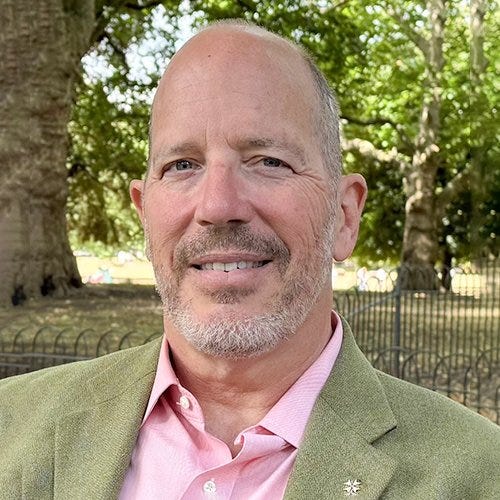
Christopher Ford
Here we must take note of the words and deeds of Christopher Ford, the former US Assistant Secretary of State for International Security and Nonproliferation, and Under Secretary for Arms Control and International Security, during Donald Trump’s first term.
Christopher Ford was responsible for overseeing arms control issues between the US and Russia.
Christopher Ford helped kill the INF treaty in 2019.
Christopher Ford strongly believes that arms control is only useful in so far as it solidifies a US strategic advantage over the Russians.
Christopher Ford is the face of post-Cold War arms control reality.
In short, Christopher Ford and people who think like Christopher Ford believe that an arms race with Russia is better than genuine arms control.
Which is why we are headed toward an arms race with Russia and are witnessing the death of arms control.
The question facing the US and Russia today is what is there to be gained by pushing agendas which lead to different outcomes?
The US demands that Russia yield.
And Russia will not yield.
It is said that we are on the cusp of a new Cold War.
Why not just embrace this outcome?
Yes, the Cold War brought us to the brink of nuclear war.
John F. Kennedy said of the Cuban Missile Crisis of October 1962 that there was a 30% chance of a nuclear war between the US and the Soviet Union at that time.
John F. Kennedy did not want to fight a nuclear war with the Soviet Union, so we avoided one.
In November 2024 select members of Congress were briefed by the CIA that there was a greater than 51% that there would be a nuclear war between Russia and the US before the year ended.
And the Biden administration said they were ok with that, and they were prepared to win such a war.
Only Donald Trump’s election took us off that path.
And Donald Trump just tried to kill the President of Russia.
The Cold War is looking pretty good by comparison.
The Cold War has been made out as an existential struggle between two competing, inherently incompatible ideologies.
But the reality was far different.
During the Cold War the US and Russia had extensive diplomatic relations.
Tourism was possible and encouraged.
There were cultural exchanges between our two nations.
Academia specialized in Russian area studies that educated students on the reality of Russia.
In short, our two nations respected each other, in large part because we feared each other. We knew that any concerted effort to strategically defeat the other side would result in nuclear driven mutually assured destruction.
The Cold War enabled the process of meaningful arms control to begin; a process predicated on mutual respect and the need for mutual trustworthiness.
But the Cold War wasn’t so much triggered by differing ideologies as it was born of the Soviet rejection of submitting to American economic hegemony.
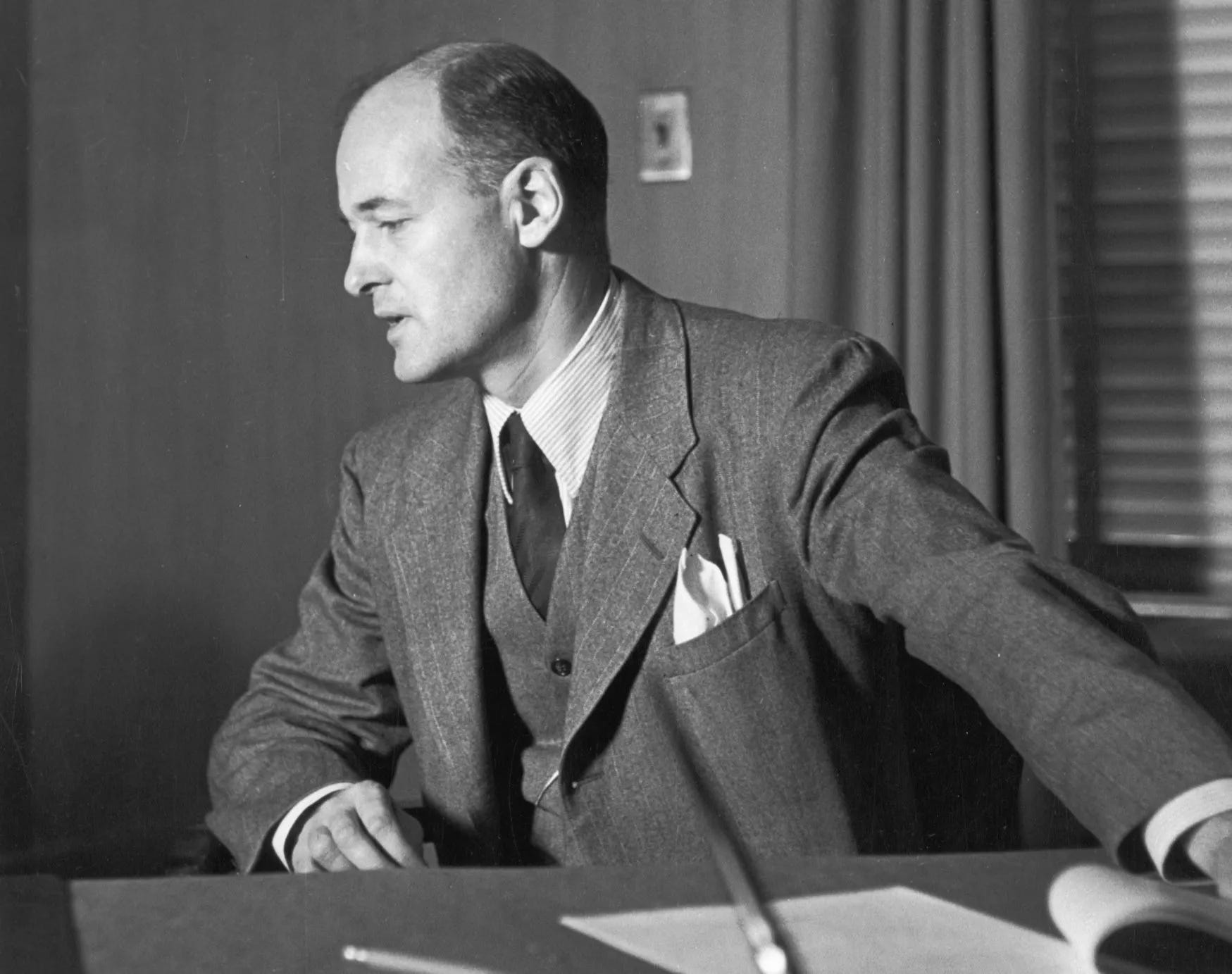
George Kennan
Most Cold War historians point to George Kennan’s February 1946 “Long Telegram” as beginning the process that led to the Cold War. Kennan’s missive painted a picture of a Soviet Union at fundamental odds with the policies and priorities of the West. This telegram set into motion what became known as the “Truman Doctrine” announced by President Harry S. Truman in 1947. The “Truman Doctrine” committed America to communism by providing financial and military aid to countries like Greece and Turkey threatened by Soviet expansion. It established the containment of the Soviet Union as a cornerstone of US policy. These ideas were later weaponized in the form of NSC-68, a 58-page top secret document which formally laid out the US goal of containing Soviet power and communist ideology.
Kennan later said that his long telegram was not intended to create the ideological foundation of the Cold War, and that the fact that it was used in this manner was largely due to the misreading of the intent behind the communication.
The genesis for the Long Telegram wasn’t grounded in concern over Soviet power or communist ideology, per se, but rather an inquiry from the Department of Treasury as to why the Soviet Union was resistant the joining the World Bank and the International Monetary Fund.
Joseph Stalin, it seemed, wasn’t keen on having the Soviet Union’s economy taken prisoner by what would grow to become the “rules based international order.”
The inherent incompatibility of the US and Soviet economic systems was the real root cause of the Cold War.
There is a myth that has gained popularity in the West that holds that the United States defeated the Soviet Union in the Cold War by forcing the Soviets to bankrupt itself by engaging in an arms race with the United States.
But the facts don’t align with the myth.
The Soviet economy, by most accounts, had by the late 1970’s-early 1980’s entered a phase of relative stagnation when it came to basic consumer goods.
This much is true.
But the Soviet economy functioned.
Most Soviet citizens who were alive during this time think fondly of Soviet society, because it was not, as the West portrays, a society in decline.
The defeat of the Soviet Union came not from outside forces, but rather internal forces. The misrule of Mikhail Gorbachev, hailed as a “reformer” by the West, is widely seen as the genesis of the collapse of the Soviet Union.
Gorbachev’s desire to transform the Soviet economy into a western-style consumer economy went against the very grain of the policy direction undertaken by Stalin in 1946, namely, to avoid being consumed by western economic organizations and systems, because to do so would mean the end of Soviet sovereignty.
Gorbachev disregarded this fundamental principle, opened the Soviet Union up to western economic ideas that were then imperfectly implemented, and the rest is history.
But the notion that the West “defeated” the Soviet Union simply isn’t supported by the facts.
The realities of the Cold War produced détente.
The realities of the Cold War produced real arms control that first sought to end an arms race by limiting the growth of the respective nuclear arsenals of the US and Soviet Union, then to reduce them, with the goal (expressed in 1986) of eliminating nuclear weapons altogether.
The realities of the Cold War allowed Ronald Reagan, a staunch conservative, to stop calling the Soviet Union ”the Evil Empire”, and concede that our two nations could be friends.
Because we respected each other.
Because we trusted one another.
Today the reality is that the US does not respect Russia and will not so long as the mythology of a US Cold War “victory” is ended.
And given the behavior of the United States over the course of the three decades that have passed since the end of the Cold War, there can be no possibility of trust existing on the part of Russia so long as the US believes it won the Cold War and pursues policies contingent upon Russia’s concession of its defeat and subsequent subjugation.
We need a reset.
Its time to go back to the future, replicating Marty McFly’s experiences in the movie “Back to the Future”, where he goes back in time to change the outcomes that manifest themselves in the present.
Moscow during the Cold War
A New Cold War accepts as necessary a new nuclear arms race, because only by resurrecting the fear of nuclear annihilation will the United States ever engage in meaningful arms control predicated on mutually beneficial outcomes as opposed to the unilateral advantages the US seeks to accrue and sustain today.
A New Cold War would necessitate diplomatic engagement, which means academic institutions would need to adjust to the need for genuine Russian experts, and not the anti-Putin ideologues that are currently being produced.
A New Cold War would result in mainstream media altering its coverage of Russia, if for no other reason that their master’s in government would need to focus on real solutions to real problems, and not pretend solutions to manufactured problems.
A New Cold War would compel the United States to reprogram its entire approach toward Russia, purging from its policies the notion of the necessity to sustain Russia as a defeated, subjugated nation, and instead recognizing Russia as an equal, possessing powerful traits, inclusive of a unique and important civilization.
A New Cold War would mandate the end of irrational Russophobia, if for no other reason than the US would become compelled to know the reality of this new adversary.
It is time to drive a stake through the heart of the failed post-Cold War policies of the US when it comes to Russia. The US must be completely reeducated about the Russian reality. This is impossible in the current ideologically driven political climate.
This can only happen if we go back in time, resurrect the Cold War, and then seek a different outcome.
One where our two nations agree to occupy the world we live in as equals, and forever dispensing with both the notion of Russia as a defeated nation, and the need for a winner and a loser when it comes to US-Russian relation.
We must learn to live together in peace as equals.
Or else die together as enemies.
This is an existential problem that can only be addressed in a Cold War environment.
We need a New Cold War if we are going to have a chance at survival.
Because the current state of US-Russian relations has us on a one-way trip on a highway to hell
oooooo
@tobararbulu # mmt@tobararbulu
Registro policial en una librería de París por un libro infantil sobre Palestina | Mundo | Naiz

Geure herriari, Euskal Herriari dagokionez, hona hemen gure apustu bakarra:
We Basques do need a real Basque independent State in the Western Pyrenees, just a democratic lay or secular state, with all the formal characteristics of any independent State: Central Bank, Treasury, proper currency1, out of the European Distopia and faraway from NATO, being a BRICS partner…
Euskal Herriaren independentzia eta Mikel Torka
eta
Esadazu arren, zer da gu euskaldunok egiten ari garena eta zer egingo dugun
gehi
MTM: Zipriztinak (2), 2025: Warren Mosler
(Pinturak: Mikel Torka)
Gehigarriak:
MTM klase borrokarik gabe, kontabilitate hutsa
1 This way, our new Basque government will have infinite money to deal with. (Gogoratzekoa: Moneta jaulkitzaileko kasu guztietan, Gobernuak infinitu diru dauka.)


