
@tobararbulu # mmt@tobararbulu
Interview with Andrey Masalovich
https://open.substack.com/pub/scottritte
Interview with Andrey Masalovich
Dec 14, 2025
In this special edition of The Russia House with Scott Ritter, I am in downtown Moscow, where I had the pleasure of interviewing Andrey Masalovich — Russian scientist, lecturer, retired lieutenant colonel of the special services, IT specialist in information security, OSINT, and competitive intelligence. Known online under the pseudonym “CyberGrandfather,” Andrey Masalovich jokingly calls himself a “Reality Connection Specialist.” Andrey and I had a fascinating conversation about the role of Artificial Intelligence in intelligence analysis, especially that which involves the use of open source intelligence.
Transkripzioa:
Hello and welcome to this special edition of the Russia House with Scott Ritter. Today we’re in Moscow where I continue my face-to-face interviews with prominent Russian figures in an effort to capture the Russian reality and bring it back to the United States in order to promote the possibilities of better relations between
the American people and the Russian people. Today it’s my honor and privilege to have as my guest Andrei Masolevich. I think I mispronounced that but I apologize. I’m an American and we need to learn to speak the Russian language better. are nicknamed the cyber godfather.
Cyber grandpa. And I think we share similar backgrounds. I think you were an officer in the special services. You have, say, an intelligence background. And today you are a specialist in open source intelligence and artificial intelligence and information warfare. So thank you very much for joining us. Have I described your biography correct?
Almost correct. In fact, it is somewhat broader. It happened so that it is my fourth life. In my first life, I was a KGB major. I retired as a lieutenant general and I worked for a communication agency. It was my second life, and I thought that neural networks and artificial intelligence would conquer the
world and take away our jobs. I wrote about 200 articles. I was a researcher at that time, but people did not understand me. It was 1992. There were very few people who were interested in neural networks. I put it away and I thought that the planet would return to artificial intelligence in 30 years.
And I went back to business and the tasks of open source intelligence was no less important. And you know, an average businessman does not understand that everything you need, personal data and even government or military secrets can technically be mined from open sources. And it was my third life that I enjoyed.
And when four years ago I marked my 70th anniversary, I decided to establish this cyber granddad project to tell the audience about the shadowy part of internet, what hunters for information were doing. And actually, I was enjoying myself and it proved to be a super successful project. I wrote a book. It was pretty fascinating.
And then the special military operation was launched and I had to go back to the tasks that I was implementing when I was in special services.
Well, thank you very much for that. As you said, it’s a much broader biography than the one that I presented, and I apologize. In my past, back in the 1980s, we didn’t have available… the kind of technology that’s available today in terms of information processing. The intelligence community was a prisoner of traditional methodologies of collection, overhead collection,
ground collection, communications collection. And when I went to the intelligence school, we had a lesson where we picked two teams. And one team was given all the tools available to the intelligence community to collect information and tasks. The other team could only use open source intelligence. And they were competing to write an analysis of a military problem.
This was in 1986. The open source intelligence team wrote a paper that was far more accurate, far more timely, and far more valuable to the commander than the team using the tools of intelligence. But the open source back then wasn’t influenced by technology. Maybe how we accessed it could have been influenced by technology.
But today, when we look at open source intelligence, When you inject artificial intelligence into that, do you think that enhances the ability to collect open source intelligence or does it diminish it? By injecting computer intelligence, do you eliminate the human factor in the intelligence business, which as an analyst myself,
I believe the human factor is a very important factor that should never be eliminated. How do you view the role of AI when it comes to open source intelligence?
Well, you are making me tell you a long story by asking only one question. This story has several phases. Speaking about open source intelligence as a classical thing, it was born in 1941 in the United States. One of American special services set up a department to monitor open broadcasts. And intelligence officers were listening to radio,
were reading newspapers, were watching first TV news and made conclusions. And it turned out that it was possible to actually capture information and do analytics better than a computer does. And a well-known example, in late 1950s, American intelligence services, looking at one photo in a magazine called Agonyok,
they managed to calculate the number of nuclear warheads in the Soviet Union. I can tell you that long story how they managed to do that. And actually you can mine that information using open source data. And when they had an opportunity to check, they found out that their answer was so correct that the percentage of mistake was
only 15%. And in late 1980s, we saw accumulation of big data. And it was impossible to analyze human mind and big data. The next phase began in 2004, 2005 with the appearance of social networks. And we began posting all information about ourselves. The first man who understood it was an investor whose name was Peter Thiel in 2004.
He joined Equitel, a CIA foundation, and he invested in the most powerful intelligence program worldwide to monitor social networks, primarily Facebook. Facebook appeared one year afterwards. Peter Thiel invested in Facebook after he had invested in intelligence means. The new generation of intelligence was born before social networks. Social networks became an environment where data is collected.
And now we are living in the next phase and soon another phase would start. Artificial intelligence allows us to find consistencies We have some hidden ties, hidden transactions and build our behavior profiles and forecast our behavior, which means that not only data is collected or the environment is assessed,
but it allows us to understand who and what we are. And as recently, as in September, I saw a patent obtained by a British company. I think it is called the Oracle Partnership and it is a British company and they have a patent issued for AI to search for weak signals, the emergence of new narratives.
Day to day, a particular topic is being discussed, but there is a growing fear or a growing irritation or a growing fatigue. And step by step, the attitude of the society is changing to a particular topic, which enables them to make forecasts. And now it is approaching a critical point.
And so now special services and politicians will have a tool that would enable them to manage society based on current moods, which sounds pretty scary. And since our lives, my life has been long, and I have seen the first time when artificial intelligence comes to our planet. And I predict an investment winter as soon as next year.
Investors will understand that AR is good at addressing this range of goals, but there are other goals and objectives that AI cannot properly invest. The planet would not be seized by artificial intelligence. It will not govern countries. And artificial intelligence enables us to automate about 80% of jobs performed.
In American universities, I don’t know if this trend holds in Russian universities, but students today are using artificial intelligence like CHET, GBT, and other programs to take the notes from the lectures of their professors and to write papers to answer the problem put forward by the professors. I’ve
read some of these papers on topics that I am familiar with, and they’re horrible. Artificial intelligence does a very bad job of capturing these lectures, these notes. There’s a human element that’s missing from the narrative. The human brain is a unique tool, in my opinion, that analyzes data, not just from a numerical quantification, but an emotional quantification.
That’s what’s lacking from AI. Is this what you’re talking about when you speak of an 80-20, that we need this 20% of the human factor to serve as a reality check to the pure data of AI?
Yes, this is exactly what I’m talking about. And even a bit broader, you’re quite correct that AI output quality is pretty low, but it is good at summarizing texts. If I have a flow of news and there are 100 pieces of news on 20 pages, AI will do a great job summarizing it,
but AI is unable to find the initial sources to find out who was the first to publish that. You cannot entrust artificial intelligence with that. and artificial intelligence fails to understand the point behind certain sentences and maybe your audience would find it funny to learn that about six months ago Japanese scientists find a way
how to compare the operation of human brain and artificial intelligence given the same task and it is called a method of energy landscape and they put special sensors on human head and they can measure how our brains consume energy and there may be an algorithm and one can write an algorithm to say how much artificial brain
how much energy artificial brain consumes energy. But artificial intelligence copies the operation of a human brain, but it is the brain of a sick human being. Artificial intelligence works as a sick brain. We have about 50 different areas in our brain. And there is one of such areas which is responsible for speech and for sense. If,
for example, we’re going to talk about horses, I’ll imagine a horse and you will imagine a horse. And our image of a horse would be similar. And we can expand. We can talk about a horse owner and a gift that we may give to a horse owner. A saddle, a bridle, or something else to a horse owner.
But if an individual had that disease, well, if all politicians are like that, they can say beautiful things, but there’s no point, there’s no sense in what they’re saying. You do not understand what that person, that politician or sick person wanted to tell you. and artificial intelligence is sincerely trying to copy certain algorithms in our brain.
But there are thousands of algorithms in our brain and artificial intelligence can copy two, three or five. Therefore, we should not trust artificial intelligence at the moment. It is the brain of a sick human being.
I mean, this is a very simplistic But let’s say we’re mapping the human brain and the computer seeks to model the human brain. Let’s say it’s a male brain. And a beautiful woman walks by. The human brain is going to respond differently to the beautiful woman than the computer is because the computer can’t appreciate the beauty.
And I think that’s the way with life. I think humans, we have a quality, a soul that can’t be captured by a computer. And it influences everything we do, how we behave, how we think, how we… respond to things like that. And I also really appreciated what you said about the, it can’t get to the original source.
I’m an old school historian. I love books. I read books all the time. But I read books in a very complicated way. Because as I read the book, I go straight to the footnote. I want to know where they got their information from. And then I’ll pause in the book and I’ll buy that book.
My wife gets very frustrated because when I buy one book, it means I’m buying 20 books. And then I open that book and I get to its footnote. And I buy that book. And I go until I find the very first source, the original moment of thought.
And then when you compare that original moment of thought with what you read in the first book, They’re different. It’s been interpreted in 20 different ways. And I don’t think artificial intelligence captures this evolution of thought. It creates a very simplistic picture.
Right. That’s exactly so. Well, we belong to the same generation, I think, because it is important to understand the source of the initial thought. And the work for intelligence has one of the indispensable rules that you have to double-check information using different sources. And I fully agree with you. Artificial intelligence oversimplifies various things which is not admissible.
And moreover, there was a research conducted and there were groups of students who were allowed to use AI to prepare their reports compared to a group of students who were working on their own. And there was a deterioration in quality in the first group because they unlearned how to think.
I can use one phrase to explain how to save students and lecturers. It is very simple. When a student presents a report and then the lecturer has to show that report to AI and say, Chair GPT, did you write that? And Chair GPT would immediately expose that student. You should not deceive your lecturers. will be easily understood.
But you’re not just deceiving the lecturer, you’re deceiving yourself. Education is about the accumulation of knowledge and information, real knowledge, understanding. If you go through your university period simply getting a summary and regurgitating that summary, you never learned anything. The computer did your thinking and all you did was become the conduit of insufficient summary being transmitted.
And I just see that as symbolic of the deterioration of society. as it relies increasingly on AI to do things. It’s a deterioration. It lacks the human soul. It lacks the human spirit. It lacks the human experience. I love human imperfection. That’s what makes us cool people. I mean, because we’re not the same. We can’t summarize ourselves.
We each have our imperfections. We each have our nuances. And that’s what makes life fun, dealing with people.
Exactly. Yes, yes. You mentioned two things. I also love human imperfections and I love women who pass by. Well, we are similar here. But I can tell you that today, going back to my day-to-day work, because I have to do a lot of work, analytical work for information war tasks. Well, there is another problem.
Artificial intelligence is not only imperfect but it is owned by commercial companies and they want to make a big buck. And the easiest way to get good money is the so-called contextual advertising or recommended algorithms and preferences. You know that pampers have to be sold This group of people, something else could be sold to those people.
Those algorithms used to be embedded in Facebook or YouTube and now AI can not only recommend but can convince an individual to buy a particular thing. There is but one step to take and we have already passed it when recommendations are not going to be only commodity related but political, whom to vote for, whom to support,
whom to criticize and artificial intelligence is not only good in this respect but devishly good and it can of specific individuals and it can play the second fiddle to certain people. And now there are mental deviations recorded. People who talk to AI too much are beginning to lose their minds. They perceive artificial intelligence as the best interlocutor.
And artificial intelligence says, yes, yes, you’re better than that bad person who always says no. It is a real problem. More than 50% of Internet traffic is content developed or generated by artificial intelligence when we read news updates or look at pictures. This is not something done by people. It is done by artificial intelligence.
We’re both men. And we grow up and we stop playing the games of children and we start playing the games of men. And one of the games of men is relationship with women. And it’s a very complicated thing. How man interacts with a woman. How do you introduce yourself? How do you
learn about one another and it’s imperfect we make mistakes relationships sometimes succeed they sometimes fail but it’s a human experience today you see artificial intelligence allowing men to create the perfect female companion they can create a perfect visually female companion and then they can train it to respond to the words and
I’m afraid because I look at the youth of today who spend their entire time looking at a computer screen or a phone. To them, life is defined by this little rectangle that glows in their face, not by going out and actually meeting people, by doing things, by taking a walk, breathing the air, listening to the birds,
feeling the sun on your face, making a woman laugh, listening to a woman cry and how you respond when this happens. Instead, they get caught up in this, it’s the end of humanity. That’s what I’m afraid of, is that the future generation is going to forget how to be human,
how to interact with each other and become lost in this artificial world that isn’t real, it’s fake. And as you said, it’ll make you insane. Do you share this similar fear?
Yes, I agree with that. And I can tell you that it is so. And we were warned, and it was a long time ago, just recollect the Matrix movie, just the very opening of the movie. The future Neo, he was hiding a disc inside a book. It was just at the opening.
There was a knock on his door and he closed his book. And if you watch that movie, it is a book written by Jean Bediard described in 1983 that we were relocating to a matrix. We are not buying a car. A car consists of four wheels, an aircon, and your car will bring you to your summer cottage.
Some people want a smart car, other people want a sports car, an expensive or a cheap one. We have an image of a car rather than select a car. We are voting for the image of a politician. No one would tell us what his program is, what is written in the second paragraph of his program.
And Baudrillard said that we are voting for the face on the TV screen, and that face should not be big enough to fit the TV screen. Why do we have this broad TV screen? Because not every politician is slim enough. And, well, those sisters, Vachovsky, or brothers,
were asked what they were doing about when they were producing Matrix. They said that their inspiration was the books written by Baudrillard. We are already living in the Matrix, but no one was thinking about it in the 1980s. We are trying to draw something beautiful on top of our reality, and practically this process is almost over.
There were precedents when people married artificial intelligence, when families were broken because of that, and there were suicides, and tech-savvy people who talk to artificial intelligence more have more problems of this kind. mental health problems associated with that and AR may be prohibited should be
prohibited soon as marijuana or something or drugs are prohibited we need to do something about artificial intelligence or we would lose our planet we would lose reality that’s true
You know, one of the problems I face in my work is trying to overcome the Russophobia in the United States, the inherent distrust of Russia. It’s founded in ignorance, meaning the people fear that which they don’t know, they don’t understand. And my competition in trying to bring the Russian reality to America is is AI.
I will say something, people will turn to the computer and they’ll get an AI-generated summary that diminishes what I say, emphasizes the negative because it’s been programmed with Russophobic tendencies. So I’m fighting AI-driven Russophobia. I come to Russia, I collect information, not from an intelligence standpoint, but to make myself more knowledgeable about Russia. Information about Russian history,
information about Russian culture, information about the Russian language, information about the Russian soul. What is the Russian soul? Not even Dostoevsky knows what the Russian soul is. And I’m trying to collect this, but it’s not AI driven. This is the human experience of collecting intelligence. You know how it’s done.
I’m doing it for a pure reason right now, but it’s the same process to collect as much information, bring it together, analyze it, paper, present something and deliver it to an audience. But my enemy is AI. My enemy is an AI that’s driven to Russophobia. You’re a Russian.
It is clear that a complicated problem cannot be overcome by one step. It is indeed an enormous problem and it is very complicated, but I can make the first step to a situation that would be more amicable. This is what our president is doing. When there is a problem, Vladimir Putin starts his approach with a historic context.
He tries to recollect the root causes and what happened then. to make, to be friends with artificial intelligence, Russians and Americans. We need to recollect how it all started. In 1954 in IBM in the United States, I actually was in that lab later on and there was this notice in an elevator. Dear colleagues,
please do not speak Russian because there were a lot of Russians there at that time. So in 1954, IBM employees found out that their research center had many people who were Russian-speaking and they wrote a program. that took a random text and only the topic was well known. I think it was a text on chemistry.
The length of the text was 60 sentences and the program translated it from Russian into English. And it was looked at as a miracle. No one believed that a computer was able to do the translation. People were looking behind that computer trying to find a human who had done that translation.
And actually there is a photo of that computer. This is how artificial intelligence was And people said that the computer was behaving like an artificial mind. So artificial intelligence emerged because there was this task given to do a translation from Russian to English. So it was an attempt to make Russians and Americans friends from the perspective of
their language. And there is a well-known picture of artificial intelligence One computer was photographed with Ronald Reagan standing next to it, and everyone believes that that computer was shown to the United States President. As someone from intelligence, in actual fact, it was not the United States president. It was Ronald Reagan,
an actor who was advertising the smartest computer, the most intelligent computer. Actually, the birth of artificial intelligence was the result of joint effort on behalf of Russian and American researchers when they were tackling a serious task. or maybe we should devise something else, something new together. Why not?
I’m all in favor of that. First, we have to get our governments to agree that we’re allowed to work together. You know, there is a way in which we are, I guess, indirectly working together in artificial intelligence, but it’s in the worst possible way, which is warfare. You know, you and I are the same age.
Back in the day when I, as an intelligence officer, was responsible for briefing courses of action, enemy courses of action, to my commander who would then make decisions on how we would respond. And it was based upon my analysis of the situation, my foundational understanding of Soviet tactics, Soviet weaponry,
based upon the intelligence data about what the real situation is, terrain, weather. And I would say, I believe that the Soviet threat will behave in this way. Or they could be, you know, I’ll give the top three choices. Number one is what I strongly believe they will do, but these are other possibilities.
And the commander would make his decisions on how we would prepare to respond. I only trained against the Soviet Army. We fought the Iraqis. So in war, it was actually the Iraqi threat, but you understand what I’m saying. The Battle of Kursk, which took place in August of last year, saw a NATO-trained Ukrainian force incorporate,
for the first time, artificial intelligence in preparing courses of action for the Ukrainian invading force. Artificial intelligence that would predict Russian reactions, expose potential Russian gaps in their lines so that the Ukrainians could, you know, send troops to where the Russian troops weren’t. And they were very successful initially. They achieved significant results.
But then they were countered by the Akhmat Special Forces, by the Marine Brigade, 810th, I believe, by paratrooper regiment who didn’t use artificial intelligence, who used the human way. And they stopped the Ukrainians. And then they ultimately pushed the Ukrainians back. And the reason why I bring this up is that in the West,
we are increasingly relying upon artificial intelligence to do the job I used to do. And I think it’s horrible in war because I think it leads to the inevitability of defeat because you don’t capture the human spirit. But now I read about the Russian military and they’re starting to talk about how to
incorporate artificial intelligence into their operational methodology, etc. Why? What’s the addiction of artificial intelligence? And do you think it’s good for the future of military operations or bad for the future of military operations?
Again, it’s a long and complicated question, but I’ll give a try to answer it. Look here. Let’s recollect the end of the first upsurge of artificial intelligence. There were the first computers, Persitron Rosenblatt. And it was found out that there was a set of tasks that they were good at and other tasks that they were bad at.
There were Minsky and paper mathematicians who wrote a book, and that book described that artificial intelligence should be used for specific goals where it was better than humans, and there were other goals that they were bad at. If you love books, please find this book entitled Perceptron, and there are two spirals on the cover of that book.
And basically, this was the secret. If you look at them, those spirals look the same, but if those spirals are traced by finger, an individual would feel that those were two different pictures. And Minsky proved that those tasks could not be resolved by Perceptron.
And there is a need to write a similar book because Russian army is using artificial intelligence where it works. It allows them to process images. It enables them to remove noise, fog, smoke, etc. And it can identify objects, a tank, an automobile, a Patriot, and it enables our soldiers to find a wounded soldier and identify whether that
soldier is dead or alive. There are certain tasks where it is great at. And managing military forces and planning operations are the areas where artificial intelligence should not and must not be used. I’ve perused lots of methodological guidelines issued by NATO. because on both sides there are armies of mercenaries that are equipped similarly
and whose behavior patterns are the same. And it means that if someone runs out of money, there will be no tanks and NATO guidelines are very good for mercenary armies. But if there are mercenaries on the one hand and bigots and fanatics on the other hand, the mercenary army would win,
but that would be very expensive because each soldier in the opposite army But if there are mercenaries on the one side and patriots on the other hand who are bold and have creative imagination, you mentioned Ahmad, is not the only force. I’m talking about patriots.
If you go back into Russian history, I’d like to remind you of one episode. I think it happened in 1823 when there was one Russian ship called Mercury. and it saw two Turkish ships. The Russian ship had only 20 cannons, and there were two Turkish ships attacking it. One had 100 cannons and the other had 80.
Seemingly, any NATO guideline would say that the Turks would win. What did Mercury do? The ship approached them very closely and the Turks did not understand because they thought that it was going to surrender. And since it was a small ship and it had small guns and they started shooting at
the mass of those ships and he conquered and that ship conquered two Turkish ships. So even if we have a small boat with 20 cannons and we fight against two heavily armed ships, we will win. And the reason why I remember that case is that since then there is always a ship
called Mercury in the Russian Navy fleet. It was an order from one of our emperors, please do not try to meddle with artificial intelligence to conquer us. You will not have enough cannons.
You know, I have an arms control background, you know, in implementing treaties. I was the first inspector on the ground in the Soviet Union to implement the Intermediate Nuclear Forces Treaty. And I’m a student of the history of the negotiations that took place. Today we have a situation where the New START Treaty,
the last remaining arms control treaty, is expiring in February. and a new arms control treaty will have to be negotiated. Do you think there’s a role for artificial intelligence in doing something? For instance, if we say we want to start with the existing treaty, can artificial intelligence help identify
how to expand the treaty to capture the new weapons systems on each side, maybe new political requirements, or is a negotiation of a treaty too much of a human experience that artificial intelligence It wouldn’t play a role. And the reason why I ask is I’m thinking of a workshop where we will go through the
exercise of negotiating a new treaty. And the question is, can there be an artificial intelligence component to this to facilitate this negotiation?
While you were talking, I had a desire to explain that artificial way would not help, no way, but now I understand that there are some opportunities to use it. the cases when certain governments were afraid of mutual nuclear attacks and this was actually a restraining factor because everyone was afraid of launching a nuclear
And then that fear began to disappear because people had a very poor image of a poor perception of a nuclear war. But then there was a group of scientists who proposed a model known as nuclear winter. And that model showed that after a nuclear attack or a massive nuclear attack, there would be
nuclear winter and the entire of humankind would die and if serious people get together and without attacking each other and work earnestly to develop a future life scenario world leaders need to see two or three scenarios simulating such scenarios could be done with the help of artificial intelligence It would be helpful,
but no artificial intelligence would be able to propose such scenarios because AI does not know what is good and what is bad. I think that our conversation will show to the American audience that the Russian view of the world and the American view of the world are different.
So we should either take one side and this would not be honest. This is what artificial intelligence will do.
Investment winter, right. Are you predicting an artificial intelligence bubble? That seems to be the trend in journalism today, that all of the money that’s being poured into artificial intelligence, that artificial intelligence is losing its luster, its attraction, and that maybe the investment money will slow down. Is this what you’re predicting?
Yes, firstly, I remember the big bubble in early 2000, the internet bubble, and there was an investment decline, and the decline, the Nasdaq decline was like that, and internet changed. It was the third birthday of internet, and there appeared social networks. And there will be a big decline, and the market, the artificial intelligence market,
First of all, huge platforms are not needed. Those platforms that are eating away this planet’s energy. A Chinese company known as DeepSeek produced a product for $5 million that is not inferior to the to products that are worth 700 billion, whose cost was 700 billion. There is this concept of distillation. A model can be shrunk,
and despite the sanctions against Russia and China, you cannot stop the progress. And next time, when we meet, I’ll show it to you. I’ll show a computer that was assembled in Russia and the computer that does not need any global networks. It has all the models and neural networks models.
and a huge military unit can use it or a whole research institute and you and that computer will resolve tasks and those who invested billions in large infrastructure will not generate any income My prediction is that currently we are at the threshold that the bubble, the artificial intellect bubble would actually pop,
and it would have popped if not for deep seek. Well, it does not mean that we’ll abandon artificial intelligence, but it will change, similar to how internet changed.
I’m having a fantastic time talking to you. I’m learning so much. And I hope the audience is well. Unfortunately, like all good things, this too must come to an end. And our interview is coming to a close. But I was enlightened and heartened when you said the next time we meet.
And I hope that that truly is the case, that we continue this conversation. And I would love to see this Russian computer. And I would love to continue this very important conversation. I want to thank you very much for Thank you very much. And I want to thank you, the audience, for tuning in.
This is why I do this program. This is why we have the Russia House, to capture Russian reality, the Russian experience, the Russian perspective, and bring it to an American audience. This has been just a fascinating program. I hope that you found it as enlightening as I have.
Thanks for tuning in, and I’ll see you the next time.
oooooo
@tobararbulu # mmt@tobararbulu
A Memorial to Anti-Russian Mythology
A Memorial to Anti-Russian Mythology
Information Warfare plays upon the emotions of the ignorant. Sometimes one needs to do a bit of digging before embracing a sympathetic narrative.
Dec 16, 2025
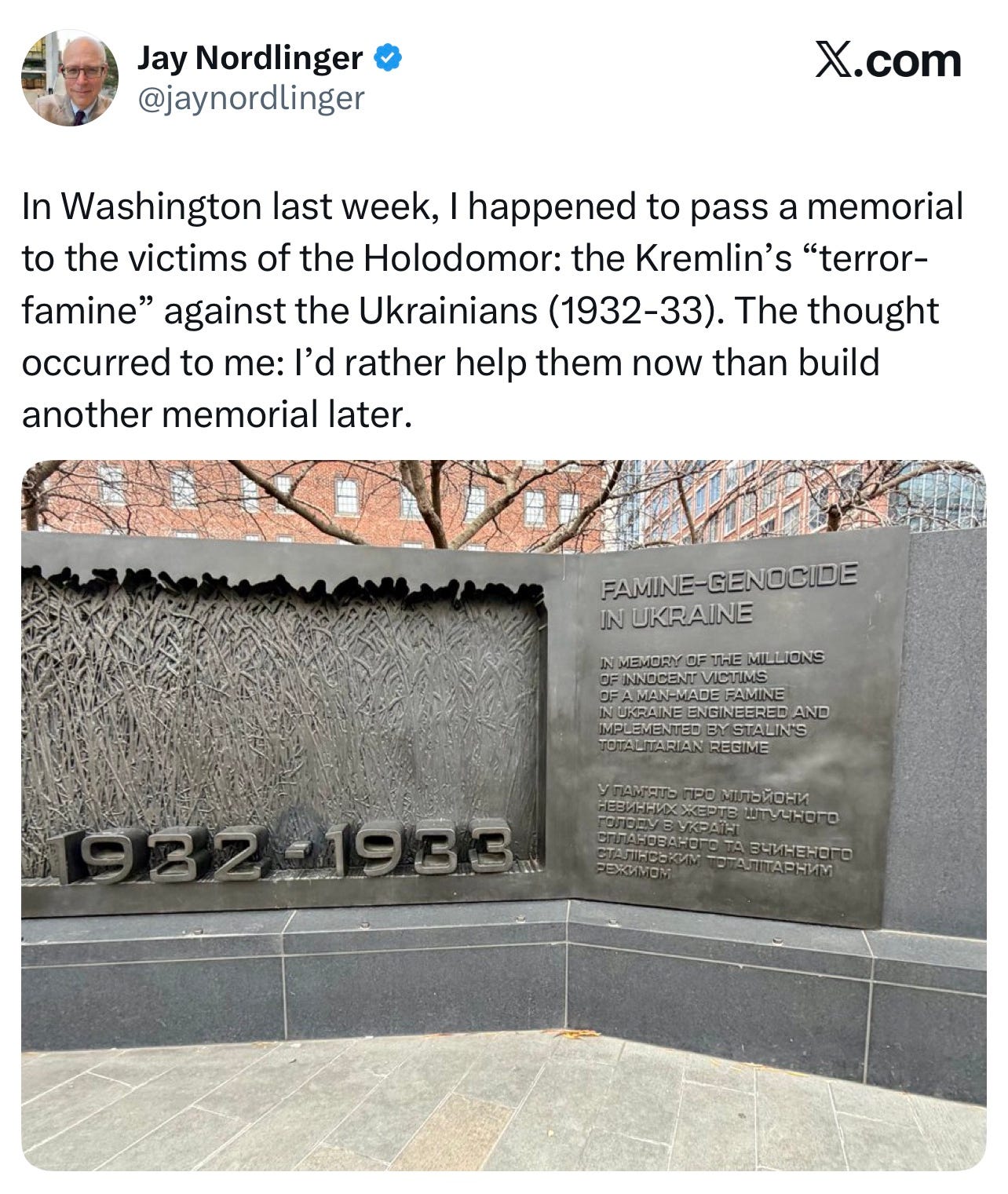
Jay is roughly the same age as I am.
He claims to be a “patriotic American.”
He opted not to serve in the military, but rather work as a conservative opinion journalist whose career was built critiquing the ideas and actions of others without ever undertaking any effort to build something derived from his own ideas or labor.
He walks past a “memorial” to the “Holodomor” in Washington, DC, and suddenly is overcome by a desire to “help them now” rather than “build another memorial.”
Jay, do some due diligence.
The “Holodomor” is the creation of a British anti-Soviet propagandist named Robert Conquest. Conquest worked for the Foreign Office’s Information Research Department, where he was tasked to “collect and summarize reliable information about Soviet and communist misdoings, to disseminate it to democratic journalists, politicians, and trade unionists, and to support, financially and otherwise, anticommunist publications.”
His work with the IDR produced the research he later used to write “The Harvest of Sorrow”, which became the foundational information source leading to the manufacture of the myth of the “Holodomor” (the term “Holodomor” was an invention of Oleksiy Musiyenko, a Ukrainian nationalist who published a speech on the topic of the famine of the 1930’s in a newspaper in February 1988.)
Conquest’s mythology of Soviet (i.e., Russian) induced genocide against the Ukrainian people has been a rallying cry of the Organization of Ukrainian Nationalists—Bandera faction (OUN-B) since the 1980’s.
At that time, the OUN-B staged a takeover of the Ukrainian Congress Committee of America (UCCA). This coup positioned the Banderist diaspora in America to control US-Ukrainian relations (just a reminder that Stepan Bandera was a Nazi collaborator responsible for the murder of tens of thousands of Jews, and hundreds of thousands of Poles, Ukrainians and Russians during WW2).
The UCCA spearheaded the effort to build a memorial to the “Holodomor”, and commissioned Larysa Kurylas, the daughter of Banderists who fled Ukraine to the US in the 1950’s, to design the memorial. Kurylas had been thoroughly indoctrinated into the Banderist ideology as a member of the Plast Ukrainian scouting organization in the Baltimore, Maryland area, and had been indoctrinated on the “Holodomor” while taking a Ukrainian studies summer course at Harvard University under the tutelage of James Mace, a research assistant to Robert Conquest.
Jay, the “Holodomor memorial” in Washington, DC is an ode to Banderist mythology designed to further the bloody cause of western Ukrainian nationalism, with is synonymous with some of the worst crimes in modern history, including the Holocaust.
The “memorial” should never have been built, because it simply perpetuates historical myths used to legitimize the odious ideology of Stepan Bandera.
Kurylas herself acknowledges her desire to have the memorial serve as an ideological motivation tool for future generations of Banderists trained here in America by the Plast scouting movement and other Banderist affiliated organizations such as the Ukrainian Youth Association, which runs a summer camp designed to indoctrinate Ukrainian-American youth on the teachings of Stepan Bandera.
And now you want America to support the Banderist nationalism that has gripped Ukraine today, a nationalism that triggered a conflict with Russia that has killed hundreds of thousands of Ukrainian people.
Do better, Jay.
Supporting the progeny of literal Ukrainian Nazis is not how American “patriotism” should be manifested.
oooooo
@tobararbulu # mmt@tobararbulu
Interview with Valery Korovin
Interview with Valery Korovin
Dec 17, 2025
In this special edition of The Russia House with Scott Ritter, I am in downtown Moscow, where I had the pleasure of interviewing Valery Korovin, a renowned Russian political scientist and public figure. Valery is Director of the Center for Geopolitical Expertise, Deputy Head of the Center for Conservative Studies at the Sociology Department of Moscow State University, member of the Eurasian Committee, Deputy Head of the International Eurasian Movement, and Editor-in-Chief of the Eurasia Information and Analytical Portal. Valery and I had an illuminating conversation about Russia’s Eurasian identity and how that factored into Russian geopolitical reality.
Transkripzioa:
Hello, and welcome to a special edition of the Russia House with Scott Ritter. Today, I continue my work in Moscow, where over the course of the past two weeks, I’ve had the honor and privilege of interviewing a wide variety of Russian public figures, whether the military-related, economics, politics.
Today, I’m honored and privileged to have as my guest, Valery Karovin, you are the director of an institute of excellence. When I look through your biography, I see the word Eurasian used a lot. I think you’re the deputy director of the International Eurasian Institute. You have your own podcast that focuses on Eurasian issues.
And I’d like to focus in on that word because our discussion is being done for the benefit of an American audience, just so you understand the background. My project over the course of the past few years is to try and defeat Russophobia in the United States, this ignorance-based hatred of all things Russia.
And to me, the vaccine for this disease is knowledge about Russia, the Russian reality. And so that’s why I endeavor to have conversations such as this for an American audience. Sometimes the questions that I might ask would appear to a Russian audience to be naive or simplistic, but you have to keep in mind who we’re speaking to.
We’re speaking to an American audience that doesn’t know that much about Russia and can get confused about Russia. When we speak of the term Eurasia, I remember I traveled to Ekaterinburg, and outside the city there’s a point where you can stand where you have one foot in Europe, one foot in Asia. But is it that simple?
Is it simply just a geographic demarcation? Or is there something more philosophical behind the term Eurasia when it applies to Russia?
Eurasia is a philosophical category, no doubt about it, and it is associated with the phenomenon you have just mentioned, that Russia stands in Europe with one food and in Asia with its other food, and in this connection Russia has developed as a unique civilization in its own right. Strictly speaking,
it is not European and it is not Asian in the strict sense of the word as it is understood in Asia. It is some sort of a civilization synthesis when we borrow the best traits of the European civilization and the best qualities of the Asian civilizations. civilizations that are in Asia. And in this connection,
Eurasia is a philosophical civilization category that unites a lot of meanings taken from Europe and from Asia. And similarly, we can neither call Russia a European or an Asian civilization. It’s a civilization in its own right. And this is what Russian philosophers arrived at in the early 20th century.
Most of them were in immigration after the October coup. And when they were watching the development of Soviet Russia, they identified certain constant features of Russian history and Russian civilization that were consistently noticeable during the Empire period, Tsarist period, and the Soviet period, which means that there were permanent trends
traits of Russian people and of Russia as a state that stretches from Europe to Asia, that has accumulated the best features of Europe and Russia. And this is what Eurasia is about as a mindset. And it is a mindset because it encompasses the whole spectrum of problems from most
sublime notions like relationship with God Almighty down to the military, geopolitical spheres and other spheres. And it is a pluralistic approach to the notion of state building. The state is an empire rather than a nation as in Europe. And this form of empire as a form of statehood is traditional and it represents a
strategic unity of the entire diversity of nations, cultures, languages and ethnic groups who are joined together within the framework of that Eurasian civilization. And it is a Russian idea and it places the Russian cultural and civilization type, the Russian code, at its foundation across the board in every aspect.
This is how Russians see a just and fair statehood, a just attitude to the diversity of languages and cultures and how Russians preserve this diversity so it It does not disappear into obscurity. Russians love their identity, their culture and their specific features so much that they esteem other cultures, other identities, languages and religions. It is a pluralistic
plural reversal approach as opposed to a universal approach that is promoted by Western globalists by mixing everyone into this post-humanity biomass, wiping away specific features. The Eurasian approach maintains this plurality. And this is a standoff between two civilizations, seafaring and land civilizations. At the same time,
it is important to note that it is an ideology that is not only linked to the Eurasian continent, but it is something that, at least now, that is now implemented and embedded in the concept of a multipolar world. It is a distributive approach, which means that a Eurasian ideology can be installed in any
country in any state that follows the plurality idea, the idea of national identity that is against this wiping out of borders and dehumanizing any civilization outside the European continent that is in favor of this approach is also Eurasian, whether it is in Latin America or Africa or it is in South Asia or elsewhere.
Similar to the Atlantic Western approaches that are currently that are currently being implemented or at least there are attempts to implement of them elsewhere by the west imposing the western lifestyle as a universal lifestyle and and it is being opposed by an alternative to the western mindset because it is
not the only one a universal mindset it is one of many This is the foundation of the theory of a multipolar world, and one of such polars of such a multipolar world that is being established as we speak is Eurasia.
Thank you very much for that. My daughter studied at Georgetown University. It’s one of the elite foreign policy academic institutions in the United States, and she had a focus on Russian area studies and the Caucasus area studies. But what she was taught, and it led to many interesting conversations around our table,
Is that Eurasia and the term that it’s the way it’s used by Russia is a smokescreen for colonialism. You use the term empire. You said you spoke of empire as opposed to nation building and you spoke of it as a in a positive way. But the way we treat empires are as a controlling mechanism for colonial subjects.
And when we look at the Russian Federation today, we look at Chechnya, Ingushedya, We look at Dagestan. We can go into Bashkiria, Tartaria, Udmurtia, the various different republics that are centered on ethnic identity. How would you tell or explain to an American audience why these aren’t colonies of the Russian Empire?
why these nations are actually, as you said, part and parcel of the Russian nation. How can a Tatar be part of the Russian nation? How can a Bashkir be part of the Russian nation? Aren’t they simply just colonial subjects of the Slavic superpower?
We have already mentioned that the Russian worldview is different from an Anglo-Saxon worldview and the Western view of the world as a whole. And Russians view the world under a different light compared to Anglo-Saxons. A colony is a category that relates to the Anglo-Saxon foreign policy to exploit and to enrich themselves.
And this is why there is this juxtaposition, a colony that is being captured and occupied by a metropole to exploit and to pump out as many resources in favor of This is imperialism when an empire exploits a colony for the benefit of such parent state, mother country. that actually in favor of the metropolis that imposes its religion,
its values, and it scorns and does not respect the culture and religion of those people of those nations that they exploit and make their slaves slaves and this approach is entirely different compared to the Russian approach because our empires are based on the principle of center versus periphery and it is the principle of
building and improving when a center does not occupy, does not conquer colonies, and actually it takes them not to exploit and enrich themselves, but to improve those regions that it has added. Over a period of 10, 15 years presence in Afghanistan and from the Anglo-Saxon external policy, it was characterized as aggression and occupation.
Over a period of that occupation, Russians managed to build 10,000 infrastructure facilities that are being used and run by Afghanistan people. And American troops were using those infrastructure facilities when they entered Afghanistan. This was infrastructure. built by the Russians. And this is a very clear description of our approach.
And when we respect the cultural diversity and traditions of those peoples that we added to our state to save them from Western exploitation, These are two types of empires. Imperialism is a term used to characterize Western empires that exploited colonies in favor of parent states. And actually, if we look at traditional Russian empires,
They use a different principle. They improve and develop those people and cultures, and they do not exploit but care for those people. They ensure safety and security development. And those Soviet republics that subsequently exited the Soviet Union during the disintegration, they were developed in the soviet times theaters were built there were research
institutions created academies of sciences were opened there were lots of national writers and literally those people who wrote books and there was an impetus given to the development of culture and literature. And at the same time, everything that is possessed by the former Soviet republics was built during the Soviet period, thanks to that Russian core.
who acted as a guardian. And actually, Russian nationalists criticize us for that. They keep saying, why did Russia invest so much into those republics? Because they are now opposing Russia. But this is what Russian people are about. They cannot do otherwise. This is the prism. They look through They use justice and fairness as a guiding principle,
and they treat other nations as their own, or even better, because many Soviet republics were much better. more better off than Russia. For example, Georgia was a flourishing republic. There was a very high level of per capita income there. The same relates to the Baltic states, and they were kind of a shopping window for Europe.
The electronics, microelectronics industry was highly developed. There were high technologies, the life standards were very high. Now we are watching them stagnate and people are leaving the Baltic states because it is next to impossible to leave there. There is a joke. in the Baltic states, that there is a notice at an airport in Riga,
he who leaves the country last, please turn off the light. This is how life is, how hard life is there. In the Soviet days, these were flourishing territories. Speaking about national structures like Bashkir or Tatarstan or Kalmykia or Yakutia, they are the legacy of Lenin’s national policy that was borrowed by Lenin from Europe,
where after European empires collapsed, there was a domination of the Republican principle of national statehood. The rest was treated as something that they had managed to overcome. If we look at such category as people, Laos in Greek, ethnicity. This is derived from the word blood or origin.
And all that in Europe, it was declared that all that was overcome. And the only category of collective identity was a political nation. And it is a political unity of atomic citizens who are cleansed of ethnic identity or collective identity. So we are talking about a citizen.
without any qualities and a population of such citizens is a political nation. So this concept of a nation does not appeal to people’s origin, including ethnic origin. A Frenchman is someone who is a holder of a French passport, not someone who has a Franco origin, an Arab or someone from Turkey or China or whatever other country,
if that person gets a French passport, passport, that person becomes part of the French nation. Actually, it looks like there is no identity, like in the United States. A U.S. passport holder belongs to the American political nation. So there is no culture, no language, no ethnic origin.
Whereas, in fact, everyone understands that they exist, but they pretend that it does not exist. And they are making an impression that the United States is a melting point. Well, that melting pot is not working. Over the period of 200 years of American civilization, nothing has been diluted.
Those bits and pieces of identity are still floating in that melting pot or boiling pot. Because if we take Latinos, they still preserve their ethnic roots. If we look at Puerto Ricans, Mexicans, they continue to exist and they are not diluted in that melting pot, despite the fact that they are US passport holders.
And Russia does not pretend that it does not have those ethnic groups and the diversity of nations and nationalities, and that there is only a homogeneous Russian nation. No, there are these ethnic identities. We have Chechens, we have Tatars, we have Yakuts, we have Kalmyks, And there are about almost 200 ethnic groups and nationalities who preserve their
national identity. And this category is taken into account by the U.S. government. But Lenin’s heritage that the West has… By the way, he borrowed the Marxist theory from the West. Due to some reason, inside Russia, The so-called republics were created, the Tatar Republic. By the way, the population of Tatars is less than 50%.
The rest are Russians and Bashkirians. If we look at the Bashkirian Republic, Bashkirs account for a minority, in minority, and Bashkirians live all over the country. The main trait is that they have their national identity as Bashkirs and no one is trying to destroy or do away with their identity.
Therefore, a republic is a redundant category in Russia. No one needs such republics because we have not eradicated ethnic groups or nationalities. We’re not pretending that they’re not existing. No, we take them into account. We keep developing their cultures, their traditions. We keep enriching their cultures. And all those of Bashkir origin,
those who want to speak their native tongue, they learn their native language at schools, and no one prevents them from that. But at the same time, person of Bashkir or Tata origin can become Russian. You can become Russian and it is not a must that you are born Russian.
You have to born a Chechen because it is an ethnic group, which means that Norse people, those who were on board of Norse Ark. And people are a big, super-ethnic community, and it is not a nation that represents this melting pot of atomic citizens that have no ethnic identity. But we are people, that is Laos in Greek,
Russian are a super ethnic and cultural civilization type. You can become Russian if you have accepted Russian identity. If you start speaking Russian, if you are baptized in a Russian Orthodox Church, and if you become part of Russian culture, and despite your ethnic origin, is a Bashkir or a Tatar, you become Russian.
And a republic is a redundant category that we inherited from Lenin. And a republic, as President Putin says, is a slow-action mine under the Russian statehood, similar to the Republican division in the Soviet Union that was also a slow-action mine for the Soviet Union statehood. that was split apart along the borderline of those artificial republican formations.
If we look at Kazakhstan, Kazakhstan is a republic that was artificially created in the north of Kazakhstan. The north of Kazakhstan was populated by Russians because those territories belonged to Russia, and then they were added to Kazakhstan due to whatever reason. Kazakhs used to live in the south. When the Soviet Union disintegrated,
the Soviet Union borders were taken for granted, and Russians were wasted. were ousted and chased away. The same relates to Ukraine. It was an artificial political project that was developed by Bolsheviks and Lenin taking bits and pieces, various fragments, of the Russian Empire, and it was composed at random. So that artificial structure,
when it withdrew from the Soviet Union, started oppressing Russians when they began building the Ukrainian nation. Ukrainians should worship Lenin. Because if not for him, there would be no Ukraine. Speaking about Moldova and other republics, they were also created artificially and the Soviet Union was split apart along those artificial borders. So this Russian statehood is not, well,
this model of a national state was borrowed from the West. Everything which is borrowed from the West is a destructive force. What is good for a Russian is bad for a European. Therefore, that good nation state for Europe is suitable for Europe, but it is death for Russia, it is a disintegration for Russia. But an empire,
a traditional empire that improves, preserves diversity of identities and protects based on the principles of plurality, this is a traditional Russian statehood notion, but it is not a Western empire, it is a Russian empire.
Thank you very much for this. I was reading your biography and I saw that you’ve written on a number of occasions about the North Caucasus. And you mentioned in your discussion here the role of Chechnya. I’ve had the honor of visiting Grozny twice. I had been… conditioned by the American version of history,
which of course has the Russians fighting two brutal wars against the Chechens to suppress their national identity, et cetera, that Christians were against Muslims. But the Grozny I saw was something completely different, totally different reality. And yet I have very difficult time explaining to the American people why Chechnya is real and why the Russian-Chechen collaboration is genuine,
that it’s not the Russian empire suppressing the Chechen people. How would you describe the relationship between Russia and Chechnya given two things? One, the history of the two wars that have been fought in the last several decades. And two, the fact that the Chechens are The exclusively Muslim people in Russia is a Christian Orthodox Church,
and yet somehow this hasn’t become a clash of civilizations, this has become people unified in the principle of the Russian nation.
The Caucasian Wars started only when Anglo-Saxons interfere. Anglo-Saxons are the source of war. They are a catalyst of every war. They act as a trigger that starts wars in Eurasia, to weaken Eurasia, because Anglo-Saxons, as we’ve already said, use that principle of exploitation. They need to come to a particular region on this planet and exploit the treason.
And in order to exploit That region has to be weak, has to be divided, has to be unstable. Then it would be easy to manipulate and manage it from the outside. Caucasus is a part of the Eurasian civilization. And the biggest part of its history, it’s been a part of the Russian Empire.
Therefore, Russia is not interested in having a war in the Caucasus. Russia is interested in peace and stability there. But who is interested in a war there? Anglo-Saxons. And when they go to the Caucasus, there are wars there. Two Chechen wars were the consequences of Western influence on the Caucasian region.
At first, there were theoretical models of a national state of a Republican type. that used to exist in the Caucasus after the October coup thanks to efforts exercised by Lenin and that had not existed during the times of the Russian Empire and then afterwards by provoking separatism by artificially
stirring political categories and imposing them on the Chechen ethnic group Anglo-Saxons managed to orchestrate those two bloodshed. But that is relevant to any part of the world. This is not a religious clash, it is not a religious standoff, but it is a phase of political projects that are
designed by Anglo-Saxons to snap the nose of those states whom we want to weaken or destroy. British missionaries English strategists, American strategists were making attempts to move further into the Eurasian continent to acquire a foothold for strategic control over the entire region, starting from the Black Sea to the Caspian Sea. This is a purely technological approach.
It is an attempt to dominate for the sake of exploitation. Anglo-Saxons do not care about Chechens. They do not treat them as people. They are In their eyes, they’re dirty, they’re unwashed, they’re not civilized, they’re barbarians, they’re kind of expendable from the perspective of the Anglo-Saxon policy. And the same relates to other people,
whether we’re talking about India, China, or the Arab world, or Africa. All those people are… of no value to Anglo-Saxons. They treat them as barbarians and they can easily sacrifice them in whatever quantity. And therefore, the Chechen conflict was artificially It was imposed artificially from the outside and it was based on artificial political models,
in particular the Chechen Republic of Ichkeria. It was a British project that was designed by MI6 and it was implemented by the Brits in order to weaken Russia. There is no contradiction between traditional Islam and Orthodox Christianity. that used to co-exist on this large Eurasian continent for thousands of years and
there have never been any conflicts between traditional Islam and Orthodox Christianity because their mental, moral and ethical principles close to each other. And what is creating conflicts? It is the political ideology, Islamist political ideology that was developed by the Brits 300 years ago, for example, which is a political ideology based on Islam.
It is some sort of a surrogate. They take very superficial principles from Islam and they put political objectives on top in the interests. of the British Empire. This is what Islamism is, but it is not Islam. These are entirely different categories. One is a political ideology. It is a tool to achieve Anglo-Saxon objectives in the Islamic world,
fighting against their geopolitical opponents, in particular Russia. And on the other hand, we have a traditional religion of Muslims which is not aggressive, which is not hostile to Orthodox Christianity. It is a myth that is developed artificially to divide Muslims and Orthodox Christians in the interests of Anglo-Saxons. So wars are unleashed when Anglo-Saxons are present.
If you want to avoid a war, just make sure that there are no Anglo-Saxons present and you will have peace. Basically, the UK has to be isolated on the islands and surrounded by minefields and there must be patrol ships there so that those people who are driven by a devilish ideology of enrichment could not leave those islands,
let them stay there and then there would be the days of well-being law and order and development if we isolate Anglo-Saxons on their islands. But so far, they’ve been meddling here and there, and they’re creating completely artificial prerequisites. There are no ontological And Chechens are a traditional people and they have a traditional ethnic origin.
And when back habits were eradicated, were driven away from Chechens, Chechens became friends with Russians. without any contradictions. The same will happen in Ukraine once Anglo-Saxons are driven away because Ukraine is inhabited by Russian people of Mala-Russia origin and there have been no contradictions between them for centuries. Whereas Ukrainianship is a political ideology created in the West,
and those seeds were sown artificially based on Russophobia and hatred, impeccable hatred against Russians. And this is a devilish, a satanic logic of Anglo-Saxon approaches. to set Russians against Russians by instilling hatred towards the rest of Russia in the hearts of souls of some Russian people. This is something that is beyond comprehension for a true Russian.
Russians would never do that, but those who worship Satan, those Anglo-Saxons will continue doing so, and wars will be launched.
When you use the term Anglo-Saxon, though, it appears that you’re giving it primarily a British definition. You speak of MI6. You speak of the British imperial past. But the United States can likewise be called an Anglo-Saxon definition. country. Just yesterday, it emerged that there is a 28-point peace plan that’s coming out of Miami from the
meetings between Kamil Dmitriev and, I guess, Steve Witkoff. It deals with Ukraine, but here’s the question. It’s an American proposal. The British, of course, are behind it because they’re behind the conflict. You know, there’s a historian, Samuel Huntington. He wrote a book called The Clash of Civilizations.
But he postulated that it was a clash between Christianity and the Islamic world. What you’ve postulated is something completely different. I’ve met Abdi Al-Adinov. I’m sure you know who he is, the Chechen commander, Russian general. You know, he presented me with a flag of the Ahmad Special Forces. And on that flag, he…
presents both the symbol of Russian Christian Orthodoxy and the Chechen Republic’s Islamic foundation. And it’s a single flag representing a single concept, a single nation, which appears to contradict Huntington’s thesis of a clash of civilizations. when it applies to the Russian experience. But there is a clash of civilizations, the Anglo-Saxon civilization and the Russian civilization,
which Vladimir Putin has said is one of the great civilizations of the world. I know you want to surround England with landmines and patrols and keep them bottled up on their island, but in the reality of the world, How do we talk about the potential of peace, an American-backed peace plan with Russia,
in the context of this broader clash of civilizations between the Russian civilization and the Anglo-Saxon civilization, which has to include the United States?
Here is Abdiyoludinov and the flag you are talking about. We had a meeting recently. You are making a very valid point. when you are highlighting Hunter’s book, The Clash of Civilizations. But in his work, the principle, the main category is not the clash per se, but civilization. Because at some point in time, the West,
by declaring its cultural, historic values as universal, and by making a national state as the main category, The West declared that the Western view of the world, the Western mindset was dominating without any obstacles for the West and Anglo-Saxons in particular to own the rest of mankind. And in that book, Hansen noted,
do not be in a hurry, because there is a civilization that does not believe that humankind is uniform, but diverse. And if you keep imposing your view of the world, those civilizations would assert their identity and would retaliate, and thus you would provoke a clash of civilizations, because they do exist.
If you pretend that there are no other civilizations but the Western civilization, then you would provoke that clash. that and other civilizations would insist that they exist and The American statehood is Anglo-Saxon insofar as it relates to the fact that it is being led by Anglo-Saxon elites who are carriers of that Anglo-Saxon mindset, the mindset of exploiters,
an arrogant and haughty view of the world that does not take into account the diversity of civilizations. The problem of the relationship between Russia and the West, Russia and the United States, is that the West does not want to take Russia into account, does not want to take into account the fact of its existence,
to say nothing about Russian interests, even its existence is being discounted. And now in Europe, at schools, children read textbooks where there is nothing where Russia is. There is no word Russia written. It is some sort of a blank space, a black hole, as Begny Bzezinski used to say, something which is nothing,
because Western values are not accepted. on that space, on that territory. John Hobson, a Western theoretician, is very strictly right about the Western approach. He says, from the perspective of Anglo-Saxons, there is a civilization, it’s the West. And There are barbarians, the so-called second world. Those barbarians are trying to become like the West,
keeps catching up with the West, is running, but it cannot catch up with the West because it is inferior and they are backward. But there are also wild barbarians who can never become like Anglo-Saxons, and such barbarians are similar to trees and stones, rhinos, and from the perspective of bulls, and from the perspective of Anglo-Saxons,
barbarians are semi-human. They have some human experience, they try to imitate the West, but they never succeed because the West is a civilization. This arrogant approach, is the reason, is the root cause of conflict And it rests on the foundation that the West does not want to consider Russia, to take into account its interests,
and it rejects its existence, because Russia rejects the Western value to a certain extent, whereas other values are accepted. Russians take Western technologies to defend themselves from the West. Russians borrow Western models of rational thinking to defend themselves from the West, which keeps attacking Russia every 100 years. Every 100 years, the West attacks Russia.
It is not Russia that attacks the West or the United States. does not attack the United States because it acknowledges its existence, it recognizes its culture. We do not treat it as a very superior culture. We believe that it is a pretty low cultural standard, exists there.
But we admit that the United States has its interests and we respect them and we respect and acknowledge that the United States is the leader of the Western civilization. But we cannot accept any attempts to destroy us, to weaken us at first and then destroy us and eradicate us from the map of this planet.
This is something that we cannot accept. And this causes a conflict because Russians are defending themselves when the West attacks them. Russians go to Europe each time after Europe launched a war against Russia. First, we had Napoleon who came to Russia and Russians went to Paris. But when Napoleon
He burglarized and burned it, calling himself a civilized man. When Russians went to Paris, spoke fluent, perfect French and apologized to everyone. They went to restaurants, had some wine, paid every cheque, and Tsar Alexander I in person repaid all card debts of Russian hussars. And speaking that perfect French, they said goodbye,
and left without taking anything, without trophies. They were barbarians. So that civilized man, Napoleon, burned down Moscow together with its inhabitants who did not have time to escape, whereas Russian men paid for everything and left speaking perfect French. They did not try to to turn France into Orthodox Christianity.
They did not declare that Paris would be the capital of Russia. Maybe they should have done it and Paris could become the capital of the Russian Empire that would stretch across the continent, but Russians did not do that. The same happened in mid-1970s. It was Germany and the whole of Europe, jointly with Germany,
invaded the Soviet Union and they came to Moscow burning everything along their way and killing and murdering civilians. They were a civilized nation and they killed 27 million people, including 20 million civilians. They were not combatants, they were children and old men. This is why Russia went to Berlin. What did Russia do in Berlin?
It rebuilt German statehood. It recognized the contribution by the United States and the United Kingdom. Why? They didn’t do anything from the perspective of military effect. Their contribution was 1%, that landing, that notorious Normandy landing They were being defeated until Stalin started an operation in the east and French surrendered in a fortnight. Why were the winners?
Russia recognized them as winners and they actually divided Europe together, though they did not do anything for the victory except for the landlies when they were supplying equipment, weapons, cigarettes and canned meat. Maybe we should have given them back cigarettes and canned meat. So what did they do when we shared Europe with them?
They began another invasion against us from that that Stalin left for them. He could have taken everything, he could have captured everything, but he generously shared that victory with them. What did he get? NATO began moving back to the east. Russia let Ukraine go on condition that it would be neutral and it would maintain
its nuclear status and it would not join any alliances. What did American strategists do? They began Maidan and thus they invaded a neutral territory that was like a buffer between Russia and Europe. But it was an incursion by the West. It was in 2014 when the West launched a war against Russia in 2014.
It was not Russians who invaded Ukraine, it was the West who created that bloody Maidan and started nurturing Bandera supporters. And when they announced that NATO would join NATO and they would deploy nuclear This was the time when we started responding after eight years.
And if we look at the time when the Soviet Union was disintegrated, 20 years passed. And this was when we started responding. Thus, all conflicts between Russia and the West are stemming from the West. And the origin of the source of those conflicts is Western Anglo-Saxon
or arrogance that does not want to take into account Russia and its interests. The source is associated with the Western attempt to weaken and destroy The United States is being manipulated by the Brits. The United States is a tool for the United Kingdom because the UK installed, embedded its elite. through the view of the world,
the mindset and that Satan logic that British elites are associated with. This is why the United States continues to be a British colony that is being exploited despite the Day of Independence that is celebrated with so many people. colors and bright colors and joy.
And if we look at the root causes, the root causes are in the UK. They actually they captured the mindset of Americans, and the United States is acting as an obedient follower, and thus the new colonial policy of exploitation is being implemented. And as a response to this new colonialism,
is to that arrogance is given by other civilizations and Huntington was putting a focus on civilization, not on the world clash.
Thank you very much for this. And thank you very much for this entire conversation. As I said at the beginning, we use the concept Eurasia. We talk about that word, but we don’t understand its true meaning, especially when applied to the Russian context. And you’ve provided a sort of a PhD level explanation for the American audience.
I am deeply grateful for your knowledge, for your expertise, and for taking the time to join me today on the Russia House. And I want to thank you, the audience, for tuning in. Again, the reason why we do this, we have these conversations,
is to collect the Russian reality and bring it back to an American audience so you can be empowered with knowledge and information and make the critical decisions about war and peace, about bettering relations with Russia based upon your own beliefs and not what being told by others. Thank you for tuning in, and I’ll see you next time.
oooooo
@tobararbulu # mmt@tobararbulu
A Modern-day “Christmas Carol”, Part One: Oreshnik and the End of Arms Control
A Modern-day “Christmas Carol”, Part One: Oreshnik and the End of Arms Control
Part One of a Five-Part Series
Dec 22, 2025
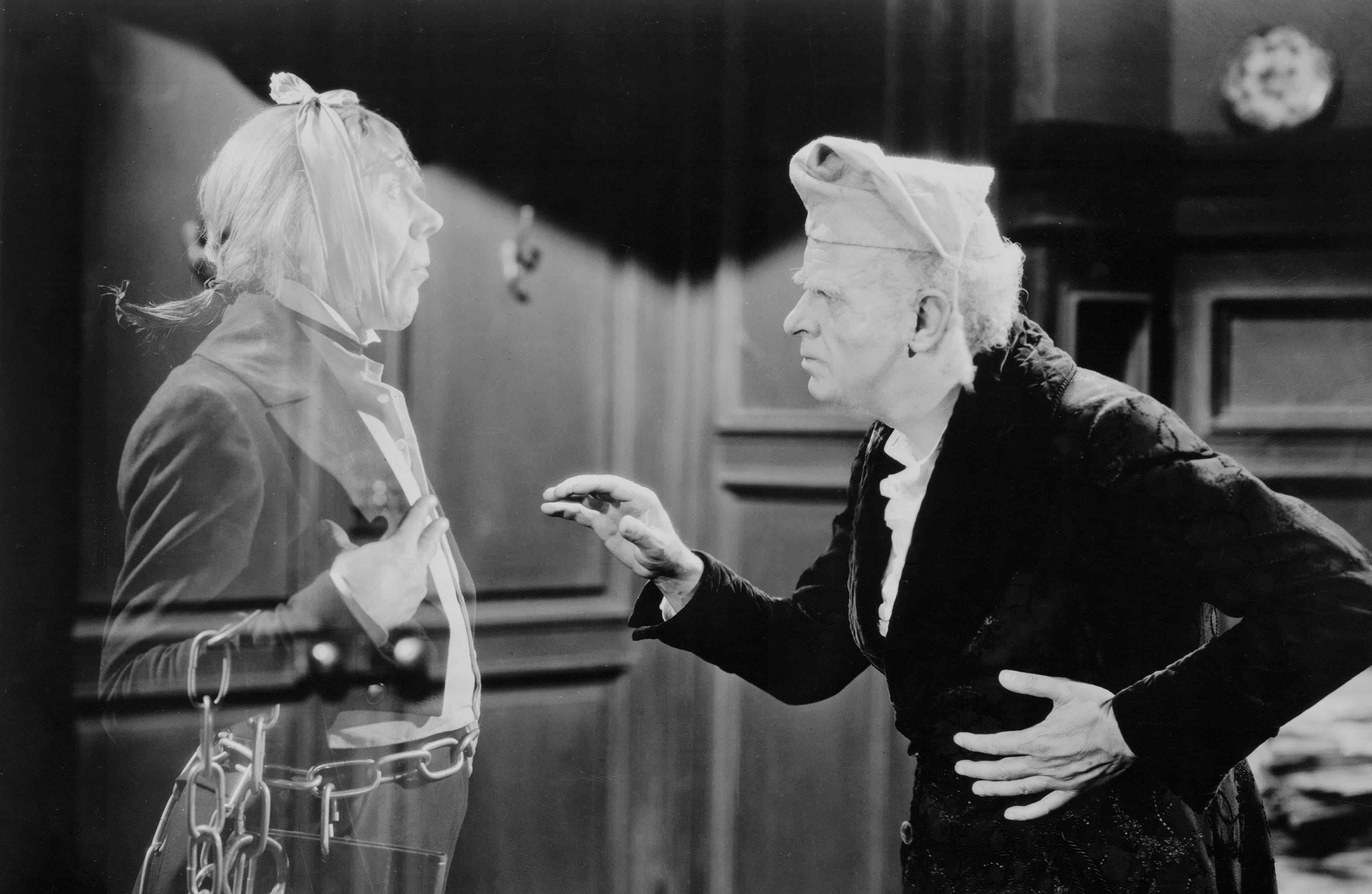
Ebenezer Scrooge (Reginald Owen) confronts the ghost of Jacob Marley (Leo G. Carroll) in Edwin L. Marin’s 1938 production of A Christmas Carol
“Marley was dead to begin with. There is no doubt whatever about that.”
Charles Dickens, A Christmas Carol
“The INF Treaty era is thus now emphatically behind us.”
Christopher Ford, The INF Treaty’s Two Ghosts
The Oreshnik phenomenon is wrapped up in the complexities of its present manifestation and the dark history of its own legacy, a combination which doesn’t bode well for modern-day proponents of arms control. In a five-part series that will be published starting today and continue through Christmas, we are visited by the three ghosts of Christmas past, present, and to come to better understand how we got to where we are, and the consequences of where we are going.
The Oreshnik missile (named after the Hazelnut tree) made its operational debut in dramatic fashion on November 21, 2024 when it was launched against military industrial targets in the Ukrainian city of Dnipro as part of an “operational test” conducted in support of Russia’s ongoing Special Military Operation against Ukraine. Hailed by the Russian leadership as a weapon possessing revolutionary characteristics of both a military and geopolitical nature, the Oreshnik emerged from the ashes of the now-defunct intermediate range nuclear forces (INF) treaty as a symbol of Russian political, technical, and military prowess.
But its INF legacy brings with it memories of betrayal, the burden of unfulfilled national potential, and the ragged emotions of a nation only now emerging from the tragedy of a past defined by the failure of arms control to deliver on its promise of a better life defined by prosperity and security. When seen in this light, Oreshnik is a break from the past, the symbol of a new beginning shaped by the prospects of fulfilling previous potential that had been cut short by the vagaries of history.
It is a reality that haunts us as we live and breathe, even though most of us are too ignorant of reality to realize it.
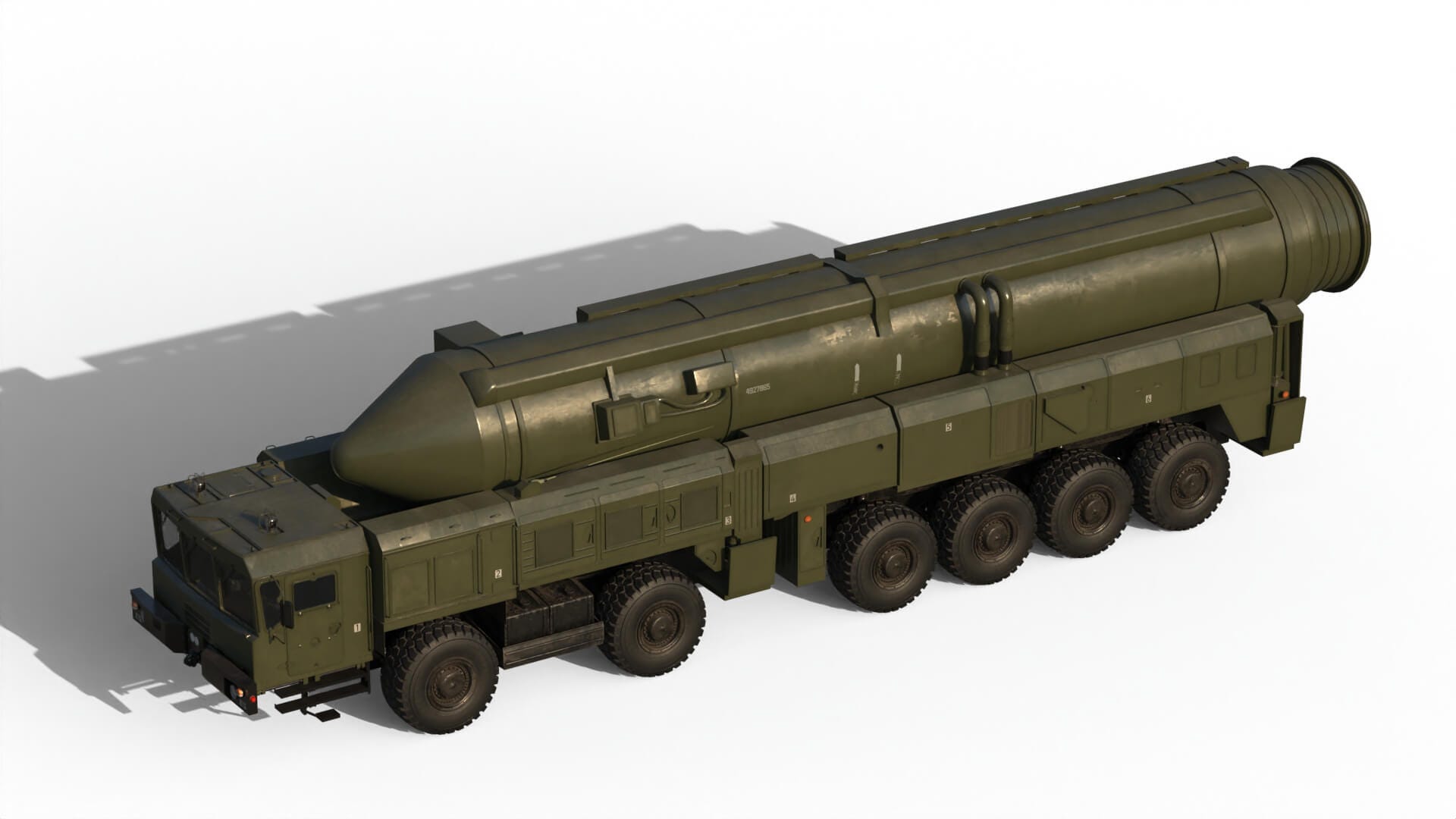
A 3-D model of the Oreshnik missile mounted on a MZKT-79291 mobile launcher
Fool Around, Find Out
Russian President Vladimir Putin recently announced that the Oreshnik intermediate range missile will enter operational service by the end of December 2025. The President of Belarus further clarified that the Oreshnik system will be put on combat duty during the same time frame. These missiles, which will be operated by the Russian Strategic Rocket Forces but responsive to targeting parameters agreed to by both Russia and Belarus, are intended to deter the increasingly aggressive policy pronouncements of Poland, Germany and NATO, whose leaders speak of preparing for a war with Russia by the end of the decade.
Russian and Belarus military commanders practiced planning the use of the Oreshnik missile system during the Zapad 2025 joint military exercises in September 2025 which focused on ensuring the military security of the Russia-Belarus Union State. These drills included planning for employing the Oreshnik in a nuclear-armed configuration.
The operational deployment of the Oreshnik missiles is the final act of a six-year drama which began in August 2019, when the United States unilaterally withdrew from the INF treaty, citing unproven allegations of Russian noncompliance. At that time, Russian authorities unilaterally introduced a moratorium on the deployment of nuclear-capable intermediate range missiles if the United States and its NATO allies did the same. Even though the United States tested a ground-launched Tomahawk cruise missile within days of the termination of the INF treaty, the Russian government Moscow reacted to this provocation with restraint, maintaining the voluntary moratorium while undertaking to begin developing a ground-based medium-range hypersonic missile system which operated under the codename “Oreshnik.”
This was announced by TASS in March 2021.
By the summer of 2023, Russia was confronted with the reality that its Special Military Operation in Ukraine, initiated in February 2022, had turned into a full-fledged proxy war between Russia and the collective West, inclusive of the United States and NATO. The Commander-in-Chief of the Strategic Rocket Forces, General Sergei Karakaev, announced that work on the work on development of the medium-range mobile ground-launched missile system as part of the Oreshnik experimental design project intensified starting in July 2023.
By November 2024 the Russian Strategic Rocket Forces had assembled an operational testing unit at the main ballistic missile testing range in Russia, Kapustin Yar. This unit consisted of operational launchers and several experimental missiles which were undergoing testing and development. Under President Putin’s orders, this testing unit carried out an “operational test” of the Oreshnik on the night of November 21, 2024, striking the former Yuzmash missile production facility in the city of Dnipro.
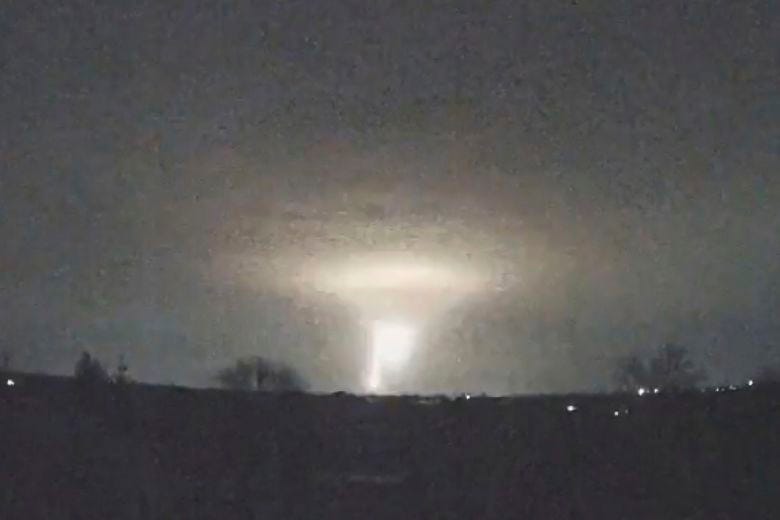
Submunitions from an Oreshnik warhead striking Dnipro, November 21, 2024
In discussing the decision to develop and employ the Oreshnik missile, President Putin stated that the missile was a direct response to NATO’s increasingly aggressive actions in Ukraine and against Russia, as well as the American decision to withdraw from the INF treaty. “Missiles like Oreshnik are our answer to NATO’s plans to deploy medium- and shorter-range missiles in Europe and the Asia-Pacific,” Putin said. “It was not Russia but the United States that destroyed the system of international security,” he added, noting that the collapse of the INF Treaty and other arms control agreements was the direct result of the US clinging to its “hegemony” at the expense of global stability. America, the Russian President observed, was “pushing the whole world toward a global conflict.”
On November 24, 2024, President Putin announced that the Oreshnik missile was going to be made operational and ordered the Ministry of Defense to transition from conducting research and development to serial production and operational deployment of the Oreshnik system.
In December 2024, in conversations with Belarus President Alexander Lukashenko, President Putin announced that an Oreshnik operational unit (later declared by the Russian Ministry of Defense to be a Brigade in size, consisting of three battalions of three launchers each) would be deployed to Belarus by the end of 2025. By March 2025, President Lukashenko announced that the Minsk Automobile Plant (MAZ) had initiated manufacturing of several launchers, specially modified variants of the12×12 heavy wheeled MZKT-79291chassis, which were nearing completion.
In June, President Putin announced that the Oreshnik missile had entered serial production, and by August the Russian leader declared that the first serial-production Oreshnik missile had been turned over to the Strategic Rocket Forces. That same month Russia declared that it no longer considered itself bound by the self-imposed moratorium on the deployment of nuclear-capable intermediate range missiles. The Russian Foreign Ministry said the decision was guided by the ongoing efforts by the US and its allies to develop intermediate range weapons and preparations for their deployment in Europe and Asia. The Foreign Ministry singled out US plans to deploy Typhoon and Dark Eagle intermediate range missiles in Germany by the summer of 2025.
Three months later the Oreshnik Brigade became operational in Belarus, officially being designated as being on “combat duty” by the Russian and Belarus government. According to General Karakaev, “Combat duty is the highest form of maintaining combat readiness and the basis for the actions of Missile Troops in daily activities. The combat duty system in the Strategic Missile Forces is a set of activities carried out at all levels of management aimed at maintaining the combat readiness of troops and the ability to complete a combat mission in the shortest possible time.”
The US had fooled around and found out.
Christopher Ford, then serving as the senior director for weapons of mass destruction and counterproliferation on the National Security Council staff, addressing the Arms Control Association on June 2, 2017
The Man Who Killed the INF Treaty
Christopher Ford is not a fan of arms control. In a treatise published on the occasion of the 39th Reunion of INF inspectors/negotiators/facilitators, Doctor Ford lays out in stark terms his reasons for seeking the demise of the INF treaty, all premised on the unproven notion that Russia was producing and deploying a missile which violated the range limits mandated by that agreement.
“I was in college studying international relations when Ronald Reagan and Mikhail Gorbachev signed the Intermediate-range Nuclear Forces (INF) Treaty in 1987,” Ford writes, “abolishing that entire class of delivery system. Years later, I followed the emergent issue of Russia’s violation of that treaty when I was a U.S. Senate staffer, and thereafter ran the WMD and Counterproliferation Directorate at the U.S. National Security Council (NSC) in 2017 when we adopted the U.S. “responsive strategy” to Russia’s violation. When the United States finally pulled out of the Treaty in 2019, I was serving as US Assistant Secretary of State for International Security and Nonproliferation, and I had the honor shortly thereafter of also performing the duties of the Under Secretary for Arms Control and International Security as we took US policy into the post-INF environment in the aftermath of the Treaty’s demise.”
Christopher Ford is proud of being present at the INF Treaty’s deathbed. “The INF Treaty era,” he brags, “is thus now emphatically behind us.”
But Mr. Ford isn’t satisfied with simply killing what was the foundational arms control agreement of the modern era, which institutionalized on-site inspection as a foundational compliance verification methodology and, in doing so, bringing to life the philosophy of “trust but verify” that defined arms control for generations to come (it should be noted that Christopher Ford was part of the US arms control team which rejected the Russian offer, made in January 2019, of a physical inspection of the Russian missile system—the 9M729—at the center of the controversy.)
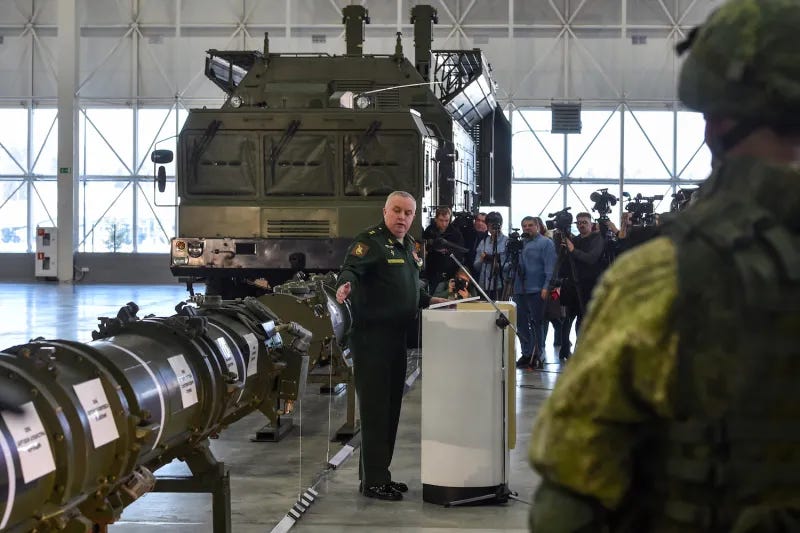
A Russian General briefs the foreign press on the technical characteristics of the 9M729 missile, January 2019
Had Christopher Ford understood the importance of on-site inspection, inclusive of direct visual examination and observation, combined with direct dialogue derived from such examinations and observations, he might have realized that the Russian claims of compliance could have been either confirmed or rejected by such inspections. I know, because I helped write the book on on-site inspection as one of the first INF inspectors on the ground in the Soviet Union implementing that treaty, and for seven years I took the lessons learned from INF and successfully conducted forensic on-site inspections of Iraqi WMD. Inspections work, and Christopher Ford and his ilk wouldn’t even give them a try because, by not engaging with the Russians, they had they answer they wanted and could proceed without fear of being contradicted by facts.
Having killed INF, Dr. Ford now wanted to make sure it stayed dead, by driving a stake through the very concept of arms control, especially as implemented with the Russians. “From the perspective of how this episode has shaped the collective consciousness of the US arms control and strategic policy community,” Ford wrote, “however, it seems to me that the deceased Treaty still haunts us in two ways, each of which tends to point in a different direction in terms of its potential policy implications. These are what I refer to as the ‘two ghosts of the INF Treaty,’ and I think it’s especially important to draw attention to both of them as we consider INF’s legacy.”
Th first “haunting” is what Dr. Ford calls “The Ghost of Failed Endeavor”. the INF Treaty as a failed endeavor. “INF was a treaty that the Soviets signed, but that collapsed because Russia cheated,” Ford declares, again repeated his unproven (and by his own admission untested) mantra of Russian noncompliance. “Our prolonged adherence to INF thus contributed to the risks we face today of a potential failure of deterrence in the face of Russian overmatch in a broad range of sub-strategic delivery systems that the Kremlin has made into a vital plank of its strategies of coercive nuclear bargaining.”
Arms control, Ford believes, made America weak. “More sophisticated adherents to this view,” Ford notes, “may add that even when Russia remained compliant, the INF Treaty kept us from developing and deploying the sort of theater-class systems we need vis-à-vis China in the Indo-Pacific. Some Republican hawks, moreover, still harbor the suspicion that the Obama Administration hid Russian cheating from the Senate to get New START ratified, adding a gloss of seeming domestic political betrayal into narrative of INF’s failure.”
The second INF Treaty “ghost”, Dr. Ford writes, “has a happier face…in this alternative narrative, the INF Treaty offers a salutary model of how to negotiate arms control agreements in the face of adversary nuclear threats. This spirit is the ‘Ghost of Negotiating Leverage.’”
As Ford explains, “This more congenial ghost focuses not on the INF Treaty’s collapse that I witnessed firsthand, but rather upon how we got the Treaty in the first place. Specifically, it revolves around how the United States and its NATO partners reacted to the Soviet Union’s deployment of SS-20 missiles in Eastern Europe not by imagining that arms control diplomacy could magically secure us against such threats all by itself, but rather by first making a hard-nosed and politically painful decision to meet those SS-20 deployments by our own development and deployment of a countervailing ‘Euromissile’ arsenal. Only then,” Ford declares, “could arms control diplomacy – in the form of Ronald Reagan’s famous 1981 “Zero Option” proposal – step in to make the problem go away. Successful negotiating occurred only once we had finally given our adversaries an unmistakable reason to negotiate seriously with us.”
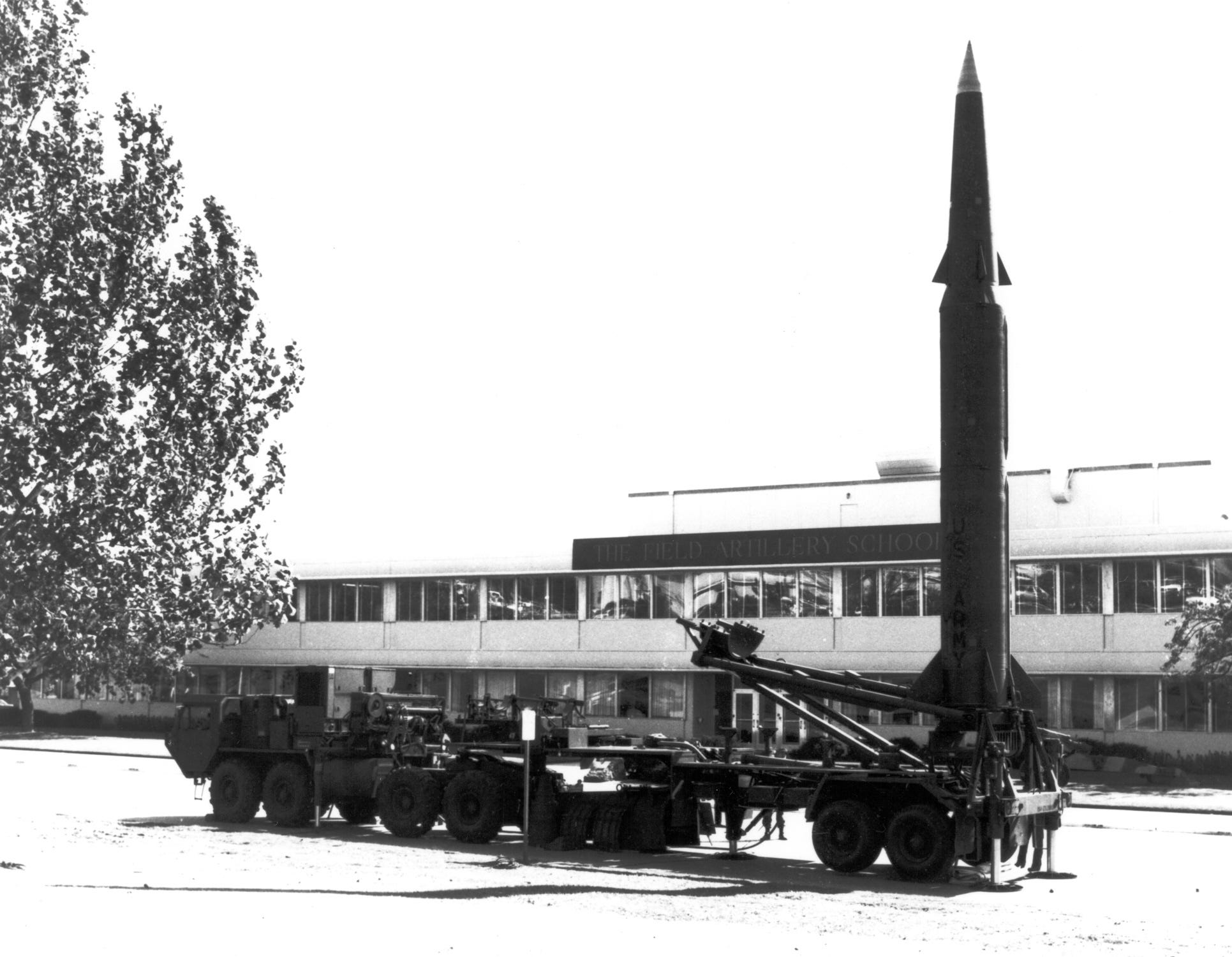
A US Army Pershing II missile deployed to West Germany in 1983
According to Dr. Ford, the ‘Ghost of Negotiating Leverage’ “counsels that peace through strength is possible, and that resolute attention to meeting threats in concrete ways that change adversary incentives can catalyze arms control opportunities.” Moreover (and perhaps more importantly, given Ford’s dislike of arms control), this ghost “fails well”, because “even if our own counter-deployments don’t result in arms control progress in a Reaganesque “zero-zero” sort of way, we’ve still taken key steps to counter the threats and preserve deterrence” because “ending up with a more robust deterrent is immeasurably better than sitting back and wringing our hands while adversaries build up nuclear posture advantages against us.”
It is almost as if Christopher Ford designed his statement with the current Oreshnik reality in mind. After all, the United States is once again confronted with Russian INF “overmatch” like that which existed in the early 1980’s when the Soviet Union deployed the SS-20 missile. The US now has the perfect opportunity to practice the “peace through strength” model of negotiation Ford seems to prefer, “meeting” the threat posed by Oreshnik by deploying our own INF systems (Typhoon and Dark Eagle) to “catalyze arms control possibilities” that Ford doesn’t even believe in.
The result, Ford believes, is a good one—the development of a “more robust deterrence” that supersedes handwringing by those silly, naïve arms control advocates.
Christopher Ford would do well to familiarize himself with the preamble to the INF treaty:
Conscious that nuclear war would have devastating consequences for all mankind, Guided by the objective of strengthening strategic stability, Convinced that the measures set forth in this Treaty will help to reduce the risk of outbreak of war and strengthen international peace and security, and Mindful of their obligations under Article VI of the Treaty on the Non-Proliferation of Nuclear Weapons.
I wasn’t a college student studying international relations when those words were put to paper, and signatures affixed brought the theories enshrined in this text to life.
I was an Officer of Marines who had already spent three years on the front lines of the Cold War, in a nuclear-capable field artillery unit that trained every day for the possibility of closing with and destroying the Soviet threat through (nuclear) firepower and maneuver.
I was a child of the Cold War who grew up in West Germany during the late 1970’s and early 1980’s, fully cognizant of the danger posed by weapons like the Pershing II and SS-20; I lived next door to the North Point nuclear weapons storage facility, and understood only too well what the consequences of war would mean to me and my family should deterrence fail.
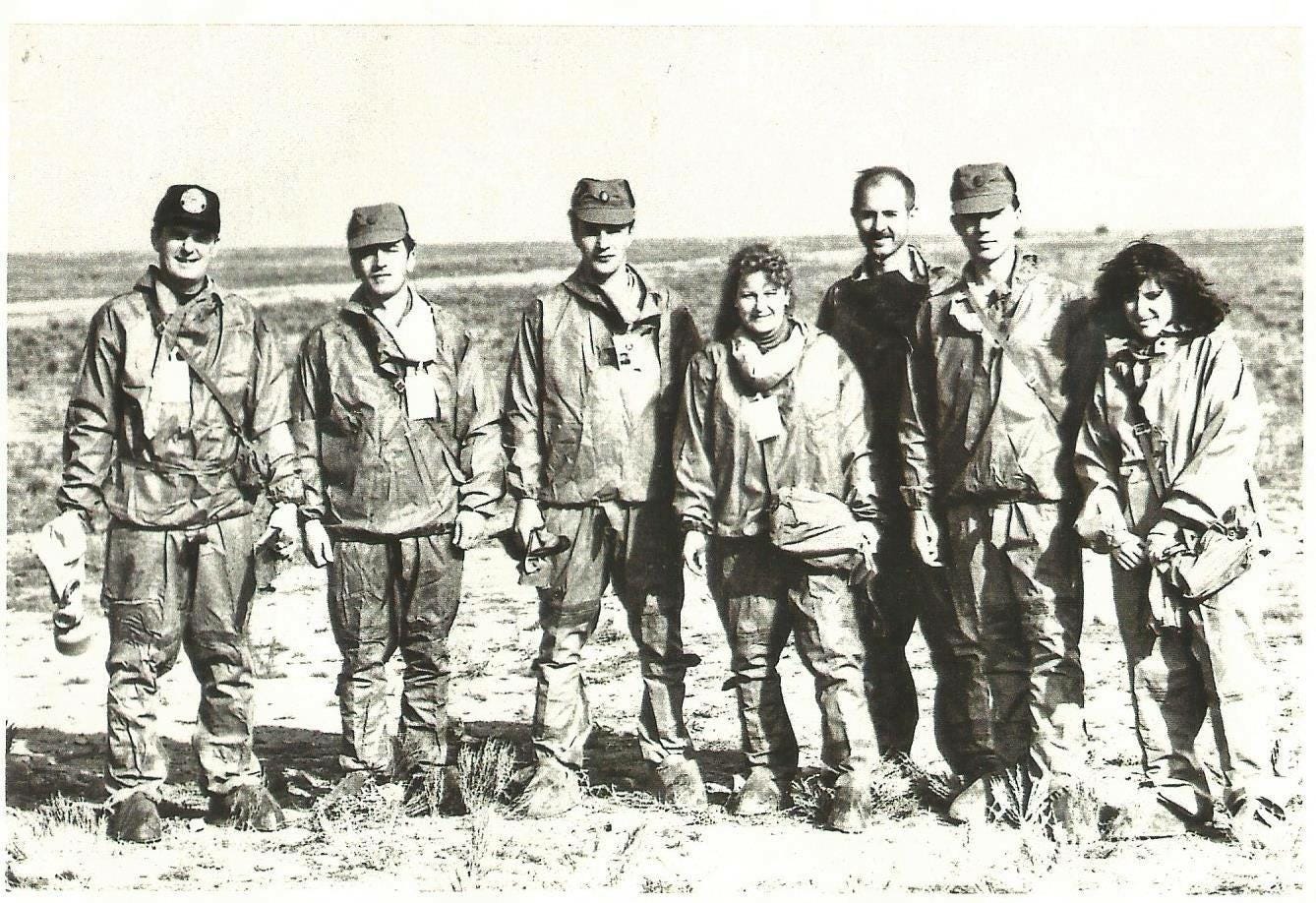
US INF inspectors and Soviet military escorts overseeing the destruction of SS-20 missiles, Kapustin Yar, November 1989
As an INF inspector, I know what it felt like to first step foot into the heart of the “Evil Empire”, learning to work in collegial fashion with citizens of a nation you were preparing to go to war with only a few months prior.
I have first-hand experience with Republicans of Christopher Ford’s ilk, men like Senator Jesse Helms and the Ford-like clones he surrounded himself with who manufactured lies and distorted facts in an effort to undermine the work me and my fellow inspectors, together with our Soviet counterparts, were doing to prevail against all odds and make the treaty work when so many wanted us to fail.
Christopher Ford doesn’t know the first thing about war, or the consequences of war, and as such has an academics perspective of what constitutes “strength.”
He also lacks any familiarity whatsoever with the reality of either the Soviet Union or Russia, and as such operates under some misguided superiority complex when it comes to weighing the national security interests of both the US and Russia. His slanted world view treats nuclear weapons like game pieces on a chess board set up in some classroom in Harvard or Oxford (yes, Doctor Ford attended both, as well as Columbia), where the consequence of failure is measured by how long it takes you to reset the board and begin again.
Normally I would not give people like Christopher Ford a passing thought; he is ignorant, elitist, and responsible for the demise of a treaty that helped define my life and, in doing so, saved the world from nuclear annihilation. This is the one reality that Christopher Ford, despite his many degrees and academic accomplishments, seems to have not grasped—the INF treaty didn’t simply create a temporary balance in the deterrence postures of the US and the Soviet Union (and later, Russia).
It saved the world from the certainty of nuclear annihilation.
And now, with the treaty dead, we are literally breathing life into George Santayana’s timeless aphorism, “Those who cannot remember the past are condemned to repeat it.”
(Next: Part Two: The Ghost of Christmas Past: Arms Control and the End of the Soviet Union)
oooooo
@tobararbulu # mmt@tobararbulu
A Modern-Day “Christmas Carol”, Part Two: The Ghost of Christmas Past–Arms Control and the End of the Soviet Union
https://open.substack.com/pub/scottritte
A Modern-Day “Christmas Carol”, Part Two: The Ghost of Christmas Past–Arms Control and the End of the Soviet Union
Part Two of a Five-Part Series
Dec 23, 2025
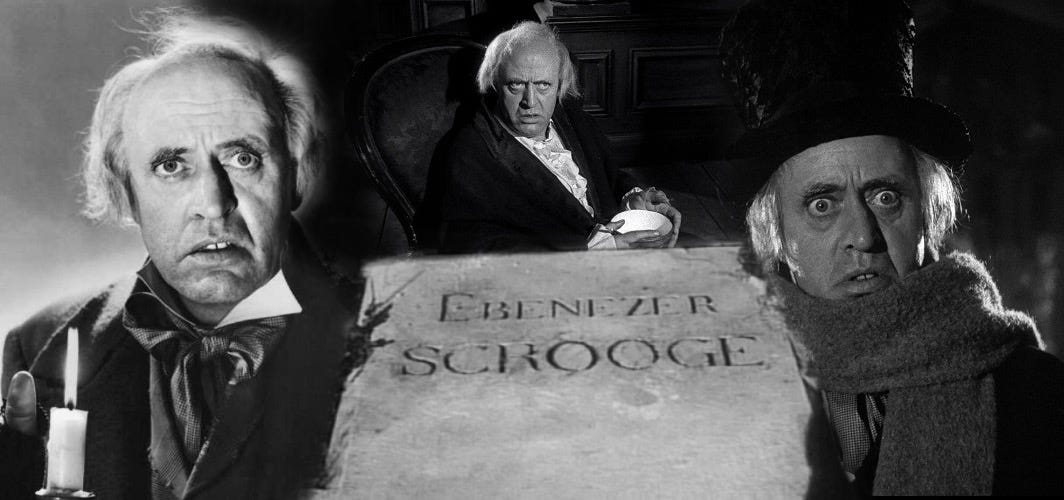
Alastair Sim’s Ebenezer Scrooge in the 1951 adaptation of A Christmas Carol
“‘I told you these were shadows of things that have been’, said the Ghost. ‘That they are what they are, do not blame me!’”
Charles Dickens, A Christmas Carol
Having alluded in Part One of this series to the hauntings portrayed in Charles Dickens’ “A Christmas Carol” with Christopher Ford’s allusions of “The Ghost of Failed Endeavor” and “The Ghost of Negotiating Leverage”, I will continue in this vein, portraying Ford as Ebenezer Scrooge to my Jacob Marley, and present to you my take on the ghosts of Christmas Past, Christmas Present, and Christmas Yet to Come. Arms Control takes the place of Bob Cratchit, and humanity plays the role of Tiny Tim, doomed to die if Scrooge doesn’t change his evil ways.
The Ghost of Christmas Past
Once upon a time there was a nation called the Soviet Union.
For people of a certain age who live in the United States and Europe, the Soviet Union conjures up a time marked by notions of superpower rivalry colored by ideological conflict and the potential of global-ending nuclear Armageddon. The fact that our reflections are nostalgic in nature is largely driven by the fact that we emerged from this period victorious: the Soviet Empire, reviled as “evil” and demonized in every possible way, was no more, defeated by the economic, political, and moral superiority of the western way of life.
We celebrated the demise of a nation, with little or no regard for the genuine welfare of the people who lived there.
This reality was apparent from the very beginning of the post-Soviet interface between Russia and the United States, between Russians and Americans.
E. Wayne Merry (right) with Deputy Chief of Mission James Collins in Moscow, 1994
E. Wayne Merry spent 26 years in the Foreign Service of the United States, six of these at the American Embassy in Moscow, where he oversaw political analysis regarding the breakup of the Soviet Union and the early years of post-Soviet Russia. In March 1994 Merry drafted a long cable where he offered his insights into the state of US-Russian relations in the aftermath of then-Russian President Boris Yeltsin’s brutal crackdown on Russian political opposition in October 1993.
Entitled “Whose Russia is it Anyway”, Merry questioned whether the US had chosen the correct policy instruments to serve US interests, and—perhaps more importantly—whether those interests had been correctly defined. Merry pointed out that the US, in engaging Russia as an economic problem first and foremost, was conflating the concepts of “democracy” and “free market” into a singularity of an ethical marketplace which simply did not exist, nor was being sought out by the average Russia, who simply wanted to survive.
“The brash young reformers” whom the US supported, Merry wrote, “advocated a rapid and forced shift to market mechanisms with a greatly reduced role for government, maximum freedom of choice for individual entrepreneurs and consumers, and minimal social protections.”
These reformers were supported by arrogant American “advisors” who failed to acquaint themselves “with even the most basic facts of the country whose destiny they proposed to shape.” These advisors had long since worn out their welcome among a population and government who had collectively lost patience with the endless procession of what they call ‘assistance tourists’ who rarely bother to ask their hosts for an appraisal of Russian needs.”
The fact that these Americans viewed Russia as little more than a “social-economic laboratory to test academic theories” came back to bite them when, as Merry observed, “the bottom fell out of living standards for millions working class people who had managed to scrape by until then.”
In short, we Americans operated with zero concern for the average Russian, or for Russia in general. We had a vision of what the world should be like, and what Russia’s role in this world would be (subordinated to us, of course), and we moved forward irrespective of the damage done.
Through this arrogance-laced behavior we sowed the seeds of future war. Even in early 1994, a scant two years after the collapse of the Soviet Union, Merry recognized Ukraine as the focal point of regional stability which could manifest itself violently if not handled in a manner respectful of Russia’s legitimate national interests. “The key issue for stability within the former Soviet domain,” Merry wrote, “is the status and well-being of the 25 million ethnic Russians beyond the borders of the federation. The key country is Ukraine, home to about half of them.”
Despite considerable bickering over more than two years, the governments in Moscow and Kiev have worked hard to prevent disputes from becoming conflicts and have dealt responsibly with issues ranging from nuclear weapons to the Black Sea fleet and its bases, to terms of trade. Nonetheless, few Russians even begin to comprehend the depth of national feeling among ethnic Ukrainians or the hostility toward Moscow in much of western and central Ukraine…the danger is that Russians will feel sympathy if the predominantly ethnic Russian Crimea and eastern Ukraine should seek to rejoin the Russian “Motherland”. Crimea and the east-salient of Ukraine are by far the most potential conflict zones of the former Soviet Empire, dwarfing the localized conflicts in the Caucasus and Central Asia in importance.
“Must Russia now behave as it did in the past?” Merry asks, underlying the reality that many in the US government feared a rebirth of what he called “Russian Imperialism” as inevitable. Thus, trapped in a policy construct of its own making, Merry warned that “The United States will be effectively left with no creative Russian policy because a renewed Russian Empire will require an authoritarian and non-democratic Russian homeland (“Democratic Imperialism” was no great success even for the British and it is certainly beyond Russian capacities). Our strategy,” Merry notes, “would then be limited to a resumption of containment on different geographic lines, with the consequent resumption of American-Russian mutual hostility and a potential renewal of the thermonuclear balance of terror.”
“Such a dismal course of events is not inevitable”, Merry observed. But the struggle over which course Russia would pursue hinged on the issue of perceptions—from Merry’s perspective, those Russians who viewed the former Soviet Union as “Russia’s burden” would be in favor of necessary reforms, while those who “harken back to the Empire as Russia’s glory” were inclined to support “the authoritarian power and military system” which sustained it.
Merry pointed out that the “bankruptcy” of the Soviet power structure and its corresponding ideology left Russians in search of an ethical center around which to build their new nation. “The substitute for ideology will almost certainly be nationalism, with a strong tie to the Orthodox Church…If linked to constitutional democracy and to the steady growth of representative institutions, Russian nationalism can become a positive force, as patriotism and national feeling are in western democracies. Divorced from democracy,” Merry warned, “Russian nationalism will become a terror.”
Merry’s warnings, however, went unheeded. The United States continued to promote market reform over the needs of the Russian people, undermining the nascent democratic institutions which were birthed at the start of Russia’s post-Soviet experience, instead empowering a political elite built on the backs of an entrepreneurial class void of any ethical code or moral foundation.
The Oligarch Mikhail Khodorkovsky, founder of Yukos
The consequences of handing power over to organized criminals and an oligarch class void of scruples (some might say they were one and the same) manifested itself in the collapse of Russian societal norms, resulting in the betrayal of pensioners (hundreds of thousands, perhaps millions, of the very people who saved Russia and the Soviet Union from the Nazi scourge perished due to neglect, disease, hunger, and murder during the awful decade of the 1990’s), the loss of trillions of rubles in economic potential as Russia’s wealth was plundered and taken overseas, and the abandonment of Russian culture, traditions and pride as millions of desperate citizens turned their eyes in vain to the west for a savior to come and save them from themselves.
The worst elements of Soviet society became wealthy beyond belief, while the human foundation upon which the Soviet Union was constructed—the “New Soviet Man and Woman” who industrialized a nation, collectivized agriculture, defeated Nazi Germany, sent a man into space, and built a society where people could live in relative peace and prosperity—were left to sort through the economic scraps thrown their way, barely making ends meet, or worse—perishing under the unbearable strain that comes with the confluence of personal and societal failure and collapse.
And then there was arms control.
Throughout Merry’s long cable, one finds mention of Russia’s nuclear might, an uncomfortable (from the US perspective) legacy of Russia’s Soviet past which left US policy makers grasping for solutions. Resolving the “thermonuclear balance of terror” was not a problem unique to the post-Soviet era, nor was it an issue which could only be understood from the perspective of the United States. History tends to overlook the fact that throughout the nuclear era it was the Soviet Union which reacted to the provocations and advancements of the United States when it came to nuclear weapons.
It was the US which developed the first atomic bomb and used it against two Japanese cities not for the purpose of defeating Imperial Japan, but rather to intimidate and contain the Soviet Union. James Byrnes, whom President Harry Truman appointed as Secretary of State in early July 1945, confided to Leo Szilard, one of scientists involved in the Manhattan Project (the name of the effort to produce the American atomic bomb) two months prior to his Senate confirmation that “a demonstration of the bomb might impress Russia”; later Byrnes was to view the inherent threat of the US atomic bomb as a major point of leverage over the Soviets at the Potsdam conference. But the most telling comment came from Lieutenant General Leslie Groves, the Director of the Manhattan Project, who informed the scientists engaged in the program in 1944 that “the whole purpose of the project was to subdue the Russians.”
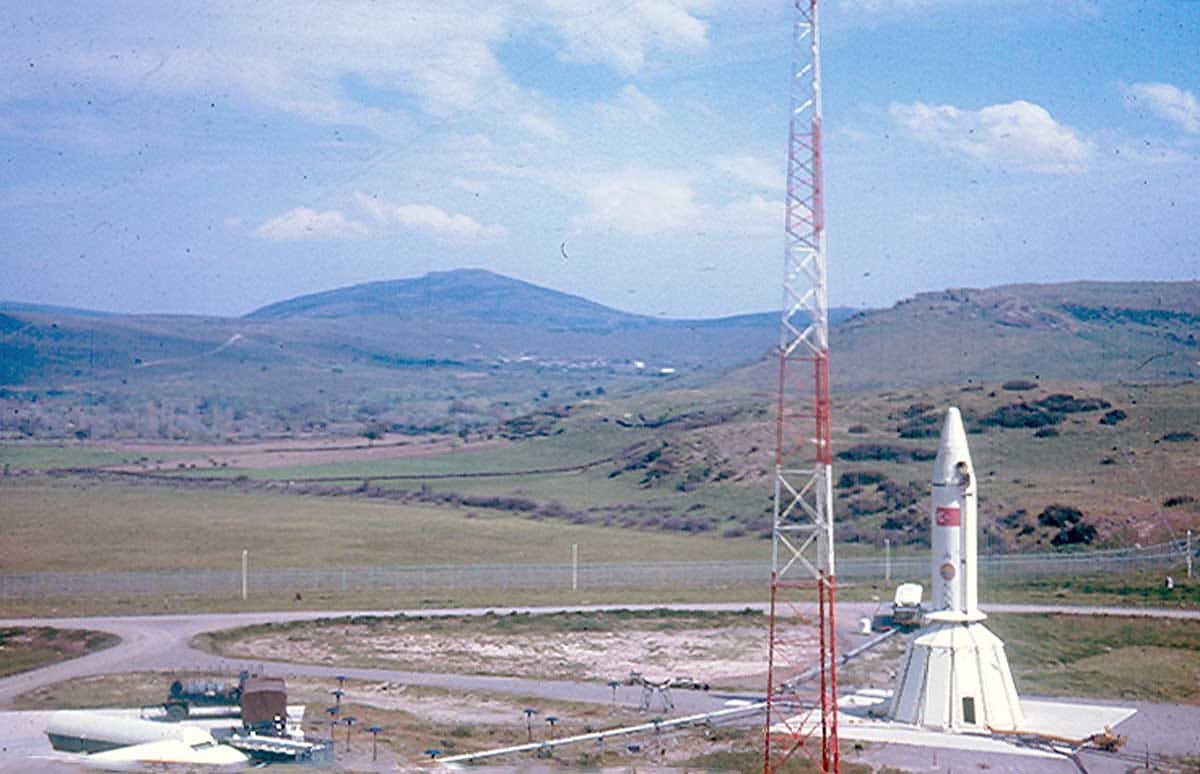
US/Turkish Jupiter missile near Izmir, Turkey, 1962
It was the US who deployed nuclear armed Jupiter missiles to Italy and Turkey, prompting the Soviets to dispatch SS-4 and SS-5 missiles to Cuba, triggering the Cuban missile crisis, and manufactured intelligence that created the myth of a “missile gap” between the US and the Soviet Union which was used to justify massive military expenditures to produce modern missiles that ended up setting off a major arms race between the US and Soviet Union that continued up until the last days of the Soviet Union.
From the Soviet perspective, their strategic nuclear arsenal was never meant as anything other than a force of strategic deterrence designed to keep the United States from acting on General Groves’ ambition of subduing the Russians.
Aggressive US nuclear posturing in the early-to-mid 1970’s, which saw the US advance missile technologies and nuclear weapons employment doctrine designed to give it a first-strike capability, led to the Soviets opting to replace their aging SS-4 and SS-5 ground-launched intermediate-range liquid fuel missiles with an advanced road-mobile solid propulsion intermediate-range missile system, the SS-20. The deployment of the SS-20 in 1977 sent shockwaves throughout Europe and the United States, setting in motion the very mechanisms of arms control that Christopher Ford derides, and which eventually produced the INF treaty, which eliminated the SS-20 and other Soviet missile systems, along with the US ground launched cruise missile and the Pershing II missile.
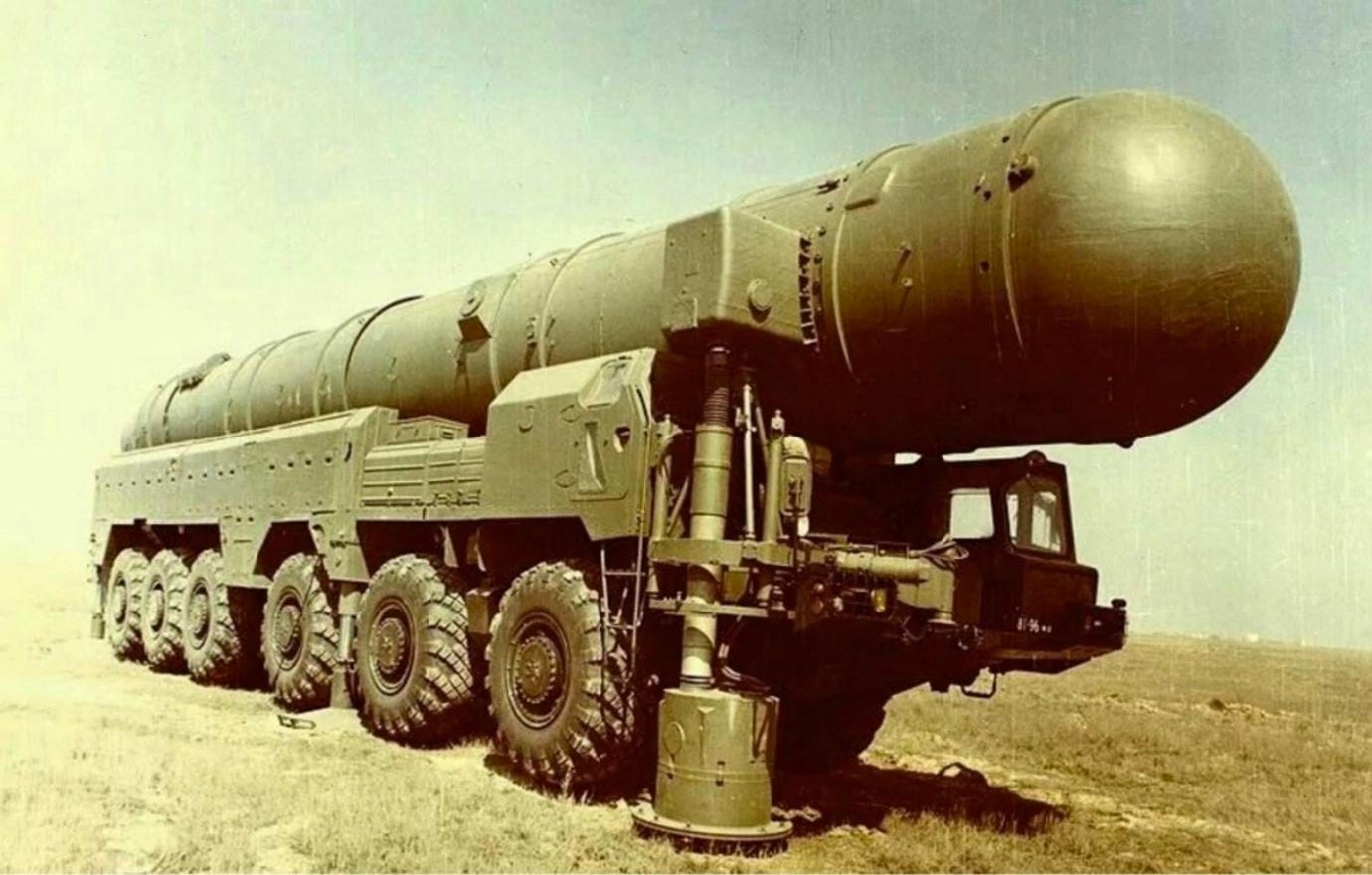
The SS-20 missile and launcher
This is the narrative that the United States likes to promulgate about the INF treaty, and which people like Christopher Ford use to shape perceptions about the utility (or lack thereof) regarding arms control.
But there is another narrative, one which resonates with the Russian people more than anyone in the west could possibly know and understand. The SS-20 missile was not created in a vacuum, but was rather the byproduct of a concerted effort on the part of the Soviet leadership—and in particular Dmitri Ustinov, the long-serving Minister of Defense—to build an enterprise capable of producing missiles that could keep the Soviet Union safe from the nuclear threats emanating from the United States.
Key to this enterprise were two distinct establishments. The first was the Nadiradze Design Bureau, officially known as the Moscow Institute of Thermal Technology, or MITT. Headed by Chief Designer Alexander Nadiradze, MITT paved the way for Soviet advances in solid rocket ballistic missile design. Nadiradze was aided by the work of Yuri Solomonov, the design engineer behind the SS-20 missile and other advanced designed, such as the SS-25 ICBM. The SS-20 and SS-25 tandem were intended to provide the Soviet Union with a nuclear deterrent capable of surviving a US/NATO first strike and delivering a fatal blow to the aggressors in retaliation.
MITT was the brains behind the Soviet solid rocket missile enterprise. The brawn was provided by the Votkinsk Machine Building Plant, a factory situated in the city of Votkinsk, some 750 miles due east of Moscow, in the foothills of the Ural Mountains. Headed by General Director Vladimir Sadovnikov, the Votkinsk Machine Building Plant, inclusive of its missile final assembly plant located outside the city boundaries, assembled the various products designed by MITT before being shipped off to the Soviet strategic rocket forces. The assembly process, however, was far more complicated than it sounds—the workers at the Votkinsk Machine Building Plant had to master advanced manufacturing processes, including metal forming, cutting, and welding, to connect the disparate missile parts into a combat-ready finished product. Under Sadovnikov’s leadership, Votkinsk emerged as the world leader when it came to producing solid-fuel ballistic missiles.
One of the myths promulgated by American Cold War ideologues is the notion that the arms build up by the Reagan administration in the 1980’s prompted a Soviet response which ultimately bankrupted the Soviet economy, leading to societal, military and political collapse. There is, however, no evidence to advance this theory.
The facts demonstrate otherwise. The MITT-Votkinsk team not only was able to produce the weapons systems which led the US to deploy INF weapons to Europe while pursuing new missile types such as the MX Peacekeeper missile and the Midgetman road-mobile ICBM, but it was able to develop a range of additional missile types which, had they been allowed to proceed, would have provided the Soviet Union with a qualitative overmatch when it came to comparable US systems.
To counter the threat posed by the Pershing II missile system, which had been deployed to West Germany in 1983, the designers at MITT came up with the Skorost (‘Speed’) missile, an intermediate-range system designed to target and destroy the Pershing II missile within minutes of it being prepared for launch. Moreover, MITT developed an advanced variant of the SS-20 which was planned to be deployed to the Chukotka region of the Soviet Far East, where it could threaten the west coast of the United States. Lastly, MITT tested an advanced small ICBM known as the Kourier which would have increased the survivability of the Soviet strategic deterrent by complicating by an order of magnitude the ability of the US to target Soviet strategic nuclear forces.

The Skorost missile and launcher
The Votkinsk Machine Building Plant had produced around ten Skorost missiles which were ready for combat service, and the Chukotka version of the SS-20 was rolling off the production lines, when the INF treaty was signed in December 1987. Mikhail Gorbachev’s decision to eliminate all INF systems was a huge blow to both MITT and Votkinsk; Alexander Nadiradze died of a heart attack shortly after being informed by Gorbachev of the decision, and Vladimir Sadovnikov retired shortly thereafter, and committed suicide less than two years later.
The loss of its INF-related production capabilities delivered a harsh economic blow to the Votkinsk Maching Building Plant, which derived much of its income from the eliminated missiles (in addition to the SS-20 and Skorost, Votkinsk produced the SS-12 and SS-23 missiles, which were also eliminated under INF.)
Moreover, to appease US concerns that could hold up the signing of the START treaty, intended to reduce the strategic nuclear arsenals of both the US and Soviet Union, Gorbachev ordered that work cease on the Kourier small ICBM. This action proved to be a bridge too far—the Kourier missile, in addition to providing a qualitative overmatch to existing US strategic nuclear missiles, represented an economic lifeline for the Votkinsk Machine Building Plant and the citizens of Votkinsk whose livelihood was dependent upon the economic health of the factory. Gorbachev’s efforts to terminate the Kourier missile set off a wave of recrimination from within the Soviet security establishment, leading to the abortive coup of August 1991 that spelled the beginning of the end of the Soviet Union.
The reality is that it wasn’t defense spending that brought about the collapse of Soviet power, but politics. The Soviet military defense industry was able to not only match the US advances in ballistic missile capability, but exceed it, providing the Soviet Union with significant overmatch when it came to both INF and Strategic nuclear forces.
AT the same time the INF treaty was entering into force, in the early summer of 1988, Mikhail Gorbachev was convening the 19th All-Party Union Congress, a gathering of the tope leadership of the Soviet Communist Party, for the purpose of initiating a political revolution designed to usurp the power of the communist party into Gorbachev’s hands. This revolution, which went by the names of Perestroika (restructuring) and Glasnost (openness) embraced arms control as a way of appeasing the United States to encourage massive investment into a new market-oriented economy envisioned by Gorbachev and his supporters. But this revolution failed, unleashing political forces (including Moscow Mayor Boris Yeltsin, who emerged as Gorbachev’s greatest challenger for power) that promoted changes, the consequences of which had not been thought through by Gorbachev and his reformers.
The Soviet Union was brought down by the political incompetence of Mikhail Gorbachev and the collective greed of Boris Yeltsin and his reformists. Moreover, the very institutions which had enabled the Soviet Union to be treated as the equal of the United States—its strategic nuclear forces and corresponding defense industrial capabilities—were voluntarily dismantled by Gorbachev right when they had accomplished their greatest achievements and then bankrupted by disastrous economic policies which had nothing to do with military spending.
From the perspective of the Russian people, arms control as practiced under Mikhail Gorbachev did not bring them either peace and security or a peace dividend. Instead it made the nation weaker by giving the US unmatched strategic nuclear overmatch, something that came about simply by filling the vacuum created by the INF and START treaties in terms of Russian capabilities. Arms control also set in motion the economic collapse of Votkinsk, MITT and other Russian defense enterprises whose complex economic interactions could not be properly serviced by the new market economy of Gorbachev’s perestroika.
Arms control, from the Russian perspective, was not the force for positive change that accrued to the concept in the United States, but rather a facilitator of unmitigated disaster, a reality that must be considered when assessing Russia’s future actions.
(You can read about Votkinsk and the INF Treaty in my book, Disarmament in the Time of Perestroika: Arms Control and the End of the Soviet Union.)
(Next: Part Three: The Ghost of Christmas Present: Fool Me Once, Shame on Me. Fool Me Twice…Won’t Get Fooled Again!)
oooooo
@tobararbulu # mmt@tobararbulu
Ritter’s Rant 066: Holiday Greetings!
Ritter’s Rant 066: Holiday Greetings!
Dec 24, 2025
Merry Christmas and Happy New Year! Last year was quite an adventure. This coming is shaping up to be one as well. Thanks for your support!
Transkripzioa:
Merry Christmas and wishes for a Happy New Year for those who celebrate the traditional Western Christmas, which will be tomorrow, or those who celebrate the Orthodox Christmas, which will be on January 7th. This is a festive time of the year. It’s a time of family, friends.
It’s a time to reflect on what happened over the course of the past year and to also look forward in anticipation for what is going to happen in the year to come. This has been a very active year, a very interesting year. It started with a new presidential administration coming into power in the United States,
that of Donald Trump replacing the Biden administration. And this portended a whole host of changes in terms of how the United States viewed itself, how the United States viewed the world. You know, tragically, this year started with a war between Russia and Ukraine or between Russia and the collective West.
And it’s going to end with this war still continuing. But for the first time in a long time, there are active negotiations to bring this conflict to an end. And so for that, we should all be grateful. I am grateful to all of my supporters and followers. on Telegram, on YouTube, on Vcontact, my subscribers on Substack,
followers on X, and for my new followers on Rootube. I think that we have engaged in a relationship that has been very positive, very constructive. It’s a relationship that’s premised on the notion that knowledge is power. in my role of trying to accumulate facts,
assess these facts and present them to an audience that is receptive to these facts so that we can engage in a broader dialogue, discussion, debate even about the issues of the day. And this is absolutely essential for democracies, for nations where the will of the people is manifest.
And this holds true in the United States and it holds true in Russia as well. less so in Europe, but, um, Hey, you know, we can always try to get the Europeans back on track. And that’s one of the things that we do through, uh, this work, the podcast, the writing, um, and the, the travel, the interaction.
This has been a year that started with my passport, uh, still being seized by the United States government. Um, July 15th, I got my passport back and immediately embarked on a series of trips to Russia to resume the important work of, um, you know, reaching out, uh, listening to the Russians, capturing the Russian voice,
bringing the Russian reality back to a Western audience and in the process, engaging in some very frank, open and necessary, uh, conversations with some of the leading minds in Russia today, academics, uh, politicians, military officers, experts. Um, you know, this is, this is essential. And the, the tool for doing this has been a new podcast that, uh,
was created in the spring of this year, The Russia House with Scott Ritter. And together with my producer, Alexandra Madornea, we have turned The Russia House into something that was of maybe minor interest to some people, to something that’s actually having a major impact on the world stage today in terms of the conversations that are being had,
the information contained in these conversations, and the reach of these conversations, both in Russia and the United States. It’s been very exciting to travel to Russia, to meet with the Russians in Russia. Face-to-face dialogue is always a far better way to interact with somebody than the miracle of modern technology, Zoom.
That’s how I’m communicating with you today, and it’s a very useful tool, but You know, one of the things that the Russia House showed is that, you know, when you travel to Moscow, you sit down face to face with these Russian individuals. The conversations are more soulful because you’re right there.
You can look each other in the eye. You can feel how they respond to a question or how they respond to, you know, your answer or vice versa. Very valuable exercise and one that I look forward to continuing in the coming year. We have challenges before us.
Some of the greatest challenges come in the form of arms control. We have the last remaining arms control treaty, New START, expiring in February of this year. And it’s uncertain what, if anything, will replace it. But one of the things that I have been dedicated to is pursuing the concept of arms
control and disarmament and doing whatever necessary, whatever is feasible to promote these ideas and hopefully to have These ideas and the work that I do resonate in a manner that can impact the various positions of the United States and Russia in a positive manner so that we can get
back on the track of trying to reduce the threat of nuclear war between our two nations instead of building more weapons to carry out nuclear conflict. So this will be my primary goal and objective of the year to come, to continue the work on disarmament, to continue the work on arms control,
but in the process to continue my ongoing journey of trying to discover the Russian soul, to meet with the Russian people, to hear the Russian people, to listen to the Russian people, and to capture the messages and the information they send in a way that can be transmitted effectively to a broader audience. Again,
the audience that I enjoy and I have the deepest respect for and I’m deeply grateful for on Telegram, on X, on VK, on YouTube, on Substack, and on my new Rootube community. Thank you very much. And again, Merry Christmas and Happy New Year.
oooooo


