
Episode 358 – Now Is the Time of Monsters: Gramsci on Counterrevolution with Vijay Prashad
Historian Vijay Prashad talks about Antonio Gramsci, cultural hegemony, and why working-class movements can get derailed by counterrevolution. A sharp, grounded discussion of class power, political education, and what real change requires beyond elections.
Audioa: https://podcasts.captivate.fm/media/5bc028fc-1b8e-408a-b3e4-c6d05a9d7874/Ep-358-Vijay-Prashad.mp3
Historian and journalist Vijay Prashad talks with Steve about why Antonio Gramsci still matters.
Listeners to this podcast know that we have a pretty good grasp of the monetary system. But we’re constantly working to expand our understanding of the systemic underpinnings of real power. How else will we be able to seize it? For help, we turn to Gramsci.
According to Vijay, Gramsci was doing class forensics. His core puzzle was brutal and practical: why did big chunks of Italy’s working-class bail on their own unions and parties and drift into fascism? That’s the real origin story of “cultural hegemony,” “common sense,” and the whole Gramscian toolbox: figuring out how consent gets manufactured and how counterrevolution recruits.
Vijay takes us through Gramsci’s political development and his imprisonment under Mussolini, where he wrote his seminal Prison Notebooks.
Then they get into Gramsci’s key concepts: hegemony (borrowed from Lenin and, per Vijay, more than a “culture theory”), the necessity of a Leninist-type party as the modern Prince, and the need to build alliances to create working-class leadership over society.
After taking a hard look at the left in the US, Steve and Vijay discuss the limits of electoral politics and the missing infrastructure for a serious battle of ideas. It’s a wide-ranging conversation about class power, organizing, and what it actually takes to change how people understand the world they’re living in.
Vijay Prashad is the Executive Director of the Tricontinental Institute for Social Research. He is a historian, journalist, and author of forty books, including Washington Bullets: A History of the CIA, Coups, and Assassination; Red Star over the Third World; and The Darker Nations: A People’s History of the Third World.
Transkripzioa:
Steve Grumbine:
00:00:42
All right, folks, this is Steve with Macro N Cheese, this week’s guest…
I’m so excited. I mean, you’ve heard us talking about, you know, the intersections of class and MMT. You’ve heard us discussing theory.
You’ve heard us talking about revolutions, counter revolutions, history. And we are going to dive into another subject today that we have touched on quite a bit as well.
You’ve heard it laced through various interviews, and today we’re going to do a deep dive into it. You know, I focused my little teeny bit of time and energy towards trying to understand how[Antonio] Gramsci fits into the current times.
And I saw my guest out there on X talking about this, and it just got me really motivated to do a full conversation because a lot of the things that I think I’m just an idiot over, turns out they’re buried in me. I kind of know them already. I just haven’t put them together. I don’t have a full analysis yet. But they’re there, they’re inside.
And in preparing for this conversation, that kind of jumped out from our guest. He spoke to me right before we did this.
So you kind of say, “hey, you know, you’re using this term ignorance, that I feel ignorant of myself, like what I’m talking about. Maybe I’m ignorant.” He said, “no, I think Gramsci would even laugh at you for saying that, because you do know these things.”
And I think that it’s worth us putting it into podcast form. Kind of the cultural hegemony, the understanding of how the state conditions us and trains us to think what we think, which maybe isn’t so true.
And also, as we move further and further leftward and we start understanding more of socialist theory and Marx and so forth, hopefully we’ll be able to touch on quite a bit of that, because my guest is absolutely a Marxist thought guy, and this guy really, truly knows his stuff. And let me just start off by the introduction. His name is Vijay Prashad. He’s an Indian historian, journalist, commentator, and Marxist intellectual.
He’s an executive director of Tri Continental Institute for Social Research and the chief editor of at LeftWord Books. And he’s also my guest today. Vijay, thank you so much for agreeing to come on with us today. I appreciate that, sir.
Vijay Prashad:
00:03:00
It’s a pleasure. And I must say, the name of your podcast really made me laugh a lot. So congratulations, Macro N Cheese.
Steve Grumbine:
00:03:10
You know, we tried to find a funny way of kind of intersecting the macroeconomics, which is where we tend to focus our attention. You know, it was largely.
I mean, for the first hundred episodes or so, we largely only focused on Modern Monetary Theory and breaking it down, understanding how fiat currencies work, et cetera. We used the academics that come from that space, and we used activists and we used other authors and writers to kind of pull out history.
And then as time went on and, you know, we would lead on about how if we could just elect Bernie Sanders or if we could just do this.
And we just kept finding out that more and more the can just kept getting kicked and bad things kept happening, and we couldn’t quite put our finger on it. And so we started digging deeper into theory and understanding the relationship of capital and the state and the ruling class.
And it really shifted, completely pivoted us away from what I kind of term, you know, “Normie”, where we just think we’re going to wake up on a Tuesday morning, go down to the local ballot box, put a I voted sticker on our forehead, and everything that we ever dreamed of would come to be. And that kind of thinking is pervasive. I mean, it really is the shortcut answer to how do we make change in this country?
And that doesn’t really hold water with us anymore. So the more we learn, the more we want to learn. It doesn’t stop. It never stops. And Macro N Cheese kind of became a, a broader project.
I think it’s still an accurate name for it, but the cheese is really all the other stuff not related to macro. So I appreciate that very much.
So, Vijay, you heard my intro, and, you know, I’ve really struggled with how to articulate what the key thesis of Gramsci, what was the key things that came out of his work? And I guess maybe start with who Gramsci even was.
Vijay Prashad:
00:05:08
Yeah, Antonio Gramsci was born in 1891. Obviously, he wasn’t born a Marxist. He was born a little baby.
He came from the south of Italy, where he experienced the inequities of life, if you understand Italy.
And later Gramsci writes an unpublished text, which in fact we’ve just published in a new translation at LeftWord Books, on the Southern question, which was the question of the rural Italian south versus the urbanized and working class North. Gramsci was very sensitive to this distinction because he himself came from the south, from Sardinia, from Naples and so on.
Eventually finds himself as a young student in Turin. This is very important because until then, of course, he had not experienced Marxism.
But in Turin, at the university at the time, there was a reflection among the teachers of a dissatisfaction with the European world order, with the world order after World War I, you know, the war years and so on. And so at that time, where the working class in Turin was rising enormously, I mean, it grew by 100,000 between 1911 and 1918.
About 30% of the working class in 1918 were industrial workers. This is a huge increase, you know, and some of it was because of the demobilization of the army.
And so the intellectuals who are teaching Gramsci, many of them started teaching socialist ideas in their own way.
And he got a hold of these concepts and gets involved in the Socialist Party, becomes an organizer of the trade union movement in Turin, sees it directly, writes about it in the newspapers, the left wing newspapers.
When the Communist Party is formed, he’s one of the first members of the party again writing in its newspapers, trying to organize the working class around their own core economic issues.
But also the political questions being raised by the Communist Party at the time, they were contesting not only the liberals, but also the rise of Fascists. You know, fascism has its first breakthrough in Italy when Benito Mussolini in 1922 conducts the March on Rome and essentially seizes power.
At this time, the Communists and other Left forces are the principal opposition to the Fascists. Gramsci plays a very important role in this front row seat to some of these battles. A number of communists are killed.
In 1926, when Mussolini is already in charge of Italy, Gramsci is arrested and he’s thrown into prison. Now, this is extremely important because it’s in prison that Gramsci sits down and writes. First, he teaches the other prisoners ideas.
He is very interested in teaching them about contemporary Italy. He holds as many classes as he can, but he also begins to write on scraps of paper, some of it in letters and so on.
He writes a critique of the intellectual class in Italy, who he feels has betrayed the Italian people.
And then he also tries to understand, and this is very important, why the working class is in Italy abandoned the trade unions and the left and went to Fascism, because they did. You know, there were large sections of Italian society that went to Fascism. And Gramsci was really quite determined to understand why this happened.
He wrote 30 notebooks, about 3,000 pages. These were smuggled out and later published as the Prison Notebooks.
And here, just to end this, he basically was not interested in understanding how culture works. That was not what his question was. His question was a class question.
Why was it that the working class abandoned its own institutions and went to fascism? And that’s really why he wrote about ideas like cultural hegemony.
That’s why he developed the idea of common sense, of philosophy in his own understanding and so on. He created a whole intellectual arsenal to understand why the hell working people went to people who wouldn’t help their situation.
That’s what he wanted to show us.
Steve Grumbine:
00:09:52
So, you know, as he was in prison, obviously the world was changing outside of the prison, but I don’t know that he was well known during that time period. He became better known after these works were published. Am I correct?
Vijay Prashad:
00:10:07
Well, in Italy, he was one of the leaders of the Communist Party and his very close comrade, Palmiro Togliatti, you know, they had some differences here and there of ideas, but they were comrades together. For them Gramsci was a leading thinker before he went to jail. I mean, his writings in the Communist newspapers were very important.
He wrote several reports for the Communist International. He was part of the debate in Lyon around the April Theses. I mean, Gramsci was very well known and respected.
In fact, he was in jail pretty much until he died. Because when they released him, he was already a broken man.
When he was sent to prison, the judge says, “we want this brain to basically stop functioning for two decades.” That’s what he says into the record. The judge.
So Gramsci was already well known, but after he died, basically a victim of fascism, his notebooks were taken out. The Communist Party, which played a big role in the fight against fascism right till 1945.
After he died, after the war ended, the Communist Party basically took Gramsci’s papers and they started to publish them. There was an institute that began to publish them because they saw that this was a vital body of knowledge produced by Gramsci.
So he was already well known. But certainly these prison notebooks made him better known.
And for a very long time, the kind of significance of the notebooks has been disputed and debated. I mean, some people have literally extracted from the Prison Notebooks a theory of culture.
I don’t think that’s a correct approach, because you have to understand that what Gramsci was doing was trying to explore a class issue, not a cultural issue. He was really trying to understand why the “working class” quote, unquote, betrayed itself.
Steve Grumbine:
00:12:13
Let me ask you, because he was looking at Russia, right? I mean, Russia in 1917, the Bolshevik Revolution made everyone take notice.
And I guess he was looking over there and saying, “what made Russia move communist and do the things that, you know, were in the interests of the working class, while simultaneously the Italians had an entirely different experience?” Can you explain or break down what his foundational message was there? I mean, what was the difference between Italy and Russia?
Vijay Prashad:
00:12:46
Well, one difference was that in Russia, the Communists won. And that’s a fundamental difference. I mean, Gramsci visited the Soviet Union. He had a lover in the Soviet Union.
They corresponded while he was in prison. He had fond memories of the Soviet Union.
I think there’s a lot of rewriting of his life where people try to say, you know, he turned against the Soviets. He believed that Lenin was a very important political actor and thinker. In fact, the term hegemony, which Gramsci adopts, he adopts that from Lenin.
Lenin was the one who brought the term hegemony out of a bourgeois scholarship into Marxism. He was the first to use it, to talk about how to develop the political leadership of the working class.
You know, that was how he used the term hegemony. How can the working class have hegemony over society? And Gramsci adopts that term from Lenin.
I mean, I adore Lenin, but I think Gramsci may not use the word adore, but he very much admired him. You asked about the difference. I mean, the difference is the kind of, you know, oddness of history.
There should never have been a communist revolution in Russia. Russia was a backward economy, it was a poor country. It was largely a peasant society.
When Marx looked around the world, he thought that the revolution would happen in Germany or in Britain, where the industry was advanced, where the working class was large, perhaps even in northern Italy, where, you know, the industrial working class, as I just mentioned, was quite significant in Milan, in Turin and so on. But instead, the revolution happened in a backward country in Russia.
And that’s actually Leninism, because Lenin made the argument, very correct argument, that look, in colonized parts of the world, including in Russia, which was, in a small sense a colony of Western Europe, he argued that these countries will never be allowed to develop by their colonial forbearers. You know, it’s not just Russia, but Indochina, India, China itself, these places will never be allowed to develop.
So you can’t sit around waiting for the working class to develop forever. You can make a revolution there. And having made a revolution, you then have to advance the productive forces rapidly.
That was Leninism, and that was key. Gramsci, when the Russian Revolution first happened, didn’t know enough about this.
That’s why he wrote an essay called the Revolution Against Capital, because he sort of looked at it and said, “yeah, you know, it shouldn’t be happening in Russia, it should be happening in Germany.”
But in a sense, even in that essay, he begins to understand Leninism and understand it very well that sometimes you have to take advantage of a political situation and you have to lead the working class to become the leading class in society to establish its hegemony. And it’s in the Prison Notebooks that he’s actually working on.
What I think of is a Leninist project is how does the working class take political leadership in society? And I think that’s why he adopts the term hegemony. You know, he’s trying to work out the same problem.
And the revolution doesn’t happen in Italy, or it happens differently, because in a sense, you have the 1922 counterrevolution of Benito Mussolini. It’s a kind of revolution. It’s just a revolution of the old entrenched elite classes against the working class.
You know, there’s a major upsurge in Turin. Gramsci is in the middle of it.
They are even imagining that the councils, the workers councils can be the Soviets of Italy, and that the workers of Turin and Milan and other industrial cities can somehow come and take power. That was the hope of the Turin uprising that Gramsci was one of the leaders of. And he wrote about this.
He wrote in Le Ordin Novo about this, the council movement in 1921. And by the way, Lenin, in his own writings, suggested that the Le Nouveau, or the New World Group, were closest to the Bolsheviks.
That was Gramsci’s group, the New Order. You know, the New World, in a sense, was closest to the Bolsheviks.
So in Italy, they were moving towards a period, you know, it’s known as the Red Biennium. Between 1919 and 1920, there was a general strike in Piedmont in April of 1920 when engineering workers struck.
I mean, there was a feeling it’s going to happen.
And then you had the counterrevolution of 1922, Benito Mussolini on the side of capital, and the old entrenched feudal classes of Italy coming in and saying, “no, we’re going to crack down on the workers. We’re going to crush them” and that’s fascism. So, yeah, you had a revolution. It was just a counterrevolution in Italy.
Steve Grumbine:
00:17:42
You say that and I think this is incredibly important point that I want to kind of focus on momentarily.
You know, there is a counterrevolution and people Oftentimes look at history of socialism and they have a lot of CIA talking points that they trot out a lot of “Oh, that’s this totalitarian. Oh, this is a dictator. Oh…” and I’m not here to, you know, defend or relitigate a lot of dead people.
But the reality is that so much of what history shows is that where there’s a revolution, there is the defense of revolutionary gains, and then there is often a counter revolutionary force that may turn into a counterrevolution. Can you talk a little bit about the outcomes of these counter revolutions?
I think people just don’t understand that when the workers rise up, you know, they’re armed.
Sure and Lenin talks about we need an armed proletariat in State and Revolution and a number of other writings, but it’s not like they’re blood savages that are just desperate to slaughter people. This is a defense of gains made, a security element for the working class. This isn’t some sort of homicidal insanity.
Can you talk about the kind of “aha moments” with counterrevolution and revolution and the interplay between the two?
Vijay Prashad:
00:19:07
Yeah, you put it very well. I mean, you know, this is a class question.
A revolution is a movement in history where the working class and allied classes, like the peasantry, advance us from the class inequities of a moment to a time when the class inequities will be different. You’ll rearrange the deck and try to move towards a more equal society. That’s a revolution.
There may be zigs and zags, as Engel said, and we’re talking today on Engel’s birthday. That makes me happy.
But on balance you’re advancing towards a future, you know, not just tomorrow, but a future means it’s not just a calendrical future, but it’s a future in historical terms, better arrangement of society and so on.
A counterrevolution is also a class question, but frequently led by a political force that could have a mass character but wants to retain the current order as it is, doesn’t want to advance to a future, wants an eternal present, you know. So counterrevolutions basically are designed to prevent revolutions from happening.
When workers are agitated and moving and starting to understand what they need to do, counter revolutionary forces come in and smash their work. That’s exactly what the rise of Nazism was. There was a real revolutionary current in Germany.
Trade unions are very active, moving fast, and the fascists arrived, were given permission in fact by the elites to suspend all kinds of bourgeois liberal niceties and smash the workers movement. Kill the leaders, arrest them, throw them in concentration camps, and so on. It’s similar in Chile in 1970. Salvador Allende wins an election.
And now that’s not by itself a revolution, but he starts a revolutionary dynamic. They start to make housing for the poor.
They start to talk about, you know, reusing the profits of the copper industry, having funds for people to have education, build this, that these are developments moving towards a rearrangement of class inequities. But this was unacceptable. So you had a counterrevolution, which was the coup of 1973.
And again, the bourgeoisie gives the coup leaders permission, throw the Left in prison, kill them, torture them, then reverse all the policies, rigidify the class structure, you know, use whatever means you can to prevent the reversals on privatization, allow the elites to have private schools for their children and this, that and the other. I mean, this dynamic of revolution, counterrevolution is actually very familiar in most countries.
It’s not something isolated, let’s say to Germany or Italy. You name a country and I’ll show you where that dynamic has played out.
It’s played out in the United States in a small way in which you were involved. You know, mass movements develop around the question of frustration with housing, frustration with student debt and so on.
Let’s call it what it was, Occupy Wall Street. But, you know, it was not the brand.
There was a lot of dissatisfaction in a generation that said, “look, you told us to go to college, we did it, and now we can’t find a good job, we’re pissed off, we have student debt and so on.” Movement germinates.
And then you get Bernie coming up and saying, “yeah, I hear you” and start to lead big triumphant march towards, well, not a revolution, but towards at least the White House. But that had to be blocked. It was blocked within the Democratic Party. That’s a counterrevolution.
Hillary Clinton, Kamala Harris, they lead a counterrevolution against that Bernie movement. It’s a mild movement within social democracy. Not even a revolution of the workers, but really a middle class movement.
Middle class youth pissed off with having to pay college debt and so on. And Bernie was saying, “I hear you. We’re going to change that.” We’re going to change, just rearrange some of the class inequities.
And that had to be snuffed out. Black Lives Matter, the biggest mass mobilization in U.S. history. Send the police in, crush it, call it racist, don’t allow the education around what they call, I don’t know, DEI or whatever it is, Diversity, Equity and Inclusion. These are little moments of the dialectic of revolution, counter revolution.
In the United States, they are much smaller because, in fact, very interestingly, in the United States, the bourgeoisie or the elite never allow the revolutionary motion to get beyond a certain point, and then they snuff it out, you know. You’ve never seen it germinate far enough. Maybe to compare Bernie to Eugene Debs is very unfair.
But even at the time of Debs, you know, any time there was a revolutionary energy, the Pinkertons were there to shoot the leader down, and that continues.
But even in the US you see this dialectic of revolution and counterrevolution, which is what people like Lenin and Gramsci are very interested in analyzing around the question of hegemony.
Steve Grumbine:
00:24:26
So it seems like all this stuff can be translated, obviously through a Marxist lens, but specifically through a Gramscian lens. I mean, I hear a lot of people bringing Gramsci up now as say that this may be the most important time to understand Gramsci.
And as you’re putting out new work in the Gramscian vein, I guess my question to you is what are the key components of Gramsci’s teachings that we need to be aware of today as we try to analyze where we are as people, not just a movement, because really, I think the idea of one organization or one direction is a little bit misguided. There isn’t one. There’s a million of them. We’re all organized in small pockets, but we’re not organized as a class.
Can you help me better understand what key elements of Gramsci’s lens, if you will, Gramscian thinking is pertinent and resourceful for us to understand today?
Vijay Prashad:
00:25:31
I’ll tell you, I’ll break it down into basically three points. And the third point, I’m afraid, will take a little time to explain.
But let me at least give you the three points and then you can see how much time you want me to spend on them.
Steve Grumbine:
00:25:46
As much as you got.
Vijay Prashad:
00:25:47
Yeah.
The first point is really interesting to Gramsci, and a lot of people who work on Gramsci in the academy really minimize this point and they in fact, remove it.
There really is no way to understand Gramsci if you don’t appreciate the fact that he believed that a Leninist party was absolutely essential, that you needed to have a political party of a Leninist kind, disciplined political party at the national scale that brought together revolutionaries from across the country who had a good sense of the mass line, who were working to build mass struggles.
Not sectarians, but working to build mass struggles, working to appreciate and understand the discontent of the masses, the spontaneous struggles that were emerging. This idea that revolutionaries had to be across the country and coordinated was essential to Gramsci.
Otherwise why would he have become one of the leaders of the Communist Party of Italy in 1921 and remained in the party right through his life? You know, this is a very important thing. And in the Prison Notebooks, he writes about the importance of the party. He calls it the modern prince.
Riffing off Machiavelli’s book, the Prince, he says the party is the modern prince and is essential for his worldview. So that’s number one. And that’s actually, as I said, minimized by most people, most scholars of Gramshi.
But it’s also not just minimized, it’s suppressed. I think the idea of the need for a political party of a Leninist kind is suppressed.
And by the way, in the United States, a real Leninist party, you know, is important to understand its role. The thing is, the United States is such a vast country territorially, it’s very hard to imagine, you know, a centralized party.
One would have to imagine a federated national party. But that’s not for me to say. That’s for you to build.
The second important thing for Gramsci with the concept hegemony, you know, the working class being hegemonic over society. The second thing is the very singular importance of alliances that must be built.
That means all struggles against the class inequities have to be united together.
Even if these struggles have contradictions amongst each other, their contradictions are not as significant, the ones that are internal to them, than that between the working class and peasantry and the people who oppress them. That is a fundamental contradiction. So alliances need to be built.
Even though there might be differences, great differences of ideology, of standing and so on, alliances must be built.
And that building of alliances is, in fact, the building of hegemony, because, you know, to have hegemony over society is not to dominate society by force, is to construct a social order that moves together. You know, even though there are political differences within it, a worldview will be built.
And this brings us directly to the third point, because Gramsci, in the Prison Notebooks, distinguishes between two forms of politics. One is the war of maneuver, which is a direct assault by the working class against the state.
He slightly mischaracterizes the Russian Revolution as a war of maneuver. In fact, it was not really a direct putsch, a coup d’ etat or something like that against the state. It wasn’t actually that.
It actually was a long motion. I think all revolutions are not wars of maneuver, but wars of position.
In other words, a long term strategy of developing cultural and political control over society. Right now the bourgeoisie has cultural and political control over society.
And the idea is to have a long struggle across the institutions, across society of building this what he calls the war of position. And you have to in a sense, take power in society before you take state power. That’s Gramsci’s theory. Sometimes this theory can be mischaracterized.
You have to wait a very long time to take power. I don’t think that’s what he’s saying.
Sometimes you could take power without having power over society and advance your agenda of the war of position. You use the state apparatus strategically to build more power, then you lose an election, then you go back to building in the war of positions.
It’s not like you should forgo state power, it’s just that don’t imagine that you can actually have a hegemonic revolution, you know, just by taking state power. State power is as a way to advance your war of position further until you have a setback in state power and then you advance again in the war of position. So that third main category, war of position, central to Gramsci. But that’s what actually takes a long time to explain.
Steve Grumbine:
00:31:03
I think that is really important because when I first started digging into this, I kept getting the two mixed up. Position, maneuver. And I know one is like an appeal to elites to kind of erode over time, kind of changing.
And the way I understand it, and I would love for you to correct me, is that the way that he positioned this was the opportunity to build up the kind of change that sticks and holds versus the war of maneuver in this case, which may not yield the same outcome, which kind of points to the differences between Russia and Italy in that, you know, hey, you know, we have this physical, violent war, whatever, this violent revolution, as they all like to say, but this revolution, and that doesn’t mean the hearts and minds of the people are trained and ready and educated and whatever for moving leftward, moving to this working class consciousness, working class solidarity. Can you definitely dive into this?
I think this is one of the most important… because this is where you see a lot of folks today trying to make decisions as to, you know, whether or not we should be supporting the existing establishment institutions, the institutions that, you know, quite honestly are hands of the existing class order that owns and runs society. I would love to hear your thoughts on this topic. It’s incredibly important.
Vijay Prashad:
00:32:34
Yeah, so the war of position is a really interesting idea. It’s what we in our institute also call the battle of ideas. It’s basically the same idea.
You know, when we talk about the patashe de ideas, which is Fidel’s category, it’s basically the war of position in a different language, you know, but here’s what it is. Look, you have an election victory in New York right now. Zoran Mandani is going to be the new mayor, and that’s an electoral opportunity.
You know, he does a few things to help people in their everyday life, but at the same time, he should try to motivate people to be out there building institutions in society because people are motivated, they are not depressed.
And you use the electoral opportunity to build hegemony, you don’t start criticizing it, saying, “why isn’t he, as the mayor, doing this, that and the other?” He is limited by the limitations of social democracy today. But use the opportunity to build your strength in the trenches of society. That’s a war of position.
Intermission:
00:33:37
You are listening to Macro N Cheese, a podcast by Real Progressives. We are a 501c3 nonprofit organization. All donations are tax deductible. Please consider becoming a monthly donor on Patreon, Substack, or our website, realprogressives.org. Now back to the podcast.
Vijay Prashad:
00:33:59
So what does Gramsci say? Gramsci says, “look, all of us grow up with different forms of knowledge in our heads.”
You know, the working class, the peasantry, the uberist working class, you know, the working class doesn’t really understand itself as a class. You can’t meet other workers.
You’re working by yourself, or you’re being called in through an app. It’s very alienating form of work organization.
All workers spontaneously understand their grievances, and they understand that they work really hard, but they earn nothing. That’s a spontaneous recognition. I don’t need to go to a worker and say, “oh, you are exploited.”
They know they’re exploited in one part of their brain. Yeah? They work really hard. They drive the bloody car Uber all day, or they deliver food all day. Nobody respects them.
And the app takes a large chunk of the money. They, you know, they know that it’s just shit. They know that. On the other side, there’s a whole other bunch of information that they digest.
They went to school, they were told that, you know, if you don’t work hard, you won’t do well in society, that, you know, your failures are your own. Then they go to some religious institutions, say to a church where the priest gives a speech saying, you know, you are sinners.
You don’t understand that your failures in life are because you know you are sinning and because you have, I don’t know, sex with somebody other than your wife. That’s why you don’t earn enough money and you’re a bad person and so on. And then later in life, the boss tells them you’re an idiot.
You know, you’ve forgotten that delivery. You took the wrong thing. They get disrespected because of their lack of earnings and their poor role in society.
Their children may not give them much respect. You know, they have trouble at home because the wife and husband are both working multiple jobs, they don’t have any time for each other, and so on.
They are also constantly worrying about their children’s future. All of this is a bundle of ideas. And Gramsci says we develop as workers of contradictory consciousness.
Our consciousness isn’t singular, it’s multiple. I know that I should, with all this hard work, earn more, but I’m not. I know that.
But I also know I’m a sinner and God has punished me and has not given me a place in society that’s good. And I also know that I let my children down and my children are upset with me.
I know all these things, and all these things deteriorate the clarity of my class consciousness.
And Gramsci says what an organizer does, what the communist organizer does, is you go amongst the people and you take that common sense and you elaborate it into philosophy. You don’t negate the person’s understanding of the world. You accept that’s how they are understanding the world.
But you have to clarify, in a way, provide a clarification of their thinking.
You have to provide, in the battle of ideas, different approaches to the world, different understandings of themselves, even their psychosocial place in the world. Not just, you know, how the economy works and so on, but you have to be at that level.
And Gramsci says, at that level, we are contesting the counterrevolution. Because you see, when the counterrevolution shows up, the counterrevolution will say, “hey, workers, look over there.
There’s that migrant who’s a piece of shit. We’re going to go and beat that migrant up.
It’s going to make us feel better and it’s going to make us feel powerful” because capitalism makes you feel weak and makes you feel, you know, quote unquote, “unable to be a human.”
And now, workers or others, we’re going to say to this woman who works all day long in a hospital, we’re going to say, “the reason you are not doing well is, look at this migrant, she is a doctor, she lords it over you” and anti-immigrant ideas start to develop in your head and it basically eclipses the other ideas. So this is a battle of ideas, very important battle that you have to fight almost, you know, trade union by trade union.
People join trade unions out of spontaneous need to confront employers. But in the trade union there has to be also political education.
For Gramsci, political education was key and which is why this is a cultural struggle. After the war, after Gramsci’s death, the Communist Party built football clubs, it built community centers.
You know, they went out there into society, they built a social world for people. They didn’t allow the churches to be the sole form of information and leisure.
They went in and said, “no, the trade union hall is going to be your education institution, not the church. We’re going to contest those ideas, we’re going to clarify your ideas, we’re going to take your common sense and we’re going to make it into philosophy. We’re going to take the contradictory consciousness and tear it apart and make it something different.”
See, that’s what Gramsci was working out in the prison and that’s really what became the agenda of the communists in Italy after the war.
And they did extremely well building a large mass party, you know, where they had music clubs and football clubs and workers halls and bars and things like that. They built a whole social world for the working class. Why?
In order to contest the institutions of the bourgeoisie that were in there, in a way eclipsing the ideas of the workers. And so that’s really a kind of brief introduction to the idea of the war of position.
Steve Grumbine:
00:39:47
Real quick, before I jump to war of maneuver, I want to say one thing. You know, when I read Lenin’s What Is To Be Done? and quite frankly, just about every publication, Lenin just straight up had a hard on for [Karl] Kautsky.
And Kautsky represents, as the way I read it anyway, represents the social democrat, kind of what we’re seeing today frequently.
And he spoke specifically of needing to have socialist discipline when it came to propaganda, when it came to education, when it came to organizing together, et cetera. Help me understand real quick how that aligns with the kind of collaboration with other interest groups within the class.
I think that’s where people, including myself, trip mightily. It feels very, very hard to thread that needle.
Vijay Prashad:
00:40:38
Yeah. Personally, it’s not fair to Kautsky entirely to say he was a social democrat. He was one of the leading Marxist thinkers of his generation.
Lenin and he had a really serious dispute, you know. When I first read Lenin, and Lenin kept calling him Renegade Kautsky. I thought that might be his first name because he keeps calling him Renegade Kautsky, Renegade Kautsky. I didn’t know who Kautsky was at the time.
You know, Lenin’s writings are hard sometimes because he refers to lots of people. He’s always in the middle of some sort of dispute or the other.
But I’m really glad you read What Is To Be Done, because in a way, Gramsci’s entire body of writing is a reflection of a text he didn’t really know, which is What Is To Be Done. That was published in 1903. You know, Gramsci never really refers to it directly. He didn’t know it very well.
He knew other texts by Lenin, but not that very well.
This is very important because that also talks about the significance of political education, the importance of building a political party, the importance of the newspaper as a way to contest the ideology of the bourgeoisie, to clarify the common sense of the workers. You know, to be out there talking about every and any issue of humiliation of people. I mean, it’s very interesting, in the Prison Notebooks called a dialogue, Gramsci writes something quite bizarre.
You know, he writes about how people live. You know, he says nobody wants to be the manure of history.
He says, people want to be the plowman, but nobody wants to be the manure. But he said, how can you plow without manure? So in the abstract, both are necessary, you know.
And then at the end of the note, he says something weird.
He says that the Jews produce the image of Job, but the Greeks imagined Prometheus, you know, in other words, Job is the sufferer and Prometheus is the great hero who goes and get fire. And then Gramsci says that the Jews were more realistic because their hero is more true to life.
It is actually more true that people are the manure, you know. Poor Job man. If you ever read that Book of Job, I mean, everybody gets killed. He gets boils, his animals, his family. And he keeps saying, “I love you, God.”
You know, God punishes him, kills him, brings pestilence. I mean, he has boils. And he keeps saying, “I love you.” You know, he’s completely, like, enamored of God.
And even though God destroys everything, Job is the image, in a sense, the worker in capitalism is for Gramsci, you know, all the privations.
And yet you are saying, ‘boss, I’m coming to work tomorrow”. But why can’t you be Prometheus? You know, go get the fire? Okay. Somebody has to be the manure, but you don’t have to be Job. And seems to me Gramsci is very much on that.
And the note ends, I think, a little pessimistically. He says that it is more realistic to think of the worker as Job. It’s true the worker today is Job, but the worker also has Prometheus in them.
Both he and she have Prometheus inside their heart, in my opinion, you know? And so when you think of Kautsky and social democracy, the idea is that you say, “look, what we have is actually perfectly okay.
We’re going to have to live with this capitalism basically forever. But we can just make some improvements” you know, and so then history is eternally capitalism.
That’s a kind of what we can think of as capitalist realism. Capitalism is with us forever. We can just enter the system and try to make it more humane. That’s an approach.
And, you know, I don’t like to argue with people who make that point because given the situation in the world today, if they just want to go and make sure children are not dying of starvation, that’s fine by me. You go ahead and do that.
I’m also interested simultaneously in awakening the Prometheus in all of us, you know, saying to people that, listen, we don’t want to live, as Gramsci wrote, a hundred years as a sheep. Why don’t you live for even a day as a lion? Let us make a struggle. Let us build the capacity to have hegemony over society.
You know, we are not there to do a putsch, to do a coup d’etat. You know, that’s not necessary because society is not with you right now. You have to work to build hegemony.
And if hegemony requires running for elections, taking power in a bad situation, advancing a little bit, retreating a little bit, losing an election, all and well. But that’s not the day we celebrate as the revolution. That’s simply one tactical maneuver that must be done.
We cannot be dogmatic about it, must be done on the road to building a revolutionary context.
Steve Grumbine:
00:45:23
You know, it’s interesting you say that because, you know, when we look at elections, the elections are, at least in the United States, and I know every country has its own form of dog and pony show that they do in these things, but we’re dealing in the United States with observably absurd fake news, fake narratives that people carry forward as if, of course, this is reality. And those are so corrosive and so destructive. And, you know, for lack of a better term, at this point evil. I mean, just indescribably evil.
We see it square up in Gaza with the way the Zionist Project paints out their struggle against the Palestinians. It’s just hilarious and sick all in the same breath. But you see this everywhere.
And you see this in the US electoral system where two private corporations known as the Republican Party and the Democratic Party and the Democrats have fought successfully in federal court down in Florida after Bernie, that they have no responsibility whatsoever to conduct a primary, much less honor the results of a primary, much less focus the funds that are for the candidate to the candidate, et cetera. So it feels like theater.
It feels like what they call in wrestling kayfabe or kind of a fake world where we accept this isn’t real, but we go along with it anyway. How do we make that matter?
Because honestly, I have found myself pushing further and further away from electoral solutions and looking more and more at the concept of, you know, kind of building resiliency outside of the electoral process, where those powers that be don’t have the chokehold on the narrative and choke hold on what, you know, maneuvers are made. Help me understand that, because it really is very challenging.
Vijay Prashad:
00:47:19
Yeah, I mean, I’m going to be a little critical of my colleagues in the United States, the professors, just for a minute before I get into this a little more. Do you know how many professors there are in the United States?
Steve Grumbine:
00:47:32
I have no idea, but it’s got to be a lot.
Vijay Prashad:
00:47:34
A very interesting number. I think you should hold on to this number. People teaching in the United States, that is adjuncts, and all of them at degree-giving institutions, it’s 1.5 million. There are 1.5 million professors in the United States. 85% of them, it is said, identify as liberal or moderate.
Yeah, there are about 10% of them who are, who are identified as far Left. That’s about 150,000 people. It’s striking. That’s 150,000, quote, unquote, “far Left” professors. I don’t hear from them in the public domain very much.
Steve Grumbine:
00:48:14
No.
Vijay Prashad:
00:48:15
Among my friends who teach in the academy, they basically write in journals which are behind a paywall and nobody can read them. What they write on social media is mainly exasperation.
They are exasperated by Trump, they are exasperated by the policies in the US or they attack people who are trying to do something in the electoral domain. You know, they’ll attack Zoran Mamdani for going to see Trump or something like that.
The ineffectualness of the intellectual class in the United States is extraordinary. It is playing an entirely regressive role in the battle of ideas.
On the one side, it is basically hunkered down in the university as if that is its protected domain and the Right has now entered to try and smash them. The counterrevolution has come there. This attack on DEI, the banning of certain books, they are not insulated by tenure.
When Trump went after, and before Trump, even Biden and the Republicans in Congress went after the college presidents. Yeah? Harvard, Pennsylvania, I mean, I watched the little bits and pieces of those hearings. They were taking the fight to the university. Why?
Because they want to smash even that domain. Where are these 1.5 million professors, or 150,000? Why aren’t they building the trenches in society of a counter struggle for battle over hegemony?
Why aren’t they there? What’s the point of theorizing hegemony when you’re not trying to build the trenches of hegemony yourself?
We can have a hundred books come out on Gramsci, but where are people out there contesting the garbage being spewed by Pentecostal churches and evangelical churches and the, you know, Right wing talk shows and so on? You have to be out there, man. You can’t hide in the academy and write articles about it. You have to be out there.
So you don’t have that section of the intellectual class out there.
Secondly, the intellectual class of the trade unions and so on are so defensive right now, fighting to maintain the small things they have that many of the unions themselves capitulate to the Right.
I mean, you see this when unions say to Trump, we agree with you on America first and so on, they capitulate to that agenda because they haven’t been doing any political education. They’re so defensive. They haven’t built the strength of the working class to confront the bourgeoisie.
They are immediately ready to collaborate with the bourgeoisie, immediately, one flank of it or the other. So in that sense, there is no Gramscian project, none in the United States I would say. There could be people writing about Gramsci, yeah, as you said.
But writing about Gramsci is not the same as building a Gramscian project. In fact, quite different.
Steve Grumbine:
00:51:11
I couldn’t agree more. I work with various academics and doing what I do here, and I’m not an academic.
I mean, I do have some graduate degrees and I did start a PhD, but I’m not.
And, you know, I frequently am disappointed because their work is behind a paywall and they don’t like getting their hands sullied with people that are really, really outwardly struggling. They like to maintain access, they like to maintain kind of that PMC bourgeois kind of relationships.
And it is incredibly disheartening at times to see that kind of elitism and eliminate the ability to do exactly what you’re saying. I can’t tell you how much I appreciate you articulating that. I do want to take us, if you don’t mind. We’ve gone through maneuver.
I want to take the war of position. Help me better understand the other side of Gramscian discussion.
Vijay Prashad:
00:52:09
You see, Gramsci was also in a way trying to understand what happened in Russia in this. And he went in a way that I don’t agree actually.
He started saying there’s a distinction between the so-called Western states where the state was more developed and there was institutions of civil society which exercised hegemony over the population. And because of that the working class was much more, you know, in a way oppressed ideologically. And so then a push to power was impossible.
And then he said, in the East, including Russia, civil society is not very well developed. The state is everything. So if you attack the state, you can take power. This is an old Hegelian distinction.
[Georg Wilhelm Friedrich] Hegel argued that the West had a developed civil society and the East had strong states. You know, later Karl [August] Wittfogel will write a book called Oriental Despotism where this becomes a theme.
And by the way, this is a cliche of many scholarly traditions that somehow in the East, in China, in India, the state is almighty. This is Hegel’s philosophy of history. And in the West you have a society. This is a ridiculous distinction.
I don’t agree with Gramsci’s distinction. He argues that in Russia there could be a putsch kind of thing because you had in a way the state all powerful and so on. That’s not what happened.
What happened there was the war basically already destroyed the Tsarist state. It also destroyed the absolute power of the Tsarist state to have any kind of control over society.
People simply didn’t believe any longer in the social power of the Tsar. That was already gone, you know? And so he misunderstood, in my opinion, or mischaracterized what happened in the Soviet Union.
And so, you know, he basically went and said that “look, no, we need a slower kind of struggle, different kind of struggle in Italy.” Well, yeah, that’s true.
If there had been no World War I, which had so destroyed and cut down the Tsarist empire, there may not have been a revolution of that kind. Same thing in China. The war against the Japanese and the Civil War destroyed the country. The Communists took power in 1949. It’s a military victory.
You know, they came, they rode to power on the backs of the 8th Route army led by Chude. It was a military victory. Very different from either a war of position or a war of maneuver. It was a whole different kind of thing, you know?
So in that sense, I actually don’t agree with Gramsci’s distinction. I think he’s mischaracterizing what happened in Russia to make the Soviet Union. I think all revolutions have their own story.
And I think in most countries where, you know, obviously the hegemonic situation is such that the bourgeois or the dominant contradictory consciousness isn’t cracked. You know, cracked by World War I in Russia or cracked by the Civil War and anti-Japanese struggle in China.
If it’s not cracked, you have to do this over the long term. The battle of ideas is central. So I agree with that point of Gramsci.
I just don’t agree with the way he adopts that sort of Hegelian distinction between East and West.
Steve Grumbine:
00:55:40
Fair, fair. So when it comes down to the organic intellectual, which was something that kind of came out of my reading of it, and again, I don’t know enough.
I read through it and some of the stuff stuck, some of it seemed fuzzy. It was not an easy read. I just want to be crystal clear for those out there that are going through this. It’s not easy to read.
Some of this is challenging. But what exactly is his view, if you will, on the organic intellectual? Because, you know, there has been different times.
We saw this in China with Mao. You’ve seen this at other times. And to your point, they’re all different, right?
But the idea of certain types of people needing to be culturally changed to have, you know, reeducation, so to speak, what is the position here of the working class intellectual? How do we look at individuals within this space for that kind of leadership? Is it natural? Are they hand selected?
How do we find the quote unquote, “organic intellectual”?
Vijay Prashad:
00:56:48
Yeah. So let’s define these actually three kinds of intellectuals. Very quickly.
Gramsci argues that every class produces its own intellectuals, and that’s the term organic intellectual. So that, for instance, the peasantry produces its own intellectuals.
You know, there’ll be people in the countryside who, because they know certain things and are able to answer certain problems of the people, are treated as intellectuals. If I have some misunderstanding of how to grow something, I go to this person, they tell me, they talk to me about the weather, the soil.
I might have some problems with my family life. There’s somebody else I go to. Maybe it’s a school teacher who has read certain things that comes from our community, that understands us, that guides us.
The intellectuals of the elite might be economists who work in a bank. Could be, you know, the chief economist said the central bank could be the lead writer in a newspaper, somebody on television.
They summarize for the elite their own ideas and give it back to them and so on. So those are organic intellectuals. Every class, Gramsci says, has its organic intellectual. Pretty straightforward.
Then he says there are traditional intellectuals, like, for instance, the school teacher or the priest. They may not be from my community. They may come from a petty bourgeois or bourgeois background and be teaching in a working class area.
And whatever their own class background, they bring ideas into the community that are not organically formed in the community. So the community might form ideas of, you know, people work hard, people have good families, whatever.
And then the priest shows up and says, “you’re a sinner.”
They bring different ideas which are not necessarily organic to the community, but come from, quote, unquote, “outside”, you know, not necessarily outside geographically, but outside the class experience. And those intellectuals have. They are able to sustain power not by whether they are right or wrong.
Because organic intellectual, if you are wrong, you are discarded, you know, of any class. If I’m the chief economist and I keep forecasting things wrong, I’m gone. Yeah? You have to be right to be treated as an intellectual.
You can’t keep being wrong.
But a traditional intellectual doesn’t matter because the force of the right or wrongness is what defends them is their class background, is the class power they bring the church, you know, the establishment of the institutions, the television channel and so on. Right? So that’s the second kind of intellectual, the traditional intellectual.
Well, Gramsci says there’s a third kind of intellectual, what he calls the new intellectual. The new intellectual is also the intellectual, you know, who is the permanent persuader. That’s the phrase Gramsci uses.
The communist is the new intellectual.
This is the person who works amongst the working class, whether in institutions like trade unions, of peasant unions, or in local working class newspapers, or running political schools or being a musician, whatever. They bring in different ideas.
And their methodology is that methodology of taking the common sense, with all its contradictions, contradictory consciousness, and making that common sense into philosophy. That’s the role of the new intellectual, and that’s the role, therefore, of the political organizer.
And so it’s not that we rely on organic intellectuals or somebody to change the world. The organic intellectual can become a new intellectual, but they are by themselves, not new intellectuals.
Like, if I’m an intellectual of the working class, I may not be a new intellectual. I could very much even take up the role of the traditional intellectual.
The new intellectual is somebody who is organized into some sort of political formation. That’s very important for Gramsci, and therefore they become what he calls permanent persuaders. They are permanently trying to persuade people to take their common sense to philosophy.
Steve Grumbine:
01:00:58
Very, very well said. I really appreciate you taking us through that.
You know, as we’re winding down here, one of the things that I wanted to make sure of is, first of all, I’m going to ask you to tell me what are the key things we want to take away from today. But before I get there, though, one of the bigger concerns I see on the emerging Left, if you will, or it’s not even emerging.
This has been going on probably since, I guess, Stalin sent somebody to put an ice pick in Trotsky’s head. Where do we stand here? I mean, is this kind of socialism can be done in one country versus around the world?
Is this in any way, shape or form a relevant conversation? I know it happens all the time, but through a Gramscian lens, through just today looking at where we are as a society, does it hold water?
Is it a relevant question? Does it matter? And what role would you say, or I shouldn’t say role. But what do you think Gramsci might have said about this conversation?
Vijay Prashad:
01:01:53
Yeah, I mean, I would hope he would say that, “well, you know, you’re beginning to understand some of my ideas.” I hope very much he would say that. I don’t know.
We don’t know how he would react to the fall of the Soviet Union. I don’t know how he would react to China and so on.
I’d be very interested to hear him on the fall of colonialism, you know, which he never got to see. The decolonization of very many parts of the world. He wrote with great feeling and anger at Italy’s colonial adventures in Libya and so on.
So anyway, I don’t want to even imagine what he would think. After all, he did die a very long time. I visited his grave. He died in 1937, you know, long before even World War II began in Europe.
It had begun in China already with the Japanese intensification of the military and so on.
Anyway, the main thing I would say is it is important for people of the Left to essentially renovate working class culture, working class confidence, working class clarity. Our job is to work in the battle of ideas for the renovation of our own class.
You know, our point, and this is very important in Marx, our point is not to take so-called right ideas and dump them in the heads of the working class. That’s the most elitist idea.
Our approach, and this is very much from both Lenin and from Gramsci, is to essentially see what is there already in people’s consciousness and work to clarify their own understandings of the movement towards socialism. You know, people already have various ideas about their exploitation, about the shit situation in the world. They don’t need me to tell them that.
What they need is they require the political education that allows them to widen their own thinking, you know, to in a sense reformulate their own understanding of the world.
And the permanent persuader and the new intellectual’s role is to basically accompany the working class on the journey to renovate its culture, clarify its ideas and build confidence in itself, to take hegemony and to take its historical role at building a better society.
Steve Grumbine:
01:04:15
Very, very well said. Thank you so much for doing this. I really appreciate it.
I know we missed a million things and I can already think of a thousand that I’d love to ask you.
But in the spirit of time, if you had one thing you want to impart on our audience that they really need to hold on to, what would be your parting words Vijay?
Vijay Prashad:
01:04:37
Well, I’m going to say something perhaps strange, but I’m going to say that, look, I am working at an institution, Tricontinental Institute for Social Research, whose mission is to help develop working class intellectuals and to develop, in a sense, or to elaborate, the consciousness of the working class. I would like all your listeners to help us in one way or the other.
At least come to our website, thetricontinental.org, help us build the kind of education that we need to have an army of working class intellectuals in the battle of ideas.
Steve Grumbine:
01:05:15
That’s fantastic. I would love for all of us to help out. I mean, just getting people to pay attention now they’re so exhausted and tired and run down.
It’s a minor miracle that you get somebody to listen to an hour long podcast about theory and so forth. So for those that take the time to do it, my hat’s off to you. Vijay, I really appreciate the time you’ve given me today.
I hope we can have you back on in the future. This has really been wonderful for me.
Vijay Prashad:
01:05:40
I’ll be happy to come on anytime you want. Thanks a lot.
Steve Grumbine:
01:05:44
Absolutely, Vijay, thank you so much. I’m going to take us out. Folks, my name is Steve Grumbine. I am the host of Macro N Cheese.
Macro N Cheese is part of Real Progressives, which is a 501c3 not for profit in the United States. We’re small, we don’t have a lot of help.
So if you think that what we’re doing is valuable and you want to see our message grow, please consider either volunteering or becoming a monthly donor. You can go to our Patreon, it’s patreon.com/realprogressors.
You can go to our substack where we have lots of great articles and we put our podcast out there. Feel free to become a monthly donor there or one time donor even.
And then of course you can go to our website which is realprogressives.org, very, very sad sometimes that we named ourselves Real Progressives as we’ve migrated and we’ve adapted and we’ve evolved. But you know what? It is what it is. So if you think the message and the work that we’re doing is worth it, please consider becoming a monthly donor.
And on behalf of my guest, Vijay Prashad, myself Steve Grumbine, of the podcast Macro N Cheese, we are out of here.
End Credits:
01:06:56
Production, transcripts, graphics, sound engineering, extras, and show notes for Macro N Cheese are done by our volunteer team at Real Progressives, serving in solidarity with the working class since 2015. To become a donor please go to patreon.com/realprogressives, realprogressives.substack.com, or realprogressives.org.
Gehigarriak:
September 2, 2025
A guerrilla war has three phases: mobility, equilibrium, and overtaking. The Lord of the Rings film trilogy perfectly mirrors these stages.
Hollywood action movies have lost their appeal. Superhero and sci-fi films may look cool, with high-quality special effects and music, but the movies themselves just don’t compel us the way they used to. More and more, we find ourselves re-watching something like The Lord of the Rings trilogy instead of a new release.
The Lord of the Rings (LOTR) got so many things right. From visually stunning sets to emotional music, an incredible amount of attention was given to every little detail. Great care was taken in adapting Tolkien’s novels to film. Elements that didn’t translate well were dropped, and others were altered to fit the aesthetic of the motion picture. This is why those movies still resonate with us two decades later.

When Peter Jackson directed those action sequences, he had to think about what makes those scenes effective in movies. He ensured that the action served the plot, not just cool stuff happening on screen. Frodo and company spend their time evading enemies; realistic characters know real fights aren’t fun and should be avoided. The first half of the first movie builds suspense by showing the protagonists – the Hobbits – narrowly escaping their pursuers, the Nazgûl.
Characters are more compelling when they react realistically to danger. After barely escaping the bad guys twice, the Hobbits light a campfire at night, inadvertently alerting the Nazgûl to their presence. This leads to their first real fight, which is a complete disaster, ending with the main protagonist – Frodo – fatally wounded. What should have been a simple walk to their next location becomes a race against the clock. Not only is Frodo on the verge of death, but the Nazgûl are right behind them. Seldom do we see superheroes in such real danger.
Too many movies today have senseless action sequences. Bullets miss or bounce off their targets. The hero dives away from an explosion just in time! In a mediocre Hollywood film, action rarely advances the plot. In a good movie, however, action is indistinguishable from the plot. Peter Jackson made fantasy films, but he grounded them in character motivations and emotions. In trying to make the best movie he could, Jackson created a trilogy that effectively depicts guerrilla warfare from beginning to end – perhaps without even realizing it.
A guerrilla war has three phases: mobility, equilibrium, and overtaking. The LOTR trilogy perfectly mirrors these stages. The Fellowship of the Ring shows a small guerrilla force using mobility to evade a larger, more powerful enemy. When the Fellowship tries to stand their ground, they lose. In their first fight with the Nazgûl, Frodo is struck with a Morgul blade. When they confront the Balrog in Moria, they lose their most powerful ally, Gandalf. And when they are attacked by the Uruk-hai orcs, the Fellowship dissolves; some members go freely, others are taken prisoner.
By the second movie, The Two Towers, the focus shifts from just the Fellowship to the kingdom of Rohan, which is in chaos. Orc raiding parties roam the land, and the main cavalry force, the Riders of Rohan, are no longer under the king’s command. The film explores different factions and their goals. When those goals align and coordination occurs, they overcome powerful enemies they couldn’t defeat alone.
By the end, elves arrive to help Rohan in its time of need. Together, they hold out in Helm’s Deep against a seemingly endless Uruk-hai army. Neither side can overpower the other. The equilibrium breaks only when the Riders of Rohan arrive and all three factions unite to defeat the enemy.

The phases of guerrilla warfare are fluid and often overlap. While victory is achieved at Helm’s Deep, Frodo and Sam continue toward Mordor without the rest of the Fellowship. They stay hidden and avoid direct confrontation. Each guerrilla cell must decide when to fight and when to move.
Victory at Helm’s Deep only meant survival for those involved. Meanwhile, other members of the Fellowship convince the Ents – ancient, sentient trees – to attack Isengard, the Uruk-hai’s stronghold. The Ents overwhelm the minimal defenses with a surprise assault. People contributing in any way they can. That’s the essence of a true guerrilla war.
The third and final film, The Return of the King, shows how quickly guerrilla warfare phases can shift. The orc invasion of Gondor’s capital, Minas Tirith, nearly overwhelms its defenders. Rohan’s cavalry arrives and surrounds the orcs, turning the tide. Then, Easterlings on giant war elephants reinforce the orcs, putting Rohan and Gondor back on the defensive. This new equilibrium is finally broken when the Army of the Dead arrives to aid Gondor.
Ghost armies are fantasy, but the back-and-forth – between mobility, equilibrium, and overtaking – mirrors real revolutions. Holding out while a stronger force overextends itself, then hitting them from behind, is a classic military strategy known as the hammer and anvil. Hannibal used this tactic to defeat the Romans at Cannae, and the USSR used it to encircle Nazi forces in WWII.
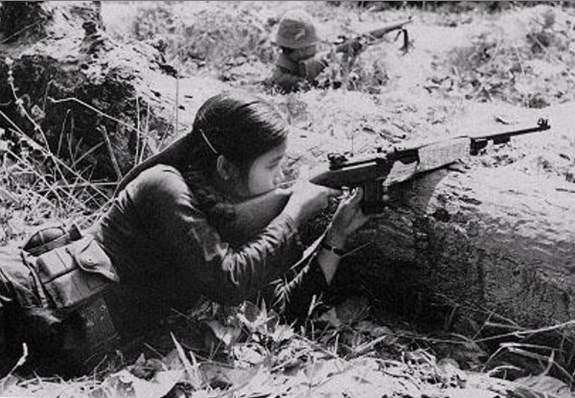
Female National Liberation Front Guerrilla. Photo by Bộ Quốc phòng. Released under Public Domain license.
The hammer and anvil are just one of many tools available to guerrilla fighters. Because knowledge is our greatest weapon, understanding our own weaknesses and our opponent’s strengths can be enough to win. A small force may be at a disadvantage in direct combat, but a larger enemy has more infrastructure to target. Guerrillas strike, then disappear before a slow enemy can respond. This turns our weakness into a strength – and the enemy’s strength into a weakness.
“We’ve never advocated violence; violence is inflicted upon us. But we do believe in self-defense for ourselves and for Black people.”
Huey P. Newton
Guerrillas in the mobility phase can’t overtake their enemies, but they can drain their resources and morale. This helps them reach equilibrium, and eventually, the overtaking phase.
The Black Panther Party simply wanted to improve material conditions in their community, but the U.S. government responded with extreme violence. They arrested members, falsified evidence, and even executed leaders like Fred Hampton without due process. As co-founder Huey P. Newton said, “We’ve never advocated violence; violence is inflicted upon us. But we do believe in self-defense for ourselves and for Black people.”
Revolution is inevitable. People will organize and fight for better material conditions, and those in power will try to maintain control. We’re not yet at the point where violence is appropriate; calls for it are premature. We need to organize as a class, and that starts with understanding revolutionary concepts like guerrilla warfare, even if we hope never to use them.
Personally, I’m out of shape and I’ve got a bad back so I’m not planning a revolution anytime soon. But that’s even more reason to arm ourselves with knowledge. We need class analysis to understand the world around us. To recognize how revolutionary forces are always building. To see how institutions like the DMV are used against us. To realize how media warps our perception of reality.
Class analysis isn’t just about nitpicking media we don’t like; it’s also about finding new meaning in what we love. The Lord of the Rings has its issues – from antisemitic stereotypes to unresolved class problems – but there’s still so much to appreciate. In a world where capitalism tries to crush hope and inspiration, there’s nothing more revolutionary than finding it. Especially in stories from decades past.
oooooo
September 14, 2025
The High Intellectual Barrier to Socialist Consciousness
If socialism is to be a mass movement, it must speak in the language of those it seeks to organize.
The modern worker exists in a state of profound alienation, a condition Marx identified as the inevitable result of capitalist production. In Capital, he describes how workers become estranged from the product of their labor, from the act of production itself, and ultimately from their fellow workers. This alienation is exacerbated today by the hyper-specialization of labor, where expertise is so fragmented that no single worker can claim ownership over the final product. The assembly line, once a symbol of industrial progress, has evolved into something predatory: a system where workers are reduced to mere appendages of machinery, their labor abstracted into a series of disconnected tasks. Tasks that may feel meaningless to the worker but remain indispensable to the capitalist.
This fragmentation is no accident. As Gramsci observed, ruling-class dominance is maintained not just through economic coercion but through cultural hegemony. The language of socialism – dialectical materialism, surplus value, proletarian internationalism – remains alien to the very class it seeks to emancipate. Burdened by the daily grind of survival, workers are systematically denied the time and mental space to engage with these ideas. The result is a cruel paradox: those most exploited by capitalism are often the least equipped to understand, let alone challenge, their own exploitation.
Compounding this crisis is the spread of economic illiteracy among the masses. In the absence of clear socialist education, workers absorb and reproduce capitalist myths: scarcity as natural, austerity as necessary, wages as fair compensation rather than stolen surplus value. This confusion breeds reactionary tendencies, fracturing the working class into factions that turn against one another rather than the system oppressing them. Modern Monetary Theory (MMT), for instance, offers a powerful critique of capitalist finance, demonstrating that inflation and debt are political choices, not immutable laws. Yet without accessible explanations, MMT is either dismissed as “magic money tree” nonsense or distorted into liberal reformism, stripped of its revolutionary potential.
Automation, which under socialism could liberate humanity from toil, has instead been weaponized against workers. Marx foresaw this in his analysis of machinery under capitalism: technology is adopted not to reduce suffering but to intensify exploitation. Today, robotics and AI displace workers, jobs are outsourced to super-exploited labor in the Global South, and the gig economy turns precariousness into a business model. The ruling class wields innovation as a cudgel, ensuring that progress for capital means regression for labor.
The barrier to socialist consciousness is not merely intellectual. It is structural. How can workers achieve true class awareness when theory is locked behind academic jargon, when even basic critiques of capitalism are drowned out by corporate media and anti-intellectualism? The working class is expected to navigate a labyrinth of abstraction just to grasp the mechanisms of their own oppression. Worse, those who do grasp these ideas often find themselves shouting into voids – either preaching to the already converted or struggling to be heard over the exhaustion and disinterest of those too worn down to engage. It is like a non-Catholic stumbling into Mass, unfamiliar with the rituals, unable to recite the right phrases, forever an outsider looking in.
This is not an insurmountable problem, but it demands a shift in how socialist ideas are communicated. If socialism is to be a mass movement, it must speak in the language of those it seeks to organize. This does not mean diluting ideas but rather making them accessible without sacrificing their depth. The task ahead is not just to critique capitalism but to dismantle the barriers that keep workers from recognizing their own power.
The crisis of labor is both economic and ideological. The ruling class thrives on the illusion that capitalism is natural and eternal. Breaking that illusion requires more than perfect analysis decked out in radical buzzwords. It demands a movement that transforms theory into action, philosophy into daily struggle. The stakes could not be higher. If the language of liberation remains the property of academics and isolated subcultures, the working class will remain trapped in the machinery of its own exploitation.
The truth is, the people who will reach Main Street are not the theorists writing in obscure journals. They are the workers who live on Main Street, who speak the language of rent and groceries and layoffs – those who know exploitation firsthand. Those who understand the mechanics of capital’s oppression.
oooooo
State and Revolution Book Club
October 18, 2025
Real Progressives is holding a five-week book club on Lenin’s State and Revolution. We encourage those who have not read the book to join us. We also invite those who have already read it to come, not only to study it further, but to help those of us still struggling to learn.
The Soviet Union was formed by transforming the imperialist Russian Empire into a union of socialist republics. This radical process was not brought on by chance; it was a deliberate and arduous process where the working class went from being a subservient class to one that could rule itself.
This miraculous transformation ended cycles of famine and established food stability for all. The economy went from an agricultural backwater to a space-faring superpower. The culture, which was once the setting of Fiddler on the Roof, produced the army that ended the Holocaust. These radical changes required expertise and could only happen because the Russian revolutionaries—the Bolsheviks—took the time to study how to transform society. They had help, though; they had their leader, Vladimir Lenin, to show them the way.
Lenin ran a newspaper to keep the masses informed. He also wrote texts that are fundamental to revolution. Every successful revolution starts by studying the basics. From Mao in China to Huey P. Newton and the Black Panthers, every real revolutionary studies Lenin.
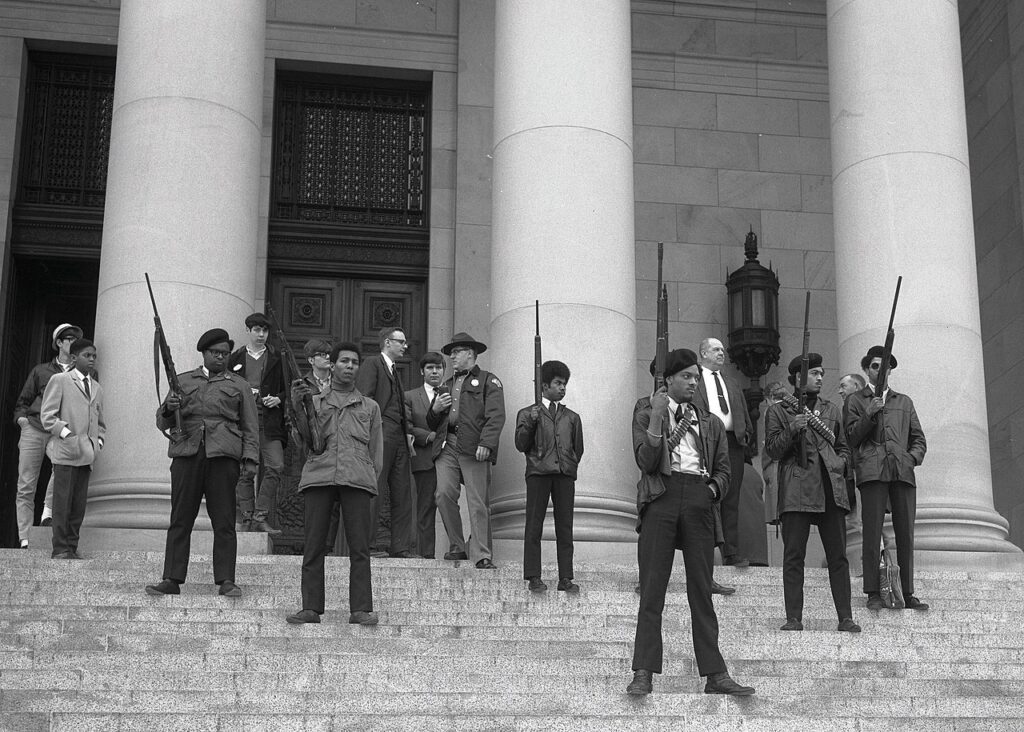
Huey P. Newton did not learn to read in school. He had to teach himself after dropping out. But just learning how to read wasn’t enough. More advanced texts required not just reading comprehension, but a process of studying to fully understand what was being presented. The Panthers would host reading sessions so they could study and learn together. Angela Davis remembers her time studying with the Panthers:
“If I still retained any of the elitism which almost inevitably insinuates itself into the minds of college students, I lost it all in the course of Panther political education sessions. When we read Lenin’s State and Revolution, there were sisters and brothers in the class whose public-school education had not even allowed them to learn how to read. Some of them told me how they had stayed with the book for many painful hours, often using the dictionary to discover the meaning of scores of words on one page, until finally they could grasp the significance of what Lenin was saying. When they explained, for the benefit of other members of the class, what they had gotten out of their reading, it was clear they knew it all–they had understood Lenin on a far more elemental level than any professor of social sciences.”
The Panthers were revolutionaries who studied revolution. They took the first steps in transforming society, and it’s up to us to take those same steps and to study those same fundamentals. Real Progressives is holding a five-week book club on Lenin’s State and Revolution. We encourage those who have not read the book to join us. We also invite those who have already read it to come, not only to study it further, but to help those of us still struggling to learn.
We owe it to yesterday’s revolutionaries to become today’s revolutionaries. I hope to see you all there.
oooooo
November 19, 2025Terminator: No Fate But What We Make
For every Darth Vader there’s a Luke Skywalker, for every Sauron there’s a Frodo Baggins, for every Skynet there’s an entire resistance ready to challenge it.
I love science fiction movies. Whether they’re big-budget blockbusters or cheesy schlock, I can’t help but become enthralled by fantastic technology and alien worlds. The best thing about science fiction as a genre is its ability to blend with others. My favorite horror film—1984’s The Terminator—seamlessly fuses horror with sci-fi, resulting in an action-packed thriller that raises deep questions about humanity, our propensity for creating weapons, and fate.
Everything about The Terminator is cool. Arnold Schwarzenegger looks badass in leather and sunglasses. A dystopian future, killer robots, and time travel would elevate any movie, but The Terminator doesn’t rely on special effects as a crutch—it uses them to build suspense. That suspense turns to terror when the Terminator’s flesh burns away in a fire, revealing its metallic skeleton.
Artists take inspiration from wherever they can. Writer-director James Cameron conceived The Terminator after a nightmare featuring a metallic skeleton crawling from flames. The Terminator’s use of phones to locate its target reflected public fears about privacy and wiretapping at the time. The film’s post-apocalyptic future, triggered by nuclear war, was clearly influenced by Cold War anxieties.

The Terminator is sent back to 1984 from a dystopian future where Skynet, an evil artificial intelligence, seeks to exterminate humanity. Skynet turns humanity’s own nuclear missiles against them, manufactures Terminators, and even builds a time machine. Its power stems from control over production, mirroring real-world class power dynamics.
I doubt millionaire James Cameron consciously cared about class analysis, but artists often embed their biases unintentionally. Skynet represents the military-industrial complex, which prioritizes war machines over human needs. Instead of hospitals, we get drones; instead of doctors, soldiers. The system thrives on conflict, not care.
Artists can recognize and correct their biases. In the first Terminator, Sarah Connor is a clichéd damsel in distress, lacking agency while the male protagonists—the Terminator and resistance fighter Kyle Reese—battle around her. Her sole purpose is to survive long enough to birth John Connor, the future resistance leader. She was just supposed to stay out of the way so men could do everything.

By Terminator 2, Sarah transforms into a hardened warrior—muscular, armed, and proactive. She drives the plot by attempting to destroy Skynet preemptively, something the men don’t do. Linda Hamilton’s physical transformation was so extreme her sister played Sarah in flashbacks. Cameron’s shift not only improved the story but also challenged misogynistic tropes.
What people truly want is a Star Trek future: no more wars on Earth, technology focused on exploration, free food, and advanced medicine. This is the kind of future we can build for ourselves. We can leave our children a world where technology like that is within our grasp.
In Terminator 2: Judgment Day, Skynet sends a new more advanced T-1000 Terminator to kill John Connor. The resistance reprogrammed an Arnold Schwarzenegger Terminator and sent it to the past with Skynet’s own time travel technology. Just like a real guerilla movement the resistance isn’t as interested in research and development as it is in using what its enemy has already developed.
The future resistance sent Kyle Reese back to 1984 in the first movie. John Conner gave a picture of his mother to Kyle Reese well before he sent Reese back to protect his mother. The first Terminator movie ends with Sarah getting her picture taken. Its the same picture that Kyle Reese will have of her in the future. This time travel loop where an event is caused by another event that was caused by the first event is called a bootstrap paradox.

In Judgement Day we find out Skynet was built using the remains of the Terminator from the first movie. There’s a ton of bootstrap paradoxes in these films that makes it seem like judgement day is inevitable. But time travel paradoxes are fictional plot devices, judgement day is not inevitable. As the film repeats “no fate but what we make for ourselves.”
Larger than life adversaries like a time traveling killer robot or the military industrial complex can be beaten. The first Terminator shows how to defeat a seemingly unstoppable foe: weaken it step by step. A truck cripples the Terminator, fire strips its flesh, a bomb mangles its body, and a hydraulic press finishes it off. Similarly, the military-industrial complex can be dismantled—through persistence, solidarity, and class consciousness.
We can overcome Skynet. We can build a Star Trek future. Knowledge is power, and collective action is our weapon. Without class analysis, Skynet’s rise seems inevitable; with it, any future is possible.
So much of artistic expression ends up being grim or dystopian, this is because a lot of artists lack class consciousness. But for every nuclear apocalypse there’s a Star Trek where the future looks brighter. The inspiration we get from fiction stories is real inspiration, and it can really help to unite us.

Early humans told stories around campfires, they expressed themselves through cave paintings. We are social beings and we have always valued our ability to connect with each other over our artistic expression. As Kim Il-sung put it in On The Juche Idea “Man is a being with creativity, that is, a creative social being.” They truly value art in the Democratic People’s Republic of Korea, that’s why they added a paintbrush to their hammer and sickle flag.
We can start building a resistance to the forces of evil. For every Darth Vader there’s a Luke Skywalker, for every Sauron there’s a Frodo Baggins, for every Skynet there’s an entire resistance ready to challenge it. The resistance didn’t start out with the ability to challenge Skynet, they started small and built themselves up over time. Just like Sarah Connor we can go from being at the mercy of production into those who control production. That’s what a revolution is, it’s a process where a class goes from being subservient into a class that can rule over itself. We can make that revolution happen. Our destiny is not pre-determined; there is no fate but what we make for ourselves.
oooooo


