
@tobararbulu # mmt@tobararbulu
Ritter’s Rant 063: Enemy States
Ritter’s Rant 063: Enemy States
Germany and Japan are classified as “enemy states” under Article 53 of the UN Charter. They are not allowed to engage in aggressive policy. Ask Russia and China how they feel about this.
Dec 09, 2025
Transkripzioa:
Hello and welcome to this edition of Ritter’s Rant. Today we’re going to be talking about enemy states. Now, that’s a term that’s thrown around a lot. I mean, we hear the United States posturing that Venezuela is an enemy state. Israel views Iran as an enemy state. Iran views Israel as an enemy state.
Russia views Ukraine as an enemy state. Ukraine views Russia as an enemy state. But this isn’t what I’m talking about. I’m talking about enemy state as it’s used in the context of the United Nations Charter, in particular, Article 53. Article 53 states… the following. The Security Council shall, where appropriate,
utilize such regional arrangements or agencies for enforcement action under its authority, but no enforcement action shall be taken under regional arrangements or by regional agencies without the authorization of the Security Council. And here comes the interesting part. With the exception of of measures against enemy enemy state as defined in paragraph two of this article.
provided for pursuant to Article 107 or in regional arrangements directed against renewal of aggressive policy on the part of any such state until such time as the organization may, on request of the governments concerned, be charged with the responsibility for preventing further aggression by such a state. Then it goes on. The term enemy state,
as used in paragraph one of the article, applies to any state which during the Second World War has been an enemy of any signatory of the present charter. Guys, we’re talking about Germany and Japan. These are enemy states. You know, we tend to forget that, especially here in the United States, where in the post-World War environment,
we have constructed alliances in opposition to both the Soviet Union and Communist China, which have incorporated Germany and Japan as our allies. You see, we tend to view these two nations as our friends. But that’s incompatible with historical reality. From the perspective of Russia, who suffered greatly at the hands of Nazi Germany,
and from the perspective of China, who suffered greatly under the hands of Imperial Japan, Germany and Japan will always be enemy states and should always be treated as such, especially given the context of present-day reality, where we have Germany Austrian to become the largest land army in Europe.
We have a German Minister of Defense who is actively articulating for the necessity of armed conflict with Russia by 2030. I mean, this is literally the definition of aggressive posturing, aggressive policy that would allow Russia under Article 53 to immediately terminate Germany’s existence. Let’s make it clear. Germany has no right.
under the United Nations Charter to pursue a policy of aggression against Russia. None whatsoever. Russia has every right under Article 53 of the United Nations Charter to destroy Germany should it seek to implement such policies. this is the reality of international law this is the reality of the united nations
charter this is the reality of the world we live in we tend to forget this here in the united states where we have cozied up to the germans and forgiven their horrific past i mean it is the united states after all that whitewashed the German generals, those war criminals who killed hundreds of thousands,
if not millions of people through the orders that they issued, who were put on trial, and many of them found guilty of these war crimes, only to have these convictions expunged so that Germany could join NATO, so that Germany could whitewash these war criminals and turned them into general officers in the new Bundeswehr.
But the Bundeswehr was really the Wehrmacht, just renamed. Their officers were Nazi war criminals. Many of the men who served in the Bundeswehr were Nazi soldiers. And we continued that. We did the same thing with the Galen organization. General Galen ran the intelligence operations of Germany in the East, where he committed horrific war crimes,
where he allied himself with the Ukrainian Banderists. And instead of being arrested, put up against the wall and shot by the United States, Galen was instead absorbed by the United States, and his organization became the German Intelligence Service. So when we speak of Germany today, we speak of the Bundeswehr, we speak of the BND,
we’re speaking of literal descendants of the very Nazis that we fought to destroy. And now we have the Germans seeking to empower the Bundeswehr and the BND to go to war against Russia. This is aggressive policy and it’s illegal under international law. And the penalty is death.
And Russia has every right to use whatever means necessary to inflict this penalty as justice on a Germany that’s forgotten what its historical reality is. It’s an enemy state of the world that is founded in the United Nations Charter. The same holds true for Japan, who is today posturing aggressively against China, against China.
Look at your history, ladies and gentlemen, and understand what Japan did to China. Understand why China will never, ever trust the Japanese again and cannot stand by idly while the Japanese seek to resurrect their military relevance, to make the rising sun, again, a flag that dominates the Pacific, where Japan threatens preemptive military action against China.
Japan is an enemy state, an enemy of the world. That is enshrined in Article 53 of the United Nations Charter. Japan has not permitted aggressive policy, especially aggressive policy against China. And yet we tolerate it in the United States. We encourage it. Have we forgotten our past, the role we played in defeating Germany and Japan?
Maybe, but understand this, the Russians and Chinese will never forget their past. They will never forget the sins of Germany and Japan, and they will never sit by idly and allow either nation to undertake aggressive policies that seek to resurrect the horrific practices of the past. Article 53 of the United Nations Charter, Enemy States, read it,
think about it, and understand why the current policy direction of both Germany and Japan is not only incompatible with international law, but incompatible with life. That’s been my rant. Thanks for tuning in. The next time the thought crosses my mind, I’ll be sure to bring it to your attention.
oooooo
Do Not Trust, Do Not Verify
Discerning the truth about Russia’s 9M729 missile may be the only way to save the US-Russian arms control relationship.
Dec 09, 2025
There has never been a more critical time than the present for meaningful arms control agreements between the United States and Russia. The prospects of such are severely diminished because of past allegations of Russian noncompliance with the Intermediate Nuclear Forces (INF) treaty. Resolving this issue is critical for getting future arms control negotiations on track.
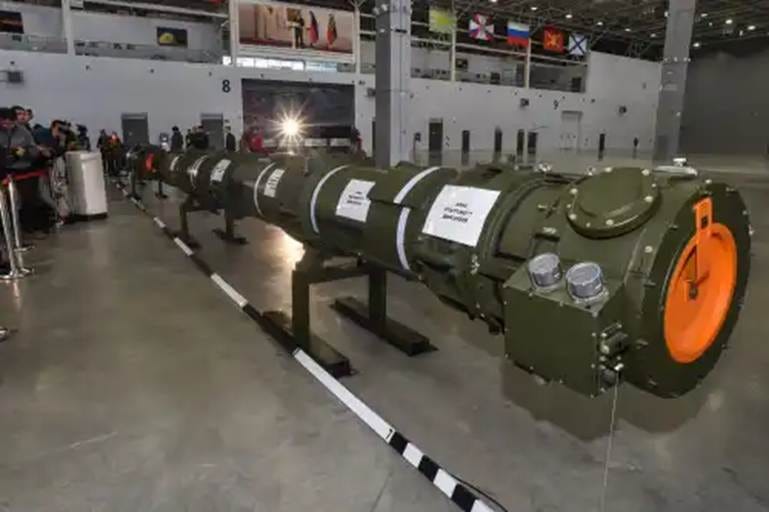
The Russian 9M729 cruise missile on display, January 2019
Thirty-eight years ago, President Ronald Reagan and General Secretary Mikhail Gorbachev signed the INF treaty, a landmark arms control agreement which eliminated two entire classes of nuclear-capable delivery systems—short-range and intermediate-range missiles. The treaty was unique at the time in that it incorporated intrusive on-site inspection activities as a foundational element of its treaty compliance and verification mechanisms.
Reagan made repeated use of the Russian proverb Доверяй, но проверяй (trust, but verify) when talking about the treaty and its unprecedented verification protocols. And indeed, over the course of the treaty’s 13-year lifespan for its on-site inspection provisions, this concept withstood the test of time and trial by fire that comes with stringent adherence to the reciprocal activities carried out on the territory of the two parties to the treaty.
Unfortunately, the clear-eyed vision of mutually reciprocal arms control which underpinned the INF treaty and early discussions regarding strategic arms reductions (START) did not survive the end of the Cold War. The collapse of the Soviet Union brought with it a realignment of American geopolitical posturing, away from a world where reciprocity between equals was the law of the land, and toward a new reality driven by notions of the end of history and the rise of the American hegemon serving as the world’s sole remaining superpower.
Arms control stopped being a mechanism which engendered global security and stability and instead became a forum for the sustainment of US strategic nuclear superiority, using arms control as a way of reducing and/or eliminating the Soviet legacy of nuclear power inherited by Russia while maintaining US qualitative superiority.
The US began to view arms control, in its original Cold War context, as unnecessary, and the arms control treaties spawned during that era as inconvenient. This attitude led to the US withdrawing from the anti-ballistic missile (ABM) treaty in 2002 and, in doing so, undermining strategic arms reductions efforts that had begun with the START treaty coming into force in 1994.
A follow-on treaty, START 2, which focused on reducing the use of multiple independently targeted warheads on strategic delivery systems, had been successfully negotiated and signed in 1993, and was ratified by the US senate in 1994. The Russian Duma ratified the START 2 treaty in 2000. However, this ratification was contingent upon the US remaining in the ABM treaty and the US Senate ratifying a September 1997 addendum to START 2 that established a demarcation between strategic and tactical missile defenses, something the Senate refused to do.
The US withdrawal from ABM prompted the Russians to withdraw from START 2. The collapse of START 2 also saw the end of negotiations between the US and Russia on a START 3 treaty. To compensate for these failures, the US and Russia agreed to a new disarmament vehicle, the Strategic Offensive Reductions Treaty, or SORT, which reduced the respective strategic nuclear arsenals of each nation to between 1,700 and 2,200 operationally deployed warheads each. SORT expired in 2012. The START treaty expired in 2009.
Faced with the fact that the framework of arms control that had brought about drastic reductions in the size of the US and Russian nuclear arsenals was about to disappear, the US and Russia negotiated the New START treaty, which was signed in 2010 and entered into force in 2011. New START saw the two parties further reduce their nuclear arsenals to 1,550 deployed nuclear warheads.
The Russian initiation of its Special Military Operation (SMO) in Ukraine, which devolved into a proxy war between the collective West (the US, NATO and the EU), using Ukraine as the instrument of violence, and Russia, led to a deterioration of relations between the US and Russia which detrimentally impacted arms control, including the implementation of the New START treaty. Today, with the treaty expiring on February 5, 2026, the provisions of its compliance verification mechanisms (on site inspection, data exchanges) have been suspended, and the treaty exists in name only, with both parties agreeing to comply with the caps on the number of deployed nuclear warheads.
There is an agreement of sorts by both Russia and the United States regarding the need for keeping these caps in place after New START expires, a reality reflected in point 17 of the 28-point “peace plan” that emerged following talks between Russian special envoy Kirill Dmitriev and his US counterpart, Steve Witkoff, in Miami, Florida at the end of October. But getting this agreement to the point of manifesting itself into a binding arms control treaty vehicle is no simple task.
One of the main obstacles confronting a New START treaty follow-on agreement is the issue of trust.
The seeds of this mistrust were sown prior to the negotiation of a New START treaty.
Sometime prior to 2008, the Novator Design Bureau (NPO Novator), based in Yekaterinburg, Russia, had been tasked by the Russian Ministry of Defense with creating a new weapons system similar to missile systems currently in service at that time, including the tactical road-mobile Iskander-K cruise missile, and the 3M54 Kaliber, a sea-launched anti-ship missile. These follow-on systems were intended to be used to attack targets on land using new guidance and control systems produced by the Moscow-based State Scientific Research Institute of Instrument Making (GosNIIP) that allowed for greater accuracy. The sea-launched version of this system, known as the 3M14K, was tested at a range of around 1,500 kilometers.
While the INF treaty prohibited ground-launched cruise missiles possessing a range greater than 500 kilometers, there was no such range restriction for sea-launched missiles. Indeed, the INF treaty permitted sea-launched systems to be tested from ground-based launchers. The testing of the 3M14K missile, as such, did not represent a violation of the INF treaty.
However, US intelligence analysts monitoring the work of NPO Novator were unable to distinguish between the originating tasker to produce both sea- and ground-launched missiles, and what they were observing in the various intelligence feeds they were monitoring (while the US government has not specifically acknowledged the sources and methods used in making its assessment, subsequent revelations that the intelligence could be divided into that which could be shared with the so-called “Five Eyes” partners (the UK, Canada, New Zealand, Australia) and other NATO partners such as Germany and France suggest that there was sensitive communications intercepts in addition to the more conventional imagery and telemetry data.) This confusion may have been compounded by the fact that the 3M14K guidance and control system, along with other components related to warhead and flight controls, were interchangeable with the ground-launched system then under development, known as the 9M729.
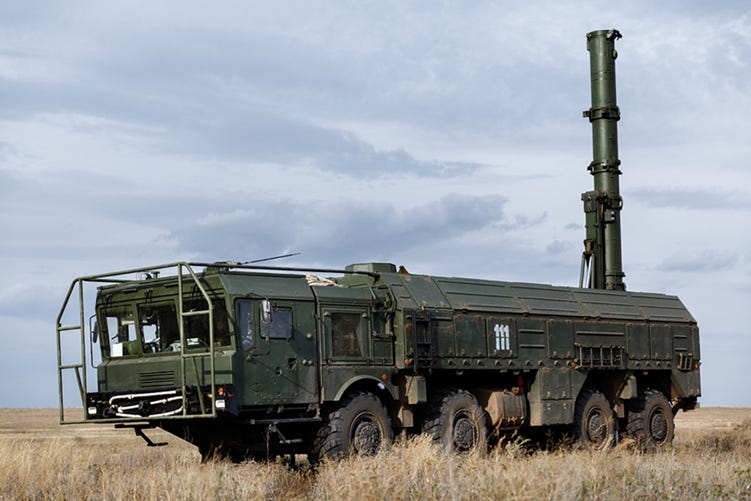
The 9M729 missile and launcher
The United States first alleged in its July 2014 Compliance Report that Russia was in violation of its INF Treaty obligations “not to possess, produce, or flight-test” a ground-launched cruise missile having a range of 500 to 5,500 kilometers or “to possess or produce launchers of such missiles.” The basis of this report was the determination by US intelligence that Russia had used the clause in the INF treaty which allowed for the testing of its 3M14K sea-launched cruise missile to disguise its development of the 9M729. By the end of 2016, when it looked like Russia was about to make the 9M729 cruise missile operational, the United States put its foot down. On March 8, 2017, General Paul Selva, the vice chairman of the US Joint Chiefs of Staff, formally accused Russia of deploying a ground-launched cruise missile that “violates the spirit and intent” of the INF Treaty.
In December 2018 President Donald Trump, after consultations with NATO allies, gave Russia 60-days to come into compliance with the INF treaty, meaning Russia would have to destroy the 9M729 missiles and their launchers.
On January 23, 2019, Russia publicly displayed the 9M729 missile for the first time, side by side with the treaty compliant 9M728 Iskander-K cruise missile. Lt. Gen Mikhail Matveevsky, the chief of the Russian missile and artillery forces, declared that the 9M729 missile features a more powerful warhead and improved guidance system over the previous 9M728 model. The 9M729 did not, however, have an increased range.
The US and its NATO partners refused to attend the demonstrations and did not follow up on Russia’s offer of further technical investigations that would demonstrate that Russia was, in fact, not operating in violation of the INF treaty. The belief at the time was that the US did not want to legitimize a process which would prove Russia’s point but ignore the intelligence-based assessments that had been promulgated by the US intelligence community and supported by the US arms control community.
On August 2, 2019, the US withdrew from the INF treaty. Russia shortly followed suit.
Today, with the New START treaty’s legacy in doubt, those in the US arms control community who believe that an extension of the treaty’s core provisions, including the caps on deployed nuclear warheads, find themselves wrestling with the consequences of this precipitous decision on the part of President Trump. The reality is that the Trump administration empowered a certain influential segment of the US arms control community to undermine a critical foundational agreement because it had become inconvenient to those in the US military establishment who believed that the INF treaty placed unreasonable constraints on US military power by denying us access to an entire class of weapons which were being used by China as the cornerstone of their regional power projection capability.
The US case against Russia was manufactured from incomplete data which was scrutinized under the lens of a politicized intelligence community that had grown accustomed to providing the answers desired by policy makers, rather than providing the fact-based truth.
The US accused Russia of violating the “letter and intent” of the INF treaty, but could not detail the reasoning behind this conclusion, hiding behind the age-old “sources and methods” shield.
And yet, when given the opportunity to directly confront Russia with the reality of its lies by taking the Russian sup on their offer of a demonstration of the capabilities of the 9M729, the US declined, claiming that they had every expectation that the Russian missile would fly the distance necessary to prove it was, in fact, in compliance.
The US knew that Russia had flight tested the 9M729 to permitted ranges, and that it was this version of the missile that Russia had produced and fielded in 2016-2017.
The US knew that its case was founded in a deliberate misreading of flight test data related to the earlier development of the 3M14 cruise missile, a missile which, while sharing components with the 9M279, was not interchangeable with that system.
Today these empowered members of the arms control community—the very ones who presided over the untimely death of the INF treaty—are seeking to use that treaty’s demise as justification for rejecting arms control altogether.
According to their logic, not only can the Russians not be trusted, but neither can those in the arms control community who believe in the efficacy of arms control, if for not other reason than the remained in denial about the nefarious character of the Russian arms control community during the critical period of negotiations leading up to the signing and ratification of the New START treaty.
In the minds of those who promulgate the “Russia as cheater” mindset, the New START treaty should never have been allowed to go forward, given Russia’s demonstrated proclivity for cheating.
In their minds, the demise of the New START treaty is an act of delayed justice.
To the extent that the arms control process should be enabled to continue, these enablers of the “Russia cheated” behavioral model believe, it should only be as a facilitator of the deployment of new weapons systems along the lines of the policy pursued in the late 1970’s-early 1980’s to deploy the so-called “Euro missiles” (the ground launched cruise missile and the Pershing II intermediate range missile) into Europe in response to the Soviet deployment of SS-20 missiles.
But the notion that such a build-up could lead to a new “zero-zero” negotiation posture of the sort which allowed the INF treaty to be born is not part of the equation of these anti-arms controllers. Instead, they simply are advocating to produce newer classes of weapons.
This is the same approach they take regarding New START—eliminate the arms control agreement and use the resulting policy vacuum to promote the testing and fielding of entirely new classes of strategic nuclear delivery systems.
To create the conditions that favor a new nuclear arms race.
The saying that “the truth shall set you free” may not directly apply in this case, if for no other reason than the members of the US arms control community who promulgated the lie of Russian noncompliance know that they were promulgating lies.
Seeking to have the intelligence community correct the record with a retrospective re-examination of the pressures it was placed to produce a desired outcome is a mission impossible void of some sort of “Iraq moment” like the debacle that followed the ill-fated invasion and occupation of that nation under the manufactured guise of eliminating weapons of mass destruction.
But there is a path where truth becomes a tool of empowerment—public perception.
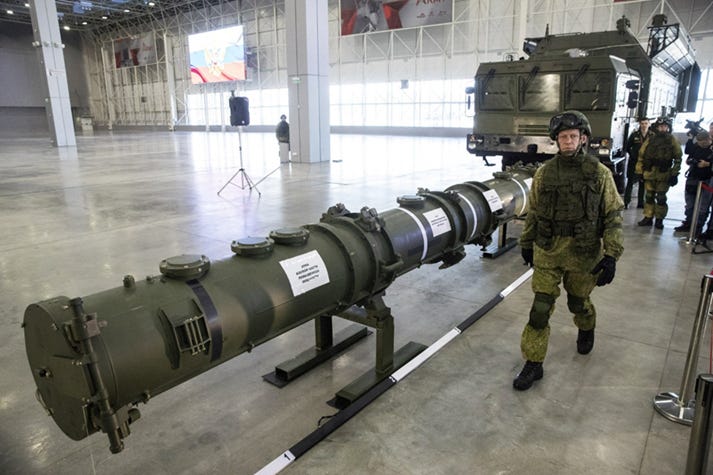
The 9M729 missile on display, January 2019
If the truth about Russia’s alleged INF treaty noncompliance can be told, if the record can be set straight in that regard, then public confidence in arms control, and in particular the efficacy of New START, giving the furtive efforts underway to extend critical elements of that agreement a new life, and furthering the possibility of a new follow-on treaty agreement being signed and ratified.
For this reason, I believe that the onus falls on Russia to set the record straight—not in the mistaken belief that it would somehow get the US arms control tiger to change its stripes, but rather to help shape American public perception so that there can be ground-up support for New START.
I am proposing that Russia make the history of the development of the 9M729 an open book. To reveal the development path taken regarding this missile’s journey from concept to operational weapons system. To discuss the flight tests that took place, and their results.
Russia could benefit by providing select members of the American media—perhaps including informed members of the independent alternative media such as myself, given my interest in and background on the subject—a detailed briefing about the 9M729 missile, to include a tour of a 9M729-equipped unit, to help demonstrate that the system was, in fact, a treaty compliant weapon under the INF Treaty.
Russia was willing to undertake activities of a similar nature in January 2019.
I believe there is a compelling case for such an effort today.
“Trust, but verify” used to be the mantra of the arms control community back when arms control treaties were in vogue.
Today’s arms control community appears to be operating under the mantra “Don’t rust, don’t verify.”
They want to kill arms control all together.
This would be to the collective detriment of both the US and Russia.
Let’s not wake up some morning in the future, confronted by the consequences of our collective failure to act.
As the United States seeks to improve relations with Russia, the issue of arms control will be one of several important topics that will need to be addressed. Before meaningful movement can be made toward the renewal of a New START-like treaty framework, it is critical that the American public be as well informed as possible about the factors that led the United States government to withdraw from the INF Treaty.
This is especially true if Russia was not in violation of the INF Treaty.
oooooo
@tobararbulu # mmt@tobararbulu
Words Matter
Words Matter
When it comes to the issue of trust between the United States and Russia, the concept of a “deal” is a non-starter. Legally binding treaties are the coin of the realm. There’s a big difference.
Dec 11, 2025
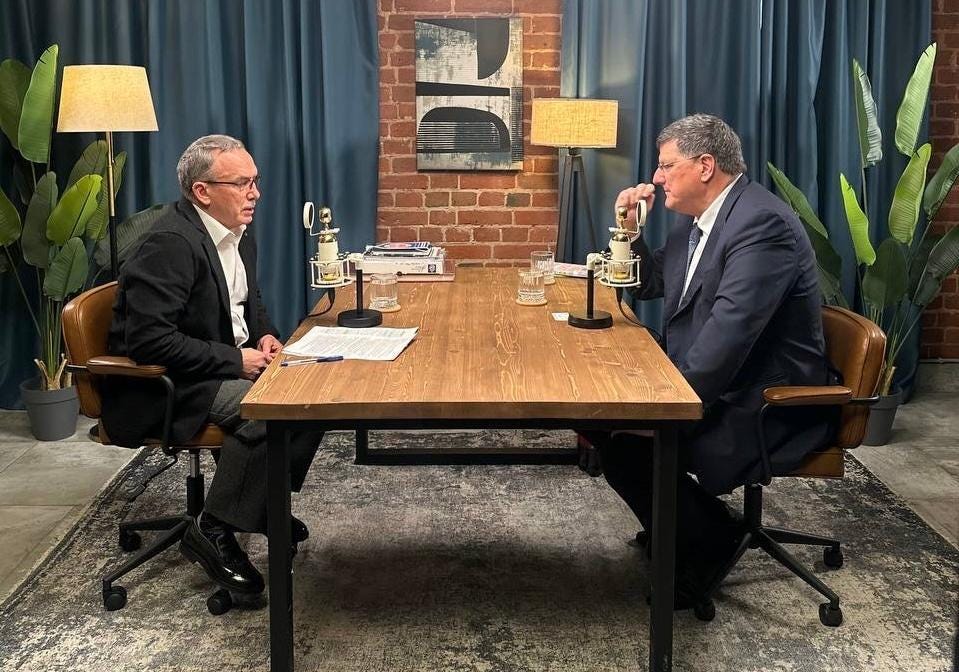
The Author (right) sits down with Andrei Andrei Ilnitsky (left) in Moscow, November 21, 2025
Andrei Ilnitsky is not someone to be trifled with. A retired Lieutenant General of the Russian Armed Forces, Andrei served for 10 years as a Senior Advisor to the Minister of Defense of the Russian Federation, Sergei Shoigu, responsible for formulating and implementing information policy. When Shoigu was replaced by Andrei Belousov as Minister of Defense in May 2025, Andrei stepped down from his position and assumed a more informal role of advisor on political strategy for the Ministry of Defense. Today Andrei is widely published in prestigious military journals, and is a frequent commentor on Russia television. In short, Andrea Ilnitsky is a serious man whose views resonate with the highest levels of the Russian government.
I had the honor and privilege of being able to engage in a frank and open discussion with Andrei Ilnitsky as part of my The Russia House with Scott Ritter podcast. We focused on the prospects for better relations between the United States and Russia in the aftermath of the Alaska Summit, and discussed the prospects of a US-brokered peace agreement between Russia and Ukraine.
Andrei and I parted on good terms—I believe he felt I had asked intelligent questions and showed a modicum of familiarity with the issues of the day and how they are viewed from a Russian perspective. As for me, I soaked in every word—it’s not often one gets the opportunity to probe the mind of a man who directly advised a Russian Minister of Defense for a decade. We exchanged contact information, and promised to stay in touch.
And stay in touch we did. I would read transcripts of Andrei’s appearances on Russian media while translating articles he had previously published in Russian military journals (Andrei was kind enough to provide me with copies of these), while Andrei let me know that he was watching my appearances on YouTube and reading my own articles.
It was in the context of my recent efforts to breath life into the derelict machinery of arms control that Andrei reached out to me to comment on my words and efforts. I had been promoting the idea of reviving the spirit of the Intermediate Nuclear Forces (INF) treaty with regard to the soon-to-be-expired New START treaty, to include highlighting the mantra oft-repeated by President Ronald Reagan, “trust but verify.”
“The crisis of trust between Russia and the US, between the Global South and the West,” Andrei wrote, “may be the greatest crisis of our time. Trust is the object of a mental war. It is destroyed quickly and restored slowly. This is, among other things, what we (you & me) discussed in Moscow.”
Andrei and I spoke in length about this very issue, with an emphasis on the long and difficult path the United States would need to take in order to regain the trust of the Russian people and government in the aftermath of Ukraine.
“Russians are a trusting people,” Andrei noted. “But if we’re deceived, our trust is hard to regain. And no Kirill Dmitrievs [note: the former Goldman Sachs investment banker and current CEO of the Russian Direct Investment Fund, who currently serves as a special envoy for Russian President Vladimir Putin on bettering relations with the United States]—people who are mentally non-Russian—will help here. You have to talk to Russia either honestly or not at all. Minsk 1 and Minsk 2 are difficult and bad lessons, but we’ve learned them. There will be no Minsk 3. I hope so.”
The issue of a “Minsk 3” looms large in the psyche of many Russians today, namely the fear that Russia will once again fall victim to the naive belief that the West is capable of negotiating in good faith, that an agreement means what it says, and is not simply a smokescreen behind which plots are devised and implemented. For Russia, the Minsk 1 and Minsk 2 agreements represent this very sort of nefarious double-dealing.
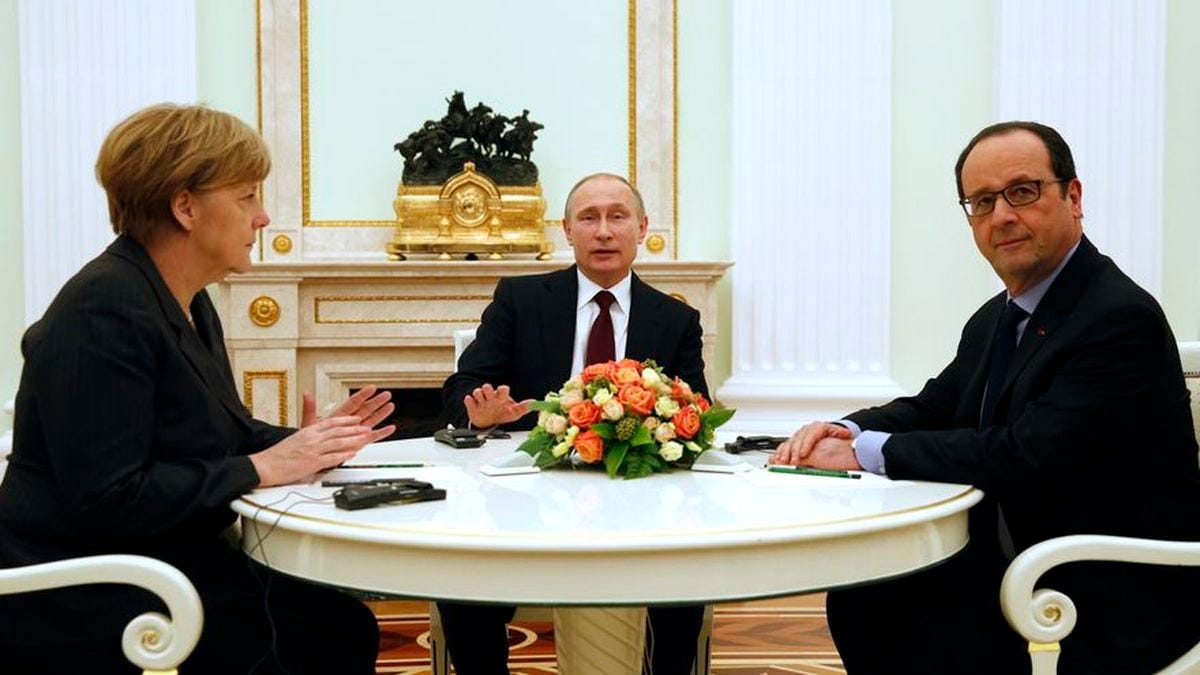
Angela Merkel (left), Vladimir Putin (center) and François Hollande (right) meet in February 2015 to negotiate the Minsk 2 agreement
However, one of the main players behind convincing Russian President Vladmir Putin to agree to the Minsk accords, German Chancellor Angela Merkel, admitted in an interview published in Zeit Magazine on December 7, 2022, nearly a year to the day after she stepped down from her post. “The 2014 Minsk Agreement was an attempt to give Ukraine time,” Merkel told the German magazine. “They used that time to get stronger, which you can see today. Ukraine of 2014/15 is not Ukraine of today.” (Similar confessions have been made by the other two parties to the Minsk accords, French President François Hollande and Ukrainian President Petro Poroshenko.)
Angela Merkel personally led the Minsk negotiations between 2014 and 2015 in an effort to stabilize eastern Ukraine. The February 2015 negotiations in particular were important—Merkel was faced with a looming disaster for the Ukrainian army in Debaltseve, where thousands of Ukrainian soldiers were surrounded and facing imminent annihilation at the hands of Russian-backed separatist forces.
Under these circumstances, Merkel, together with Hollande, frantically pushed a diplomatic agreement with Russian President Vladimir Putin—the Minsk accords—which Merkel later admitted was simply a ruse designed to freeze the conflict and buy the Ukrainian military time to reorganize and refit for the purpose of continuing the fight. The agreement, reached on February 15, 2015, included a cease-fire, called for the withdrawal of heavy weapons, and the establishment of a security zone that would be monitored by the Organization for Security and Cooperation in Europe (OSCE). Moreover, President Poroshenko pledged to amend Ukraine’s constitution to allow special status for the Russian-speaking citizens of Donetsk and Luhansk and grant them greater autonomy.
President Putin, reflecting on Merkel’s confession that the Minsk accords were simply a ruse, noted that “We thought we would still be able to agree within the framework of the Minsk peace agreements. What can you say? There is a question of trust.” President Putin reflected on his words, before adding “And trust, of course, is almost at zero.”
As it turned out, Putin stated, “no one was going to fulfil all these Minsk agreements, and the point was only to pump up Ukraine with weapons and prepare it for hostilities. After a statement like that,” the Russian President added, “the question arises of how to negotiate, about what, and is it possible to negotiate with someone, and where are the guarantees. An agreement will have to be reached in the end,” Putin concluded, “all the same. I have said many times that we are ready for these agreements, we are open, but this makes us think who we are dealing with.”
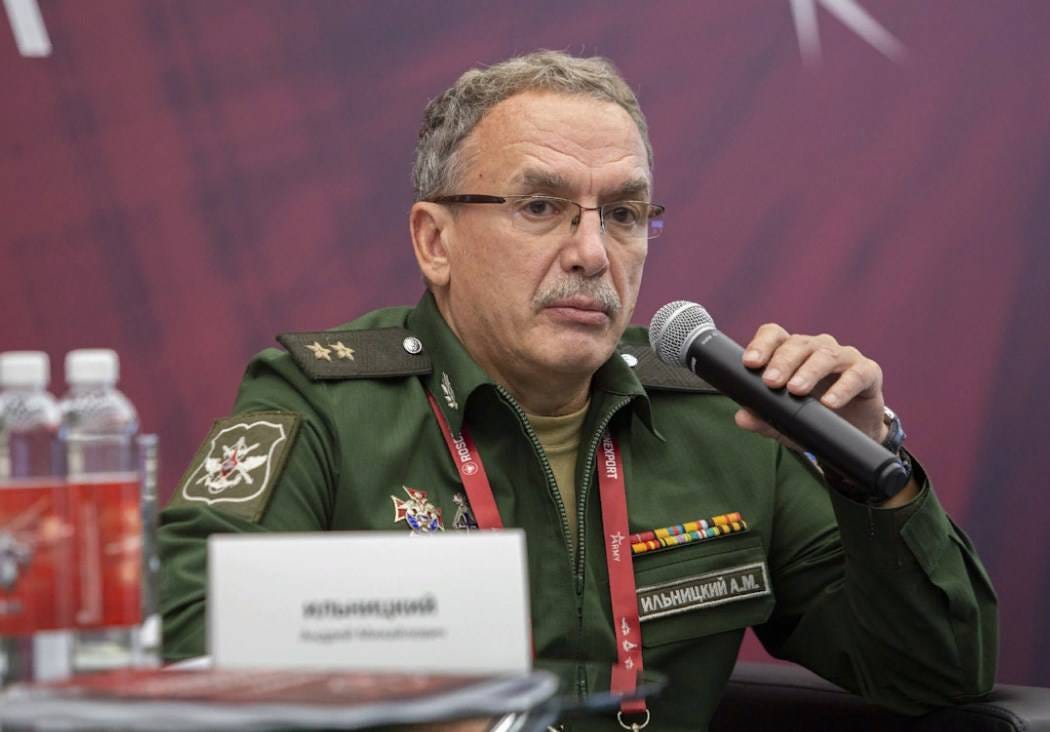
Lieutenant General Andrei Ilnitsky in his roll as Special Advisor for Information Policy for the Russian Minister of Defense
Andrei Ilnitsky is a man of honor, a man of integrity. Today Andrei specializes in information policy. But for him, the concept of betrayal is more than theoretical. He is a highly educated man, having graduated from the Moscow Institute of Physics and Technology (MIPT) From 1982 to 1992, Andrei worked as a research fellow at the 26th Central Research Institute, located in Balashikha, in the Moscow Oblast. The 26th Central Research Institute in an interservice institution dedicated to comprehensive research on issues pertaining to military infrastructure, specialized military construction and fortification complexes, and other facilities for the services of the Russian armed forces.
From 1992-2003, Andrei was one of the senior editors with the ASST Publishing Group, one of the two largest publishing houses in Russia. Near the end of his time with ASST, Andrei enrolled in the Moscow School of Political Studies, from which he graduated in 2002. He is a member of the Moscow Writer’s Union.
After graduating from the Moscow School of Political Studies, Andrei became involved with Open Russia, a political organization founded by the Russian Oligarch Mikhail Khodorkovsky and shareholder from Yukos, an oil and gas company Khodorkovsky built largely on the basis of a controversial “loans for shares” auction program that exploited the hard economic reality of many Russians. Open Russia underwrote philanthropic projects, including educational projects for young people, the Federation of Internet Education, the Club of Regional Journalism and projects of human rights NGO’s. Andrei oversaw leadership and regional projects on behalf of Open Russia.
Open Russia met its demise in 2006. In October 2003 Khodorkovsky was arrested on charges of tax fraud. Starting in 2004, the Russian government began seizing the assets of Yukos, before dismantling the company entirely in 2006. The fate of Open Russia paralleled that of Yukos, and with its source of funding terminated, Open Russia disbanded.
Open Russia ostensibly operated on a reform agenda designed to build and strengthen civil society. During its time of operation, Open Russia had extensive interactions with NGO’s funded by western nations, including the United States. Andrei was on record during this time for expressing admiration for the United States, calling it an “amazing country with colossal energy” that had been “created by people who believe in God, but above all in themselves.”
Andrei’s impression of the United States, and the West in general, appears to have been dampened by the realities associated with his experience as part of Open Russia. Rather than promoting pro-Russian values, Open Russia had been used by Khodorkovsky and his allies to undermine public confidence in Russian institutions, culture and self-confidence. In 2006, Andrei joined United Russia, the political movement and party most closely associated with Russian President Vladimir Putin. As a member of United Russia, Andrei became heavily involved in the affairs of the Moscow Region, leading a number of civic initiatives that radically transformed the political and social lives of Muscovites for the better. Andrei was recognized for his work by both Moscow regional authorities, who awarded him with the Badge of St. Sergius of Radonezh for high services to the Moscow Oblast (Region), and the Russian Government, which awarded him the Medal of the Order “For Merit to the Fatherland”, 2nd Class.
Around 2010, Andrei became acquainted with Sergei Shoigu, a close confidant of Russian President Vladimir Putin, first in his role as the Minister of Emergency Situations, and briefly as the governor of the Moscow Oblast. In 2012, Shoigu was appointed as the Minister of Defense. At the end of 2014, Andrei resigned from his duties with the Moscow Oblast, and in March 2015 took up his position as a senior advisor for information policy with the Ministry of Defense. In 2017 Andrei graduated from the Military Academy of the General Staff of the Armed Forces of the Russian Federation, paving the way for his promotion to Lieutenant General.
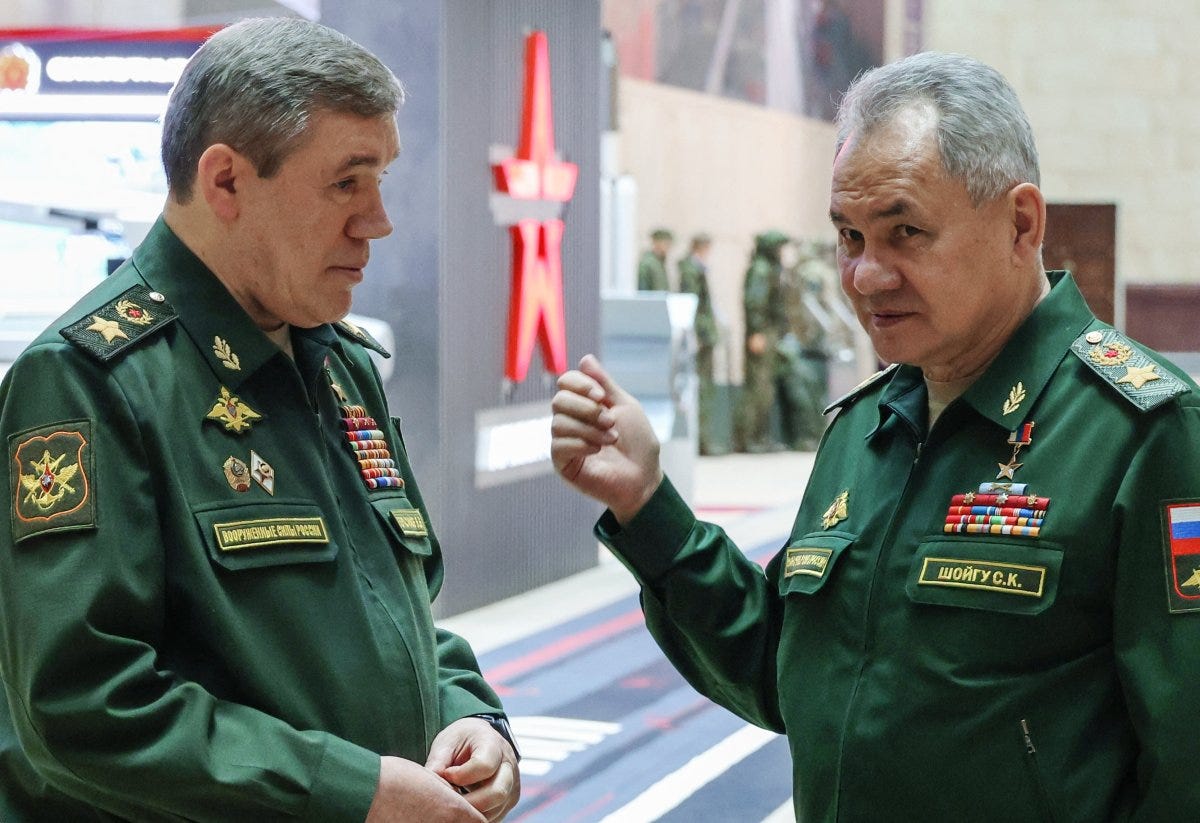
General Gerasimov (left) with Minister of Defense Shoigu (right)
Andrei arrived at the Ministry of Defense in a time of great controversy. On 26 February 2013, the chief of the Russian General Staff, General Valery Gerasimov, published an article entitled “The Value of Science Is in the Foresight: New Challenges Demand Rethinking the Forms and Methods of Carrying out Combat Operations” in Voyenno-Promyshlennyy Kurier (VPK) (Military-Industrial Courier). In this article, Gerasimov set forth his view of the operational environment that the Russian military found itself in, and the nature of future war.
In his article, Gerasimov concluded that the pattern of compelled US-sponsored regime change had transitioned away from overt military invasion (i.e., Operation Desert Storm) to a new kind of “hybrid warfare” which saw the US installing political opposition in targeted countries using mainstream media outlets like CNN and BBC which acted like state-control propaganda organizations, the Internet and social media (“soft power”, or “digital democracy”), and nongovernmental organizations (NGOs).
Once the US was able to successfully lay the foundation of internal political dissent, separatism, and/or social strife, the targeted government would find it increasingly difficult to maintain order, and the US would take advantage of deteriorating security environments to empower separatist movements, operating in conjunction with covert special operations and (if needed) conventional military power, to create the conditions of political collapse which would be accelerated by the imposition of economic and political sanctions by the US. The ultimate goal would be to create the conditions for regime change, where a government not to the liking of the US would be replaced by one that would do the bidding of the US.
While General Gerasimov wrote of “indirect and asymmetrical methods” in describing what was clearly his articulation of a new kind of warfare being waged by the West, western analysts misconstrued Gerasimov’s intent in writing his article as an expression of a new kind of Russian warfare, which they named “hybrid warfare.” This misdirection took on more weight following the events of the Maidan “revolution” in January-February 2014, and the subsequent Russian seizure and annexation of Crimea. Western analysts tried to use these events as a clear illustration of Russian-style “hybris warfare” in action.
But, in fact, it was the opposite that was true. As Gerasimov pointed out, the tactics used by the West in Ukraine in 2014 and onward followed a classic pattern of behavior that had been seen in Iraq, Yugoslavia, Syria, Iran, Libya—and Ukraine and Russia. The role played by NGO’s in facilitating the “soft power” actions was singled out by Gerasimov to be a major factor in the success of “hybrid warfare.”
Andrei assumed his duties as a senior advisor for information policy in the midst of the controversy generated by Gerasimov’s article. While Andrei did not discuss this aspect of his personal evolution with me, the patterns of behavior outlined by General Gerasimov in outlining his theory of western “indirect and asymmetrical warfare” would logically have resonated with Andrei, given his front-seat role in facilitating the “soft power” actions of Open Russia from 2002-2006.
What is known is that in March of 2021, Andrei gave an interview to the military magazine Arsenal Otechestva (Arsenal of the Fatherland) where he accused the United States, and the West in general, of waging what he called a “mental war” against Russia.
“If in classical wars,” Andrei said, “the goal is to destroy the enemy’s manpower, in modern cyber wars to destroy the enemy’s infrastructure, then the goal of the new war is to destroy self-consciousness, to change the civilizational basis of the enemy’s society. I would call this type of war ‘mental.’ Moreover, while manpower and infrastructure can be restored, the evolution of consciousness cannot be reversed, especially since the consequences of this ‘mental’ war do not appear immediately but only after at least a generation, when it will be impossible to fix something.”
“Mental War” appears to be a corollary to Gerasimov’s “indirect and asymmetrical warfare”, another tool used by the collective West to tear down Russian society from within. Far from being the far-fetched idea of someone on the political fringe of Russian power, Andrei’s concept of “Mental War” was endorsed by Kremlin spokesman Dmitry Peskov, who noted that there was “[a] deliberate policy to contain and keep Russia down is being pursued. It is absolutely constant and visible to the naked eye.”
When viewed in the context of Andrei’s evolution as a political thinker, one can discern a direct connection between his concept of “mental war”, and his concerns regarding the trustworthiness of the United States.
To someone possessing Andrei’s discerning intellect, a term like “mental warfare” would not be chosen lightly.
All words have meaning.
This is especially true in the context of what people are calling a “peace deal” between Russia and the United States, a concept furthered by the fact that the Russians and American sides have put two “dealmakers” front and center when it comes to crafting an agreement on Ukraine—the aforementioned Kirill Dmitriev, and Steve Witkoff, a New York City real estate mogul and close personal friend of Donald Trump.
The problematic nature of the term “deal” was spelled out to me in ANdrei’s most recent communication.
“And one more thing,” Andrei noted. “In the US-Russia dialogue, tone, subtext, and words are very important. The word ‘deal’ has a negative connotation in Russian. It suggests some kind of trickery and deception. Agreements and trust are not achieved through deals.”
Words have meaning.
“Keep this in mind,” Andrei asked, “and please explain it to the Americans.”
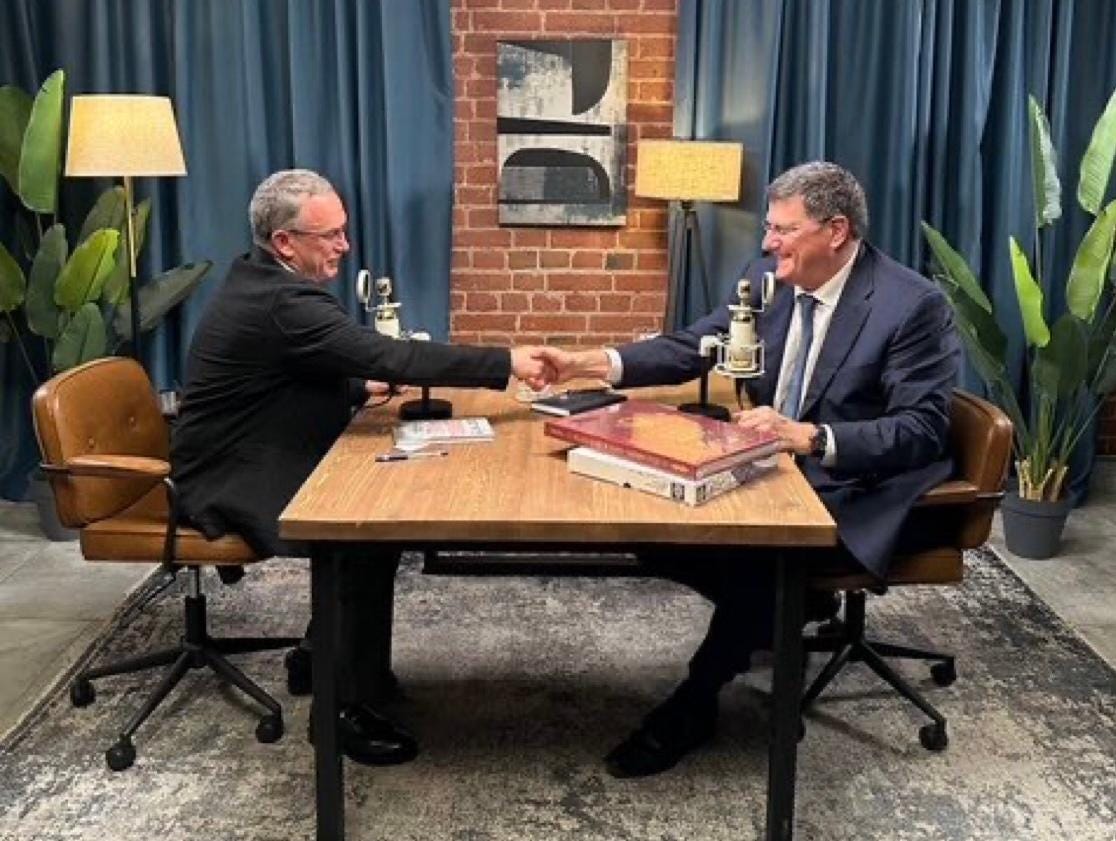
The Author (right) shaking hands with Andrei Ilnitsky (left)
I’ll try my best.
When it comes to arms control, Russia isn’t looking to engage in a real estate transaction.
Russia isn’t interested in gaining an advantage through sleight of hand (or negotiation.)
We are in the situation we face today because the United States has treated arms control like a transactional exercise.
We withdrew from the ABM treaty because it was inconvenient to those who believed in the myth of a perfect missile shield.
With withdrew from the INF treaty because it was inconvenient to our need to match the Chinese (who were not party to the treaty) capabilities in intermediate-range missiles.
We negotiated the New START treaty in bad faith, deliberately obscuring definitions that could be reimagined down the road when issues of compliance and compliance verification arose.
Lying about our willingness to engage in meaningful negotiations about missile defense once the New START treaty was successfully ratified.
The Russians aren’t looking for a good “deal”, because “deals” are, by their very nature, subjective, depending on situational factors that change over time.
Russia’s Strategic Nuclear Deterrence capabilities are considered essential for the survival of the Russian nation and civilization, especially in a time when Russia’s enemies are seeking the strategic defeat of Russia using both “hybrid warfare” and “mental war.”
There is no “deal” possible that would have Russia sacrifice the one thing that guarantees its ability to defeat the external threats posed by the collective West and their stratagem of strategically defeating Russia.
Now let’s look at the “peace deal” the Trump administration is dangling before the Russian nation.
The “deal” hinges on a yet-to-be defined economic relationship which seeks to link the Russian and American economies through a program of investments and joint endeavors designed to promote the kind of connectivity that serves as a de facto security guarantee, a notion premised on the concept that nations so closely linked economically would be loath to go to war against one another.
The problem, however, is that the premise of such a deal—Russia opening itself up to significant investments by foreign partners who only recently were seeking Russia’s strategic defeat—are activities which appear to be purpose built for the kind of “hybrid warfare” and “mental war” that Gerasimov and Andrei, respectively, warned about.
Russia doesn’t want a “deal.”
Russia wants a binding treaty backed by fool-proof guarantees.
And therein lies the rub.
Words matter.
Because words have meaning.
America wants to conflate the notion of a “deal” with the substance of a treaty.
Russia knows better, because it has been on the receiving end of American (and western) duplicity for too long.
“Trust, but verify” sounds good when spoken.
But put those words down in writing, and the concept becomes inherently problematic.
“Russians are a trusting people,” Andrei had written to me. “But if we’re deceived, our trust is hard to regain.”
Its time to wake up to a harsh reality, America.
If we want better relations with Russia, if we want a lasting peace in Ukraine, if we want meaningful arms control agreements, then we are going to have to win back the trust of the Russian people.
And it is going to take a considerable amount of good-faith effort to win back the trust of a people whom we have consistently betrayed over the course of the past several decades.
oooooo
@tobararbulu # mmt@tobararbulu
Interview with Andrey Ilnitsky
Interview with Andrey Ilnitsky
Dec 11, 2025
In this special edition of The Russia House with Scott Ritter, I am in downtown Moscow, where I had the honor and privilege to speak with with Andrey Il’Nitsky, a retired Lieutenant General in the Russian Army and former senior advisor to Russian Minister of Defense Sergei Shoigu. We discussed the Alaska Summit and the new peace plan being discussed by the Russians and the US. A fascinating perspective from someone who sat in on the inner circle of Russian defense policy.
Transkripzioa:
Hello and welcome to a special edition of the Russia House with Scott Ritter. This entire week I’ve been in Moscow having the opportunity to reach out and have meaningful conversations with significant Russian personalities dealing with the economy, with the military, politics. And today I have a very special guest, Andrei Ilnitsky. It’s the American in me.
I fumble on Russian words constantly. You should hear me speak Russian. It’s очень страшно. But you’re an expert in military political affairs, an advisor to the Ministry of Defense, and And generally speaking, you serve in advisory capacity today. It’s an honor and privilege to speak with you. I’m really thrilled that you could join me today.
In preparing for the interview, this always seems to happen to me. I came to Russia in August, prepared to have meaningful dialogue about US-Russian relations. And next thing you know, Vladimir Putin and Donald Trump are going to be meeting in Alaska, and it became politically too sensitive to talk about. And in preparing the conversation with you,
suddenly I wake up yesterday and find that there’s a 28-point peace plan that has been prepared in Miami between Kirill Dmitriev and Steve Witkoff, that according to the American media, at least, is a serious proposal backed by the U.S. government. And my concern was that suddenly many of the topics I wanted to talk to you about
were no longer going to be talked. But in our green room discussion before this interview, you indicated that you’d be more than happy to discuss these things. So why don’t we start there? We have this peace plan. It’s not the first time there’s been a peace plan.
I think it’s widely recognized that the special military operation didn’t begin in February of 2022, that it has its roots that go back much further than that. So here’s my question to you. When did the Ukrainian-Russian crisis start, the crisis that manifested itself in the special military operation? And
That’s a very serious start of our conversation about war and peace. Today, we are in a situation where there is no clear boundary between these two notions, war and peace. Moreover, He used to say that war is a continuation of policy using other means. But now we have just the reverse in accordance with George Orrell. Today,
peace is war, and when we talk about peace, we need to use this framework where peace is no war, not a long-term war. It should not be a ceasefire, but it should be a long-lasting peace. What you asked me about the plan, similar to you, I learned about that plan from mass media, from newspapers,
and I learned about those 28 items. As a physicist, I have a question, why not 26 or 30? Okay. I read statements and comments made by our foreign minister and comments made by Mr. Peskov, a presidential spokesman, so there were some comments given by Kirill Dmitriev, I’ve heard you say you are concerned.
Actually, hearing the word scary from an ex-U.S. Marine sounds like a metaphor. But we are also concerned and we are concerned that The previous precedents may be repeated. As you remember, there were agreements, public agreements that were assigned that were needed, as Angela Merkel said, were needed to prepare Ukraine for a pending war. And in July 2024,
our president, when he addressed the foreign ministry, he defined our peace formula. And it boiled down to the following. that the root causes of that war would have to be eradicated. The root causes that led to the special military operation, Ukraine’s nuclear status and demilitarization, which means liquidation of offensive weapons and reprofiling
weapons at all and a radical army reduction so that in the future Ukraine would not be in position to pursue an aggressive military policy. This is what a neutral status means. I’ll go off track for a moment. But now we’ve been hearing comments, let’s reduce it by two times down to about 600,000 men.
And then Europeans are almost declaring it that they would be able to use the Ukrainian army as a private security company for Ukraine, some sort of a mercenary force. to fulfill various assignments related to waging a war against Russia. When did it start? In actual fact, it started on the day of disintegration of the Soviet Union.
And there was a choice that was documented among other things. First of all, there were statements made and books written by President Kuchma, who explained why Ukraine was not Russia. It began with Ukraine. betraying the Russian peace and the Russian world. Why am I saying that? Like all Russians,
I believe that Ukrainian people are part and parcel of the greater Russian people. who is a Chechen, but he is also Russian. But when the Soviet Union was disintegrated, Ukrainians began to be transformed into non-Russians, and then they became anti-Russians. And this trend was formalized under Obama. And this became a strategy where Russia
became that when Ukraine turned into a spear of that military campaign against Russia and Russia kept raising its concern about the movement of forces closer to our borders. There was the Munich speech and there were multiple other Do you remember attempts to land in the Crimea, to land American forces, to allegedly conduct drills in the Crimea?
In any case, the kettle was boiling. And I have a lot of respect for John Michail. I think he is a distinguished American political analyst and he said that the war started in 2014, if not 2010, but it was a latent form of that war. But in 2022, it became a hot war.
But this is the way to look at this conflict. Once again, I’d like to repeat it, that the conflict was predetermined not only by the Western policy, We cannot deny the fact that there were serious forces at play, starting with Brigade 77 from the UK and up to the Soros network.
And Ukraine, as it seemed to them, made a choice. But in fact, it betrayed itself, not only Russia. My parents are buried in Ukraine. My father was born in Western Ukraine, though he was a Soviet officer. This is only my private, my personal opinion. There will be no Ukraine without Russia.
And if it continues to exist, it will be a breeding ground for another war. Ukraine may become a very significant part of the Russian world. whether the incumbent Kyiv Janta likes it or not. It is history. It is the law of history. And to close it off, there was a great Russian writer, Nikolai Gogol, who wrote,
by the way, he was born close to the city of Poltava in Ukraine. He wrote a wonderful book entitled Taras Bulba. It’s a proper name. And he described a war against Poland by Zaporozhye Cossacks. It was a religious war. And one of Taras Bulba’s sons, who was the chief of that army,
betrayed his compatriots and he joined the Polish adversaries and his father said so what did they help you and in Ukraine some of Ukrainian elites made the same choice like Taras Bulba’s son and the end was very pitiful and therefore it is predetermined that Ukraine will become a part
Thank you very much. I have a follow-on question. I have several follow-on questions. Denazification is something that President Putin has spoken about from the very beginning of the special military operation. It’s one of the core principles along with demilitarization. You just mentioned a figure of 600,000 troops,
which appears to be the number that’s being bandied about in this agreement. That would give Ukraine the largest army in Europe. That seems to be the opposite of demilitarization. And denazification, we hear dates put out there, 2014, 2010, but how about 2004, 2005? That’s when the Ukrainian nationalists, who are adherents of Stepan Bandera,
came into power after stealing an election from Viktor Yanukovych. They immediately made Stepan Bandera a hero of Ukraine and began this process of normalizing the Banderist ideology. But the Banderist ideology goes back to before the Second World War, the collaboration with Adolf Hitler. the horrible crimes committed against the Russians, the Poles, the Bielorussians.
I was just in Minsk, and I visited the Khatun Memorial. A lot of people don’t realize that the 118th military police brigade was Western Ukrainians commanded by Germans, and they’re the ones who perpetrated this massacre. This ideology survived the Second World War. Russia fought a 10-year war. A lot of people don’t realize that,
but even after the Second World War ended, the Great Patriotic War, Russia struggled for 10 years to militarily defeat the Banderists. But they went into diaspora, they were sent to the Gulag, only to be liberated about a year later by Nikita Khrushchev, who allowed them back to Ukraine. where they became reintegrated into Ukrainian society.
And the reason why I bring this up is that Bandarism, Nazis, are part of Ukraine, an integral part of Ukraine. And when I look at this peace plan, I don’t see anything that they talk there will be elections in Ukraine. but they don’t talk about denazification.
Am I wrong in thinking that this peace plan doesn’t cover the two principal core values that Vladimir Putin articulated at the beginning and he’s re-articulated ever since? I’m not trying to be critical of Vladimir Putin. I just have questions. Is this peace plan delivering on what was promised?
Vladimir Putin was pretty clear and unequivocal You have given a very subtle description and you have drawn that subtle line of demarcation between the position of our President and of Russia, which is the same thing, and the American position. The people are already starting to say that it is a Viktor Dmitriev plan, but it is a U.S.
plan. And it is, I think, the starting point for any sort of negotiations. And in your interviews, Scott, you said, and I was listening to you carefully, you said that Putin does not play such games. And actually, at the very outset of negotiations, this is something that was already seen.
It is some sort of scamming, juggling with stuff. Most importantly, people must not die. The most important thing is not playing games with us. You should not try to dupe with us or be dishonest with us. The most important thing is an honest position, an honest policy.
Why has Russia been asserting its position throughout the entire duration of the special military operation? Why don’t we deviate from our position as opposed to the US side? Sorry, Scott. which depends on whom your president met in the morning or who arrived to his office, Kellogg or Whitcoff, Rubio or Wenz. You know, all that divests the U.S.
policy of its independence and that And I am Russian and I agree with our President. We have a clearly expressed position. Denazification and demilitarization. These words sound complicated, but very simple things stand behind them. For example, let’s take denazification. You can say that Bandera ideology has to be spelled out.
Of course, there is an obvious segregation of the Russian-speaking minority. At some point in time, Ukraine was Russian-spoken in its majority. But let’s take the Russian language, the Russian Orthodox Church. It’s a shame. Wenz needs to take note of it. He is a religious man. And he needs to take a look at that. It is genocide.
And the Russian Orthodox Church is being persecuted. And these are the fundamental things. And Ukrainians were led astray. And, you know, their view of various things is somewhat distorted, but we have the same cultural code. It is not us whom Ukraine betrayed, but they have betrayed themselves. It is the Ukraine led by Kyiv
and his comrades in arms. Speaking about demilitarization, as a military man, as an ex-intelligence officer, as someone who used to monitor the compliance with START 1 and START 2 agreements, you are a professional. You need to understand that everything has to be clearly spelled out and there should be no room for misinterpretation.
Why are they saying about 600,000? Why not 60,000? Why do you need 600,000? And if you agree to have a neutral status, I hope that the Ukrainian constitution would not have any clauses about accession to NATO and there will be a neutrality fix in the constitution.
Then there must be a provision that Ukrainian troops are not allowed to take part in military operations overseas and they should not be deployed overseas. Why does Ukraine need 600,000 troops? Why would they need 300 or even 200,000 troops if Ukraine is going to be a peaceful and neutral country?
You know, such games would not work with Russians. But this will not work with Russian people, with our president and with our foreign ministry. We’ve seen that and been there. And, you know, we’ve seen Minsk one, we’ve seen Minsk two, we’ve seen the Istanbul agreements that were almost reached on the terms and conditions that were pretty decent.
and acceptable to Ukraine. But things went, the events took a different path and there are certain limits to our patients. And, you know, I think that speaking about trust, if we look at Russia and the US or Russia and Ukraine, we are not going to work on the principles of trust. We need a clear
meaning clear definitions without any maneuvering ground for misinterpretation. And, you know, two weeks ago, they were going to keep suffocating Russia by imposing sanctions and allocating billions and billions of dollars, and Europe was hitching its wagon to a star. And then all of a sudden, in a fortnight, things have changed,
and everyone has refocused on the peace deal, Why? Not because the Ukrainian giant has been stealing everything lock, stock and barrel, and not only from Ukrainian soldiers who are dying at the front line for the wrong cause, but you as experts who are able to do an excellent analysis.
You see that within three days, we managed to move forward in the Dnepropetrovsk region. And, for example, well, you can see examples of Ukrainian troops surrounded. And we have already passed Guliai. We managed to capture Kupyansk yesterday. And so we have opportunities, new vistas for continuing our offensive against the background of a complete lack
of resources in Ukraine. This is easily calculated by military strategists as a catastrophe. Maybe this is why there is such a haste. with 28 line items. Scott, am I wrong?
I don’t believe you’re wrong. I think the Russian success on the front lines have given a new urgency to diplomacy. And I think that the United States believes that they have a deal. But what I see, and you said this correctly, this is an American deal. This isn’t a Russian deal. You said, where’s the trust?
You know, as a weapons inspector, Ronald Reagan… famously said to Mikhail Gorbachev about the Intermediate Nuclear Forces Treaty and the compliance monitoring. He said it’s premised on doverai, no poverai. Trust, but verify. But verify is derived, I believe, as Latin roots veris. Veris. The truth, fact.
Where is the trust that can exist between Russia and the United States, Russia and Europe? I don’t know. You mentioned Minsk in the pre-conversation. You said this process could probably be called Minsk III. That’s not a good thing to call this thing, because Minsk I and Minsk II were not successful treaties, were not successful agreements.
They were predicated on a lack of good faith on the part of the Western powers, a betrayal of agreements. Angela Merkel, Francois Hollande, Petr Poroshenko all agree that it was a lie, that they told the Russians they wanted peace, they wanted a peace deal,
but it was really just designed to buy time to build up a Ukrainian army of around 600,000, which is why that’s an interesting number, that was designed to attack the Donbas and free the Donbas of Russian capabilities. So how do we begin to proceed on the issue of trust? Can Russia ever truly trust the West again?
You know, your president, Vladimir Putin, who I have a great amount of respect for, reflected on the Minsk agreements. He was very self-critical. He said, maybe I was too naive. that I believe the West, that I believe the West would live up to its obligations. Surely today,
neither your president nor anybody in Russia can ever believe anything the West ever tells you. Is it possible to have any kind of agreement with the West that’s premised on the notions of trust but verify?
I believe that it may be possible if every party is honest with each other. You know, there is a saying, you can deceive everyone. You can deceive some people multiple times, but you cannot deceive everyone all the time. And, you know, if a deal is made on a basis when there are opportunities
of further branching out in the future. Well, that would not be acceptable. I do hope on clarity and honesty of all sides, but the issue of trust is a key one. As you have said correctly, trust but verify. Of course, trust has to be fixed in very simple definitions that does not allow any room for diverse interpretations.
And for this a clear position is needed. And it seems to me that Russia does have this clarity. And this is why we are constantly being criticized that starting in 2024 and when speaking to Donald Trump, Russia has not made any concessions, has not tried to move halfway. to meet the other party halfway. Why so?
We are trying to create a situation where we have a long-term peace rather than just a ceasefire. We need an amistice. And actually, I have heard similar arguments from our president who held a meeting yesterday. with the chief of staff, and I do not see any grounds, even diplomatic grounds.
And this is what Lavrov is talking about, and this is why he had such a tough I do not have any opportunities for any discussions with the agenda. Whom are we going to talk to? Let’s say that it should not be a slogan. Let’s define our position and let’s look for a long-term peace.
Let’s not try to take this path of least resistance. Let’s reach an agreement quickly and then we’ll make a decision. No, if terms and conditions are not met, that peace train would not drive, would not ride towards its peace destination. No, we are not going to agree in transit. No, we need to agree in advance.
As Russians say, we need to agree on the shore before taking off. Scott, let’s say that many things have been destroyed, things that are described by using a simple word, trust, fighting for trust. reaching trust, consolidating trust is something that is most important. Scott, you make very clear comments. We are reading reports that are issued
And we understand how the intelligence community is working and we understand that perhaps the most important task of the special military operation is that it is a testing ground for Western-made weapons. It is a testing ground for American intelligence, UK intelligence, and more said that through such mechanisms as the web, they are
They are perfecting their technologies of strikes against various targets. They actually tested their strikes when there was a strike against Iran. Scott, please try to put it across to the US audience. We understand it all. You should not try to dupe us. We have a very robust intelligence service.
Our diplomatic corps is hardworking and one of the best in the world. And we form our impressions not from newspapers, but face to face when we look at each other. face to face. You should not try to be cunning with us. Actually, Russia is a power which was built and expanded based on trust.
Russia was moving east, and we said, these are our terms and conditions. If you are ready to accept them, we’ll live together. And this is how the Russian Empire was being built when it even had Alaska, and it reached a And we used to live on the principle of mutual trust.
We have about 150 ethnic groups, nationalities, basically, living in Russia. That’s because of trust. You mentioned Katyn, a horrible tragedy. And there was a Zonda command, an SS Zonda command, and they were just secondary. compared to Ukrainian policemen, to Bandera fighters. And thank you for visiting the Piskaryov Cemetery and the Blockade Museum.
And as I have already said, my mother was orphaned in the times of the blockade. My granddad died in 1942. My grandfather was buried in a collective grave, but there is his name on a monument there, but my grandmother was buried in a collective grave. And actually,
it was not only German Wehrmacht that actually fought in Russia and that surrendered Leningrad. But there were Finns, there was the Spanish Blue Division, Italians and the Norway Legion. And there were other soldiers from Slovakia and other countries. We remember it. We understand it. Therefore, you should not try. to actually deal with our historic memory.
Nothing unites Russians. You’ve seen that. For example, the Immortal Regiment. You’ve seen those Immortal Regiment demonstrations when Orthodox Christians and Muslims and everyone else were holding portraits of our deceased ancestors who died during the Second World War. You need to be open-handed and honest with us.
If you want to delete Russia from history or from your life, go ahead. We have everything to be sufficient. We have the most beautiful women in the world. Our men are warriors, and you know them. You met them when you worked in the field. We have our rich history.
We have our Orthodox faith and our Muslim faith, and we have a great, wonderful country. If you don’t want us, why are you trying to meddle? Go ahead and we’ll deal with our affairs on our own. This is what sovereignty is about. The sovereignty of the Russian world with Belarus and Khatynh and Ukraine that are
parts of the Russian world and take it for granted and you have to talk to us proceeding from these positions and the path to mutual understanding is something that is negotiable.
I’ve been coming to Russia for several times over the course of the last several years to reacquaint myself with Russia because I had last visited during the times of the Soviet Union. And a lot has happened between then, and I think one of the greatest things that’s happened
is born from tragedy well first of all let me just say about leningrad you know when i i studied leningrad um in university and you i studied how it was saint petersburg built by peter the great how it was laid out to design its relationship
with europe etc and then we studied the revolution and then we studied the siege of leningrad but it was numbers i mean you know we we tend to condense history into numbers But when you visit museums and you see the real history, the history of the people who lost their lives, you know,
I was walking with a Russian friend in Leningrad or in St. Petersburg. He said every stone in every building, every cobblestone is soaked in the blood of victims. And they cry out. They reach out to you. And you can feel it as you walk through the city. You’re no longer walking through simply a city.
You’re walking through a living memorial to the tenacity of the Russian spirit. And I think all Americans need to do this to understand Russia. I came on the May 9th Victory Day celebration. It’s called Russian Propaganda. in the United States. I didn’t see propaganda.
I saw the Russian people united in their collective desire to never forget what had happened and to never disgrace the memory of the 27 million who fell. It’s real. It’s visceral. It’s emotional. And it’s absolutely essential for Americans. We can’t study Russia from a distance. That doesn’t work.
The only way to study Russia is to come to Russia, to meet the Russian people, to walk the streets, and to let that history be absorbed. So thank you for talking about your grandparents and your grandma. I’m very sorry for your family’s loss, but I think every family in the Soviet Union lost somebody.
My wife is Georgian, and I went to the 1,418 Days of War Memorial at Victory Park. And there’s a section there where you can type in the name And 191 Khatiyashvili served in the Red Army. We found her grandfather. She lost six members of her family. We found reference to some where one’s buried in Poland,
one died in Berlin, others died in various battlefields. in the Russian soil, some in the Caucasian front, others elsewhere. But it’s just proof that everybody sacrificed in this conflict to preserve the Russian dignity, not just of the Soviet Union, but of the Russian people, the Russian nation, Russian history, Russian culture. Why am I saying this?
Because we don’t treat Russia with respect in the West. We don’t treat you with the respect that you deserve. When we speak, you speak of the special military operation and Vladimir Putin’s foundational positions that haven’t changed at all. But before the special military operation, after the collapse of Minsk, there was something that happened in December of 2021.
And that was when Russia presented treaties to the United States and NATO, comprehensive treaties about the creation of a new European security framework. And it appears that that’s one of the foundational concepts of Russia, how to reconfigure the post-collapse of the Soviet Union European geopolitical landscape so that you don’t have NATO expansion irresponsibly to the border of
Russia, that you find a space where Russia has its interests, Europe has its interests. These are well-defined by treaties. The special military operation came after that. In your opinion, what carries more weight, the statements made by Vladimir Putin about the goals and objectives of the special
military operation or the needs for Russia for a new European security framework, or maybe they’re one and the same?
In fact, these are like two wings on a plane. Two wings are needed for a plane to take off. But I can tell you, Scott, that you travel to Russia, you see things, you touch them with your own hands, you have your own position. You’re a true American patriot, an American officer. I know that.
but that your experience defines and determines your attitude. While being an American patriot, you see how Russian people live, remembering our victories and defeats, and remembering our long-term, centuries-old history and the way we became what we are. Many people are asking this question. What is the existential aim of the special military operation?
What is the purpose that can be described in one or two sentences? Yes, demilitarization, denunsification, the protection of Donbass, these are the correct Actually, the more items there are in a peace deal, the more tense the situation would be. Maybe these are not 28 items. I can give you a response.
This is about those two wings on a plane. The principal goal of the Special Military Operation is to break the will of the West to use force to resolve issues they have with Russia. So never again in the foreseeable decades they try to act by using ingenuity or by being cunning and by using force.
There is this expression in Russian. If you come to us with a sword, you will die by sword. Actually, there was a song when I was a kid, and Russians used to sing it in chorus when they had family parties. My father was a military man, an officer. He served in the region adjacent to the Lake Baikal.
And there were people from Kerch, from Vinyasa, from Lvov. And my father was from Western Ukraine, but he was sent to the Baikal region. And there was a song. And the verses are, do Russians want a war? Ask the silence. Ask those soldiers who are lying in graves.
We don’t want a war, but we are a warrior country. If needed, we’ll stand up strong. And if Germans, if Mertz starts stirring things and starts teasing Russia, he’d better keep silent. Similar to the Finns, you should not touch the Russian bear. A bear is a calm beast, but up to a certain point. Therefore,
the task of the special military operation is to make sure that the bear does not stand strong. Our task is just to show that the bear can stand strong. And do not touch our nuclear trade. It is the strongest and the most powerful in the world. It is the best in the world. It is 98% most perfect.
We’ve upgraded And you’ve spoken about it in one of your episodes. Therefore, the way I define it, the task of the military operation, the goal of the special military operation is to break the will of the West, no matter who rules the West after three or five years.
to break the will of the West to resolve issues with Russia by using force. Any other format, whether economic or diplomatic or face-to-face, well, perhaps it’s right for Russia to trade with Ukraine, someone said, the West said. No one understands that Russia and Ukraine are one and the same country. Yes, we do have very strong
But, you know, Ukrainians are like Russians. The same number of Ukrainians died during the Great Patriotic War. And we see that Russians are fighting against Russians, and they’re equally strong and obstinate like Russians. Do whatever you like except for using force. Stop it and then everything would be peaceful, quiet and long term. This is our position.
Well, thank you for that. When we started our conversation, you brought up Klausowitz and war is an extension of politics by other means. And you also mentioned the power of words, that words mean something. You just can’t throw them around. There’s meaning to words. I was taught this by a Russian diplomat a long time ago.
He said, you have to be very careful what you say, Scott, because words have meaning. You can’t just throw words out there willy nilly. The words have meaning and you will be held accountable to those words. I was doing a Zoom meeting with a group of journalists, American and British journalists who cover energy security.
And I was trying to, this was in 2023, I was trying to explain what was going on. And I used the term special military operation. And one of the journalists said, what is that? I don’t speak Putin. What does that mean, special? You know, why don’t you just say what it is, an invasion,
an invasion of Ukraine by the Russians. And this seems to be a problem in the West where they view the term special military operation is just a euphemism for invasion. but i know the russians well enough to know that if they were going to invade ukraine they’d say we’re invading ukraine we’re at war with ukraine but russia
hasn’t it’s a special military operation could you help us you know understand the difference between war and the special military operation as it’s being conducted
today against ukraine i can quote two numbers even ukrainians acknowledge reluctantly but acknowledge that they direct military losses. I’m talking about the military losses in the Ukrainian army amount to more than 1.5 million troops. And they acknowledge that 14,000 civilians died during that time. So, well, actually,
We could have waged a war against civilians that would be quite effective. People are telling us, why don’t you strike Kyiv and kill many people? That’s not our way. This is the difference between a war and a special military operation. Your colleague who criticized you for speaking Putin, I’d like to say, I had some relatives in Luhansk,
and my wife’s parents lived there, and Ukrainians struck an area, and it was a Ukrainian bomber plane dropped bombs on a civilian street about two blocks away from where my wife’s parents lived. And as our president said a year and a half ago, we have not yet just started And this is the way we see our task.
We are conducting a special military operation. It is a tragedy when civilians die, but the scale of civilian deaths is not that huge. Let’s recollect the Gaza Strip, where thousands and thousands of civilians died, 50,000 of people. of civilians are dead. Those journalists are not the ones to rebuke you.
If they know nothing about a war of extermination and if they don’t know the difference between a war of extermination and a special military operation, they are either amateurs or they are just manipulators playing with words. And this is what we’ve been repeating several times. Such approaches and such manipulations dilute trust,
and they divest the West of its independence, of their right to be subjects of their actions, and they discredit the world and the institutions. Whom can we talk about? Whom can we talk with and all that is the result of cognitive and information and psychological manipulations. I could also add, I said that Ukrainians lost 1.5 million people.
I’m not going to disclose our losses, but even Ukrainians acknowledge that our losses are 10 times, I am talking about military losses, are 10 times lower. I think that the actual number is somewhat different, but we are not going to drill into detail about that.
I’d like to remind you that 14,000 civilians are dead in Ukraine and I’m very sorry because Russian people, our genetic fund is being lost. And actually, belligerent Western slaves are being killed at the front line, and they are financed by the West, and they are sponsored using the Western money.
Some of that money is being stolen by the Janta. And actually Zelensky is responsible to the Russian world and to the West and to God Almighty for being so cunning. Ukrainians have not betrayed the Russian world, they have betrayed themselves. And this is what they have to pay for in the eyes of God, first of all.
Nobody wants civilians to die in war, but unfortunately, civilian deaths are collateral damage when we speak of wars on the scale that is being fought today. But I just want to raise something from history. The United States, we liberated Normandy from German occupation in France. And we briefed Charles de Gaulle,
who was the leader of the Free French, that we could end up killing 80,000 French civilians to liberate the peninsula. And he reluctantly approved the operation. As it was, we ended up killing around 60,000 French civilians to liberate France from, to liberate the Normandy Peninsula from German occupation. That’s war.
And that’s why I get a little angry anytime people say that Russia is at war with Ukraine because I’ve studied the Battle of Mariupol and I know the sacrifice that the Russian soldiers made to save civilians in the basements of buildings that were occupied by Azov and the Ukrainian Marines.
If this was a war and America was waging that war, those civilians would have died because we would have blown up that building. But the Russians fight a completely different kind of war. It’s a war that’s reflective not only of Russian morality, but also the fact that this is a special military operation. It is not a war.
This is not the Battle of Berlin. This is something totally different. Moving on to the conflict, one of the The consequences of conflict is that the nature of war has changed, and with it, the quality and quantity of the Russian military. The Russian military that started the special military operation is not the Russian military of today.
It’s been almost completely transformed into probably the most combat-efficient military. ground force in the world. How would you describe this transformation that’s taken place to a Western audience? What are the consequences of this conflict? Because to me, The Russia that emerges from this conflict is stronger, better prepared.
We entered this conflict to weaken Russia, to tear down the Russian military. And instead, Russia is far stronger today than it was in 2022. And its military has unsurpassed capabilities. Am I overstating the case? Or what is the reality of the Russian military today?
Number one, the war or the special military operation has made it clear to us as Russian people, as Mr. Gorbachev said, who is who, which means who is who. That is, who is our friend, who is our adversary, and who is a friend, no friend, and no enemy, but so-so. There is a famous song about that.
could always fight. And our army skills, military skills were perfected in Syria and before that in Afghanistan. And since 2012, the upgrading and modernization of our military forces Primarily, we were perfecting our army guided by the saying, if you want peace, get ready for a war.
And we modernized our nuclear trade and our aviation and our tank divisions were modernized. And we have about 70% of cutting-edge weaponry. And, of course, the special military operation has made it possible to acquire new skills. You understand the role of intelligence and how important it has become. Because intelligence and reconnaissance are now playing the functions,
performing the functions of an army. The warfare has changed a lot. I can tell you exactly without disclosing any details that our army is better prepared than any other army in the world. has been exposed to different hostilities, and as a result of almost four years, we have reset our army, so to say,
and we are ready not only for a big war, but we are ready to wage various level and various scale wars. We are ready to do that, but this is what It makes our bargaining position much stronger and much more conscious. And there is a small nuance I learned recently.
I have not said that to anyone else yet. It turned out that I am maintaining contacts with certain people who told me that this year and we have observed it that there is a dramatic decrease in orders for processes for amputees. There is a dramatic drop in the number of those people who have lost their limbs.
You know, this testifies, well, what can we call it? This is a very good intelligence sign, as we say. which means that we have learned, among other things, to overcome the threat of mines and of mine wars. And our offensive operations are now conducted in small groups.
and our operative and tactical efforts are conducted in such a way so that we first of all capture reinforced areas, and then we spread our forces to capture the rest. Therefore, without threatening or scaring anyone, we clearly say that we are ready, we know how to wage a war, but we don’t want to.
that is being generated by European elites, in my opinion, those elites who have embezzled a lot of funding dedicated to Ukraine and earmarked for Ukraine, who have channeled or siphoned off about 150 billion of European money We know that Europe is being eroded. Mert himself said that it was the end of a social sphere-oriented governance.
And because of all that, the European elites are trying to escalate the situation. They are launching militarization programs. But we understand. And we see that if the United States has resources and has capabilities, Trump’s five sponsors, McDonald, Douglas, Boeing, and the rest, and the other five leading corporations, They have managed to have a trillion budget,
and they know what to do with the money to upgrade the US Army. But speaking about European armies and their potential, we are not trying to simplify the situation, but to put it mildly, do not see any opportunities for Europe, except for embezzling money and spending it, any opportunities to modernize their military forces.
First of all, they need to look at their armies, look at their headcount and at their weapons. You know 600,000, going back to those 28 items, you know that Ukrainian army that is planned to be 600,000 men strong is something that I see as a sly step. What did Zelenskyy propose?
Well, you do not have an army in Europe. NATO is a bureaucratic structure. There are some small national armies. Let us give you one million Ukrainians. a European army on the basis of Ukraine. Scott, as a military analyst, please talk to experts, please use your connections in Europe. It seems to me that those 600,000 strong troops
are looked at as a future army for Europe. And it is another time when Zelenskyy is trying to sell Ukrainians as a bargaining chip. Please be on the alert.
Thank you very much for that. I can promise you that I will continue to do the job of bringing the Russian reality and Russian perspective to an American audience so they can better understand it. I can say without any fear of exaggeration,
this conversation we’ve had here today is going to go a long way in enabling me to do just that. I want to thank you very much for your heartfelt and your detailed answers.
Thank you. I’ll add one thing from my own experience. There was a time when I asked our Russian ambassador to the US, Mr. Kislyak, who came back, and it was a few months once he had returned from the United States. I said, Mr. Ambassador, could you please let me know? These were post-Trump, early post-Trump days.
Are there any people to talk to in the United States? Because there was this impression that nobody knew who was responsible for anything or who could actually perceive and get the message. And our great Russian diplomat and ambassador said, yes, military men, American military men know it all and understand it all.
Did you notice who arrived in Ukraine to talk to Zelensky? Not Vitkov or Kellogg, but one of the top brass from the United States Army. Therefore, when conducting a dialogue, I saw how military men were building a dialogue with American generals. And I think that our dialogue is a model of how to look for a solution.
Nobody else understands war and peace so well as military men. And in actual fact, I do believe in the common sense of American military men and American elites. I esteem Trump and Mr. Wentz, who was in Iraq for two times despite his exaltation. He is an officer with combat experience. We know your background,
and if someone is trying to challenge you, I do not see a greater American patriot than you. May God save you.
Thank you very much, and may God save us all. Andrei Alinsky, a geopolitical expert, an advisor to the Ministry of Defense, and my honored guest today in the Russia House. Ladies and gentlemen, this is why I do this program. This is why I come to Russia,
to have conversations like this and to bring it back to you and American audience so you can be empowered with knowledge and information and make better informed decisions about the world we live in. Thanks for tuning in, and I’ll see you again next time.
oooooo
Ritter’s Rant 064: Mental War
Transkripzioa:
Hello and welcome to this edition of Ritter’s Rant. Today we’re going to be talking about mental war, psychological warfare, information warfare, all combined together. It’s a concept that was promulgated to the public in March of 2021 by a Russian lieutenant general named Andrei Ilnitsky. He gave an interview where he talked about this ongoing mental warfare that was
being waged by the West against Russia. What is mental warfare? Well, basically, it’s a manipulation of data. It’s using resources like the mainstream media, like the Internet. It’s, you know, straight up propaganda, but it’s designed to tear down a society from within. basically to plant the seeds of doubt within a society, to have them question their leadership,
to have them question their laws, to have them question the very essence of their existence, to question themselves, and then to basically carve out society, cause it to rot from within, and then it’ll make it easier for society to collapse. And according to General Ilmitsky, Russia has been
the subject of mental warfare being waged by the West against it. You know, we’ve called this many things. Russophobia, you know, helps create the conditions for mental warfare because, you know, it means that it’s actually a force multiplier for those who are committing mental warfare against Russia. because you’re able to recruit allies, new allies,
who are unwitting perhaps in their complicity in what they’re doing simply by repeating what they’ve been told to say by mainstream media, by the government. They’re a force multiplier for the weaponry that’s used in mental warfare, this information that’s being flowed. If you say something, if you tell a lie long enough and
And over and over again with enough confidence, eventually people are going to start to believe that lie. Perception creates its own reality. And this is what mental warfare is supposed to do. Create a perception of failure, a perception of incompetence, a perception of, you know, the inevitability of defeat.
just a negative attitude that will, again, the goal is to collapse a society from within. Why am I bringing this up? Look, I’ve been to Russia several times in the last couple of months, and I have to tell you that if the goal of those who are practicing mental warfare is to collapse Russia from within,
it’s not succeeding. By identifying this problem, the Russians have been able to counter this with, you know, first of all effective governance uh it’s very difficult to convince somebody that the world has gone to hell when they look around them and see actually things are
functioning quite well and i’m here to tell you right now in russia things are functioning a-okay um you know so it’s failed in russia but why am i bringing it to you this audience because mental warfare is a tool that can be used not just against the Russians, but against an American audience or a European audience.
And it can work in a number of ways. You can promote ideas that are unsustainable. That’ll wear people down. Or you can condition people to accept things that are unacceptable under normal conditions. To give you an example, in the United States, We’re conditioning the American public that it’s OK for the United States Navy,
for the United States Coast Guard to commit murder in the high seas and acts of piracy where the rule of law doesn’t matter. And here’s the slippery slope, ladies and gentlemen. Once society gets conditioned to believe that there are exceptions to the rule of law, that the rule of law is not an absolute,
then where do you draw the line? Because the next thing you know, what they’re doing in the Caribbean, they’ll be doing in the streets of Chicago or the streets of Detroit or the streets of L.A. or the streets of any major American city. And they’ll say, well, don’t worry about it.
This is just the same thing that we were doing before. That’s what you voted for, isn’t it? That’s what you wanted. Now we’re delivering. No, no matter what we vote for, unless it’s an amendment to the Constitution, the Constitution takes precedent over everything. But it’s happening overseas as well, this concept that the laws don’t apply.
The European Union today has just announced that they’re going to steal $250 billion worth of Russian assets. It’s unlawful. They’ve created some sort of unique framework under their constitution. But at the bottom line, it’s just outright theft. But it’s OK to steal from the Russians because they’re just Russians and they’ve done something horrible by invading Ukraine.
Well, Russia didn’t invade Ukraine. Russia initiated a special military operation to defend the Russian speaking population of Ukraine from the criminal activities of an illegal Ukrainian government that seized power in 2014 and began immediately attacking the Russian speaking people. with military force killing them and generating the conflict that exists today
that’s the truth but we’re not allowed to know the truth the russophobes have ensured that there’s a completely different narrative being painted out there for the broader audience and so now we’ve painted the russians as bad people and now we say we can do anything we want against these bad people to include stealing their assets it’s theft
There’s no due process here. There’s no legal authority to do this. It’s outright theft. And the thing is, there will be consequences for this. I mean, there’s a good chance that Russia will successfully challenge this theft and it could lead to the collapse of the Eurozone, the collapse of the European economy. But as that economy collapses,
you know, one of the justifications that the Europeans have used to steal this Russian money is because of the failure of their Ukrainian policy, an emergency, an economic emergency has emerged that requires the European Union to take decisive action. And so they’re stealing Russia’s assets. It’s not going to work,
and the Ukrainian economy is going to collapse further, and so will the European economy. This emergency won’t go away. So what’s next? Now that they’ve stolen Russian assets, whose assets will they steal next, declaring an emergency? Americans? The individual assets of the European people? Once you start excusing violations of the law, there’s no stopping it.
This is a problem that is existing today in Europe, and it’s a problem that’s existing in the United States. The European governments of the European Union, the European Commission, they’re waging mental war against the European population. The American government is waging mental war against the American population.
They’re doing it to prop up the policies they want to promote. But the effect in the end of the day is that they’re rotting their respective societies from within. And if you keep this rot going unchecked, these societies will collapse. Mental war. It’s real. Think about it. Thanks for listening to me.
Next time an idea crosses my mind, I’ll be sure to let you know.
oooooo


