
@tobararbulu # mmt@tobararbulu
Book event
https://open.substack.com/pub/scottritter/p/book-event?utm_campaign=post&utm_medium=email
Book event
Dec 03, 2025

“Highway to Hell” is the third book in a trilogy devoted to the danger of nuclear war and the absolute necessity of arms control.
The first book in this trilogy is “Scorpion King”, a history of America’s addiction to nuclear weapons. It traces the development of America’s relationship with the atomic bomb from Hiroshima to the present.
The second book is “Disarmament in the Time of Perestroika”, a personal history of the author’s experience as a weapons inspector implementing the INF treaty. This book brings to life the danger of nuclear weapons, and the possibility of eliminating this danger through effective arms control.
“Highway to Hell” completes this trilogy, tracking the modern development of nuclear weapons s and the disintegration of strategic relationships that make nuclear war increasingly possible.
“Highway to Hell” reinforces the author’s argument about the absolute importance of arms control today.
I look forward to meeting you and telling you more about the book.
oooooo
To Be Free, or Not To Be Free…
To Be Free, or Not To Be Free…
That is the question. And when it comes to financial sustainability, there is no easy answer.
Dec 03, 2025
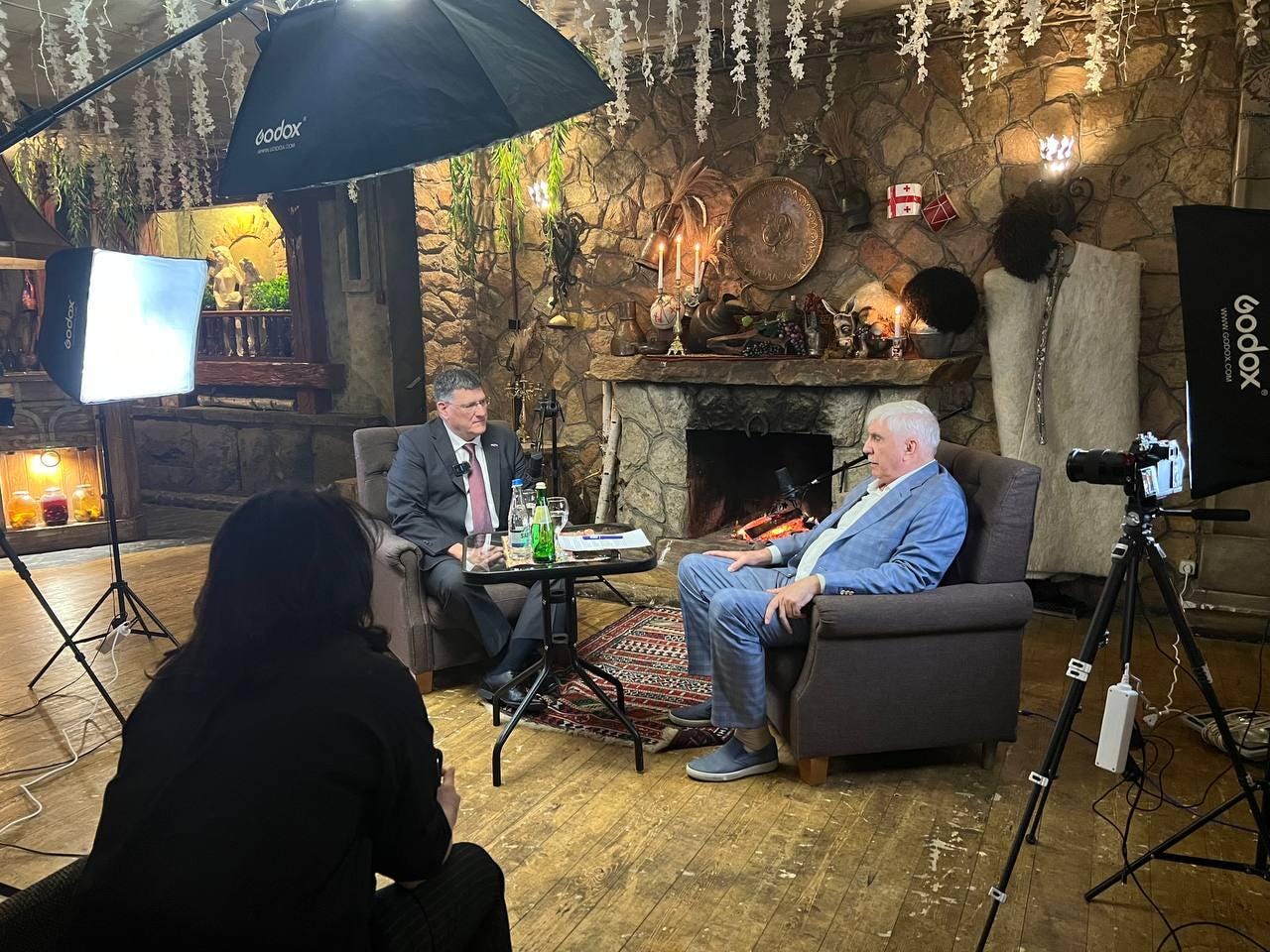
The Author conducts an interview for The Russia House with Scott Ritter, August 2025
What they show are the performance of my Substack page over the past 30 days.
In short, the paid subscriptions that serve as the primary source of my income have fallen by 72 subscriptions.
And the free subscriptions, which constitute the vast majority of subscribers, have grown by 81 subscriptions.
Good news (growth) and bad news (decline).
But it is the bad news that is what brings me here.
It reflects an alarming trend which has been discernable over the course of the past 90 days.
2,308 paid subscribers has plummeted to 2,150, a decline of 158.
56,825 has grown to 57,798, an increase of 27.
This is during a period of time which marks the return of my passport and my ability to resume travelling to Russia and continue the important work of furthering better relations between the US and Russia that has served as the cornerstone of the work that I publish regularly on my Substack page.
During this time I have enhanced the quality and quantity of the interviews done for the podcast The Russia House with Scott Ritter, transitioning from a paid subscription service available on Telegram to a free product available to my subscribers on Substack.
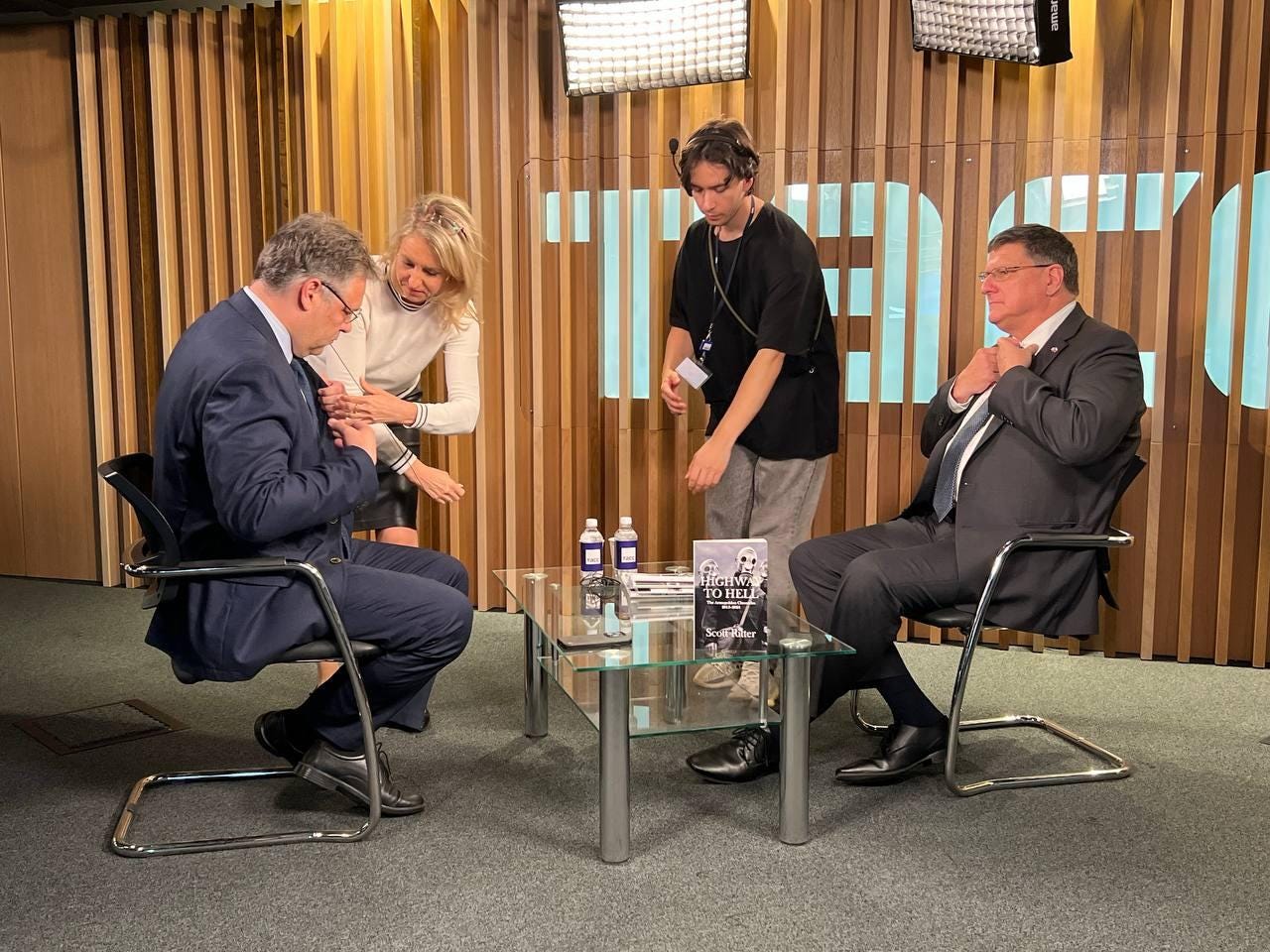
The Author prepares to record an interview for The Russia House with Scott Ritter, August 2025
This is in keeping with my philosophy not to place important material behind a paywall, but
rather to make it available to the public at large.
I have worked very hard to establish my credentials as an independent journalist. While I do derive income from several sources outside the framework of my Substack subscription base, the reality is that Substack is the driver of my economic reality.
Without the paid subscriptions to Substack, the economic viability of my independent journalism efforts would be nil.
I make a living wage from Substack which puts me squarely in the middle of the Middle Class of America.
I don’t live an ostentatious lifestyle.
I have a mortgage, and I make a car payment (a Mazda CX-5, not a Mercedes!)
I help pay my daughters’ college debts.
I put food on the table, and a roof over my family’s head.
I feed and care for three dogs and two cats.
And I am deeply grateful for those of you who have supported my work through paid subscriptions.
Since August I have posted a number of articles offering unique insights into the critical issues of arms control and disarmament, and US-Russian relations.
I have embarked on three separate trips to Russia, where I have conducted dozens of unique interviews and reported on the critical issues of the day.
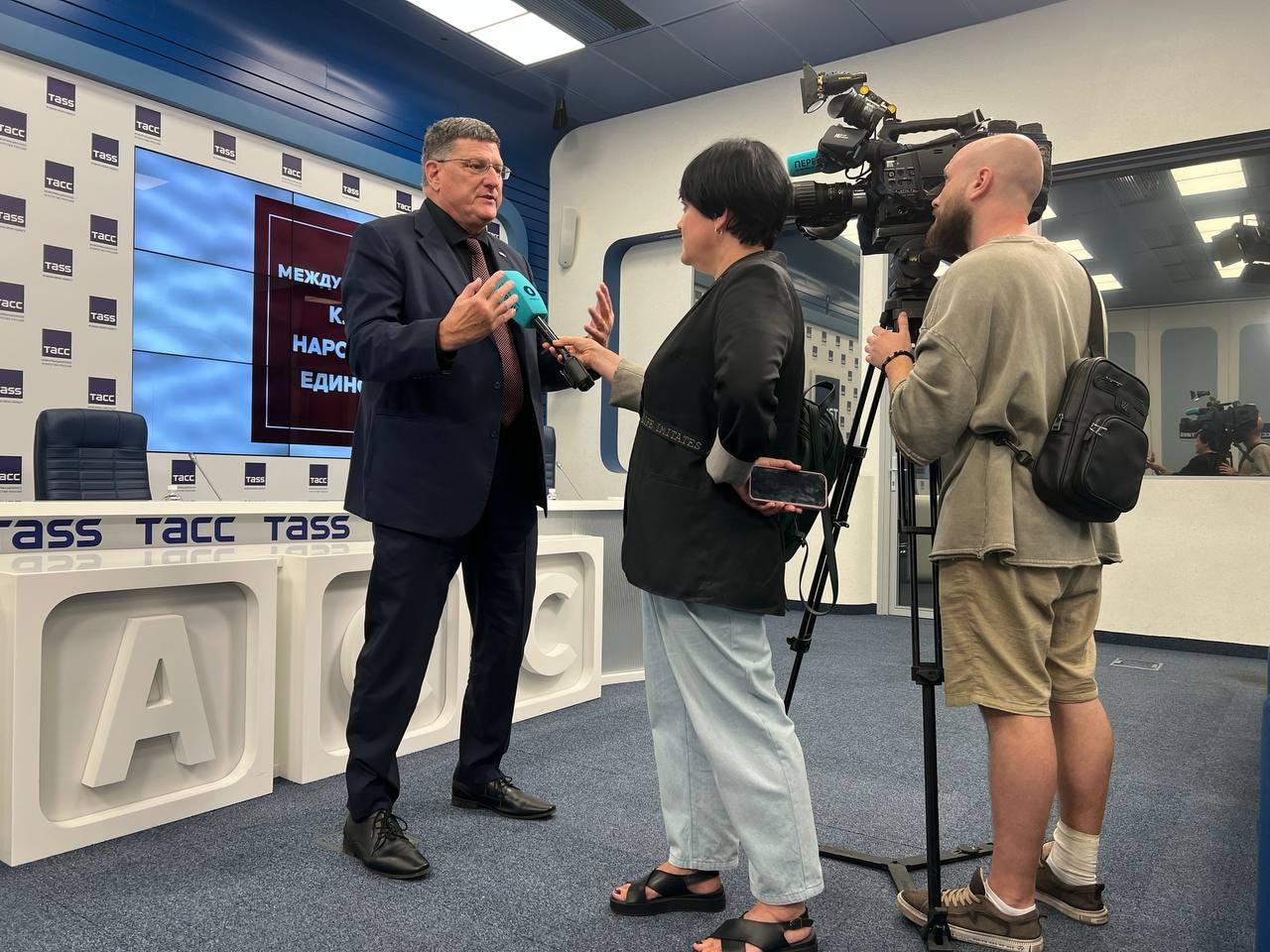
The Author is interviewed by Russian media, August 2025
While the costs of these trips is largely underwritten by donations specifically for that purpose, the last Russia trip cost me more than $7,500 from my own income.
A price I’m willing to pay to get the job done. And I price I can pay because of the paid subscription base to my Substack page.
I have also delved into using Substack as a vehicle for self-publishing. I have published the prologue and the first four chapters of my history/memoir of the Gulf War and UNSCOM weapons inspections, The SCUD Hunters.
None of this is hidden behind a paywall.
In the coming year, I plan on increasing the quality and quantity of products published on Substack.
But I also have to take a look at my business model.
I cannot sustain consecutive 90-day performances like the one I just had.
I understand not everyone is in a position to be a paid subscriber.
And I recognize the reality that a considerable number of the unpaid subscribers subscribe because it doesn’t cost them anything.
I get it.
But the reality is this current trend is unsustainable.
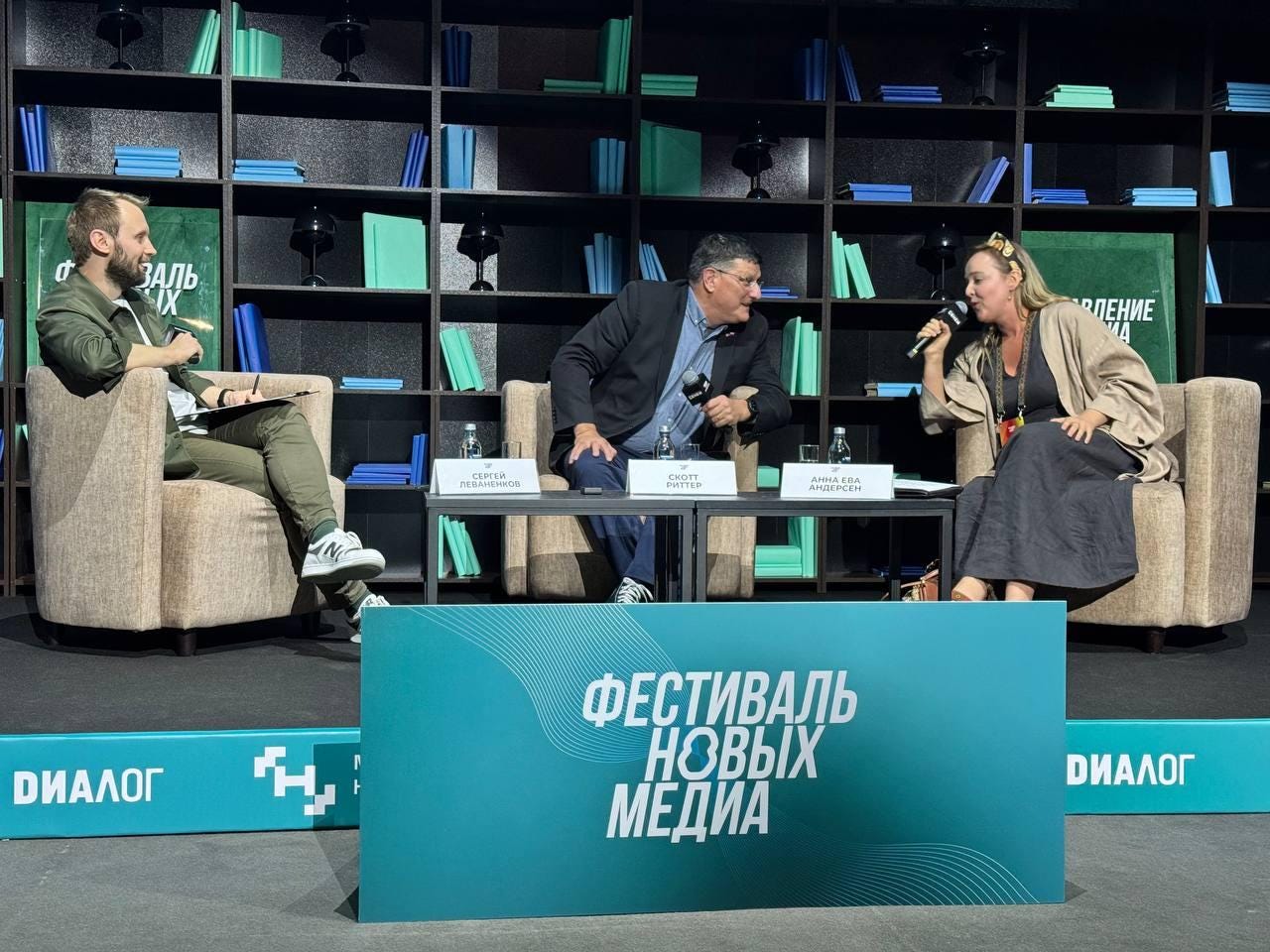
The Author is interviewed as part of the Festival of New Media, August 2025
As I move into 2026, I have to balance my goals and objectives with my ability to sustain them, and myself, financially.
To be frank, if I have another 90 day performance report that shows a continued decline in paid subscriptions, I will have no choice but to put my work behind a paywall.
Most of my peers who use Substack operate in this fashion.
As I said, I’ve avoided it because I feel my work is more than journalism. It is a mechanism of empowerment, the living embodiment of “knowledge is power”, a factory that produced better informed citizens.
I’d like to keep it this way.
But I need your help to do so.
Happy Holidays.
oooooo
Interview with Fyodor Razzakov
Interview with Fyodor Razzakov
Dec 03, 2025
In this special edition of The Russia House with Scott Ritter, I am joined by my co-host Garland Nixon in downtown Moscow, where we had the pleasure of interviewing noted Russian writer Fyodor Razzakov, where we discussed the role of cinema in the collapse of the Soviet Union and dragging Russian society down during the decade of the ‘90’s. It turns out how a society sees itself through the lens of a camera influences reality.
Transkripzioa:
Hello and welcome to this special edition of the Russia House with Scott Ritter. I’m here in Moscow with my co-host Garland Nixon, a renowned journalist, a political observer, and I’m honored and privileged to have as our guest today Fyodor Razakov. He’s a historian of the Soviet Union. First of all, thank you very much for joining us.
What I’d like to discuss today is the role that cinema plays in shaping the minds of people. And I think to start, let’s turn to your specialty, the Soviet Union. My wife is Georgian. She’s in Soviet Georgia, and she exposed me to Soviet cinema. I have watched the classics from the 1950s and 1960s. To me,
these films embody what anybody would want to be the foundation of society, the principled approach to life. But The Soviet Union collapsed, and the kind of movies that were made in the 1950s and 1960s and even into the 1970s stopped being made. Do you see a link between the evolution, or some might say devolution,
of Soviet cinema and the collapse of Soviet society?
The evolution existed like in any country. A country where social sciences are of high importance And in the Soviet Union there was a devolution as well The evolution, the positive trends existed until the 1970s The phenomenon that existed in the Soviet Union was called socialist realism It was a movement in culture that emerged
in late 1920s after Stalin put an end to the new economic policy So the Soviet realism trend was to show positive sides of the life in the Soviet society There were some negative features depicted as well, but predominantly it was the positive that was shown. Like in the US, the Roosevelt course was also about it.
The Hays Code of 1934 also also declared this happy end trend. So, Roosevelt and Stalin took this new course. There was socialist realism and in the US, negative phenomena were not allowed to be depicted politicians or also clergymen were not allowed to be shown negatively It is either the USSR that followed the trend and emulated the
United States or vice versa And actually this has led to an alliance between the two countries during the Second World War And the victory was won thanks to that alliance, but the Soviet Union bore the brunt of the Second World War and we should say that the Soviet cinema won a victory over
German cinema because our soldiers were watching movies before they went to fight and so socialist realism had a very strong impact And this continued until Gorbachev came to power and the principal ideologist was Alexander Yakovlev who was a propaganda man when he worked in the city of Yaroslavl
Here the Department of Propaganda was a permanent fixture in any Communist Party committee, local committee, and that Department of Propaganda used to focus on cinema and they knew very well how to create value and how to destroy value by using cinema and their task was to replace the Soviet or socialist realism with a negative attitude
was to find shortcomings, to find defects. They said that they had to expose them to be able to fight against them. And as Alexander Yakovlev confessed later in his memoir, they were cheating. It was a deceit. They wanted to actually create a negative attitude to the Soviet life. And it started in 1976.
I should say that Perestroika began with movie makers. It was the famous congress that held in 1986. From the 13th of May through the 16th of May And then there was a Congress of Writers Why did they begin with cinema makers? Because cinema makers had a bigger impact on the life of the Soviet society Similar
to the US or Europe Yes indeed, people were watching movies a lot and they replaced people who used to shoot positive movies, Sergei Bondarchuk, Stanislav Rostocki, Kulijanov, people who used to make positive movies based on socialist realism They removed them and they brought Remklymov, Andrey Smirnov and Sergei Solovyov who used to make negative movies They didn’t
like Soviet movies, they liked Italian neorealism And it was a big mistake trying to transplant Italian realities to the Russian soil Italians did not do that, they did not take Soviet realities and transplant them to the Italian soil It was a one-way traffic Some people think it was a mistake. I think it was a crime
It was done purposefully. Alexander Yakovlev and other Perestroika activists confessed that they did it consciously. But these confessions were made when they were already retirees. We need to keep it in mind that cinema-making was the starting point of ideological destruction. Cinema had a huge influence on people The peak of the Soviet cinema was late 1960
when 4.5 billion people watched movies When Gorbachev came to power There were 3.5 billion viewers who watched movies per annum And the population of the Soviet Union was 380 million people On average, people visited movie theatres 16 times a year Americans went to movie theatres 6 times or 5 times
a year there was a crisis in those times there was a crisis in the US in those times and then there appeared technically more perfect movies in the US later on but if we compare American movies and if we look at Soviet movies, Soviet movies were watched much more frequently than American movies When new
people came to cinema, to movie making, they had this that cinema was no longer popular and movie directors had to change their approach and expose problems to make movies more interesting to people and this lie was exposed later on when historians began looking at statistics and archives But in those days, mass media were managed by Alexander Yakovlev,
who managed all that But in those days they said that the Soviet Union was facing lots of critical problems in politics, economics and culture And a change was urgently needed They made that change But in five to six years, this resulted in disintegration of a huge power of a huge country 380 people
inhabited the Soviet Union But if we take the Eastern Bloc, there were 400 million people living on that territory It was a huge resource. Those global leaders were looking at people as a resource. If we look at Gorbachev, in May 1986 there was a Congress of Cinemamakers and in December he went to
Reykjavik to meet with President Reagan and it is known that and there was a famous description that Gorbachev was throwing gifts at the feet of Reagan and his team their goal was to transform socialism into capitalism and this happened and for this purpose they transformed Soviet or socialist realism into realism. And actually, they were painting everything black.
Well, actually, of course, it was not only movie making, but cinema played its role. In 1980s, Americans managed to to rebound from depression thanks to American movies. And if we look at Gone with the Wind or other great movies, they played a huge role
And they actually, given that America, the U.S., was a kind of a lighthouse, a torch for them, Actually, through Stalin and his experience away But there was a question why they tried not to follow the U.S. experience when they managed to rebound after the Great Depression But given that they had a different agenda,
they did not rely on Stalin’s experience or American experience Their task was to make sure that the Soviet Union is collapsed
I interviewed an expert on China a few months back, and I asked them about Chinese restrictions of U.S. Internet companies and U.S. Internet social media companies, etc. And I asked them, you know, why is that? And their exact answer was because China learned the lessons of the Soviet Union.
People don’t go to movies as much as they used to, but social media is a medium for the exchange of information. Add one other thing. There were a number of news articles that came out about a year ago, and they admitted that in 2019,
there was a CIA team operation and their job was to use social media to influence the Chinese public, of course, in a negative way against their government. Your thoughts on taking what was learned in the Soviet Union, particularly perestroika, moving up through the 1980s and applying that to today in the modern medium of
social media and how that’s used.
Well, thank you for this question, because the Chinese experience has to be taken into account Because China was one of the leading powers in late 1980s and currently as well And Chinese were watching with a lot of scrutiny the perestroika as it was conducted by Gorbachev, as it was implemented
And it was not a random decision to create a number of institutions, a number of institutes that study perestroika processes that resulted in an opposite outcome Not in strengthening the Soviet Union and the Eastern Bloc, but to their destruction And those institutes are also studying cinema, because ideology is destroyed through cinema
When Gorbachev went to Beijing in 1989 when there were thousands of youngsters who were greeting and welcoming Gorbachev and they hoped that China would join Perestroika that was not only launched in the Soviet Union but in Poland and Czechoslovakia But China was standing aside and Gorbachev went to China to persuade them to join the process
This is well known from interpreters’ memoirs. When their talk was over, the Chinese chairman said, which means an idiot. Why did he call him an idiot? Why did he diagnose him with a psychological disease? It was clear to him the country was in a systemic,
in a structural crisis But the systemic crisis was later on It was a structural crisis China was also going through that structural crisis when Mao died and then the Xiaoping had to rebuild the country They did not touch ideology They did not take Mao’s body from his mausoleum. They did not paint Mao black.
They did not conduct a de-maonization in China. And that’s why Deng Xiaoping called Gorbachev an idiot, because Gorbachev was trying to restructure the economy and ideology. People do not do such things simultaneously. And Denzel Ping was right. And by the way, when Gorbachev left, Denzel Ping
nipped all student protests in the butt and people protested against it but then later on everything was quiet and Gorbachev had to do the same he had to be strong and use strong and radical measures because the situation in the country was similar to 1917, it was the breakdown of the system, it was a red line,
and Gorbachev was afraid to do anything like that. I think he was not scared. He tried to achieve his goal to destroy the Soviet Union and that’s why he tried to meet the opposition halfway In May 1986 there was the Congress, he met with President Reagan in December and then he released 160 Soviet members of opposition, dissenters,
they were interviewed, they were shown by TV companies, and those people who were imprisoned for their anti-Soviet views, they began promoting their views through mass media, and people who used to think that they were anti-Soviet, they were against the Soviet Union, and they could not put two and two together and understand who was right,
Gorbachev or his predecessor. This is why the Chinese leader called Gorbachev immediate. He was trying to accelerate the development of socialism and democracy, but there are certain laws to be observed, and democracies also have their laws. And the United States were a strategic foe, a strategic enemy to the Soviet Union.
And Reagan never said that he and Gorbachev were friends. Gorbachev used to talk about shaking hands, stretching his hand. But when the Soviet Union began its brinkmanship and was standing on the edge of an abyss Then this was the time when Margaret Thatcher and other politicians came here And they understood the state of affairs,
similar to Maidan when Nuland came to Ukraine and when they realized that the country was standing on edge and needed a slight push to end up in a precipice. Actually, in China, there were no American movies shown in those days. We had seven to eight movies, then there were 150 movies,
and then there was an unprecedented reign of American movies China did not show American movies The United States existed, but there was no cinema there from the Chinese perspective Now there are about 20 US movies that are screened in China, but there is a lot of scrutiny and screening selection and they basically show critical movies.
For example, as far as we are concerned, movies by Stanley Kramer and other critical US movies screened in the Soviet times and comedies but during Gorbachev times they left only entertainment movies when people were watching movies and were green-eyed and they were envious of the way of life And starting in 1987, there were no anti-imperialistic movies shot.
It was prohibited to make movies about MI6 or about the CIA. It was prohibited. And this is why the Movie Makers Congress re-elected a new leadership. Actually, in those days, there were annual plans. There was a special commission that usually decided how many movies should be made about teachers, about medical professionals, about spies, CIA spies, etc.
And they actually took out any plans to create scenarios about CIA agents. There was a plan to depict Americans as good and nice people No spies were allowed And so, actually, instead of our strategic Opponents are still there The collapse of the Soviet Union was very eloquent The Warsaw Treaty was dissolved NATO approached the borderline,
the frontier of the Soviet Union And Gorbachev’s line of action And Alexander Yakovlev did it mostly as the chief ideologist The 5th Congress was held by him, practically it was orchestrated by him, though he was standing behind the stage. Well, we had the ideological department at KGB and the preparation of
The process that I am talking about began in 1986 after the January 26th Congress of the Communist Party and Vasily Shaurov was replaced with Alexander Yakovlev as chief ideologist. He was a journalist by profession, but he was a body of Gorbachev and he was in charge of propaganda And Yakovlev
assumed the office of the head of propaganda Gorbachev was the General Secretary of the Communist Party and his team was handpicked and the editors of major newspapers and TV channels were replaced and Aksyonov was appointed as one of TV chief editors. And these were not mistakes committed. This was a targeted campaign. I am referring to Yakovlev’s
We were obliged to lie to people, he said, but we wanted to change the socialist system and create capitalism He died in 2005 and he believed that the capitalist system was much better compared to the Soviet Union Though he fought during the Second World War, he had He was wounded heavily, he was lame, but, you know,
there were people who fought during the Second World War who were members of that team There were movie directors like Bondarchuk who fought during the Second World War But there were other war veterans, for example, one of war veterans who made movies about prostitutes. During the new economic policy in 1926,
there was a movie made which was called Prostitute, and Todorovsky made a movie that is known as an inter-girl. It is about a prostitute. So no one allowed movie makers to make movies about prostitutes. There was prostitution here, but it was not allowed to show them in movies. Badass could not be…
There was a movie entitled Small Vera about two sexually obsessed youngsters. And prior to that, there had been no such movies. And that’s why when such new trends emerged, there were throngs of people at movie theaters, especially young people. For example, if you make drugs available to everyone. There would be a big increase in drug use.
And Gorbachev appointed Yakovlev because he knew very well how to He replaced Soviet propaganda with West-oriented propaganda. And this is why he succeeded, and it was quite efficient. We have to give him his dues. He was an expert. And Chinese took a different path in this respect. And we see where China is.
You speak of the role of Yakilev in transitioning from the old Soviet morality, socialist realism, to a targeted effort to tear down society. What you’re saying is that this wasn’t an audience demanding certain kinds of films. of Central Authority giving an audience films for the purpose of achieving a result of tearing down Soviet society.
In America, we have a different approach because it’s business driven. Hollywood is a business. And it’s not the government telling Hollywood what movies to make. It’s Hollywood saying, how do we make money? Sex is something that makes a lot of money. Violence makes a lot of money. Showing society in its worst possible way makes money. And yet,
some could say that that has the same impact on American society as Yakolov’s initiatives had on Soviet society, that it’s bringing American society down. Do you see parallels between… the role of film in bringing down Soviet society and what’s happening in America today? Are there parallels there? Even though the root causes,
meaning one is driven by financial interests, the other was driven by specific targeted ideological interests, are the results the same, that cinema plays a role in the devolution of society, wherever it is?
Yes, thank you.
Well, the point is,
cinema was maybe called a business in the Soviet Union There was no such word as business in those times There was another word used, commercial, movies were also commercial And there was some capitalization of cinema It happened in Stalin’s times and later on Soviet ideologists were treating cinema as a commercial form of art.
There were 4.5 billion people going to movie theaters in the late 1960s.
price was 25 copies and a discounted ticket for children was 10 copies so a lot of
money was and so when there was a movie about the those movies were not a big hit compared to commercial movies Soviet comedies or action films were shot in the Soviet Union and in Moscow and in Leningrad there were two leading The Dovzhenko studio, which was studio number 4, used to make 10-15 movies per annum,
which was twice, two times less than in most films. Actually, the bulk of the movies were generating money, and it did not only relate to cinema. Literature was also commercialized. The government, for example, was creating certain benefits The Soviet studios, movie studios were government owned But how were films made?
There was a director there to make a movie that a studio director had to go to a bank to take a loan, to raise a loan. The government did not allocate money. It was a government owned bank that provided such a loan and the studio had to repay the loan in a year.
So when a loan is raised, But it failed, or that it did not generate sufficient income to repay the loan. There was a change in plans. Soviet Union movie studios, except for Ukrainian in the Soviet Republic, were operating at a loss. For example, Georgiana. because Georgian movies were not watched by the rest of the Republic.
Georgian movies were watched by Georgians. If a Georgian movie was brought to Moscow or Tashkent, it was not popular. Armenian or Uzbek movies were not here, so they had to be financed at the expense of movies made in Moscow, because they were generating profit.
Therefore, the government was giving a helping hand, but it was sort of a hybrid. There was a government plan. cinema plan but there was a commercial aspect because movies had to generate income for the government and movies ranked second after alcohol sales and Gorbachev started an alcohol campaign in May 1985. First of all,
he led to a collapse in income generated by the government by putting restrictions
on selling alcohol. And then
People stopped going to movie theaters, but they started going to such private video rooms to watch movies And an average Russian could buy a video tape recorder, buy a cassette and watch a movie Plus there was the Chernobyl tragedy It was not through the fault of Gorbachev But
that also led to a budget collapse Because billions of rubles were spent Plus Americans together with Saudi Arabia Brought oil prices down to a minimum level This is why Deng Xiaoping called him an idiot. Given the circumstances, he had to be very careful with money and try to save each topic. For example,
when there was the dry law established in the United States, it made a hugely negative impact. Instead of following the American experience, and learning a lesson from them, he took the opposite part and these were not mistakes, these were done purposefully There were analytical institutes who programmed all
that There was an analytical institute that specialized in social problems Sociologists were studying economics, politics, and social and ideological issues and they had to also study movies and which movies are watched by people which movies were most popular in the Soviet Union and abroad And such analytical institutes initially worked to strengthen the Soviet system But new
people came to power and they changed their agenda They gave an instruction that the process should be the reverse They wanted to establish capitalism Therefore, this hybrid approach, when partly movies were made because of the government plan and other movies were commercial, only the commercial part remained. And those people who wanted to be well off,
wanted to have villas and everything else, they succeeded. are now facing a disaster because nobody needs Russian movies in Soviet times there were Oscars awarded to Russian films now Russian filmmakers are not able to make movies that can be nominated. No Cannes Festival, no Oscar ceremony would notice such movies. And of course, Western
leaders were interested in the collapse of the Soviet Union. The same relates to cinema makers. Metro, Golden, Mayer and other huge studios are transnational companies and they own shares of Hollywood studios and winning, conquering the Soviet market of the Soviet Union and also conquering other markets like India
and Middle East and Western Europe was one of their objectives and they conquered that big market and they conquered Russia, I mean the American cinema. And actually, the American cinematography, American movies dominated our movie theaters before 2022 And actually, you know, a lot of Many Russian movie makers are still following the previous trends,
and the money that they are making stays in Russia partially, and a big portion of the money is funneled away to the West. And movie makers succeeded in becoming dollar multi-millionaires But as creators, they ceased to exist Sergei Bandarciuk received an Oscar for War and Peace And
Vladimir Menshov had an Oscar awarded for the movie called Moscow does not believe in tears Well, actually, maybe our movie makers have never thought about that, but there were people who warned them against trying to conquer the West market Our movie makers were not welcome, no one had opened doors for them
But they agreed to exist on these terms and conditions That they get good money, but they make movies nobody wants And, you know, nobody watches their movies Soviet movies are screened mostly, especially during holidays. People want positive movies. A human being is born to be happy and to look at the bright sky rather than overclouded skies.
And as a result, we’ve got what we have now.
You know, when we look at American movies today, you spoke of Yakolov, and I was trying to find an American parallel. We do have a situation where it’s not the government that’s seeking to impose values, but Hollywood has anointed itself as the center of American virtue. But it’s a virtue that promotes a political ideology. For instance…
Every movie has to be politically correct. You can’t tell a story the way it was supposed to be told. The story now has to have inclusion, diversity to promote things, to emphasize things that, for instance, homosexuality is a part of society. It’s there. But movies now put an overemphasis on homosexuality, transgenderism.
Movies put an overemphasis on it to make it normal, to make it seem as if it’s normal, to create an image of what society should be. I think what we’re seeing is that the American people are rejecting these movies. They’re not attending these movies. We see attendance fall. These movies are failing at the box office.
Do you see this happening in Russia as well? Russian movie-going audience get a vote on what kind of movies are made in Russia. Because in the end of the day, Hollywood can’t make too many movies that lose money. They have to change. And you’re seeing Hollywood start to change.
More traditional movies are coming out, movies that Americans want to see. movies that are uplifting, maybe a return to Gone to the Wind kind of movies. Do you see a trend like that in Russia today? Do you see the Russian people starting to make demands of their movie industry to say these are,
because if they watch the old classics, one would think that that would be sort of a motive for Russian movie makers today to make movies like the old classics, not something else.
Well, old classics, movies that are similar to old classics are made, but these are low-quality movies because the Russian Federation movie-making industry has degraded. We cannot compare Russia to the US or any other country. Similar, the US as a country is also incomparable. Well,
we cannot take the United States or Holland and the UK and compare them because the United States can be called a kind of a cauldron as well because it is a country built by migrants And the culture that existed during the days of the Soviet Union, it existed for 74 years,
but we discard the years of the 1920s because there was a new economic policy. But the rest… of the existence of the Soviet Union this was the period when a new type of movies were created and even Italian neorealism imitated Soviet movies if we look at Potemkin movie such movies had to be treasured
And the Soviet Union had to be treasured When there was the Cold War and when the Soviet Union existed There were two systems, the socialist and the capitalist system But when you remove one pole and there is only one pole left The United States, in my opinion, failed to perform its role of a global policeman
And, you know, one country cannot take this huge burden and carry it. The same relates to culture. This is why the Hollywood movies also degraded. And if we look at European cinemas, at Fellini, Pasolini in Italy, at Claus Renier in France, all that, Why? Because of the globalization process,
when borders were erased If we look at different countries, different concessions, different cultures, the globalization kind of sucked up the whole of the world And the culture was averaged out, it is imposed on everyone Black Americans were imposing Hollywood, Hollywood, Hollywood And now the transgender agenda is being imposed And these democratic
standards are being imposed But when there was a fight between two systems, socialism and capitalism Something was born in that fight. Politicians were born. Look at Charles de Gaulle, Churchill, Stalin. Can we compare the incumbent politicians to them? No The collapse of the Soviet Union has led to averaging out the world You know,
it is a kind of sausage factory When there is a flow line When there is no quality but this quantity You go shopping and you can see sausages everywhere But it’s hard to find good quality sausages The same relates to Let’s look at Bollywood, look at the movies they’re making. We cannot call such movies genuine cinema.
We remember good movies. Younger people are… But we can compare the quality of movies as the oldies but goodies and the movies that are made currently The younger generation failed to understand Actually, there are no serious Soviet classical movies that are shown today on TV Only entertainment films, movies If we look at Soviet cinema It was psychological,
there were lots of dialogues, people were not just talking for the sake of blah blah blah They were saying serious things, discussing something that was relevant to their lives, to their families, etc. They were discussing philosophy Well, if we look at Stanley Kramer, who was making wonderful American movies, I love that movie Anyway, to cut it short
those movie directors like politicians are no longer there because everything is kind of mediocre and a human being is also averaged out We have gadgets with short, very brief texts If you send a longer message, no one would read it, no one would understand it There are too many letters in that message And if we
look at Hollywood, we don’t see good quality movies Scenarios and the plot But people watch those movies because they do not know the difference They have not seen anything different This was the result of the collapse of the Soviet Union This should have been preserved The fight should have continued Even if the two
systems were fighting It is similar to exercising every morning when people muscle up When you have won the Cold War, awarded medals to everyone, you rest on oars, and as a result, America is in a crisis, and that has led to a global crisis. Currently, we are looking very seriously at
whether there will be a big change in the world, whether there would be the Third World War But there was a time when we believed that there would be no global catastrophes because the Soviet bloc had been destroyed and we would live in peace and we failed to handle weaker countries
You know, George Bush was against the disintegration of the Soviet Union. I am talking about George Bush senior, not the son, and he is an ex-CIA director. I am just saying that not all Americans are uniform. You know, there was Ronald Reagan, there was the The oil and gas lobby from Texas, the Bush family,
and they were thinking about the Soviet Union and whether it should be torn up There was China, China was very helpful because of cheap workforce They were also looking at the Soviet Union as a source of cheap workforce and there were plans to build factories to manufacture goods and there was a decision made
tear up the Soviet Union and preserve China who would supply goods, but China is not the Soviet Union Their ideology is different, they have confucius and they do not want to imbibe Western ideology, they do not show They have their own laws,
they have the Chinese wall that separates them from the rest of the world It was a mistake, if the West focused on China, the situation would have been different and it would be easier to reach an accord with Soviet leadership because the Soviet Union was a European country and China has a different mindset and therefore I see
a future conflict between the US and China or Europe versus China because China would never surrender like the Soviet Union because it does not have idiots like Gorbachev and they will never have And this is why they imprison people, put them behind bars, and they even execute ministers and high-profile people In the United States there
is capital punishment allowed in some states, whereas in China this capital punishment. The Soviet Union has a moratorium on capital punishment, Russia has a moratorium, but China is incongruable. Well, you could have focused on China rather than the Soviet Union, but we can only state that there may be very serious events that are in store for
us and the Chinese problem will have to be addressed and it’s hard to say how
It seems to me that one of the things you’re talking about is, and I know there are others, but two types of cinematic productions, one that seems to come out of culture, one that is truly art, okay? And on the other hand, a type that is meant to influence and change culture, such as, you know,
the things you were talking about that came in when the Gorbachev administration wanted to paint, wanted to show the Soviet Union in a negative fashion. as opposed to some of the great producers of movies who were genuine artists and wanted to put forth something that would be artwork as opposed to influence people in a political perspective.
The Soviet cinema was, like in every country, was ideological Well, it depends on the form and scope In the Soviet times, censorship was very tough initially Then it became weaker and weaker, and then it disappeared But in any case, Soviet cinema was positive and it helped the Soviet leadership to make the Soviet structure,
the Soviet Union stronger Soviet movies also had If you look at the so-called Perestroika movies, there are no happy ends All protagonists either die or they face a life failure And when someone in 1995 went to a movie theater, that person had huge difficulties in everyday life,
went to watch a movie and saw the same on the screen. When that person turned on his TV set, he saw the same negativity on TV. And this is why he thought, let this country collapse, let this country go to hell. And the country did collapse, and this was done purposefully.
There was a shift from positivity to negativity, and you do not have to be very brainy to do that. And Yakovlev was much cleverer than Gorbachev and the rest This is acknowledged by everyone He was one of the smartest men, but he was an enemy to the Soviet Union And he managed to grope his way upward to
the political leadership He was the second-ranking person after Gorbachev Gorbachev was managing everything, economics and policy and the second man in his team was a traitor You can imagine the kind of information He supplies enemies with This is what happened to the Soviet Union And this is what the Soviet movie-making industry faced When good producers,
good film directors were replaced with those who were socially close to him And it was very obvious
I want to thank you very much. This has been a fascinating conversation. First of all, general American audience is going to be absorbed by this, but this is the kind of conversation that belongs in American universities when they talk about the history of cinematography, the role that film makes. I have found this to be invaluable,
and I just want to thank you very much for sharing your ideas with us. And I want to thank you, the audience of the Russia House, for joining us today. Garland and I both appreciate it. We’ll continue to have these conversations in Moscow throughout the week. Thanks for tuning in.
oooooo
A New Start for New START
A New Start for New START
New START expires on February 5, 2026. It cannot be extended. Negotiating a new treaty seems impossible. The best bet might simply to recycle the treaty in its entirety, and put on a new date.
Dec 05, 2025
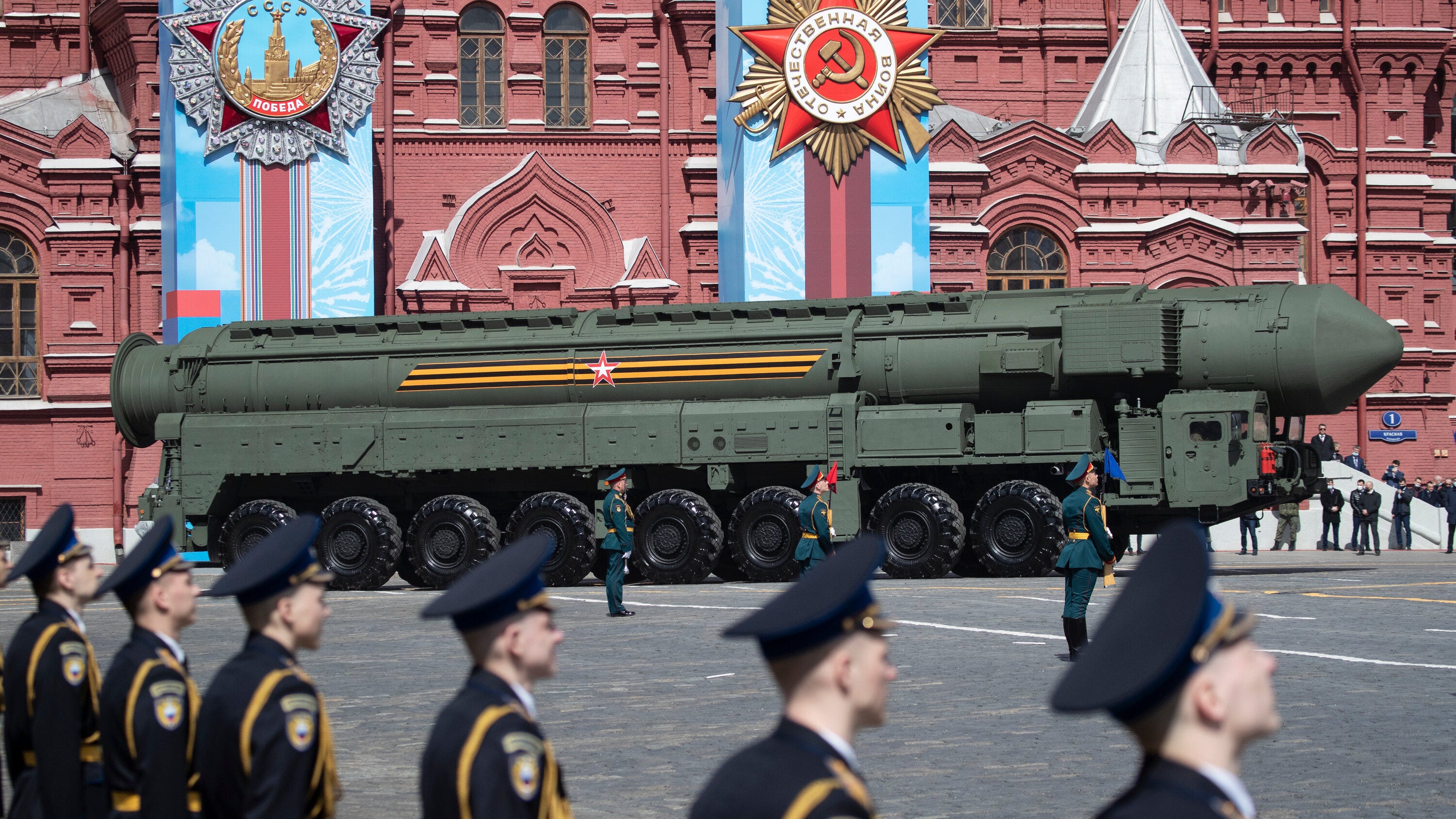
Russian RS-24 Yars ICBM missile and launcher
Back in September I participated in a unique exercise, together with former Congressman Dennis Kucinich, MIT professor Ted Postol, and retired CIA analyst Ray McGovern, where we discussed the prospects for the extension of the New START treaty, and what conditions would have to exist politically in both Russia and the United States to achieve this goal. Known as the Poughkeepsie Peace Initiative, this gathering of the minds, so to speak, unfolded over the course of three days, during which time we wrestled with the many problems that could arise that could block the extension of New START, and the domestic political hurdles that would need to overcome to bring the issue of treaty extension to President Trump’s attention. The conclave ended with all of us agreeing to reconvene following my scheduled visits to Russia, in October and November, where I hoped to be able to engage Russian officials on issues related to arms control and nuclear disarmament, including New START.
The October visit, which took place on the occasion of RT’s 20th Anniversary Gala, helped shape the informational space, so to speak, leaving me with high expectations for my scheduled November trip. One reason for such optimism was that certain assurances had been made during a previous visit to Russia, in August of this year, regarding access to influential Russian figures, including those in positions of authority. However, my arrival coincided with the announcement of the Alaska Summit between Trump and Russian President Vladimir Putin. The Russian government, understandably so, put a moratorium on interviews by high-level officials so as not to generate any controversy in the lead up to this important meeting. I was told at that time that things should calm down by November, and I should plan on returning then.
My November trip, however, turned out to be disappointing when it came to getting the promised access. The Russians were strangely reticent when it came to explaining why November suddenly turned into an inconvenient time for the kind of discussions I wanted to have. The Ministry of Defense made it clear that now was not the time to be discussing arms control, and when I tried to organize a panel discussion with the Valdai Club on arms control and disarmament, we were quickly put on notice by the Kremlin that the nuclear issue was not open to discussion at this time.
While I was still in Russia, the news broke about a 28-point peace plan that had apparently been brokered as a result of meetings that took place at the end of October in Miami, Florida between Steve Witkoff, Trump’s special envoy for Russia, and Kirill Dmitriev, his Russian counterpart. Suddenly the source of the Russian reticence became crystal clear—as had been the case in August, the Russians did not want to get ahead of their skis when it came to US-Russian relations.
This point was further driven home when the details of the 28-point peace plan were leaked to the press. Point 17 was particularly informative: “The US and Russia will agree to extend the validity of treaties on the non-proliferation and control of nuclear weapons, including the New START Treaty.”
The very discussions I was seeking to promote between Russia and the US were already taking place. There was no need to muddy the waters by engaging in dialogue with someone who would not be party to whatever agreement would be reached.
So now the question is, what next?
There are some knowns that have emerged from this experience. First and foremost, the New START treaty cannot simply be extended by the stroke of a pen—the treaty text does not allow for this.
Two, it is virtually impossible to negotiate a comprehensive follow-on treaty vehicle that would take into account the myriad of arms control issues that have manifested themselves since the New START treaty was signed in 2010. Issues such as how to account for the new generation of nuclear delivery systems that have been fielded by Russia, the demise of the INF treaty, and what to do about missile defense are all too complex to resolved in the short time that exists before New START expires.
Third, President Putin’s offer of a voluntary moratorium on the caps on the number of deployed nuclear weapons set by New START, while valid and made in good faith, cannot survive the tests he himself laid out regarding red lines to this offer—the deployment of the planned “Golden Dome” missile defense system, and the planned deployment of “Dark Eagle” intermediate-range hypersonic missiles in Germany next year.
There appears to be only one path forward that could see the New START treaty continue to serve as the foundational agreement upon which future US-Russian arms control negotiations could be conducted—simply put, the treaty would need to be embraced as it, with no amendments or modifications, and endorsed by both Trump and Putin as a new treaty. Given the fact that both the US Senate and Russian Duma had previously ratified the New START treaty, it is not a stretch of the imagination to believe that rapid ratification of a re-born New START treaty could be accomplished by both the US and Russia.
By breathing new life into a 15-year old treaty, Russia and the US would engender a sense of strategic stability which could anchor the necessary negotiations about new strategic weapons, INF missiles, and ABM defenses that would need to take place. Moreover, given the fact that China has just published a new arms control white paper which puts the onus on both the US and Russia to enter into serious talks about significantly cutting the size of their respective nuclear arsenals before China could see fit to join into any multilateral arms control discussions, a revival of New START would serve the purpose of preventing the kind of nuclear arms race which would make such negotiations impossible.
The question now is what kind of pressure, if any, can be put on the Trump administration to act on Point 17 of the Ukraine-Russia peace plan. Is it wise to have nuclear arms control be held hostage to the various issues and actors that are conspiring to undermine Trump’s push for peace? Should Congress be engaged in an effort to assist this process by fast-tracking the ratification process for any future agreement?
These are the issues that I and the other members of the Poughkeepsie Peace Initiative will be contemplating in the coming days. Difficult issues, yes. But we are in a good place, where the question that confronted us back in September regarding if the Trump administration would be amenable to extending the New START treaty has been positively answered.
Now we just have to help Trump and his team get across the finish line.
oooooo
@tobararbulu # mmt@tobararbulu
Interview with Francesca de Bardin
Interview with Francesca de Bardin
Dec 07, 2025
In this special edition of The Russia House with Scott Ritter, I am joined by my co-host Garland Nixon in downtown Moscow, where we had the pleasure of interviewing Francesca de Bardin, an American businesswoman who has made Russia—and Moscow in particular—her new home.
We discussed her reasons for moving to Russia, what she thinks of the Russian people and culture, and why Russia may be the ideal destination for people looking for a society that appreciates family values and quality of life over pure commercialism.
Transkripzioa:
Welcome to this special edition of The Russia House with Scott Ritter. I’m here today in downtown Moscow, joined by my co-host, Garla Nixon, first time in Russia. And we have a very special guest today, Francesca DiBardin. She is an American. who lives in Moscow and she has written a book Moscow Diaries that explains life in
Russia for an American audience. And it’s just an absolute honor and privilege to have you here today to talk about not just Moscow and Russia, but your perspective, because it’s it’s so very important to get an American perspective. I’ve spent the last several years trying to capture the Russian reality and take it to an American audience.
And I’ve found that there are difficulties in translation. I don’t just mean the language, I mean the culture, the whole experience. And I’m hoping that you can be our interpreter today about Russia, Moscow, and how being an American and interfacing with this, just how that works. So thank you very much for joining us.
Thank you. It’s a pleasure for me because I’ve followed both of you for years. And it’s like meeting old friends. So I’m very happy to meet both of you.
Thank you. Well, you know, I’m going to actually, Garland, I’ve been to Moscow many times. This is your first trip. And I think you have some questions for Francesca that I think you’re looking to her for some assistance. So why don’t you lead off?
Yes, in fact, I do. And, you know, I’m… It’s just a few days here in Moscow, but I’ve been very, very impressed with a number of things. And here’s my question as an American. Having been here for a while, what do you think are the things about Moscow that would be the most surprising to
Americans based on what we’re told about Russia and about the culture here and everything? What do you think people would be most surprised about life in Moscow?
Well, the thing that surprised me the most was the humanity of Russian people. I came here knowing two words of Russian, so I needed help for everything. And Russians were always taking care of me, whether I asked for help or not. If they would see me struggling with English and Russian, somebody would always, who spoke English,
come up to me and try to help out. So I have, in my book, it’s actually one of the reasons I wrote the book, because I was… stunned by the humanity and the kindness, which I had not seen anywhere else. I mean, people are nice everywhere when you’re a tourist,
but when you live in a city is when you really get to know it. And I was just overwhelmed by the compassion and the And the welcome, they embraced me. You know, they would talk to me in Russian, and I would say in Russian, I’m sorry, I don’t speak Russian. I’m American. And they go, oh, great.
And then they would start asking me questions or telling me where they’ve been in the States. So I was embraced here from the very beginning, from the very beginning. And even after the conflict in Ukraine started, I wondered, well, How would they feel about an American now? So I wondered, what am I going to do?
And I said, well, I’m going to still say, I’m sorry, I don’t speak Russian, I’m American. And nothing changed. Nothing changed. I was still welcomed and embraced, and nothing changed.
You know, when I was in college, I studied Russian history. And I had to take a semester of Russian literature. For a guy who played football and drank beer, it was a challenge. But I actually poured myself into it. you know but you read dostoevsky you read tolstoy you read you know all the the
classic 19th century russian writers and one thing that comes out of it is the russians struggling to define the russian soul now it’s not the process of defining russian soul that i want to ask you about it’s the existence of the russian soul you speak of the russian humanity would you say that that’s americanization of
Well, I don’t look at it from a spiritual point of view. I look at it more from characteristics, traits, things like that. I think it’s a phrase that was only invented maybe 100 years ago, the Russian soul. But I think to describe Russians, you have to contrast it with what I know the best, which would be Americans.
And there’s many similarities and many, many differences. The thing that I like that’s really very nice is that Americans and Russians have the same communication style. We’re both very direct and say what we think. more in the past in the United States than today, but definitely that’s something.
And it makes life much easier for me because I lived in France where nobody says what they think. It’s a question of how you say what you say, not what you say. So there are traits and characteristics that I discovered living here And attitudes, I talk about the most important thing, differences, I think,
Russia is a we culture. It’s about we. It’s very much about all of us. And contrasted to the states, it’s very individualistic, materialistic, and competitive. Those are not Russian traits. So that puts a whole different character. on living here. Other Russian traits and similarities, well, there’s many differences. Men are very masculine here, and women are very feminine.
it’s very common for me to be struggling with something, a shopping caddy or a big box, and some man will just come up and pick it up and take it, and just with a let me help you, and that’s it, and then they go on.
And I’m quite comfortable if I’m having trouble jumping across a puddle to extend my arm to a man, and there’s always somebody there to help me. So they’re very chivalrous here. Men are very, very chivalrous, which is such a pleasure.
No, but it’s so nice. I mean, it’s so nice. And I mean, even if a woman invites a man to lunch or to dinner, a man is expected to pay. The woman never pays. And they’re big with flowers. I mean, flowers all the time, all the time. So there’s a, and also there’s a misconception about,
they say Russians are very serious, they don’t smile. I don’t find that at all. I see people everywhere always joking and laughing and talking and smiling, so I don’t know where that comes from. But they are serious, you know.
You know, one of the things growing up in the United States, I found my parents because of my age, my parents, my grandparents, part of who they were was shaped by the struggle. They recalled the Great Depression. They recalled World War II. So they had been through difficult times and that shaped their culture and their
view of the world. The Russians been through some difficult times. World War II, which is constantly remembered. And of course, the 90s, they’ve been through some tough struggles. Do you find that that has shaped the culture? Do you see the effect of a history of overcoming difficulties such as that?
Yes. In fact, as soon as I started understanding this humanity, I had a lot of questions. Where did this come from? How did it arrive? And I contacted a Russian historian that I knew, and she spent a couple of hours with me, and she gave me a lot of things to read, and I did.
And what I discovered and what I uncovered was that you’re absolutely right. Part of the we culture comes from a thousand years of hardship, whether it’s from wars or from famines or from weather. Russians have been struggling together for hundreds of years, and they’ve worked collectively together. As farmers
80% of the country were farmers up until 100 years ago, and so they did everything together. They grew their crops together, they survived together, they helped each other, not to mention the role of the Russian Orthodox Church, which has been, from the beginning, a profound influence on the culture of
It really was the foundation from the beginning of the focus on helping each other and humanity and being kind. And so that was probably the first we-oriented aspect. And then, of course, during the Soviet times, the schools were… geared to encouraging the children to do the right thing.
And they had schools and organizations that the children were involved in by necessity, two different age groups, and they were taught the values that the Russians believed were important for them in terms of their growing up. So the we comes from a long, a long history of struggles and wars and famines and
But they were always together helping each other. Today, everybody has a dacha, pretty much. The dachas are all in small communities. They’re dacha communities, and they’re close together. Russians like being near each other.
Muscovites live in apartments, big apartment buildings. And almost all of them have a second home, which could have been handed down for many generations. And some of them are new, and they’re newly built. But they all have some place to go on the weekends and for holidays. So that’s pretty much, and they all have kitchen gardens.
They call them kitchen gardens, where they grow their fruits and vegetables and flowers. And they’re all near forests also. so they can pick mushrooms and pick berries. And so they’re very, very connected to nature here, very connected to nature.
When you described the Russians, and I brought up the Russian soul, you opted out of the spiritual aspect of it, but you just spoke about the importance of Russian Orthodoxy, the church. Is there a separation in your experience? Meaning, for instance, if I were answering, I’d say, look, I’m not a spiritual person. I don’t embrace Orthodox religion.
Therefore, my perspective would be different from somebody did. Or are you seeing that the Russian society is more complex than that? the orthodoxy doesn’t necessarily bring with it the ultra-religious aspects, but more of a moral and principled foundation that can exist without becoming overly spiritual, if that makes any sense.
I have friends who are Muslim here, and I’ve met I understand that many different religions are represented in the hierarchy of the Russian government and the military. And all my friends are Russians, and they all speak perfect English. And some of them are very involved with the church and some are not.
It’s not something that is they wear, you know. It’s a very personal private thing. And everyone respects their religion. and other people’s religions here. I’ve never noticed any kind of animosity or anything negative from one religion to the other. Everything here is all for one. It’s we. It’s all of us. This is a very unified country.
It’s true. It’s true. It’s true. But things get done a lot easier and faster. You know, when people are all moving in the same direction, look at the accomplishments that they’ve made in the past 25 years. This is extraordinary. When you think of where Russia was on its knees in the 90s,
And look at where they are today. It’s staggering when you think about how you could turn around a country this large in such a short time. 25 years is nothing when you think about it.
Speaking of large, the Moscow. One of the things that I mentioned to Scott and our friends that we are with when we rode through Moscow was the size of the roads. We’re riding through the middle. I’m used to maybe Washington, D.C. or Baltimore and Maryland where I live.
Of course, in New York, you go to the various cities, been to many cities. But I’ve never seen a seven-lane highway running through the middle of the city and many of these gigantic roads the size of Moscow. If you could talk about that and how you think that affects things.
The thing that pleases me the most about living here is you look at all the cars and you look at the traffic jams. There’s no honking. Right. People don’t honk here. You don’t have, you know, in Europe.
New York. In New York, I mean. They drive like this. One hands on the wheel and one hands on the horse.
There’s no honking here. Russians obey rules that they believe are legitimate. But they don’t like stupid rules. So following The rules of traffic and what you do is fine, and they go along with it. But stupid rules, they will ignore. And it’s really rather amazing when you think about it,
because this is part of this we aspect also. I was told that during the COVID, the government decided to have people wear masks to get on the metro. Well, the Russians decided, there are 230 subway stations. The Russians decided, no, we’re not going to do that. We refuse.
So the whole subway system was shut down for two days. Nobody went to work. Everything stopped. So what happened? The government said, okay, no masks.
But that’s another example. But you said big. Yes, everything is big. The monuments are big. The sidewalks are big. Everything is big. Look at the Stalin’s buildings that were built. I mean, they’re extraordinary. But the architecture here is incredible because you go back to the 1400s with these great cathedrals all the way to these, you know,
Moscow has seven of the nine tallest skyscrapers in Europe right here. And everything in between. Mansions from every hundred years exist here. So yes, it’s big. It’s difficult to get around. And I like going by taxi because I can see things more. But yes, it is.
No, and they’re so easy because you have an application on your phone. And so you tell the phone the address that you want to go and where you are because they know where you are already. And then within a minute or two,
you get a message saying you get to choose what fare you want to pay based on the type of car you want. economy, economy plus, et cetera. So you pick the fare, and they then tell you the name of the taxi, the license plate, the name of the driver,
and you can see where the taxi is and how long it’s going to take to get to you. So there’s no surprises, and everything is paid for by your credit card or your debit card. So it’s very simple. It’s very simple, and they’re available all the time.
No surprises. Let’s get back to, I guess, the cultural aspects or differences between the West, let’s say the United States since we’re both Americans, and Russia. And I’m going to focus in on the the we versus me, you know, comparison. Does this carry over cross-generational?
Because what I’m finding in the United States is that the biggest divisions that are taking place in America today are generational divisions. And it didn’t used to be that way. I mean, again, I’m aging myself, but, you know, you used to respect your elders and you used to honor.
their opinions and used to honor their traditions and used to honor their experiences. And today, as I get older, I’m finding that I think the younger generation would just like us to go away, to disappear and not to be part of a life that they’re choosing that is
demonstrably different than the life that I led and that I am living today. Do you see that in Russia? Do you see this generational divide, this gap in society?
It’s the opposite. We have to remember that this is a Eurasian nation. There’s a lot of Asian influence here. and has been for many, many, many hundreds of years. What I have found, which is consistent, children bond with their parents for a lifetime. They usually live nearby each other. And the family is everything.
So sometimes the children will help financially for the parents, but the bond is forever. The bond is forever. And it’s this closeness. being close together is critical. And so it’s rare when they’re going to leave Moscow and move to a different city. That’s not so common. It’s not so common.
Do the people in Moscow, do you find the Russian people, tend to be parochial and tend to stay in the same areas or focus in the same areas? And in the US, I find a lot of that. They’ll even say all politics are local. But the
I have not been all over Russia. I can only talk about the few places that I have been and people that I know that came from those areas. I find that Russians are… very interested in self-improvement, and they’re always looking at new things to learn. So I don’t find them that parochial in their outlooks.
This is a very sports and health-minded culture. So people are very active, and the children are very active in sports, and that’s encouraged. And they travel a lot. Russians travel a lot. And in the winters, they like to go to the warm climates. But they travel around Russia quite a bit, too. There’s a lot to see.
He just finished a 17-day visit to Russia and has written about his experience in his notes. And the Russia he describes, I can’t make it fit to your Russia. Why do you think? And I’m not being critical. Everybody’s welcome to their own opinions. I believe everybody has their own experiences, etc.
But for an American audience, it gets confusing sometimes. Because here we’re having this wonderful dialogue about a Russia that’s very approachable, embraceable. And there’s other people having dialogues that make Russia sound… more remote, more difficult, etc. Are you seeing Russia through rose-colored glasses? Is there problems that you’re not seeing?
Or maybe Mr. Doctorow is being too focused on things or not understanding the context. How would you explain this?
The implication is that, for instance, life is becoming far more difficult for foreigners in Russia today, that Russia’s making life harder, that life is becoming harder for Russians, and that Russians are dissatisfied with their leadership. and that Russia is seeking new leadership. Basically, his indication is that Russia is heading in a certain direction,
Well, everyone is working for someone. So when you come here with an agenda, it’s easy to prove your points or highlight your points. I’ve been living here four years. I speak to university students and they ask me, should I move to the United States or Europe for my career? And I tell them, no, stay here.
This is the future. This is where things are going to really, really be happening. Stay here. So I have not read what he’s, I’ve read some things he’s written and I didn’t agree with him. But you really need to live somewhere before you can form such broad generalizations.
Although I do speak in generalizations, of which I’m aware, but normally they’re true. Normally they’re true. But of course the United States and Russia are going to compete, of course. But competition is good. That’s what I remember from my capitalist days. Competition is good, right? It moves the bar up for everyone.
Can I just ask a quick follow-on on that, though? Do you see the future of Russia and the United States as competitors or as a corollary of Samuel Hutton’s clash of civilizations? Are we destined to be friends or are we destined to be enemies?
Russia and the United States have been allies for 300 years. Most people don’t remember that. But Catherine the Great was doing business with the 13 colonies before the American Revolution. And she continued to do business. And she told her, ships, don’t let the British stop you. Fight. And when
the King of England asked her to send 20,000 troops, Catherine the Great said no. During the Civil War, Abraham Lincoln contacted the foreign minister of Russia and told him that he was worried about the British. The United States didn’t have a navy then,
and he was worried about the British and the French coming down to help the South. Alexander, Tsar Alexander II, sent two fleets, one to the Pacific coast to protect that and one to the east coast to protect that. This is the first time we’ve had any disagreement with Russia from that point of view.
There’s been hundreds of years of collaboration. We helped build the Trans-Siberian Highway and So to get back to your question, of course, all nations are obliged to look after their own best interests, just as the U.S. does and Russia and every other country should do. And where we can collaborate to make it better for both of us,
you know, it’s the Russian, it’s a Russian concept. How can we help each other. I think that’s a foreign affairs byline that’s used all the time. How can we help each other? And I think that’s where we need to go with this. But that should be the calling card of every diplomat with every country.
You know, when we were driving out to Rusev yesterday and on the side of the road, I saw the tough Russian guys. You know, I’ve often told people my father was a dock worker, a longshoreman. You know, I saw that old tough guy that works in the cold. We’re driving down the road and that’s what I saw.
I saw the Russian guys out there working on the road in the mud and they were old fashioned tough guys that work outside in the cold. But here also, I see there’s the ballet. There’s great conductors. There’s the arts. There’s the sciences. And I think many people in the West,
they think of the tough guy Russian who’s working out on the road and forget about the arts and the sciences and the academics and the philosophers. If you could speak to your exposure here of the Russian people’s relations to these arts, sciences, academia, et cetera.
Russians are—the other thing I’ve noticed recently, Russians don’t brag about anything. They are very—if you say something very positive about Russia, they’ll say, yes, but. They don’t brag. It’s really interesting. They are passionate about their culture. They participate in every kind of exhibition, museum openings. I see lots of children at the ballet and at concerts.
In Russian homes, Everyone learns how to play an instrument or dance or sing or do something. And that is very much encouraged. So culture is just part of their everyday life. The children learn to recite poetry, Pushkin poetry at a very young age. And they start studying languages at the age of seven years old in Russia. Seven.
My wife is a Georgian from the Soviet times. And she was raised exactly as you said. And she raised our two daughters exactly the same way. I mean, piano lessons, dance lessons, culture. The first book she bought were the classics, you know, to make them educated.
And my job was just to step back and stay out of the way because that’s perfect. That’s the way life should be. Russia is now promoting come to Russia. They’re telling people come to Russia. This is where family values are and things of that nature.
And oftentimes Russians tell me, Scott, you have to come and live in Russia. You’ve got the Russian soul. And I’m not against the idea of visiting Russia. I love Russia. I think it’s just a great place with great people. But I’m an American, and I know there’s problems in America today.
But I’m the kind of guy that I can’t run away from the problems. I want to fix America because I believe that America should be good friends with Russia. And a good friend is a friend that has solved its problems. and America needs to solve its problems. But that’s my solution. There’s other people who have come here.
If you’re speaking to Americans today, maybe there’s some people who are saying, the America I live in isn’t the America that I wanted, that it’s drifted in a direction. Is the Russian government’s proposition, I’m not asking you to reflect on the technical details of it, but conceptually, is it a valid offer? Meaning,
is Russia a place where an American family can come and find values that are in keeping with traditional American family values?
They’re already here. I’ve met at least 30 or 40 young American men who have moved here recently for that. They want a different life. And families, there’s a major push. But it’s not just Americans. They’re coming from Europe, all over Europe as well, Germans, One of my good friends is French, but he’s been here 20 years.
In my book, I interview people who moved here from other countries to get their point of view. And it’s always the same. They’re thrilled that they came, and it’s everything that they expected. So it’s a very serious welcome. Yes, they are definitely making it as easy as possible because you can…
fast-track so many different aspects of residency now. If you come here because of the values, you are fast-tracked to become a resident.
Are the values sincere? I know that’s a throwaway question because I know what the answer is going to be, but it’s a necessary follow-through question. You can be lured into a process, and then once you get here, find out that It was all smoke and mirrors.
Are the people that you’re talking to, are they satisfied with the Russian experience? Are they satisfied with the quality of life, with the values of Russia?
Yes. Many of them came many years ago. These are the people I interviewed. And they were grateful to be able to have a family here and start a business here. And many of them were educated for free here from grants from their countries. So that’s rather a big effort that’s made by Russians in terms of educating,
offering free education to many different countries. There’s no such thing as a cold call in Russia. There’s no such thing. This is a relationship-oriented country. Everyone develops a very wide network of acquaintances so that they can have someone to call if they need access to something or need an answer to a question.
Instead of going direct, they have somebody they can get an answer from. So it’s very much… So that’s something that foreigners would have to learn, how to develop those relationships to make their lives easier. But I have found that in all of the times I’ve been here that I’ve had to deal with the government,
there’s always someone who spoke English that would help me get through what I needed to get through.
I think it might seem a little strange question, but it’s important. It has to do with my background. I was in law enforcement, retired from law enforcement. And I find that a person’s interaction with the government oftentimes is law enforcement. That’s like their basic interaction with the government. And you can learn a lot from that.
If you could explain the police in Moscow, how do people view them? Are they afraid of them? Are they angry at them? What is the interaction between the police in Moscow and the citizens?
I almost never see that. I never see interactions between police and citizens. I hear stories, but usually the Russians will argue with the police. They’ll tell them whatever that’s on their mind, and they will argue with them. There’s a saying in Russian that the government cooperates with the population by not enforcing the law,
strictly so so if people want to break stupid rules they look the other way they don’t really it’s not really but to answer your question I haven’t really that’s what I love about living here I am totally safe at any hour of the day or night on the metro alone. It is clean. There’s no graffiti.
There’s no homeless. There’s nothing really that irritates me from a visual or an audible point of view. It’s clean. And people are very respectful. And they keep their voices down. The children are very well-behaved also. The children are Russian, all children, whether they’re Russian or German, it doesn’t matter. Children are idealized in Russia.
And parents do everything to encourage the advancement of their children, whether it’s extra classes to improve something that they’re struggling with in school. But the school system here, I’ve noticed, spends a lot of time, weekend time, with the students to take them on excursions, to see different ways of doing things, to visit museums.
If, say, American families watching this and the husband and wife say, okay, we’re going to go to Moscow. We’re going to first-time visitors coming here. Top five places you’d recommend an American to see when they’re in Moscow.
Yeah. Of course you have to start with the Kremlin because it’s the center. And one of the things that surprised me the most was seeing… three Russian Orthodox cathedrals going back to the 1400s that are still in existence. They did not destroy them. They are still there. And I was stunned to see, you know,
with all of the communists and all of that, but they’re still there. And there’s wonderful museums in the Kremlin that are must-see places with gifts from all over the world, and I would start there, of course. I would definitely go to the military museum. It is huge, and it’s extremely moving,
and it gives you the sense of the impact that the Second World War had on the Russian population. There’s a hall which is huge, which lists on both sides of the wall, under glass, the names of the 27 million Russians that died during the Second World War. And there’s a lot of old history there too.
I mean, it’s an incredible place. I recently visited the big cathedral that was built to honor the military, which is about 40 minutes from Moscow. That was truly amazing. It was truly amazing. It was magnificently beautiful. and covered every type of art technique that is done, and it was built in at record time, which is amazing.
That was very overpowering. I’m a ballet and opera lover, so if you have that in mind, The Bolshoi is, of course, a must. And the Bolshoi has different theaters inside, so you don’t have to go to the main theater, but the same singers are singing in smaller venues, so the prices are not so high.
So that’s very good to know because there’s different venues. And there’s other theaters that do ballet and opera. And, of course, concerts constantly, constantly in Russia. Every kind of composer. And there are orchestras that come from all over the world and all over Russia as well. And the former Soviet republics. That’s definitely, if you’re interested in that.
Which is different from the New York Zoo, and I’m not talking about the Bronx Zoo. I’m just talking about the subway.
Definitely the subway. You absolutely must get on the subway. And there are, all over the internet, you can check and see the different stations because there’s around 15 or 20 of them that are mind-boggling in terms of their beauty. And they were created as palaces for the people. And they are extraordinary and spotless. Spotless. Spotless. It’s safe.
It’s a park that celebrates the scientific achievements of Russia, dating back, I guess, in the Soviet times. But when I was here in December of 2023, they still had the celebration of all of Russia. And so every… obelisk every district of Russia had its own section where they promoted what they
They change the exhibitions all the time, and it’s a fabulous place because they cover any subject, you know. Particularly, I love the space part when they talk about outer space and all the simulations that you can participate in. That’s fascinating.
I did want to ask you about Russian food. Now, I’ve been here, I’ve had Georgian food, you know, there’s restaurants from, you know, all over the world. But Russian food in particular, your thoughts on, I’ve had the, what was that, Palmini? Palmini. Palmini, you know, that’s a, they’re very, very proud of that. But your thoughts on Russian,
having been in France and New York, you want to talk about lots of food, but your thoughts on Russian food.
I’m a foodie, so having lived in, well, I love to cook. I’ve discovered cabbage for the first time. I’ve been learning lots of cabbage recipes. My Russian friends helped me with Russian recipes. But my repertoire is mostly Mediterranean. But you’re right, the variety of foods.
And the other thing that’s really incredible is that even in the small cafes, the quality is extremely high. The quality of the food is very high. The ingredients are all very fresh. They take great care in that. And the other thing that’s amazing is you can order food from a restaurant anywhere in Russia, in Moscow,
Oh, I haven’t seen that. I haven’t seen that. No, the food is varied, you know. And it depends… It’s quite varied. But they stick with the basics. And I’ve learned lots of new things from my Russian friends. And then I teach them things too.
I teach them about the best olive oils and the best whatever I find locally that I think is worth. You can find anything here, everything. Japanese ingredients, Chinese ingredients, lots. Italy never left Russia. Italy has been here through the whole time. And I’m not sure you know this, but The American AmCham, it’s called,
the American Chamber of Commerce in Moscow has been around and has been functioning here since many, many years, and it’s still very active. There’s a lot of major American companies that are still members and still operating, which surprised me. Okay.
Now, you’ve written a book. Yes. Could you tell the audience about your book and tell them where they can get your book? We’re primarily an American audience, and your experiences should be captured by all Americans and understood by all Americans. So please tell us about your book and where we can get it.
I do, of course. It’s in my briefcase. And it’s available in English on Amazon.com. And I also had it translated into Russian because I found that the Russians were as brainwashed about the United States as Americans are about Russia. So I decided to address some of those issues in my Russian version. So this is the English-speaking version.
One of the reasons that affected me and hurt me, actually, was during all of this anti-Russian rhetoric that was going on, All of my friends stopped communicating with me.
Americans. As of today, of all of the people that I have known, there are only five people that still communicate with me, and two of them are my brothers. People are so intimidated. I’m sure they’re just afraid to write to somebody in Moscow. Well… That really made me very mad.
And that’s one of the reasons I wrote the book, because I wanted them to know how misled they have been and how what they’ve been told is just not true. And the same thing with Russians. Russians think everything is better in the West and in the United States. It’s the best. Right. And I’d say to them,
it’s because you’ve been watching too many American films and soap operas that give you the wrong idea. In fact, one of my friends, Russian friends, asked me, did you see the TV series Santa Barbara? And I said, I’ve never heard of it. She said, what? Yes. You’ve never heard of it? And I found out.
She said, that’s all anybody in Russia watched. Every week, we couldn’t wait to see what was going to happen next. And we talked about it. And this series went on for 10 years. It was the longest running American series in Russian history. So she said to me, I can’t believe you’ve never heard of it.
They were like family. And I said, oh, my God, you know, I’ve got to talk about that. So in my Russian version, I tried to remind them that everything that they’ve seen is not necessarily the way the average American or Westerner lives, that it’s a lot of hype.
You know, I’ve been fighting the war against Russophobia in the United States for some time. I find that to be the largest impediment of improving relations between the United States and Russia is overcoming the ignorance that is inherent in Russophobia. And that’s why it’s just been such a thrill to be able to talk to you because,
you know, one of the ways I fight is to, again, bring the Russian experience to the United States. But what you’ve done is bring the American experience in Russia to the United States. And sometimes that translation is what’s necessary to help push people. Because you said they’re afraid, they’re fearful.
And I think your book makes the Russian reality that much more approachable to an American audience. I want to thank you very much for joining us today. It’s been an absolute pleasure. honor and privilege to talk to you and to listen to your stories about Russia. And I just hope everybody out there buys the book.
I mean, guys, think about it. Our two nations today are headed down a path that could lead to conflict, nuclear war, the termination of life as we know it. And one of the reasons is that American politicians are held prisoners to the ignorance that comes from Russophobia, the lack of understanding of the Russian reality.
And for the price of a couple cups of coffee, you can get the guidebook to peace. And this is what I would encourage. Thank you again, Francesca, for joining.
Thank you. Thank you, both of you. It’s been such an eye-opening day for me because you are two people I’ve watched for such a long time. So to be sitting here talking to you is such a privilege and an honor, and I’m very grateful. Thank you.
And I want to thank you, the audience, for tuning in to this edition, this episode of The Rush House with Scott Ritter. We’re here in Moscow with my special co-host, Garlick Knitson. And again, I want to thank our guest, Francesca, for joining us, talking about her experiences in Russia. Thanks, and I’ll see you on the next episode.
oooooo
Vindication
https://open.substack.com/pub/scottritter/p/vindication?utm_campaign=post&utm_medium=email
Vindication
Back in 2023 I began a journey of peace. Many have since joined me. Today, some two and a half years later, we are able to see the finish line. We’ve come a long way, Baby! Now let’s finish the race!
Dec 07, 2025
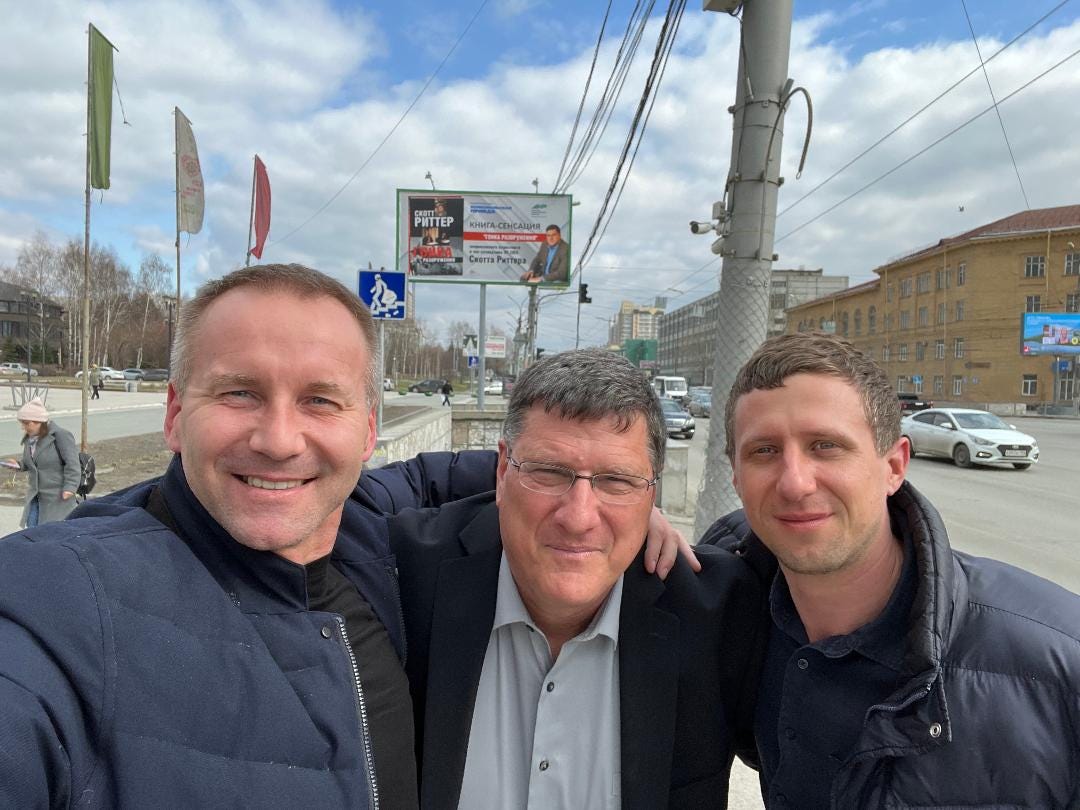
The Author (center) with Alexander Zyrianov (left)and Ilya Valkov (right) in Novosibirsk, April 2023
In April 2023 I was preparing to board a flight in Istanbul, headed for Novosibirsk. The Russian lady processing my ticket was dumbfounded. I had just handed her my American passport. She stared at it, then at me, and then back at the passport. “The gate for Moscow is down there”, she said, pointing.
“I’m not going to Moscow,” I said. “I’m going to Novosibirsk.”
She just stared at me.
“Why?” she finally asked.
It was a question I had been asking myself for awhile.
The world was a little more than a year into what Russia called its “Special Military Operation” in Ukraine, and what my country and most of the Western world called Russia’s unprovoked invasion of a sovereign European nation.
Russia was being painted as a threat to both the United States and Europe, and the Ukraine conflict had devolved into a proxy war then intention of which was to achieve the “strategic defeat of Russia.”
“Strategic defeat” meant meant trying to collapse the Russian economy through the imposition of stringent sanctions.
It meant wearing down the Russian military in an endless war in Ukraine that sapped Russia of its physical strength (i.e., by killing Russian soldiers and destroying Russian military hardware.)
It meant collapsing Russian society in an effort to trigger a “Moscow Maidan” that would remove the government of Russian President Vladimir Putin.
It meant trying to bring about the end of Russia.
I had, by this time, been a student of all things Russia for more than four decades, dating back to my earning a degree in Russian history from Franklin and Marshall College in 1984.
During this time, I had followed Russia’s historical path, from the collapse of the Soviet Union in 1991, through the horribly destructive decade of the 1990’s, and to the coming to power of Vladimir Putin and Russia’s modern-day resurrection—and the resentment this resurrection had caused in the collective West.
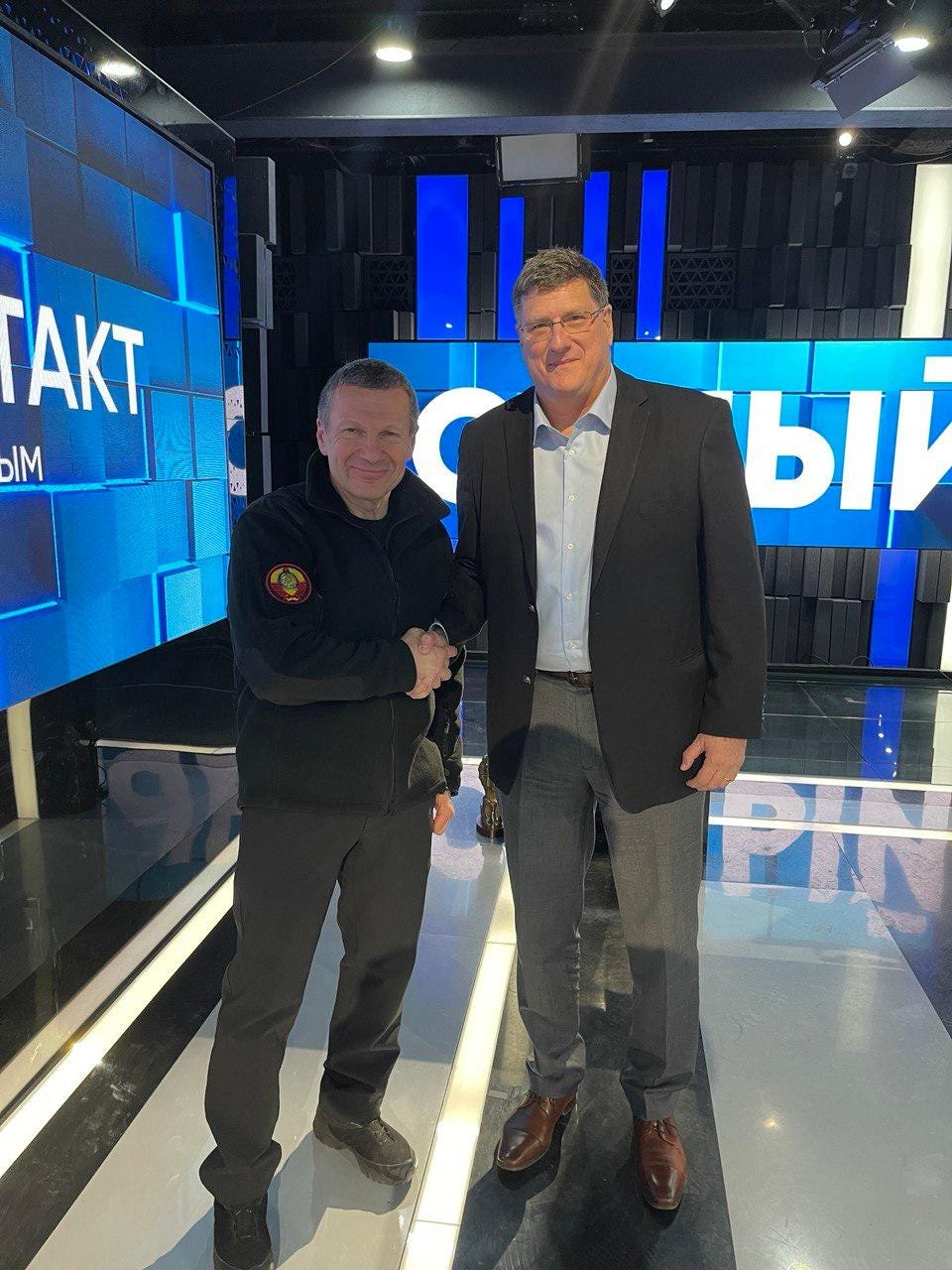
The Author (right) shakes hands with Vladimir Solovyov (left), Moscow, January 2024
This resentment—and the goal of undermining Russia—was known to Russia and its leadership. In 2018, while being interviewed by Russian television host Vladimir Solovyov for his film World Order 2018, President Putin made a very telling statement:
Зачем нам такой мир, если в нём не будет России?
What use to us is a world without Russia?
The collective goal of the United States and its European allies to “strategically defeat” Russia was a thinly disguised effort to undermine and destroy Russia.
I personally didn’t believe the collective West could succeed in their plan.
But that wasn’t the point.
The point was that they were trying to accomplish something which, if they succeeded, meant the end of the world.
Because, as Vladimir Putin noted, “What use to us is a world without Russia?”
Russia, I knew, was not an enemy of either the United States or the collective West.
The problem was that the American people, together with their European counterparts, had been subjected to Russophobic messaging for decades which blinded them to the reality of Russia.
I made it my mission to travel to Russia, to convey a spirit of friendship to the Russian people, and to capture the “Russian reality” and bring it back to America in order to help overcome the blind hatred of all things Russia that unencumbered Russophobia produced.
In doing this, I believed, a groundswell of support for better relations between Russia and the United States could be generated which could eventually manifest itself in a real and meaningful change in the trajectory of US-Russian relations.
So I went to Russia, a journey which at the time was so unplausible that even the Russians couldn’t believe I was doing it.
My motto during that initial visit was “one handshake at a time.”
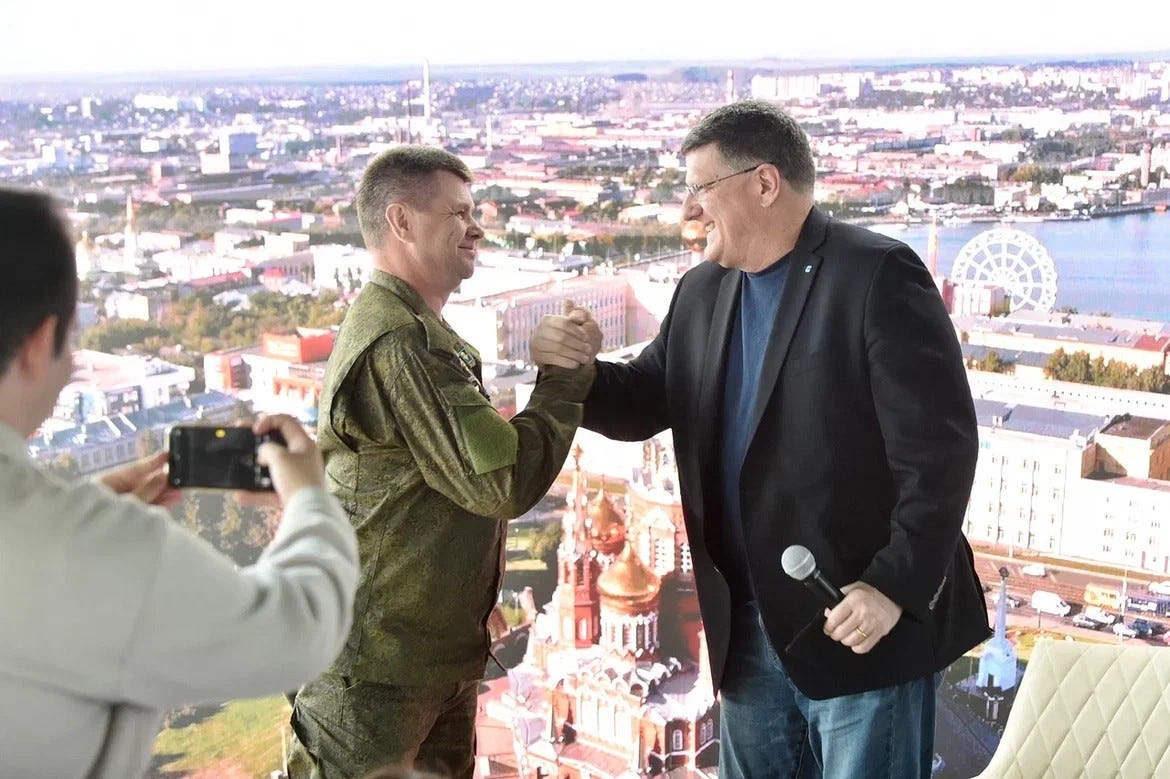
The Author shaking hands with a Russian veteran, Izhevsk, May 2023
For 20 days I travelled to 12 cities, meeting the Russian people up close and personal, and shaking every hand I could in an effort to convey the spirit of friendship I believed could, and would, eventually unite our two nations.
I returned to Russia in December 2023, intent on conveying the same message—”waging peace”, one handshake at a time.
The Author (left) shakes hands with Sergei Aksyonov (right), the Governor of Crimea, January 2024
I travelled to the places the US government and Europe didn’t want people to know about—Chechnya, Crimea, Kherson, Zaporozhia, Donetsk and Lugansk—in order to learn first hand the reality of the war being waged from a Russian perspective.
While the Russian people appreciated my efforts, the US government did not.
In June 2024 the US government seized my passport in an effort to prevent me from returning to Russia and continuing my mission of “waging peace”.
And in August 2024 the US government sent FBI agents to raid my home, accusing me of being an agent of the Russian government.
Their goal was to intimidate me into silence or, failing that, to imprison me.
But the mission of peace was too important to allow myself to be intimidated or silenced.
Increasingly the message of peace which I had been promoting in virtual isolation in April-May 2023 began to catch on. In America I began to work closely with like-minded independent journalists, tapping into the well-spring of goodwill that exists amongst the American rank and file.
We challenged the tired Russophobic tropes being echoed by the mainstream media.
And people began to listen and respond.
Author (right) shakes hands with Pavel Balobanov (left), Moscow, August 2025
We worked with like-minded people in Russia as well, like Pavel Balobanov, with whom I collaborated to resurrect the 1985 “Citizens Summit” that brought Soviet and American people together through the magic of satellite television by hosting a new “Space Bridge” that linked a New York-based American audience with a Saint Petersburg-based Russian audience for three hours of conversation—the kind of dialogue that is essential if our two nations are going to learn to live in peace.
In November 2024 the American people had a chance to make a decision about whether they wanted to continue down a path that led inexorably toward nuclear annihilation, or chose an alternation route that led to the possibility of peace with Russia.
They chose peace.
Elections matter, and with the political momentum that drove the FBI’s raid on my home and attack on my person now eliminated, I was once again able to resume my mission of “waging peace.”
With my passport in hand, I made three successive trips to Russia—in August, October, and November 2025.
My singular focus of these trips was to promote the betterment of relations between the US and Russia.
To promote peace, not war.
To promote arms control, not an arms race.
And to bring an end to the fighting in Ukraine on terms that resolved the root causes of that conflict, such as NATO expansion and the desire to “strategically defeat” Russia.
This past Thursday President Donald Trump published the National Security Strategy of the United States.
The previous edition of this foundational policy document, published by the administration of former President Joe Biden in October 2022, painted Russia as “an immediate and persistent threat to international peace and stability” and sought the strategic defeat of Russia, with all that entailed.
The new Trump National Security Strategy no longer cats Russia as a threat—as an enemy—which needs to be strategically defeated.
Instead the Trump roadmap promotes the concept of “strategic stability” with Russia premised on the recognition of Russia’s legitimate national interests.
This is a foundational change in strategic direction on the part of the United States.
Americans are no longer being told by their government that Russia is an enemy which must be confronted at costs.
Rather, Russia is a nation with whom we must have stable relations.
A nation that has legitimate goals and aspirations that must be respected.
And nation that American must seek to peacefully coexist with.
As colleagues.
Partners.
Friends.
I wish I could capture this moment, and bring it with me back in time, to that ticket desk in Istanbul.
“Why?’ the Russian ticket agent had asked, incredulous that an American would want to travel to Russia at that time.
“Because of this”, I would respond, showing her how far we had come.
The Author (left) shakes hands with Apti Alaudinov (right), Moscow, August 2025
In 2023 I began a journey of peace.
I started alone.
Over the two and a half years since this race began, I have been joined by thousands of others—Americans and Russians alike—who have embraced the same cause.
Today we can see the finish line.
We haven’t crossed it yet—we still have a ways to go.
But we can see the journey’s end.
We’ve come a long way, Baby.
Let’s finish the race.
oooooo
Interview with Maxim Lavrukhin
Interview with Maxim Lavrukhin
Scott RitterDec 08, 2025
In this special edition of The Russia House with Scott Ritter, I am joined by my co-host Garland Nixon in downtown Moscow, where we had the pleasure of interviewing Maxim Lavrukhin, a member of the expert council of the State Duma Committee on Energy.
We discussed energy war being waged between Russia and Ukraine, and in particular how Russia was responding to the threat posed by Ukrainian drones to critical Russian energy infrastructure.
Transkripzioa:
hello and welcome to a special edition of the russia house with scott ritter today we’re in moscow and i’m here together with my co-host garland nixon and we have the honor and privilege of speaking with maxim lavruk and he is let me get this right
you are a member of the extra council for the state duma committee on energy you’re also a former military intelligence officer and you specialize in transportation and energy security and First of all, thank you very much. I welcome you to the show. What I’d like to talk about today, if we can, if we look at headlines today,
because understand that this show is primarily for an American audience. We have an audience of Americans today who are largely ignorant about the reality of Russia. And one of the reasons is because of Russophobia. We’re conditioned to not trust any information that comes out of Russia and to always view Russia in a negative light.
So when we look at the headlines, we’re seeing, you know, simply put, an energy war between Russia and Ukraine, where Russia is systematically destroying Ukraine’s ability to generate electricity. But Ukraine is responding with long-range drone strikes that are hitting Russian oil refineries. And the media in America is saying that Ukraine is going to win this fight,
that Ukraine will bring Russian energy to its knees, that the Russian economy will collapse, and that Russian President Vladimir Putin will have no choice but to sue for peace. Meanwhile, we see Ukrainian cities with the lights out and winters coming. Could you— Give us a perspective on this. Let’s start, for instance, with what’s happening in Russia.
As a specialist on energy security, are the Ukrainian drone attacks having a significant impact on Russia’s ability to produce oil, to produce gas, produce diesel, and to generate the income it needs through export to keep its economy afloat?
If we talk about the damage inflicted by drones, and unmanned boats, then we can say that all previous attacks that were before today inflicted certain damage. But anyway, the consequences of such attacks were rectified pretty quickly.
show everything in the bright light, so to say. But I know hands-on how quickly our production facilities were restored after attacks. Speaking about ensuring security of such facilities, The energy committee that discusses the security of fuel and energy facilities We view our goal as making sure that all such facilities
are safe and secure and granting all legal opportunities to security and security services to all those who ensure security of such facilities and to law enforcement to perform their duty effectively. And we see a lot of actions and we interact with a big number of law enforcement agencies and operators, refinery operators interact with operators of other
refineries and they implement various actions to retrofit their refineries with security nets with other types of equipment with radio intelligence and protection systems so we are implementing a huge complex of actions and our enemies, Diversive and Intelligence units and terrorist units can launch a small drone And the cost of that drone is insignificant,
it’s peanuts compared to our efforts to re-equip and retrofit our energy facilities. heat is treated as a huge success and this asymmetry is something we are trying to counteract I can tell you that the actions that we’ve developed, the measures that we’ve developed, all those who are involved in ensuring security of fuel and energy facilities
enable those who work for private security companies and those who work to ensure transport safety. have additional opportunities and additional capabilities to use various methods of course if we are talking about technological equipment that has enabled us to ensure a breakthrough Before 2022, people were almost clueless about various means of counteracting air attacks, except for military experts.
CEO, every executive of fuel and energy refinery knows the types of equipment that can be used. And if we look at the equipment that is currently used and that used to exist before 2022, they are entirely different.
One of the things that a number of observers of the conflict before the conflict and the results of the economic, I would say, warfare against Russia have found of note is the concept amongst some Western political analysts that Russia and they used to use this term. I’m sure you’ve heard it.
Russia is a gas station masquerading as a country that Russia. oil was the principal export of Russia and that if Russia’s oil exports were in any way impeded, that the country would just fall apart. Can you talk about the diversity of Russia’s export market and where oil falls in
in the overall economy of Russia and the various things that it exports? We know Russia exports weed and gas and various other things also.
If we talk about oil exports, I can put it this way, today everyone knows that there is a whole campaign to hunt down the so-called shadow fleet of Russia that is engaged in exporting Russian crude to Europe and other regions I think it is known, you know about it, that British special forces jointly with NATO forces
have been conducting a big number of drills I think the number of such drills was significantly smaller before 2022 I’m talking about bolt tops, bolt down and bolting down the recent drill And people are saying that special forces from the UK are perfecting their skills to seize civilian ships and oil and gas platforms. Well,
perhaps it testifies to the fact that the North Atlantic Treaty that was created to oppose an aggression is transforming into a mechanism of sea pirating to seize energy resources produced by other countries and day by day the Baltops is focused on and aimed at occupying the Kaliningrad region the top
The military leadership of NATO is proclaiming it openly that the key goal is to destabilize the situation and to seize Kaliningrad If we look at a Baltic down drill to seize oil and gas platforms in the Baltic Sea There are not numerous those platforms and we know the names of those oil platforms
I don’t think I have to refer to those platforms by name There are only two oil platforms located in the Kaliningrad region and they pump a huge volume of oil Seizing such a platform would be a very simple task for an elite unit And I do not
understand why elite military units from the UK are trained to seize energy facilities and to steal energy resources after such a seizure This would be very simple use a tanker to moor it to an oil platform to pump hydrocarbons from the oil platform to the tanker And we know the situation that is being faced by Lukoil,
one of the chief Russian oil majors That has been sanctioned and as a result it will have to bid goodbye to its international oil assets, to its assets overseas And there is a huge fight for such assets And recently there were discussions that a Hungarian company called Ganva would buy those assets, but the United States said no,
When we look at Russia, again, coming back to what Garner was talking about, the way it’s described in the United States, a gas station disguised as a country. But the reality is that Russia has significant energy infrastructure. Energy plays a very major role in the Russian economy.
Russia is a huge country, and its energy infrastructure is spread throughout the nation. How do you go about protecting infrastructure of this nature, especially given drone technology today that allows these longer range strikes? I know you can’t give away state secrets, and I’m not asking you to,
but I thought it was fascinating when you talked about the synchronization between the Ministry of Defense and the energy companies that energy executives now are actively involved in. you know, looking at the security of their of their facilities. President Putin recently spoke of the mobilization of reserve forces to to protect.
Is this part of is the energy companies working with the Ministry of Defense to incorporate these new reserve units in the most effective way possible?
That’s an excellent question. I was not aware that you know so many details. It is a recently published federal law on mobilization of reserve forces in the Russian Federation. to engage them to protect critically important facilities in the Russian Federation including oil refineries and oil loading facilities, loading terminals.
This law is one week old or maybe a week and a half old. This law was fast-tracked. I learned about that initiative. I followed up on that initiative. It went through all the committees, stakeholders committees in the Duma, and it took up a week to have it adopted, and it was signed by President Putin.
The way I see it, the federal law, If there is a significant reserve force, then it would be extremely helpful in ensuring the security of our fuel and energy facilities, because the Russian military forces have more authority to use various means of defense. Speaking about private security companies or transport security companies,
they can use but a very limited range of equipment and means whereas reserve forces can use a diverse type of equipment including air defense including guns and various types of guns and rifles there are various modifications of such to counteract drone attacks. We cannot talk about them, but in May this year,
there was a roundtable discussion with representatives from major energy companies to discuss I am one of the people who is against using radio electronic means to counteract attacks from the air, air attacks. I, for example, think that more lethal means could be used for the purpose and I am the author of one of such complexes.
It is a laser complex to counteract drone attacks It has passed several industrial trials and I know that Saudi Arabia has already tested such equipment made by China and there was a letter of gratitude from the government of Saudi Arabia to China today Russian military forces have more leeway,
they have more opportunities to use various means And it is a well aligned type of collaboration across various structures Because many people did not know whom they should report to, what information flows should look like And this information is of the highest operative interest And it is important that
information is provided as quickly as possible To timely deploy various means of warfare I need to be open with you that everyone understands that there were mistakes committed by both sides, including us and our opponents But we have managed to perfect the mechanism and the information flow management mechanism There is a map that is an information flow
And by the way, speaking about the round table discussion, it was a pleasant surprise that many industrial majors from the fuel and industry complex fuel and energy complex that are using electronic and radio warfare means have already gained experience in using such devices and systems so they even keep their own statistics
on the number of drones that they destroyed So this is something different from the statistics compiled by the Ministry of Defense When I looked at the statistics, I was surprised And after that, I talked to the chief security officers and I said, is it really possible that you managed to down so many drones?
And they said, yes, we have bits and pieces of drones that we managed to drown And it was a pleasant surprise. So this whole suite, whole complex of actions enables us to be pretty efficient in counteracting this relevant threat. But we should not think that the threat posed in drones.
It is only drones that pose a threat to our energy facilities or unmanned boats We observe drone attacks against Moscow on a daily basis And there are dozens of drones that are targeting not only military facilities but energy facilities as well And it is not the only threat that we are trying to
It is not only a threat against energy facilities and transport facilities. There is also another way that has been applied. I’m talking about underwater mines when oil loading tankers that are based in oil terminals in Russia were attacked by underwater mines. And they were activated, those mines were activated when those tankers were either unloaded or the loading
was starting And so there were attacks against them that caused leaks, and we had to actually engage emergency response forces. Once again, I’d like to repeat it, that these were civilian boats. Though they are in part of energy security of Russia but in terms of their crews there are no military men on board and those ships,
those vessels have never been used in military operations And there are unprecedented attacks against such vessels. And I do not know any country that has faced such a threat. I think we are a kind of a testing ground when the enemy is applying different methods. How will Russia… How will Russia respond to that?
And today we’ve developed an action plan that enables us to ensure protection against underwater mines and it is no secret I’m not trying to I’m not trying to divulge a secret. This information is publicly available, and information about such subversive underwater attacks is in public domain. And all vessels that arrive… at Russian ports, including foreign vessels,
have to be subjected to a mandatory underwater inspection using underwater robots, remotely controlled robots, of course, and using divers. And if there are potential suspicious objects that are detected, then there are specific response actions by specialized crews who have to eliminate the threat
Before I ask this question, I’d like to know, is nuclear energy something that you’re also familiar with or involved in?
The reason I ask is this. There’s been a lot reported recently about Russia and China working on some projects together in the field of nuclear energy, of Russia working to develop new methods to utilize nuclear energy. And this is a question, I don’t know if you could answer it or not, but it’s, I think, an important question.
I have a friend who is a naval engineer. We were discussing the new Brezhnev missile, but his position was that the new technology used for the propulsion system has potential for nuclear energy, that they could create very small nuclear power plants that could be used for energy.
Do you have any thoughts or knowledge on any of the new work that Russia is doing and or maybe Russia and China is doing or new technologies that are being created for the advancement of nuclear energy?
To be honest, I’m not well versed in technical details of nuclear energy in terms of propulsion technologies being used. Unfortunately, this is something that is not my sphere of expertise. I’m mostly focusing on how to How to protect all such facilities, what kind of equipment and devices could be used,
how to streamline the mechanisms of response As to technologies and equipment, whether nuclear or otherwise, unfortunately I’m not in position to give an answer
Well, in that case, could I redirect that to a question about the difficulties of protecting nuclear power plants? We know that there has been repeated attempts to attack the Zaporozhnev nuclear power plant. Certainly, it was widely reported that part of the Kursk incursion was a plan to seize a
nuclear power plant and then utilize that to essentially blackmail Russia. Your thoughts on the importance, the methods, et cetera, used for protecting nuclear power plants? It was even reported at one time that the Ukrainians had a plan that if they would lose, they would attack and blow up their own nuclear power plants in order to, you know,
cause problems. So your thoughts on the protection of nuclear power plants and the importance of it.
Thank you very much for your question. Speaking about the Zaporozhye nuclear plant, today the Ukrainian side has been using very cunning attempts of hidden attacks including drones, both including plane-like drones I’m not divulging any state secrets I do not have access to state secrets to tell about what we’ve got But judging by my own experience,
I make an assumption that in order to protect such a facility We should have the Ministry of Defense, Air Defense, and anti-missile defense forces, including the Panzer systems, plus the Russian nuclear agency or atomic agency has more capability to use larger radio and electronic warfare systems.
And the systems that are being applied by the Russian atomic energy use a broader range of frequencies compared to devices that are available in the Russian market. Speaking about the Zaporozhye power plant, nuclear plant, our diplomat Mikhail Ulyanov I attended a meeting with Rafael Rossi,
and Mikhail asked Rafael whether he had any doubts that it was the Ukrainian side that was attacking the Zaporozhye nuclear plant. The response was, I have no doubts whatsoever. But if I proclaim it publicly, there would be lots of questions addressed to me. He is under a lot of pressure. from the global international community as a whole.
And he said that if he declared it openly, people would demand proof from him and he had no evidence. And if I show drones that are used by Ukraine, no one would believe that. So he’s in a straight jacket, he’s between hammer and anvil.
First of all, thank you very much for that. I’ve spent the last, gosh, 16 years, I guess, involved in energy security from an analytical standpoint, not from an operational standpoint. So I find what you’re talking about to be extraordinarily fascinating. You know, today in the United States, we have massive energy infrastructure as well.
We’re the largest oil producer in the world. We produce a significant amount of natural gas and we’ve diversified our production down to the local level with fracking and such. Right by my house, we’ve just undergone a massive rehabilitation of a gas pipeline facility with new pumping equipment and such. I walk my dogs by that facility every day.
And if I wanted to, I could destroy that facility in minutes. There’s no security whatsoever. And the entire United States is like that. And I would imagine that much of Russia was like that, with just facilities there, no effective security. What you’re doing is revolutionary. You’ve been compelled to take a look at energy security, infrastructure security,
and your energy companies are working hand in glove with the Ministry of Defense to come up with the most effective way to do that. I know you’re at war right now and such, but the stability of the global energy market is in everybody’s interests. Everybody wants a stable energy market.
And therefore, the security of national energy infrastructure is in everybody’s business. Could Russia? when this is done, become a nation that shares its experience with other energy producing countries to say, not necessarily the secret of specific weapon systems, but conceptually, for instance, you speak about the information flow, the diagram that’s there.
This would be information, I believe, that is in the interest of the the better good of the world when it comes to information security. Do you envision a time when the Russian energy companies, Russian Energy Defense, would be able to invite their counterparts from around the world and say, hey, look, in the future,
you may face a threat similar to what we faced, and this should be the things you should be thinking about how to secure your energy infrastructure?
that’s an excellent question when I was going to the interview I was thinking about how to put this discussion on the table and you’ve done it wonderfully for me I’ve been trying to do benchmarking looking for best practices in the global community I think that many countries looking at the developments in Russia are fully aware of the
threats posed by drones and they are trying to apply various means to protect their facilities But we should not go too far to say that we know that Mexican narco cartels have been using drones There are a lot of facts, a lot of evidence and the members of such cartels have been spreading this
information boasting how they destroy plantations of their competitors Speaking about international exchange of experience Actually I did contact General Denis Savier who is VP for Total Energy for security, Total Energy Denis Savier used to be the chief policeman in France and prior to that he had been the chief of GIGN, a special division
And I wrote to Mr. Favye and said that we could try to do a benchmarking exercise and exchange best practices I could share something without drilling into sensitive details And you could share something as well So to cut it short, it was an attempt to establish a contact and to have something Based on publications of Total,
they’ve been using radio-electronic systems to protect their overseas assets and they are training their staff He was reluctant to exchange information. He said, I cannot talk to you discussing such sensitive topics Well, again, perhaps I’ll repeat myself that it is a political matter due to the fact that France
is not in a very good relationship with Russia but at the same time I’d like to say to Denis Favgier I’m not your enemy I’m your colleague I can share information with you to protect energy facilities without disclosing state secrets and we can help each other
how to secure our facilities and it is no secret and it is a useful experience I’m not going to divulge secrets and it is not a story when energy facilities in one country would be so heavily protected that there would be no possibility of a warfare against But we must take into account that there are also terrorists,
not only other countries that may threaten their neighbors And counteracting terrorism is an important topic to secure transport facilities and energy facilities But unfortunately, people are reluctant to talk to Russians about security So I’ve been trying to do that. Of course, I can only talk about myself.
Are you involved in, I mean, there’s two things. There’s the energy infrastructure for Russia’s export facilities and Russia’s export market. But as has been discussed recently with the drone attacks and how that affects everyday Russians, there’s certainly the infrastructure for supplying gas, energy, etc. to Russia’s domestic market and ensuring that everyday Russians have their energy needs met.
Are these separate security measures or is it all one security measure? Is there separate infrastructure or is it viewed as one entire process?
Well, we have a single process in its entirety in line with federal laws to ensure protection and security of energy and transport facilities. When we talk about oil loading terminals, they are treated as energy facilities and transport facilities. When we talk about oil products that are exported and the security measures that we have adopted
to ensure that those oil products reach their destination and reach the right terminals, there are general provisions for ensuring this security. As far as I know, many companies that are shipping oil products or other energy resources using Tankers in those areas where there is a high pirate activity,
they are contracting private security companies that have weapons to counteract pirates Quite recently there was an attack I don’t know whether it was a pirate attack or a terrorist attack but there was an oil tanker that was seized by a certain group and held by them for more than 24
hours or even two days Then there was a response team that arrived at the spot and those who seized the oil tanker had to As I’ve said, there are lots of private military companies or security companies that are contracted by hydrocarbon shippers When we talk about pipeline security, there is no security system per se,
Let’s just get back to propaganda for a second, American propaganda or Ukrainian driven propaganda. And this will be a short question and I’m assuming a short answer. We’re told that because of the Ukrainian drone strikes against Russian production facilities and Russian distribution facilities related to gasoline, diesel, that there are shortages of gasoline and diesel in Russia today,
that Russia’s export market has been impacted by this, and that Russia actually asked to import gasoline and diesel now to make up for these deficiencies. Are there long gas lines in Russia? I mean, I’ve been driving around Moscow now for several days looking for them, and I can’t find them.
But is there a regional impact in some areas of Russia where there is gasoline shortages, diesel shortages, or is this Western propaganda? What can you say about the issue of the supply of gasoline and diesel to the Russian domestic market and the ability of Russia to export gasoline and diesel because of Ukrainian drone attacks?
As you’ve said, you’ve been trying to find long lines. I can tell you that there are no long lines of people at gas stations. This is propaganda that has no truth behind. Perhaps during the first days after such attacks there was a shortage of fuel but now all of the supplies have been renewed.
In terms of prices, I wouldn’t say that the prices There was a scheduled price increase, energy resources price increase And I think that it is not the kind of problem that is depicted by foreign mass media As far as I know, once there was a problem with fuel after a number of successful attacks against our
energy facilities There was an emergency meeting held by President Putin with the leadership of the Ministry of Energy and law enforcement agencies and CEOs of major oil and gas corporations both government owned and private and everything has been sorted out and there were price ceilings established and price limits and they could not exceed those limits and today
I am not aware of any such problems. I think the problems are non-existent I am from the city of Murmansk and there were various attacks One of the targets was a strategic aviation airdrome And there are no waiting lines in Murmansk, there are no waiting lines in Moscow I visit Kaliningrad and other regions,
the future of uh energy security in the same way that um you know drone technology has dramatically changed the face of um of conflict and and war russia is building massive pipelines the power of siberia too etc to to china is the uh russian federation looking into creating new technology you know you thousands of kilometers literally of
of pipelines that would need maybe satellite views, maybe cameras, things of that nature, maybe drones that fly along those pipelines to regularly inspect them. Is there a group or organization? Are you involved in researching new types of technology to ensure the stability and protection of some of these very long distance and remote pipelines that are
certainly out in the wilderness? And I’m not asking you to reveal any new technology or reveal anything, certainly, that would be compromising to Russia’s security needs.
Our designers who are involved in designing oil and gas pipelines, including the power of Siberia, have a huge experience. It is not something new. We’ve built lots of underwater pipelines and on-land pipelines. Those underwater pipelines were destroyed. I’m going to talk about it a bit later. The technical specifications that we use to ensure security of pipelines,
I’m talking about operational safety so that there is no loss of integrity, so that the pipelines are operating effectively without leaks or spills. Well, everything is designed correctly and effectively as to inspection flights. As far as I know, we are not only fighting against drones, but we are also developing drone systems.
And we are designing various technologies for the agricultural industry and other industries of the economy that can benefit from using drones To inspect remote facilities, to inspect the integrity of such facilities, to scan the terrain And speaking about the success in designing pipelines Let’s look at our Nord Streams 1 and 2 that were blown up.
There are no doubts that it was a terrorist act and certain people were detained, people who committed that crime, though initially in Europe people were claiming that it was Russia that took part in that act to orchestrate a collapse. The way those pipelines were designed and the Baltic pipeline was designed and the
Baltic pipeline was ruptured by an anchor of a sea vessel, these were two different technologies. Our pipelines were laid extremely correctly. Even if an anchor was actually on the sea floor, it would not rupture the pipeline The Baltic pipeline was designed improperly and this is why it was… It lost integrity,
it was overhanging the seabed and there was no soil or any other material covering the pipeline and this enabled the criminals to destroy that important pipeline
I want to get back to something that you discussed early on. You said that, I mean, for instance, in your discussion with the gentleman from Total, you talked about the fact that France had extensive experience in radio electronic technology. defense applications for their infrastructure. And yet, when you spoke about the ideal way to protect the infrastructure,
you said you don’t like radio electronic, that you prefer kinetic, you prefer lethal. Could you dig a little bit deeper into that? Why you prefer? Because radio electronic seems to be the fad. Everybody wants their jammers, their various electronic equipment. You seem to be old school to shoot it down. Why are you heading that direction?
Thank you very much for this question again. This was right on spot. I just wanted to lead you to this discussion. Why am I not a fan of radio electronic defense systems? All such devices that are being used, all drones that are being used, are modified and upgraded on a daily basis.
It is like using modules for radio frequency. In simple words, if a drone is using 450 GHz, if its signal is killed at that frequency,
to another frequency and that device will keep changing frequencies until it finds the frequency that is not being killed At least some of the devices available in the market Let’s be honest, many radio electronic devices have certain gaps in the radio frequency spectrum, and that creates vulnerabilities and enables people to… And such means, such devices,
radio-electronic devices are expensive And there is a fad, as you rightly said, and one of the top managers of an energy company said Everyone is buying and we are buying too We should not devise anything else for us to apply to counteract the threat At the same time I was suggesting laser complexes
Laser complexes that are already available and are exported by foreign partners And we also have knowledge and expertise in creating our own laser weapons and such projects are already ongoing I think it was in late 2022, early 2023 when I suggested a concept of a complex to handle drones, to respond to drone attacks by using laser complexes
I sent that complex to stakeholders who actually agreed that those complexes would be quite relevant So they approved them, but at the same time, there is no energy facility in Russia that uses such complexes for protection purposes As far as I’ve said, they are using radio-electronic defense systems and they are working, cooperating with
Kinetic weapons that destroy drones are much more effective because it does not have frequent vulnerabilities The only error it may make is when it misses If we talk about air defense, but speaking about laser weapons We are not talking about blasters that actually have a certain length of a laser
ray It is a single ray that can reach its target at a distance of 1200 kilometers or even more A piece of steel will be burned in fractions of a second You will not be able to blink an eyelid when five millimeters of steel will be burned And five kilowatt of
electricity would be sufficient for that That’s not much I began looking at that in late 2022 And we have eventually arrived at a comprehension that laser equipment is efficient and we have to focus on it and ramp up manufacturing of such complexes because it is efficient and Rostek is a government
corporation that is developing its own laser technologies to respond to drone attacks and there are other players who have conducted successful trials But so far those trials have been conducted, were conducted using small copters, using small drones But in any case such systems would be sufficient
to counteract plane attacks The only thing is the price tag They are much more costly compared to radio-electronic defense systems For example, an actively used device costs 1.5 million rubles It is not a 360-degree complex, but it is used by many and has been quite effective We have a catalogue of devices
that have proven their efficiency and that are recommended for implementation both on energy facilities and other facilities Such a device costs 1.5 million rubles And a laser complex is about 30-40 million rubles. And it is only one laser. And we need to set up a cooling system, a navigation system, a targeting system,
and lots of other accompanying systems. And we made an estimate for a major facility, a pretty complicated facility, from the technical perspective. It is not just an ordinary refinery located in the middle of nowhere, but it is a pretty sophisticated technological facility To protect such a facility, there is not a single point to install a laser complex,
a high point to cover that facility 360 degrees. We chose three elevated points for three units, and there must be a control room for that complex. That complex cost was 350 million rubles, including VAT.
The good news is that the energy industry is one of the few energies that makes enough money to be able to pay for that kind of expense. Maxim, I want to thank you very much. This has been a fascinating interview. I really, really appreciate it. Garland, thank you for your questions.
you, the audience of the Russia House, for tuning in. You tune in, you learn something. And today, I know I learned something. I believe Garland did too. And that’s the purpose of it. So again, thank you very much. And thank you, the audience, for tuning in. And we’ll see you next time.
oooooo


