
@tobararbulu # mmt@tobararbulu
The Cold November Rain
Nov 26, 2025
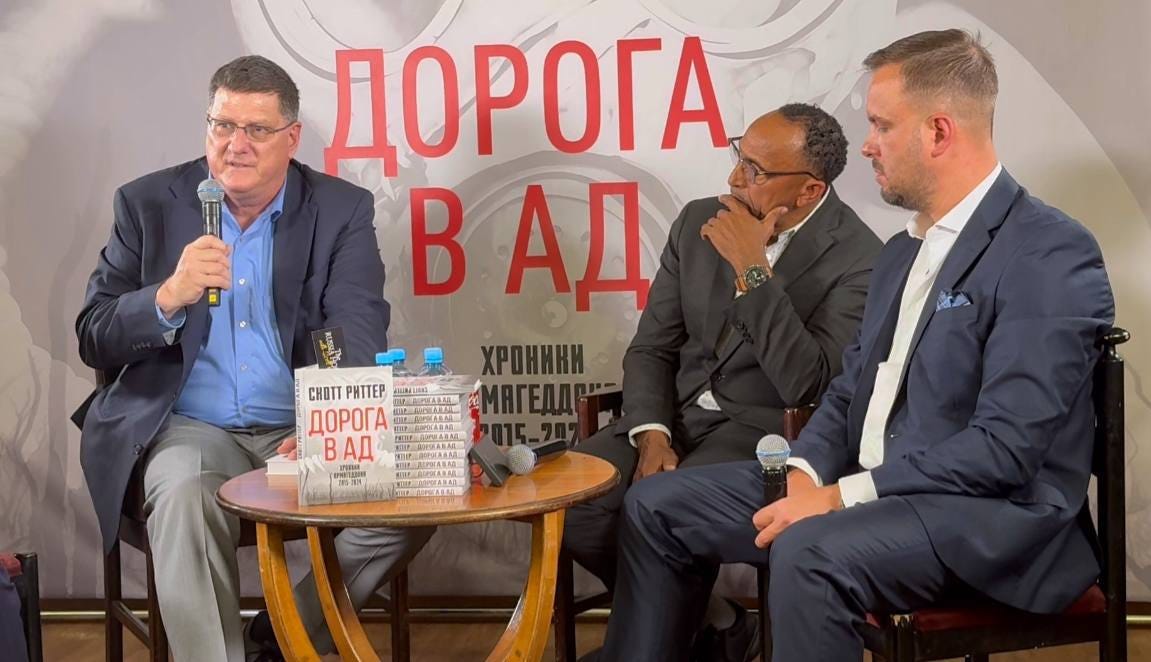
The Author (left), joined by Garland Nixon (center) and Anton Karpov, at the November 9 book launch
When I received my new passport, back on July 15 (a quick reminder—the US government had seized my passport back in June 2024 for the purpose of preventing my being able to travel to Russia), I was determined to make visiting Russia my first trip. I specifically timed the trip so that it fell on the first anniversary of the FBI executing a search warrant of my home, seizing my personal electronics based upon a statement of probable cause that postulated that I was willingly and knowingly serving as an unregistered agent of the Russian government. The accusation was absurd. However, the actions taken by the FBI and Department of Justice, which included empaneling a federal grand jury for the purpose of bringing forward criminal charges, were intended to intimidate me into silence.
I refused to play that game, instead aggressively advocating for arms control between the US and Russia to reduce the threat of nuclear war under the guise of what I termed Operation DAWN. Part of the multi-faceted approach taken under the Operation DAWN umbrella to increase public awareness of the threat of nuclear weapons was a book I wrote for that purpose, Highway to Hell: The Armageddon Chronicles, 2015-2024. This book was published by Clarity Press in the Spring of 2025.
During my August trip to Russia, I used the English language version of Highway to Hell to help promote awareness of the nuclear issue. This largely proved to be effective in making the Russian audience aware of the threat posed by nuclear weapons. But it quickly became evident that to have a broader conversation, the book would need to be presented to the Russian people in their own language.
My producer for The Russia House with Scott Ritter, Alexandra Madornaya, arranged a meeting with Konstantin Antipin, the editor of the Russian publishing house Konzepual. After discussing the book and my vision, Konstantin agreed to publish the book in time for my November visit to Russia.
My goal for November was to use the Russian language edition of Highway to Hell as a vehicle for a broader discussion of the nuclear threat that I would have with the Russian people and government. I planned on jump starting my visit with a public launch of the Russian language edition of Highway to Hell on the evening of November 9, held in a reception hall at the historic Central House of Writers, in downtown Moscow. The presentation was made to an audience of around 80 handpicked people, including those I believed would be able to help my message resonate more effectively amongst the Russian people and government.
Back in August, I had been asked to write letters to a number of senior Russian officials, including the President, the Foreign Minister, and the head of the Foreign Intelligence Service, as well as the President of Belarus and the former Russian President, Dmitri Medvedev, requesting interviews. I was told at the time that there was a very good chance for most, if not all, of the interviews being granted. But then came Alaska, and the decision by the Russian government to freeze all interviews in order not to generate any publicity that could interfere with the broader objectives of the Trump-Putin summit. I was specifically told that if I were to come back in November, that these requests would be able to be accommodated then.
I also submitted a request, through two major Russian media outlets, for interviews and tours that would shine a light on the consequences of the decision by the Trump administration to withdraw from the INF Treaty. One of the themes I wanted to explore was how the decision by the United States to withdraw from the INF Treaty in August 2019 had manifested itself regarding the development and deployment of INF-capable weapons systems used by the Russian military today.
The United States government had accused Russia of violating the terms of the INF Treaty and specifically named the 9M729 missile as the weapon that was in violation. On January 23, 2019, Russia publicly displayed the 9M729 missile for the first time. Lt. Gen Mikhail Matveevsky, chief of the Russian missile and artillery forces, declared that the 9M729 missile features a more powerful warhead and improved guidance system over the previous 9M728 model. It did not, however, have an increased range.
I was interested in learning about the status of the 9M729 missile today. The United States claimed that the 9M729 possessed a range greater than the 500 kilometers permitted under the treaty. I asked to receive a briefing about the 9M729 missile, and, if possible, conduct a tour of a 9M729-equipped unit, to help demonstrate that the system was, in fact, a treaty compliant weapon under the INF Treaty
The issue of arms control, I pointed out, was central to any prospect of improved US-Russian relations. It was therefore critical that the American public be as well informed as possible about the factors that led the United States government to withdraw from the INF Treaty. This is especially true if Russia was not in violation of the INF Treaty.
A briefing about, and a tour of, the 9M729 missile, I believed, would help resolve this point.
I also brought up the Oreshnik missile.
On November 21, 2024, Russia delivered a strike on a Ukrainian military industrial facility using a new INF-capable missile, the Oreshnik. On August 1, 2025, President Putin announced that the Oreshnik missile had entered serial production. On August 4, 2025, the Russian Ministry of Foreign Affairs declared that Russia no longer considered itself bound by the restrictions of the INF Treaty, and that the Oreshnik missile would enter operational service with the Russian military.
As President Putin highlighted in his statement of November 21, 2024, the development and deployment of the Oreshnik missile was a direct consequence on the decision made by the United States government to withdraw from the INF Treaty in August 2019.
Today the American public remains largely ignorant of the new reality that exists in terms of the balance of power in Europe that has emerged with the development and deployment of the Oreshnik missile.
In the early 1980’s, when the Soviet Union deployed the analogous SS-20/RSD-10 Pioneer missile, public opinion in both the United States and Europe was mobilized in support of arms control that helped create the political conditions under which the INF Treaty was able to be successfully negotiated and implemented by the United States government.
I believed it was critical that the United States government avoid policies that could lead to a nuclear arms race in Europe, and the dangers that would accrue as a result. It was therefore imperative, in my opinion, that the United States government embrace policies which reduce the threat posed by INF-capable missiles. The ability of the American public to rally around such a policy, however, was and is hampered by the lack of information about the Oreshnik missile system and its capabilities.
To help inform the American public about the reality of the Oreshnik missile and the need for policies which would mitigate against its future use against targets in Europe, I requested that consideration be given for providing me with a briefing about, and a tour of, the Oreshnik missile system during my visit to Russia.
I submitted one request in September and followed up with a second in October. By the time of my arrival in November, the jury was still out. Planning for a best-case scenario, I extended my November trip by an additional five days to provide opportunities for either some high-level interviews, the missile tours, or both.
As we now know, serious back-channel talks between the US and Russia were initiated in late October, which once again had a chilling effect on my ability to conduct the requested interviews, which would have focused on the very issues being sorted out behind the scenes, including the possible extension of the New START treaty. Once again political reality trumped journalistic optimism.
I also received the news that while my request had made it to the desk of the Minister of Defense, and was actively considered, the decision was that Russia would not be granting the requested tours and interviews at this time.
This information hit me like a body blow.
I had raised a lot of money to make this trip possible and invested over $6,000 of my own funds in hopes of moving the issue of nuclear arms control forward in an aggressive fashion.
All was not lost, however. I had contacted representatives of a prestigious discussion group, and approached them about the idea of hosting a panel on the danger of nuclear weapons and the need for arms control. They agreed that this was a good idea, and plans were being solidified when, at the last minute, the word came down from “above” that nuclear questions were not the purview of this discussion group, or any other outlet outside the Russian government.
It was a moment of clarity as chilling as the cold November rain that followed me throughout my visit to Russia.
Throughout the extensive preparations for this visit, I was buoyed by the success last year of Operation DAWN, the effort to make preventing a nuclear war an issue of concern for the candidates involved in the 2024 US Presidential race. Because of the work done with Operation DAWN, I was able to gain access to senior Trump administration insiders and member of Congress, all of whom helped promote an agenda of preventing nuclear war by restraining efforts by the Biden administration to provide Ukraine with long-range missiles capable of striking the Russian strategic depth and, in doing so, potentially triggering a Russian nuclear response.
I learned a hard lesson while in Russia, namely that what works in America does not directly translate in Russia. Russia has its own way of doing business, and it’s done on a timeline that Russia and Russia alone chooses.
This was a lesson learned the hard way, at great expense in terms of time and money.
But it was a lesson that had to be learned if I was to have any hope of success going forward.
And I will be going forward.
I wasn’t told “no”.
I was simply told “not now.”
Because of the connections made during this visit, there is a plan which is being considered by the Russian government which could address the issues I am interested in pursuing, namely the threat of nuclear war and the need for disarmament, in a new and innovative manner.
Discretion mandates that the details of this plan be kept closely held until it reaches the point of implementation.
I am confident this plan will reach fruition.
But it will be done at a time convenient to the Russian government.
None of this detracts from the fact that my November visit to Russia was a huge overall success.
None of this detracts from the fact that my November visit to Russia was a huge overall success.
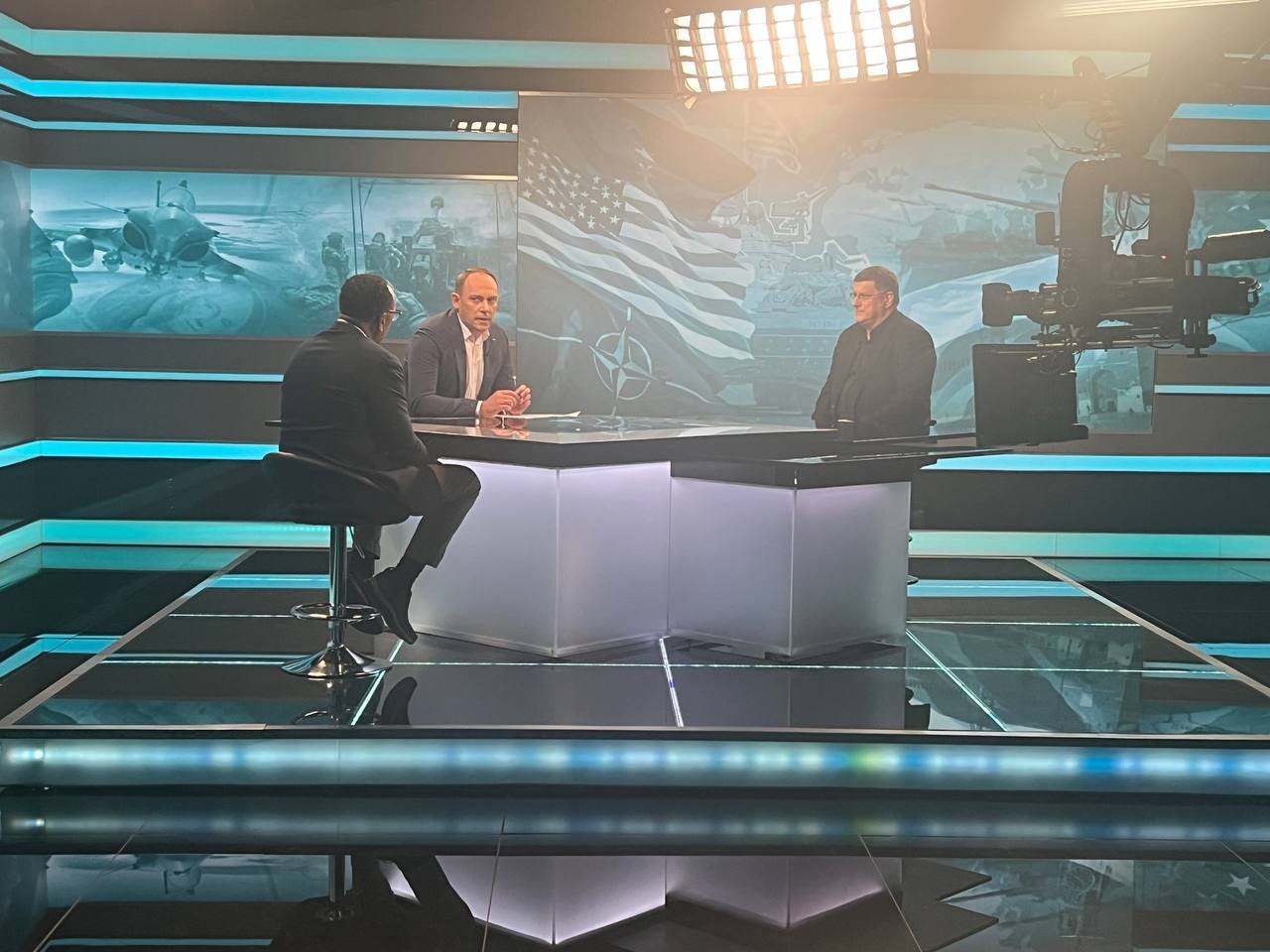
The Author (right) with Garland Nixon (left) on the stage of OTN Television in Minsk, Belarus
First and foremost, I (together with the assistance of very kind and generous donors) brought Garland Nixon to Russia for the first time. Garland got to experience Minsk and Saint Petersburg, in addition to Moscow, participate in several public speaking events, served as the co-host for The Russia House with Scott Ritter, participated in several high-profile media interviews, and meet hundreds of Russians from all walks of life, all of whom were thrilled to see him in Russia.
Garland Nixon went to Russia as an independent journalist, with all expenses paid for by donations received from the supporters of both his and my work. While this places a burden on us and our supporters, it enhances the credibility of our work since we are readily able to defeat any allegation of being “Putin’s paid puppets.”
We were also liberated in that the agenda we pursued in Russia was purely ours—we were not held hostage by the whim, desires and needs of a host organization. Sure, we didn’t stay in a luxury hotel, and our method of transportation was economy class, including taxis. Other than the times in which we were invited to dinner by friends, we took our meals at the same neighborhood restaurants and working-class fast-food joints as did the average citizen of Russia.
Garland got to see the real Russia and meet real Russians.
And such experiences are priceless.
This trip also established my independence in the minds of the Russian government, media and professionals.
I think prior to this trip many in Russia were confused as to who I worked for, and who crafted my agenda. One of the main reasons for this was that in the past my visits were hosted by Alexander Zirionov (April-May 2023, December 2023-January 2024), the National Unity Club (August 2025), and RT (October 2025.) Except for the RT-hosted visit, where I was a guest helping RT celebrate its 20th anniversary, I was always in control of my agenda, picking the places where I would visit, the meetings I would participate in, and the media interviews I would give.
However, the events of 2024 turned my world upside down.
I was under a microscope wielded by powers (the FBI and the Department of Justice) for whom truth did not matter, just the warped perceptions they could construct by reading nefarious intent into fragments of data selectively picked for the purpose of fabricating a narrative that did not exist.
I could not afford to create any window of opportunity for the FBI to misconstrue my work, whether it be from the standpoint of funding to who originates the goals and objectives of my work.
The November visit was my declaration of independence.
Whereas in the past I would make use of studios and interpreters provided by others, on this trip I had Alexandra rent our own studio space and pay for our own technical and linguistic support. And where I would in the past sometimes allow others to arrange for interviews with prominent Russian figures, on this trip Alexandra and I carefully selected those whom we wanted to interview in collaborative fashion. The result was a tour de force of Russian expertise covering a wide range of issues pertaining to Russian society. In short, if the objective of The Russia House with Scott Ritter is to capture the Russian reality and bring it to an American audience, we delivered in spades.
In the days and weeks to come, the byproduct of this labor will be released to the public. The audience will get a better understanding about the real situation of the Russian economy through from the perspective of noted economist Mikhail Delyagin. Courtesy of Alexander Artamonov, we delve into the complicated topic of what “de-Nazification” means in the context of Ukraine. You will examine the impact of cinema on Russian society through the lens of the Russian journalist Fyodor Razzaokov. Alexander Stepanov, a military expert affiliated with the Russian Presidential Academy talked about Russian policy in Central America, with an emphasis on Venezuela. Valery Korovin talked about the meaning of the word “Eurasia” from a Russian historical perspective. With Nikolai Starikov we explored some of the conspiracy theories surrounding key aspects of Russian and Soviet history. Maxim Lavrukhin talked about energy security in the age of drone warfare, while Andrey Masalovich—the famous “Cyber Grandfather”—explored the impact of artificial intelligence on open-source intelligence. Francesca de Bardin, an American expat living in Moscow, discussed her new book, Moscow Diary, and what life was like as an American living in Moscow. And I touched upon the current state of play in US-Russian relations with Andrey Mikhailovich, a former senior advisor to the Minister of Defense.
Ten interviews in total (we had scheduled fourteen, but life intervened, as it does, causing four persons to cancel.)
The goal of these interviews was to capture the “Russian reality” and bring it to an American audience.
Our independence was almost our undoing. Word came down from high that there was counter-intelligence interest in the interviews Alexandra and I were planning on doing. I wasn’t picking “big names” to generate “clicks” or mobilize the masses. Instead, Alexandra and I had selected people with real expertise, the kind of experts whom, once you interview them, are able to provide a deep analysis and understanding of Russian society today. There was some thought that my interviews were being done as a front for intelligence collection.
In the end, the Russian authorities allowed our work to go on uninhibited. But I take it as a mark of pride that my effort to capture the “Russian reality” was seen as being so thorough as to provoke genuine counterintelligence interest on the part of Russian authorities.
I did three separate book events—the Moscow book launch, a book presentation in Saint Petersburgh, and a second Moscow event organized by an organization known as “Day Center.”
All three were very well attended.All three were very well attended.
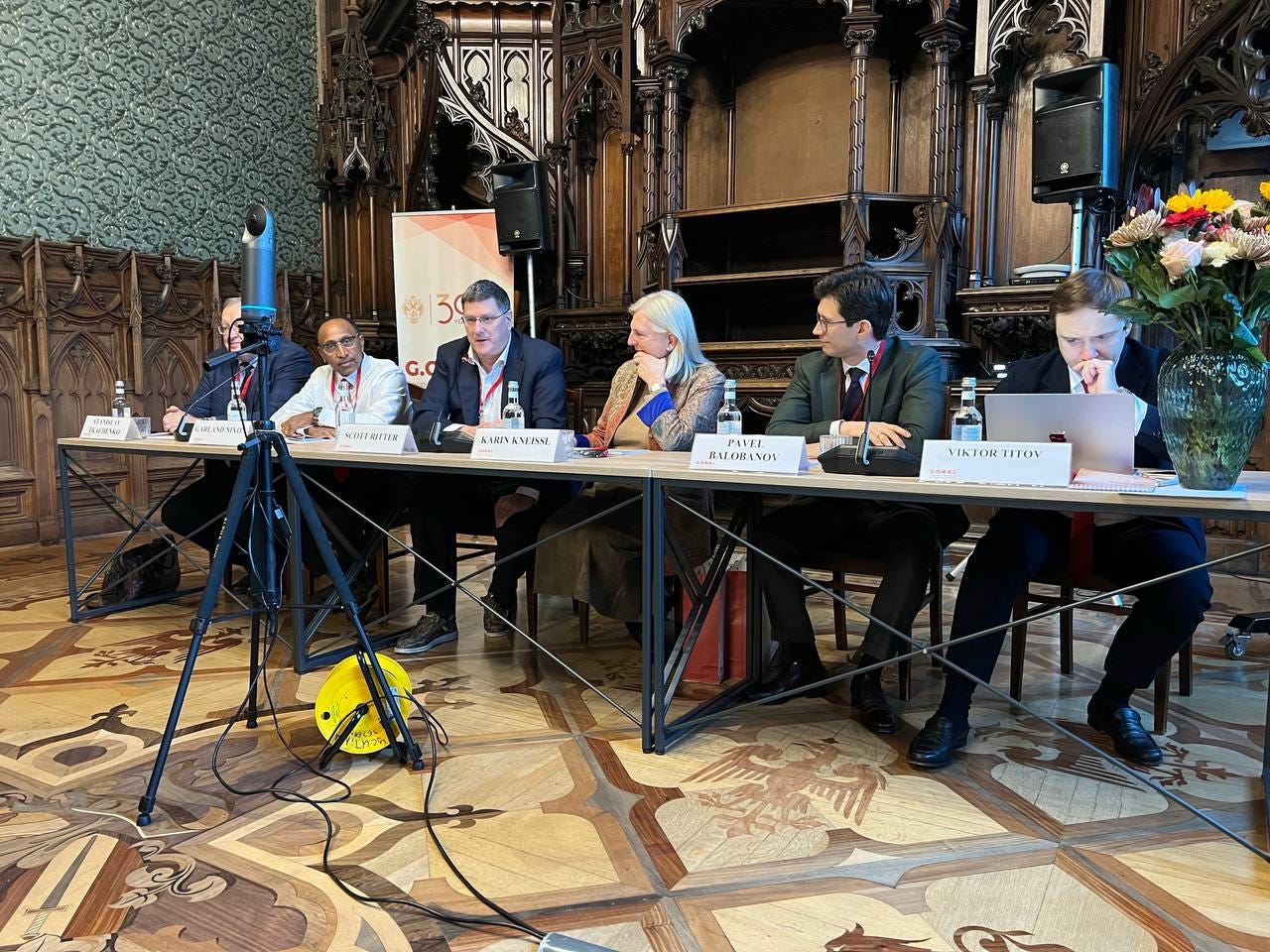
The GORKI expert panel, from left to right: Stanislav Tkachenko, Garland Nixon, the author, Karin Kneissl, Pavel Balabonov, and Viktor Titov
I spoke on a panel at the Geopolitical Observatory for Russia’s Key Issues (GORKI), a think tank run by the former Austrian Foreign Minister, Karen Kneissl, in association with the University of Saint Petersburg, where we discussed the Anchorage Summit. The panel was very well attended, and the audience asked deep and thoughtful questions.
I was also invited to speak before students at the Moscow State Institute of International Relations (MGIMO), the diplomatic school of the Ministry of Foreign Affairs. The students asked questions befitting their elite status.
I was interviewed by a major Belarus TV channel (OTN, with Garland Nixon), by Radio Sputnik, Sputnik television, Izvestia, TASS, Channel 1, Match TV, RuTube, Vovan and Lexus, and the MetaMetrica and Peya Pervy podcasts.
I met with volunteer organizations who provide humanitarian goods for frontline soldiers.
I held private discussions with Russian frontline military commanders, Artificial Intelligence experts, Caucasian political activists, Russian geopolitical journalists, and others.
And I toured memorials dedicated to those who were killed during World War Two—the Memorial to the Soviet Soldier, in Rzhev, the Khatyn Memorial outside of Minsk, the Museum of the Siege of Leningrad in Saint Petersburg, and the Victory Park complex outside Moscow.
One can never forget.
There were no “down” days—even the five additional days I had laid on the schedule were fully consumed with important work.
My November visit to Russia will go down as the most productive trip I’ve made to Russia as an independent journalist. It represents an important steppingstone for my future work, a portal through which I had to cross to get to where I want to be going.
I am deeply grateful to everyone who made this trip possible.
And I am especially thankful for the work and support provided by my producer and fellow team member, Alexandra Madornaya. Without her this trip literally could not have happened.
I am blessed with good friends and supporters inside Russia, including Anton Karpov, who kindly provided the reception hall at the Central House of Writers for my book launch, to Mauka Pipea, whose hospitality at his restaurant, Genatsvali, is world class, to Peter Hanseler, who presided over great dinners and even better discussions, Alexander Stepanov for showing me Russian history and hospitality, Yulia Prokharova, for introducing me to so many interesting people, to Pavel Balabonov, for opening up his home and hospitality to me and my team, and Kirill Sokolov, who gratuitously made himself and his car available to drive us in and around Moscow.
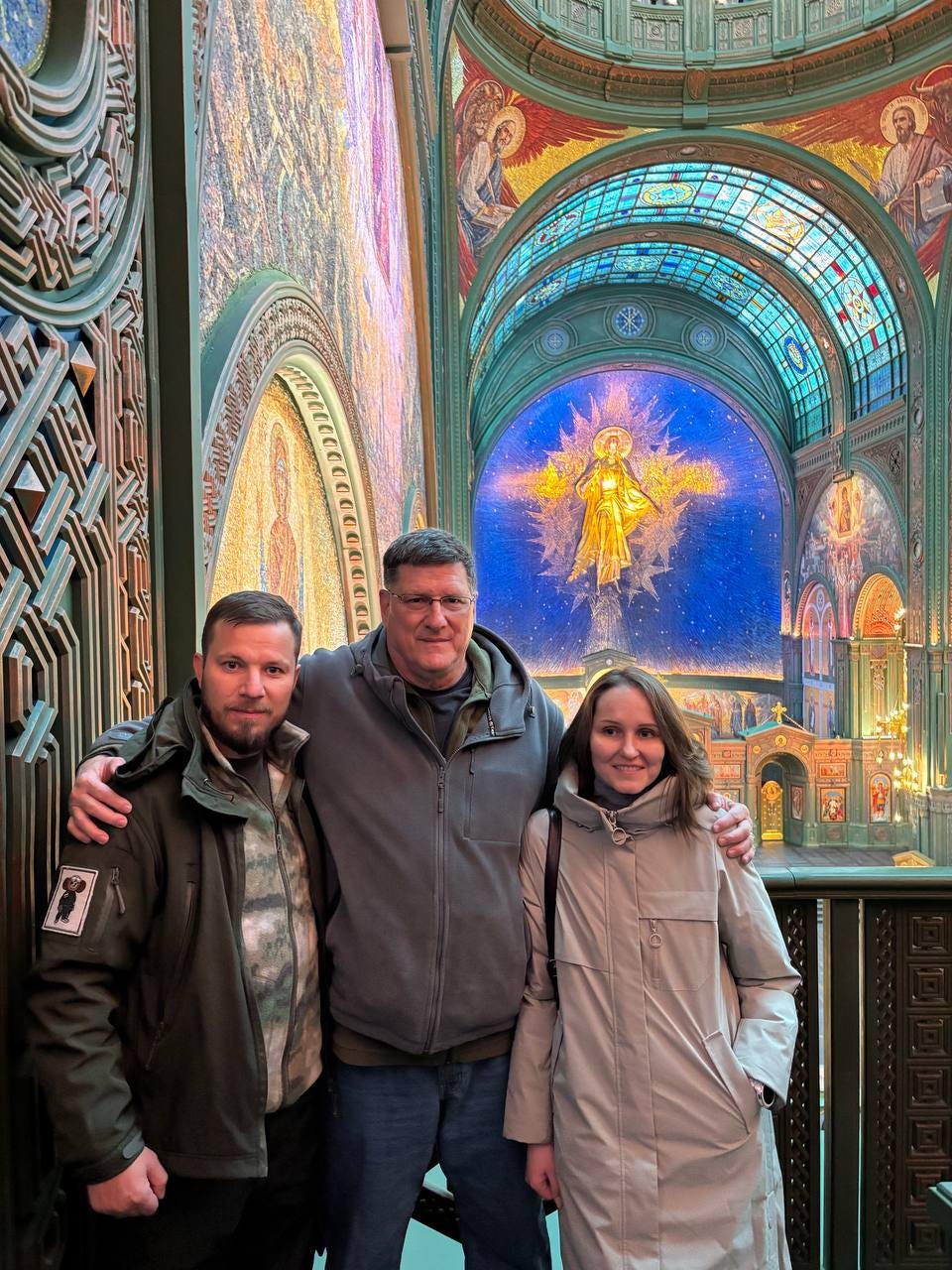
The Author (center) with Kirill Sokolov (left) and Alexandra Madornaya (right) inside the Victory Part Cathedral
But most of all I am grateful to you, the readers and supporters whose donations made this trip possible.
Thank you all for making the cold November rains of Moscow such a warm and receptive destination, and a springboard for future work that will further the mission of improving US-Russia relations and reducing the threat of nuclear war by promoting effective arms control.
I have just returned from travelling 19 days in Russia, conducting interviews of prominent Russians in order to help capture the Russian reality and bring it to an American audience. This article was motivated by this visit, which was mostly funded by the kind donations of you, the reader. If you want to see more articles like this, please subscribe. And if you want to help make possible more trips such as this, please donate (the Author’s next scheduled trip to Russia is in March-April 2026.)
Interview with Mikhail Delyagin
Interview with Mikhail Delyagin
Nov 27, 2025
In this special edition of The Russia House with Scott Ritter, I am joined by my co-host Garland Nixon in downtown Moscow, where had the pleasure of interviewing noted Russian economist Mikhail Delyagin. We explore the reality of the Russian economy today, how it transitioned from the depths of the chaos and disaster of the post-Soviet collapse to what it is today, where it is heading, and its present strengths and weaknesses.
Transkripzioa:
Hello, and welcome to a special edition of the Russia House with Scott Ritter. Here we are in downtown Moscow, and I’m joined today by my special co-host, Garland Nixon. And we have the honor and privilege of speaking with Mikhail Delyugin, a, I mean, you’re Your biography lists you as one of the top Russian economists.
And when I look through your biography, it’s it’s very impressive. You’ve been an advisor to presidents, prime ministers, etc. But I’m going to start the interview. a little off-kilter perhaps, I was reading through the various monographs that you have authored, and I was struck by the title of one of them. And basically it said,
A Return to Oprachnina, which I guess is the time of Ivan the Terrible, or Get Out of Roshka, which is a derogatory slang for Russia. The article was written in 2011 during the time of President Dmitry Medvedev. It was a time, at least in the West, where we felt that Russia was going through a period of optimism,
etc. But the title of the article is rather pessimistic. I was wondering if you could help me understand the title and why the pessimism at that time?
When you were asking your question, I was feeling some joy inside my heart because you did not read my articles that I authored in 1990s. Well, we are in objective competition with the West. And the time when Medvedev was president was the time when we surrendered to the West. Vice Prime Minister Mr.
Dvorkovich said that we had to pay for financial stability to the US and that it was right. And the time was very similar to 1990s in terms of policy, politics and economic policy. Economically, everything was satisfactory. But speaking about Aprychnina, well, if we translate it into modern language,
this is building an institute for development and ensuring law and order. If we say Aprychnina now, it means that we are starting to observe the criminal code with respect to thieves and crooks. This is what it means if we translate it into modern Russian. Of course, those who are scammers and crooks, they don’t like it.
Speaking about Russia, it is indeed a derogatory name used to refer to Russia and the meaning of the word is that it is a country that would never succeed, never, and it would never do anything good because it has failed to give in to the West.
It is a liberal view of things and it is a pro-Western view of things. The situation is entirely different. I understand that you would like to talk about the economy with me. What we are doing, we are violating the standard economic theory. We exited it due to three reasons. The first reason is as follows.
Why are we able to withstand the strong economic pressure from the West? And from the economic theory perspective, there should be no economy in Russia in 2020. when Obama was expressing the standard economic theory opinions. But we managed to withstand it thanks to a very high degree of digitalization. In 2020, there was a small revolution.
Mr. Mishustin was appointed head of the government. He digitalized the taxation system here and it is to a great extent automatic. And he spread that technology across the entire government, civil government. Everything that did not relate to military and law enforcement was digitalized through digital platforms. And this was an amazing improvement in efficiency.
We still have all the problems, shortcomings and effects, low quality, lack of responsibility and corruption. You can go on forever. But the quality of governance and management was thanks to digitalization. And thus, we violated the economic theory because our financial policy is disruptive. thanks to budget spent we are able to offset and compensate for negative
consequences our companies our business cannot raise loans the money is too expensive the government says we have made our calculation and estimates You need the following amount of money. We’ll give you a grant or we’ll give you benefits or we’ll simplify the red tape and administrative procedures for you to be able to work.
And this has proven to be sufficient. The second reason why we are not in line with the standard economic theory is that in our economy there is a shortage of money. The standard economic theory describes a situation when there is enough money or there is an oversupply of money. Therefore, you have to increase the interest rate,
impose certain restrictions and everything would be fine. But our situation is entirely different. There is a shortage of money and standard economic measures do not work. We can compare it to people who are overweight and underweight. If I’m overweight, I’ll have to eat less and everything would be fine. But if I suffer from
underweight and people are telling me that I have to eat even less, it would become worse. The Russian economy is suffering from being underweight and dystrophic and it is told that it has to eat less. The more active the central bank in fighting the inflation, the worse of the Russian economy is.
And the third thing relates to everyone else. Why is the financial policy wrong here if it is pursued by very smart and brainy people? If we look at 2011 or the times of Ivan the Terrible, we’ll see that the market relations story is a fight between financial speculators and manufacturers.
financial speculators need instability and manufacturers need stability in 1991 the global power was seized by financial speculators and it continued until 2020 when thanks to digitalization digital capital emerged and it began to seize power and Our power structure was built in 1990s when the top dogs were financial speculators and the economic block,
the financial block in Russia is being managed by financial speculators who sincerely believe that there should be instability, who sincerely believe that Russia has to take capital out of the country for support. And if we look at the global situation, Then there is a struggle in the US where the digital capital along with the
industrial capital has begun to dominate a little bit over financial speculators. Whereas in England, the country that has been transformed into a financial boutique, financial speculators wield all power. And this has caused a very tooth and nail conflict between the UK and the US, because your competitors are China, whereas your real foes are the Brits. And eventually,
at the end of the day, we are fighting the Nazis in Ukraine, but the government is in the UK. Financial speculators began exiting the global arena because they were ousted by the digital capital. But financial speculators do not want to die, they do not want to be things of the past.
And to be sustainable, they devised a scheme that is something of a genius. If we cannot succeed, we can bring the humankind back to Middle Ages. And then, like in the time of Ivan the Terrible, we’ll be the bright future for that humankind. And this is why we observe destruction of families due to propaganda of various perversions.
This is why we have this climatic scam and the arrangement of that global migration of peoples. because they have to replace those people who were raised in the logic of abstract thinking by migrants from other countries who were not raised by that. Unfortunately, our economy is being managed in the interests of financial speculators,
Let me ask you about a major change in the world and particularly in Russia and the BRICS countries. And that is the use of local currencies. Russia buying from India in rupees for rubles as opposed to the dollar. And you want renminbi. What do you think of the the new paradigm,
the new model of countries purchasing in their own currencies? And has that been a positive thing for Russia in your or necessary in your opinion? What has been the effect of that?
Well, this is something that we are forced to do, because once about 50% of our international reserves were frozen and in fact stolen, it became obvious that dollar was toxic and would be dangerous. A huge number of people here suffered because Western countries are changing the design of their currency.
People used to have cash and now there is a changed design. This relates to the UK, for example. And this is why people began using their national currencies in settlements. And this was complicated and unpleasant because it is much more convenient to have one single currency for such exchanges.
Well, as to China, they have not yet made the transition to the digital yuan. We will be using it shortly. It’s a pity that we do not have a digital ruble yet for such settlements. We should have done it some time ago. But speaking about national currencies, all amounts are still calculated in dollars afterwards.
It is not a perfect technology, but it is a solution. We have telephone communication. fixed-line telephone communication that is not very convenient. But when the lines are overloaded, fixed lines may be more reliable. The same relates to the topic of our discussion.
The dollar is a hard-line communication system. I like that. When we look at U.S.-Russian relations today, two individuals have emerged as some of the key players. Kirill Dmitriev, a Russian financial leader, investment specialist, and Steve Witkoff, an American real estate advisor who’s close to President Trump.
And the speculation is that there’s a grand bargain in the making between the United States and Russia that will be based on joint economic prosperity. But in listening to you discuss the American economy and the Russian economy. How do they sync? Is it possible for the Russian economy and the American economy to sync that so
that they could truly work together in a mutually beneficial way? Or is this just a dream? Is this just a fantasy that the two systems aren’t compatible at all?
Well, is this thinking? No. But is this mutually beneficial? Yes, but not today. Because when we are talking about the US-Russian relations, we forget about the key players, the UK. The UK controls France, Spain and Germany in Europe, which is unprecedented. The UK never controlled Germany.
It is now controlling Poland and perhaps some other countries that I have forgotten to mention. What is the problem of Ukraine? Politically, Ukraine is controlled by the UK and the resources of Ukraine are critically important for the UK to exist that has sunk into a deep financial crisis.
Without Ukraine, the UK would cease to become a global factor. It is a global factor thanks to the high intellect, to the high performance of its intelligence services and government structures, but it is based on resources pumped from Ukraine. Why does the United States want to stop financing Ukraine?
Because the United States understand that the money sent to Ukraine is stolen and then transferred to the UK, and thus the United States are financing its biggest enemy. Of course, the political establishment would not agree to that and say something else. And the idea of Mr. Trump, of President Trump,
is to take control over Ukraine and use it for the benefit of the United States. If he succeeds with our assistance, he would not be able to succeed without our assistance. things would be good and we would have some grounds for cooperation. We can reach various agreements with the United States,
but no matter what kind of agreements or accords we reach in Istanbul or somewhere else with other players, the UK will arrive and say, it is so good that you have reached this agreement. I have this bucket of gasoline to ignite fire again.
The traditional descriptions during the Cold War of economies were two very clear descriptions. I don’t know if they were appropriate then, but they were communism. It was defined as state control versus free market or, well… basically bank controlled, but we called it free market. But I look at China and they seem to have evolved into something different.
I look at Russia and I see large state corporations that handle commodities, oil, gas, and I see some that are owned by people or individuals. Is there a transition to new models outside of the traditional understandings of state control, free market? Are there new models, in your opinion, that are beginning to evolve,
We here have not noticed two transitions that mankind has never seen before. In 1991, there was a transition from the industrial epoch to the information epoch. In the information epoch, there is a most significant change in our mindset that was unprecedented. In 2020, we made a transition to the digital ecosystems to these platforms when we create
digital trails to teach artificial intelligence. The mission of mankind has changed two times over 40 years when we are talking about capitalism or communism we are describing the realities that are 100 years old i’d like to remind you that the soviet union began its disruption in 1950s if we
If we look at the small business in Stalin’s times when there was dictatorship of proletariat in 1920s, late 1920s, the share of small business was higher than in modern Russia, or the same as here, about 6%. China has taken the Soviet model and is trying to adapt it to the digital epoch.
China has lots of domestic internal problems that someone who is not Chinese will not be able to understand it. For example, if we look at young and prosperous Chinese men and women who take kittens and puppies and they pamper them as their own children because they will never have children, they will be childless.
It is one of the most profound problems in China. But China is trying to resolve its problems and by addressing the problems it is adapting to the new world. We keep talking about communism and we perceive communism as the power of those who are dependents. But communism is the power of people.
This was the initial idea as expressed by Karl Marx or Vladimir Lenin. And in China today, a businessman can be a Communist Party member and can take part in managing the affairs, not using his or her money, but by investing his or her own personality. I’m not going to say anything good about Stalin. These were horrible times.
But when the Great Patriotic War started in 1941, poor Soviet people used their savings to buy tanks and airplanes for the army. Because there were certain circumstances when they could earn money. Not everywhere. But there were opportunities. And when we are talking about communism, as I’ve said, we are talking about the power of dependence.
We are thinking about destruction. And when today we are witnessing this confrontation between financial speculators and digital capital and manufacturers on the other side, in the early Soviet Union, Elon Musk would be a parliament deputy because he succeeded, he would be invited to join the Communist Party and even if he had said no,
he would be elected to the parliament. Yes, he would have problems with the government authorities, but he would be a part of the system. Jack Ma in China is not an opponent to the system in China. And these days, the conflict between the working class and entrepreneurs is still there.
But against the background of that confrontation with the financial speculators who want to bring the humankind back to the Middle Ages, this is nothing.
Before I got on an airplane to come to Moscow, I had been invited to participate in a discussion online. And they were going to bring a Russian individual who left in 2022. and who has spoken very badly about Russia ever since. And I declined, but I watched part of the interview,
and his entire premise is that Russia is collapsing economically, that Russia’s a failed state, that Russia can’t continue this war because its economy can’t continue the war. And I’m not saying any of that’s true. I’m saying that unfortunately that resonates amongst a certain audience in the West who wants to believe it so. But when you were talking
I mean, again, I’m fascinated by this digitization revolution and the concept of efficiency. Because normally, if I have a car that needs to run better, my job is to repair the car, to make the car more efficient. But here, the car runs perfectly. It’s other issues that need to be dealt with, the tires or something.
You said Russia lacks money. Why? Is it because of corruption? Is it because of the oligarchs? Because if Russia could get more money with the efficiency, I think would the Russian economy be unbeatable?
Well, you know, the Russian economy is not an engine where you have to replace summer tires with winter tires. The Russian economy is a car that has to be remodeled, has to be redone. Our problems are very in-depth, but we are able to take advantage of our problems to achieve our goals.
If there is a shortage of money, as I’ve said, the reason for that is as follows. The economic block in the government is managed by people who promote the interests of financial speculators. Roughly speaking, the London city. They are not conscious of it.
They are the third or the fourth generation of liberals who do not know that they can do things differently. They do not understand the actual problems of the Russian economy. To make loans accessible and affordable we need to limit financial speculations. The United States America did it until 1999. Japan did it until the year of 2000.
All developed countries that are developed at the current maturity level of the financial system limit financial speculations. Because if you do not limit financial speculations, All money will go to the currency market, forex market and equity market. We are not doing that because our economic block is being managed by people who serve financial speculators.
You cannot limit yourselves. You cannot limit those whom you serve. You cannot limit those who are a religious value for you that’s why our financial policy is inadequate and that’s the reason for shortage of money this is why we are suffocating because of this
lack of money for our economy to become unbeatable we need to put a stop to limit the monopolies and this is indeed very politically difficult Practically it’s very easy, but politically it’s easy. We need to limit financial speculations and we need to restructure the customs and taxation system.
In the 1990s we turned ourselves into an economic colony that produces raw materials and exports them. And Swiss experts calculated that we sold raw materials whose value was 20 billion euros and they made 3 trillion euros out of those raw materials. And that was a mistake. That was wrong.
And we have a very rough path in our relationship with China. when we start rebuilding our manufacturing. And Chinese would tell us, why do we have to do things with your hands? We can supply those products to you. You’re so good at creating new technologies for us.
This is going to be our next conflict that we are not grown up enough to start. But today we have to reorganize our… We have to restructure it to make sure that we have to rebuild our own manufacturing for our own benefits rather than keep supplying raw materia
But I think we’ll be able to address it within the next four years. Speaking about people who escaped the countries in 2022, there is nothing worse than immigration because you live in a different cultural environment. Until you find yourself in a different language environment, you would never feel it.
There were three times when I was on the verge of leaving Russia, and there were things that stopped me. The first thing was stop. They will not be speaking Russian here. And the second thing was that if I find a job, I would have to work against my own motherland.
And eventually I made a decision that I would have to stay in Russia, then work against my country. And I understand that people escaped, they were scared and frightened. And in the West, they have to say the things that are expected, that are demanded. And they are not in a bad company.
Churchill made his Fulton speech after the uneducated Truman edited it. Churchill spoke English beautifully. He was very well educated. And Truman was editing his speech for Churchill to say the things Truman wanted him to say. What can you expect from our escapees? And the majority of people who were scared and who
left Russia in 2022 are not criticizing Russia. Just take note of it. Not because they think that they may have to go back to Russia one day and they’re scared of special services and law enforcement agencies, but because they love their country even when they think they hate it.
You’ve spoken of rebuilding Russia’s industrial capacity, strengthening Russia’s industrial capacity. Russia is a very large country, but the number of citizens, it’s a small number of citizens compared to the size and the potential for Russia industrially. How would Russia… deal with an expanded industry, provide the number of people needed to work in that industry?
Or would Russia need to reach out to neighbors such as North Korea or other countries to provide workers? Or do you feel that Russia already has enough workers for an expanded and rebuilt industrial industry?
Well, everything depends on the type of industrial sectors we’re going to rebuild and expand. Our problems are when we started rebuilding our industry, we found out that the headcount at a factory was 3,000 people. When this factory is rebuilt, It turns out that instead of 3,000, we would need only 500 people.
And the other redundant hands are walking in circles and are saying, you are scoundrels, you’ve robbed us of our jobs. Of course, if we try to rebuild the industry as existed in 1960s, We would find out that, oh, yes, we do not have enough people. We have to have migrant workers.
But given modern technologies, we need to train people in an intelligent fashion. We should teach them. not to be blue-collar workers, but to be specialists who can teach robots, who can service robots. And we need to think about that 90% of our population who would be unemployed in case of successful robotization.
Because if those people sit and play video games, they will get crazy and they will destroy everything. And then we would have to recruit those people and train and educate them as specialists. If I engage in creative activities without practical application of my creations,
no one would be able to draw a line of distinction between art and madness. And therefore, the fact that we bring quite a lot of people that are culturally alien to Russia, that happens not because we are short-handed. This is a lame excuse. It is part of the global plan to ensure this global migration of civilization.
The United States government is trying to put a stop on that. I wish them success, but it is working here.
When I look at your biography, I see that you’ve advised various Russian leaders from Boris Yeltsin into the Vladimir Putin presidency, various prime ministers. Would you say that the Russian economy today is geared to the personality of the leader in power, or is it independent of the personality of the leader? I know that executives make decisions, but
For instance, Vladimir Putin has been president for 25 years, or prime minister, president. Will the Russian economy change dramatically in the post-Putin era? Not that I’m predicting that, but eventually everything changes. And will the Russian economy change with new leadership if that comes to pass?
The problem of our culture is in the weakness of the institutional environment. In 1995, President Clinton addressed the Duma and I said to my American friends, America is blessed because even Clinton can run it. Our country is different, our institutions are weak, therefore the role of a personality is significantly higher.
and therefore the personality makes too big an imprint on economic structure but the ongoing digitalization and the fact that we are going to find ourselves in a straight jacket of digital formats we were not able to build economic institutions and the role the place of those institutions is being taken by such digital formats
And thanks to that, the role of a personality is diminishing. Yes, President Putin has been running this country for more than 25 years and will continue running it for some time. And I can tell you that he’s changed quite a lot, quite dramatically over this period.
If we compare his policy in 2001 and even his policy in 2014, you would say that These are two different people, and people change. After Putin, there will be significant changes. There will be a very short period of fight for power. And in all likelihood, we would never notice it, because it will be an internal tough war.
But there would not be any significant de-organisation of the digital economy, we can put it this way. There is a threat of mutinous times. This is a mass psychosis that people are afraid that we would find ourselves in a mutinous era. And when people are consciously afraid of something, this would never happen.
The humankind is afraid of a nuclear war. This will never happen. Things that we are not afraid of, things that we are not thinking about will never happen. A nuclear plant cannot be destroyed. Only a utility line may be destroyed. Of course, naturally, sewage line, I mean. Of course, I assume that…
In the times when there is a change of power, there will be a flexible period for us to address a lot of economic problems that we are not addressing now due to other more prominent issues that are of higher priority. Well, no one could imagine that our government would be digitalized. But when Mishustin joined the cabinet,
I laughed and I thought that an expert in taxation would not be able to run the government because he had been engaged in performing other functions, but he succeeded thanks to digitalization. So I believe that this transition of power would not create a problem And there would be no dramatic events similar to the dramatic period when Yeltsin
handed over to Putin. This would look smooth like handing over of power from Putin to Medvedev and back to Putin. And we do not even understand how much digitalization is embedded, how strong this carcass, this skeleton is.
Well, that’s the thing. This has been such a fascinating conversation. We could go on forever. But I want to thank you very much for joining us today. I can guarantee you that any American who watches this is going to learn something about Russia, about the Russian economy.
All right. Well, on this, we can agree. Thank you very much. Thank you very much. And I want to thank you, the audience, for joining us in this very special edition of the Russia House with Scott Ritter, with my special co-host, Garland Nixon. We’ve had the honor and privilege of having Michael Delyagin join us today,
one of Russia’s top economists, discussing an issue that is on the mind of everybody as we… collectively struggle to figure out how we’re going to move down a path away from confrontation and towards peace. Thank you for joining us and until next time, have a good day.
oooooo
@tobararbulu # mmt@tobararbulu
Ritter’s Rant 062: Thanksgiving
https://open.substack.com/pub/scottritter/p/thanksgiving?utm_campaign=post&utm_medium=email
Ritter’s Rant 062: Thanksgiving
Thanksgiving is about the importance of family and friends, the very things that make life worth living and work worth doing.
Nov 27, 2025
Transkripzioa:
Hello and welcome to a special holiday edition of Ritter’s Rant. Today I’m joined by my co-host Maverick. Maverick and I would like to wish everybody a very happy Thanksgiving. He’s very restless. He knows that there’s a turkey waiting out there to be cooked and he wants me to
drop little pieces of turkey on the floor for him so he can eat them and get fat and be happy. But Maverick is sort of the embodiment of family. and uh and that’s what i’d like to talk about family and the importance of family
um i just finished a a very long trip to russia a very fruitful trip a rewarding trip but it was a trip that took me away from family and it um the people who were assisting me in in russia and assisting me at this trip are also taken away from
their lives we uh we all are on this journey the you know, of life. And in this case, a journey trying to make life better by making relations between the United States and Russia better by trying to prevent nuclear war, promoting friendship. And it’s an important journey, but we also have to stay truth to our foundations.
And that foundation is family and whatever family means to you, whether you have big families, small families, um at the end of the day when you go home you go home to family and um this is why we do everything i mean there’s a reason why we get up in the morning there’s a
reason why we uh set out on these journeys and it’s to make life better for family we speak of family values of the importance of family values defending our family promoting our family And this is what drives us, what motivates us. So today on Thanksgiving, it’s a day to be very grateful for family, for friends,
and for those people who make life worth living. And so… That’s what I’d like to do on this rant, is just send out my deep, heartfelt gratitude for everybody who has become part of my extended family, the people who make this work worth doing, who makes this journey worth taking. Today is Thanksgiving.
Thirty-four years ago, my mother gave me a cookbook. She said… You got to feed your family. Now, generally speaking, my wife is responsible for cooking and she’s a very good cook and such. But on Thanksgiving. It falls on me. And so this is what we call.
the turkey bible you see the stains on this this is 34 years of cooking turkey for the family this is the turkey bible in the ridder household this is a holy artifact this goes up on the altar that’s on top of the refrigerator and it sits there and
once a year it gets pulled out and opened up to the page where it tells me how to make a turkey Thanksgiving. And today the Turkey Bible will be put into full force. But it’s things like this that make life worth living, that make life fun, that make life enjoyable. These little traditions and such.
And I’m just hoping that everybody who watches this has similar family traditions, similar things that make life fun, that bring families together. um according to the turkey bible the 16 pound turkey that uh is sitting out there in the kitchen is going to require around five hours of cooking now according to
turkey bible that means that i have to start preparing the turkey about an hour and a half before that there’s things that have to happen um and then it goes into the roaster and it’s going to roast for five hours while i do other stuff like make the potatoes get the other vegetables up make
get the table ready for the family. We are planning on sitting down around 3 p.m. today for the feast. It’ll be a great feast. Today I’m joined not just by my wife, but my two daughters, both of whom are now married. Victoria was just married on November 1st, and their husbands are here.
So we have the extended family. In the background, you can probably hear my cats meowing. They’re hungry too. They’re looking at the turkey saying, when’s it going to be ready? Maverick and Iceman are running around chasing the cats because they’re competing for the turkey. Welcome to family life. It’s the thing that makes life worth living.
So from my family to yours, happy Thanksgiving. Thank you very much for all the support you’ve shown to me and us and the team over the course of the past year. And let’s have a great day, a good family day and use it as the foundation upon which we’ll launch into even
greater adventures in the year to come. Happy Thanksgiving.
oooooo
@tobararbulu # mmt@tobararbulu
Calumny
Gilbert Doctorow has accused me of “calumny” (the making of false and defamatory statements about someone in order to damage their reputation). I’ll let you, the reader, decide if this is so.
Nov 29, 2025
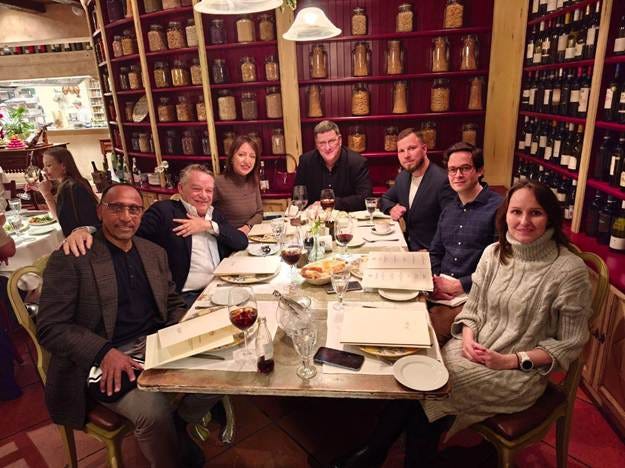
The author (center) with (from left to right) Garland Nixon, Peter Hanseler, Masha Hanseler, Kiril Sokolov, Auguste Maxime, and Alexandra Madornay, at the restaurant Cantinetta Antinori, in downtown Moscow, November 8, 2025
Cantinetta Antinori is a high-end Italian restaurant located in downtown Moscow. The staff is courteous to a fault, and the menu provides an exquisite selection of Italian cuisine which, if you simply allowed yourself to be caught up in the warm ambiance of the restaurant, could easily be sourced from Tuscany itself. And let’s not talk about the wine list…
There is a table in the far left reaches of Cantinetta Antinori which, over the course of three separate occasions between October and November of this year, served as the gathering place for the kind of intellectual discourse one only reads about in works such as Bulgakov’s “The Master and Margarita”, Robert Bolt’s “A Man for All Seasons”, or Edith Wharton’s “The Age of Innocence.” Overseen by Peter Hanseler, a Swiss-born businessman turned journalist who resides in Moscow with his lovely wife, Masha, where he edits and publishes Forum Geopolitica, an online journal which provides “independent commentary on a fractured world”, these dinner conversations offered deeply philosophical discourse on the nature of good and evil (à la Bulgakov), moral and ethical conflicts (Bolt), and social commentary and critique of upper-class Russian society that would do the gossips of Wharton proud.
These dinners coincided with a period when a certain curmudgeonly fellow named Gilbert Doctorow had singled myself and some of my colleagues out for some very pointed and vitriolic criticism for our work in reporting on issues pertaining to contemporary Russia.
Doctorow is a self-described “Russianist” (i.e., “professional Russia watcher and actor in Russian affairs”) whose credentials, beyond decades of first-hand exposure to Soviet and Russian life, include being a “magna cum laude graduate of Harvard College (1967), a past Fulbright scholar, and holder of a Ph.D. with honors in history from Columbia University (1975).”
Normally I would be inclined to associate myself with someone possessing such a pedigree, for the simple fact that he would have seen and done things I have not and could interpret these events through the lens of erudition influenced by both the academic world and the kind of practicality that comes with first-hand experience. I have experienced more than a few things in my time on this planet, enough to know that I haven’t experienced everything that needs to be experienced. As such, I am always hungry for the kind of informed insights people who have experiences different than my own can bring to the kind of broad discussion, debate and dialogue that is essential for true enlightenment.
I’m just a simple Marine. I didn’t graduate magna cum laude from Harvard, but I did graduate with honors in Russian History from Franklin and Marshall College (although I played football and drank beer during that time, which impacted my ability to retain some of what I was being taught at the time, including much of the Russian language imparted to me during two years of study.)
I don’t have a Ph.D. from Columbia University. But I do have two years of on-the-ground experience helping install and implement a sophisticated arms control compliance monitoring system outside a Soviet missile production facility in a remote region of the Soviet Union, some 750 miles due east of Moscow (I like to refer to experiences such as this as my “Ph.D in life.”)
I am fully aware of both my limitations and my capabilities. I try to compensate for the former while making maximum use of the latter. I do this by associating with people possessing similar inclinations.
Unfortunately, Gilbert Doctorow is not similarly inclined. Our differences exploded in the public eye, when Doctorow lamented my “calumny” in calling him out as ‘a moron’ and as ‘a piece of shit.’
First allow me to plead guilty to the charges: yes, I did say these things about Gilbert Doctorow. I stand by my words and the underlying sentiment they represent. I perhaps could have been more diplomatic in my critique, but as I’ve already noted, I am but a simple Marine and am prone to publicly airing critique in terms more suitable to the barracks than the public eye.
For this I apologize to the public.
But not Doctorow.
Nothing happens in a vacuum.
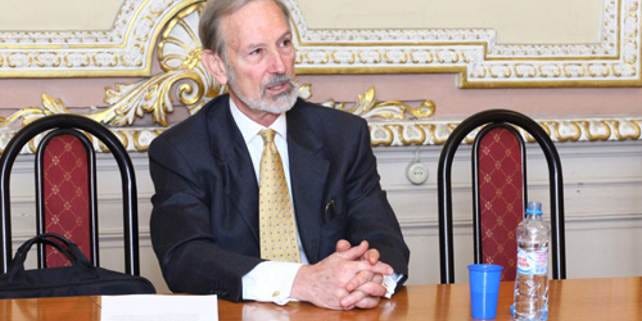
Gilbert Doctorow
The immediate source of the angst between Doctorow and myself were comments he made regarding a presentation by Russian President Vladimir Putin at the Valdai Discussion Club on October 2 of this year.
Doctorow used Putin’s comments as a foil to foist his own assessment that not only was the Russian President a failure, but weak and susceptible to being pushed out of power by dissenting forces within his government.
I called “bullshit” and disparaged Doctorow’s assessment as the work of a “moron.”
But this “calumny”, as the erudite Gilbert Doctorow labels it, is but the tip of the iceberg.
His “analysis” parallels a narrative that has been pushed by British intelligence and their agents/proxies for some time. It is a very dangerous narrative, as was seen in June 2023, when Yevgeny Prigozhin led his ill-fated “march on Moscow”, ostensibly at the behest of a business elite run out of London who promised him a “Moscow Maidan Moment” if his Wagner forces could occupy Manezhnaya Square in the heart of the Russian capitol.
I’m very familiar with Doctorow’s past life, connected as it is to the “roaring ‘90’s” and the rise of the corrupt Russian oligarch class that today has found refuge in London, where they plot against President Putin and the Russian nation daily.
I don’t believe in coincidences and have enough respect for Doctorow’s intelligence to believe that he is cognizant of this London-based nefariousness, and the consequences of openly aligning himself with their work.
Is Doctorow in the employ of the British Secret Intelligence Service and its exiled Russian host?
I can’t say.
But a man who has made Belgium—the lair of the NATO beast—his home these past decades cannot be said to be free of the influences of those for whom his very daily existence is dependent. Doctorow is smart enough not to get his hands caught in the cookie jar, so to speak. But his task as a “Kremlinologist” isn’t to openly cavort with the enemies of Russia but rather position himself to assist in the denigration of Russia and its leadership through narratives masked under the guise of a long-time “friend” of Russia.
At least this is what my “Spidey Sense” leads me to believe.
One of the things that disturbs me the most is how Doctorow has used the platform provided by my good friend and colleague, Judge Andrew Napolitano, to attack those who take umbrage with his analysis. Doctorow is a frequent guest of Judge Napolitano’s popular podcast, Judging Freedom.
“I am an outlier who serves as a useful demonstration of the program’s openness to diversity of opinion,” Doctorow has written, “if nothing more, since none of his guests agrees with my positions on this or that as regards Russia.”
That’s fair.
“And why should they?”, Doctorow asks. His answer to this question is the source of his undoing.
Apart from Ray (Ray McGovern, a retired CIA analysts and noted Russian expert who is also a dear and close friend of mine) and me, not a single one of the guests on this channel is a Russia expert.
As I said, I don’t have the highly (and repeatedly) touted academic credentials of Gilbert Doctorow.
I’m just a simple Marine who happened to graduate with a degree in Russian history and who shortly after graduating from college had an article published in Soviet Studies, the premier scholarly journal at the time for Soviet issues, edited by the esteemed historian, John Erickson.
Who followed this article up with another on Soviet history published in The Journal of Contemporary History.
And another on the conversion of Soviet defense industry published in Problems of Communism.
Who was directly accessed into the intelligence branch of the Marine Corps by order of the Commandant of the Marine Corps because of my expertise in Soviet area studies.
Who helped transform the tactics and operations used by the Marine Corps to better confront the Soviet threat by immersing himself in the operations and tactics of the Soviet Army.
Who was hand-picked to serve in the On-Site Inspection Agency, a Department of Defense activity created to implement the Intermediate Nuclear Forces Treaty, and who became the first US inspector on the ground in the Soviet Union when the treaty went into force in July 1988.
Who received national-level acclaim for his analysis of the Soviet Union, including two classified commendations from the Director of the CIA.
Now, I’ll be the first to acknowledge that the term “expert” is thrown around a lot and attached to people who may not be worthy of the intent of the word.
I’ve always said that there are two ways to become an “expert.”
The first is by having actual expertise derived from serious study and accumulation of knowledge and experience over time.
I graduated from college in May 1984 and was on the ground in the Soviet Union in June 1988.
Barely four years passed between these two events.
Malcolm Gladwell, in his book Outliers, speaks of the “10,000-hour rule”, namely that one requires at least 10,000 hours of practice before one can truly be said to be an expert.
If you add up all the time I spent studying Russian history, culture, literature, and language in college, and the time I spent researching and writing the articles I published, and learning Soviet operations and tactics, I think I came close to the 10,000-hour mark by the time I set foot on Soviet soil.
But I wouldn’t call myself an expert at that time.
The real experts were the Soviet Foreign Area Officers, like General Roland Lajoie and Colonels’ Douglas Englund and George Connell, whom I worked for while in the Soviet Union, men who had dedicated years of their lives to not only studying the Soviet Union, but transforming their knowledge into practical application as defense attaché’s assigned to the US Embassy in Moscow.
But there is another way one can be labeled an “expert”, and that is to be the first person ever to do something, because for a brief shining moment you are the only person to have ever done it, making you, by default, the world’s greatest “expert” on the topic.
I am proud of the fact that I and a handful of other American patriots were the trailblazers for on-site inspection in an arms control environment. We—literally—wrote the book on on-site inspection.
In the Soviet Union.
Which allows me, without fear of contradiction, to call myself an “expert”, at least how it is narrowly applied in this situation.
Moreover, when I finished my tour of duty with the On-Site Inspection Agency, I was proud to have General Lajoie, Colonel Englund and Colonel Connell all nominate me to be a Soviet Foreign Area Officer, noting that my two years of on-the-ground experience had given me an expertise and experience most Foreign Area Officers could only dream of.
I’ll leave it up to others to decide whether I am worthy of the descriptor “expert” when dealing with my Russian activities. I certainly don’t apply it to myself (I prefer to be called a “specialist”.)
I do not denigrate Doctorow’s academic achievements while in Columbia, prowling the Russian state archives in 1971-72 while researching the history of reforms of the Russian State Duma against the background of Russia’s defeat in the Russian-Japanese War of 1904-05.
That’s right up there with my own research into Ibrahim Bek and the Lokai tribe’s anti-Soviet activities from 1922-1931 in terms of relevance to the complicated realities of Russia today, especially in the context of the Special Military Operation.
“The introduction of parliamentary institutions in Russia during the Revolution of 1905-1907” may be better reading than “The final phase in the liquidation of anti‐Soviet resistance in Tadzhikistan: Ibrahim Bek and the Basmachi, 1924–31.”
Or it may not.
I’ll leave it up to those who chose to read both works to decide.
But I would never challenge Doctorow’s expertise on Russian matters.
But I do take umbrage at Doctorow’s knee-jerk dismissal of my background.
Not a single one of them knows more than three words of Russian.
Normally I wouldn’t get my dander up on this point. I mean, I know myself very well, and I will never go down in history as an accomplished linguist.
I struggle daily with basic English (don’t laugh—it is true. I was a military brat who moved every two years. I never took an English grammar course in my life, instead arriving in my new school in time to take literature or writing. I can read and write—I just can’t diagram a sentence.)
I college I struggled with Basic and Intermediary Russian. I use as an excuse the fact that I played football and drank beer during this time, but the fact is I have no grasp of basic grammatical rules, making the learning of a language like Russian, which is replete with complex grammatical rules, a mission impossible. Professor Diane Sands probably would have failed me if she hadn’t been approached by my senior thesis advisor, who asked me to check my translation of Soviet military journals. Professor Sands asked me who did the translation for me, and I showed her my workbook, where I had translated each page, word for word, in a process that was laborious and time consuming. She literally cried when she saw how much effort I had put into trying to learn Russian and gave me a “C” even thought I deserved far worse.
I was fired from the On-Site Inspection Agency because of my deficiency in the Russian language.
I worked myself back into the good graces of the command but was ordered to take a mandatory two-week Russian refresher course before leaving as part of the advanced party of inspectors sent to the Soviet Union in June 1988. My instructor, a senior Russian-American who taught at the Defense Linguistic Institute, likewise cried on my graduation—not because she succeeded, but because she felt she had let the country down—my Russian was that bad.
During my time as a weapons inspector in the Soviet Union, I didn’t speak Russian as much as I communicated in Russian.
It was ugly.
It was painful to listen to.
But it got the job done.
And this still applies to this day. When I was called upon without warning to address 25,000 Chechen soldiers in Grozny in January 2024, I gave an unscripted five-minute address that will go down in history for both its audacity and bad Russian.
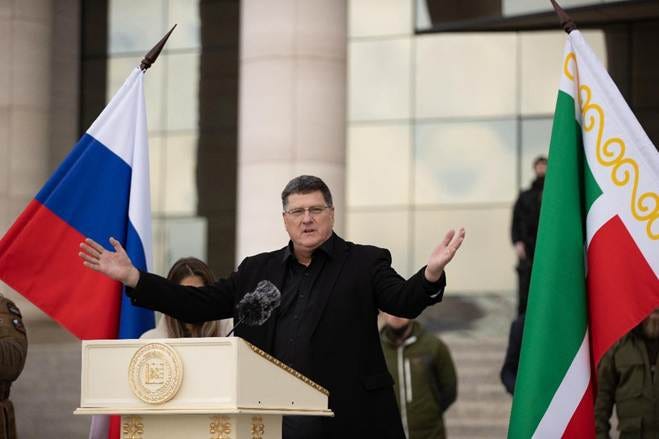
The Author addressing 25,000 Chechen soldiers, Grozny, January 2024
The same can be said of a similarly unscripted moment earlier this month, when I addressed Russian volunteers who worked to bring humanitarian goods to soldiers at the front.
The Russian was cringe-worthy; the sentiment behind my words was not, and the Russians (and Chechens) loved me for it.
But “three words”?
Come on.
Блин.
Твою мать, Gilbert.
I mean, my Russian may not be Умопомрачительно, but Ёлки-палки, when I do speak, the Russians I hang out with view me as a Сногсшибательный парень.
That’s seven.
I think I know a few more as well.
We work from very different methodologies, which by itself predetermines outcomes of analysis.
I’m a big fan of letting people be who they are.
Doctorow likes to emphasize his academic credentials, repeatedly underscoring that his Harvard and Columbia degrees, representative as they are of some of the most rigorous scholarly preparation in the world, somehow propels him into a class of elite intellectuals who operate on a higher plane than us mere non-credentialed minions.
That may be.
But I come from the school of hard knocks, a professional intelligence analyst seeped in the harsh reality that if I got it wrong, Marines would pay for my mistakes with their lives.
I don’t imagine Doctorow ever confronted such a quandary when defending his academic research.
My methodologies are the time-tested tools of the trade, emphasizing the need for deep knowledge and understanding of every facet of a problem before attempting to forecast outcomes based upon subtle changes in the data set.
Evaluating the credibility and veracity of sources is far different when debriefing prisoners or spies, or interpreting meaning in fragments of intercepted conversations, or discerning substance in grainy photographs.
Fumble the interpretation of a diplomatic cable from 1905, and you get a comment in the margins of your thesis.
Fumble the assessment of a source, either by giving it more emphasis than it deserves or discounting it altogether when in fact it was the truth, means letters get written to parents explaining why Johnny won’t come marching home.
So, forgive me when Doctorow goes off on some rant about how he evaluates comments from Russian television talk shows as an indicator of ground truth reality in Russia today, and I call him a horse’s ass.
Such a methodology may pass muster in the hallowed halls of Harvard or Columbia.
But it would get you laughed out of the briefing room in Dam Neck, Virginia, home of the Marine Intelligence School.
You’re right, Gilbert. We work from very different methodologies, which produce decidedly different analytical outcomes.
You got a Ph.D.
I briefed General’s, Presidents, Prime Ministers and Secretary Generals on issues possessing life and death consequences.
And they kept coming back to me for more.
I wonder why?
Gilbert invites his audience “to see and consider Ritter’s thinking processes, because they are emblematic of how this very popular public figure in Alternative Media bases everything he says about Russia today on what he hears from front line military commanders including the director of a drone unit, from government officials in the energy sector, from intelligence officials. These are, for Ritter, the whole of Russian society, which is fully backing the war, the way it is being waged, the collegial government around President Putin, and Putin himself.”
Duh.
Yes.
This is how I operate.
I mean, it is a bit more complicated than that. I’ll let Gilbert help me introduce just how complicated it is.
“He [Ritter] is not being feted by RT, he says, but is on a book promotion tour. Indeed! And one may ask who his publisher is and who actually is putting up the funds to host him.”
Gilbert is reflecting on an appearance I made on Judging Freedom a few weeks past, while I was in Russia on a 19-day (yes, Gilbert—two more than you!) visit to Russia.
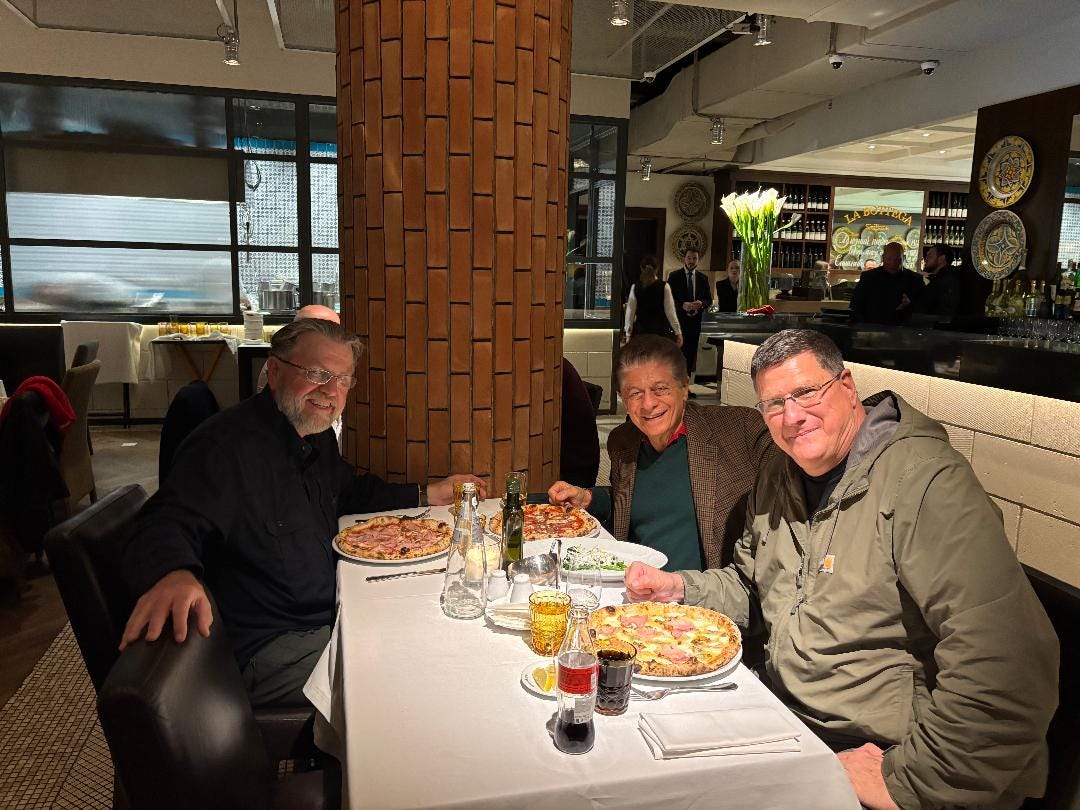
The Author (right) with Judge Napolitano (center) and Larry Johnson (left), enjoyin pizza in Moscow, October 2025
Doctorow is still fuming about how myself, Larry Johnson, and Judge Napolitano were invited guests of RT back in October of this year to help celebrate their 20th Anniversary. Oh, the sin and shame of accepting such an invitation!
But this anger/jealousy (“where was my invitation?” Doctorow appears to be asking) clouds Doctorow’s judgement. My trip to Russia in November had nothing to do with RT, and everything to do with a book promotion tour.
Indeed!
And since Gilbert asked, the publisher of the Russian language edition of my book Highway to Hell is Konzeptual Press.
Who put up the funds to host me?
“He is admittedly not paying his way,” Doctorow writes, “which should make the Buyer beware.”
It is curious how Doctorow, who spends so much time trying to impress his audience with his academic credentials, ostensibly the mark of a more discerning intellect that would demand factual accuracy before committing to a narrative in public, came up with such a statement.
I have admitted no such thing.
Quite the opposite, to be precise.
Konzeptual Press executed a standard publishing contract with my US-based publisher, which provides a $1,000 advance (split evenly between publisher and the author), as well as royalties for books sold. If the entire first printing sells out, my publisher will receive $2,200, of which $1,100 will come to me as the author.
Basic math.
For me to get to Russia to launch this book tour, I purchased my own ticket (around $3,000 round trip.)
I paid for my own hotel (a little more than $2,000 for the entire stay.)
I paid for the event hall, for the camera crew filming the event, and for the simultaneous interpreter used to help communicate my words to the Russian audience (a total close to $2,000,)
I paid for the books we handed out to the audience at the book launch (around $800.)
I paid for representational gifts commemorating the book launch ($2,500.)
I paid.
Using a combination of donations received from supporters, and from my own pocket.
The notion that I was on some fully funded junket is as absurd as the day is long.
The Russia book tour was never seen as a money-making event (I personally “lost” more than $4,200 on costs solely associated with the book event and not linked to the overall Russia trip, which in its totality cost around $35,000, all paid by me using a mix of donations and my own money.)
But this trip was never about making money.
It was always about engaging in a dialogue with Russia and the Russian people about the danger of nuclear weapons and the need for arms control.
Every dollar/ruble spent in support of this mission was money well spent.
“I pay for every visit to Petersburg out of my own pocket,” Doctorow likes to brag.
So do I, Gilbert.
So do I.
Tensions between myself and Doctorow have been growing for more than a year now, when Gilbert opted to believe the worst about me following the FBI’s raid of my home in August 2024. I don’t know when exactly Gilbert Doctorow decided I was a person for whom he could freely denigrate in terms of motive and expertise when it comes to Russian affairs. In September 2023, after a joint appearance on Press TV where we discussed the current state of play on the battlefield, Doctorow posted on his blog “It was a pleasure yesterday evening to join celebrated analyst and critic of the Ukraine War Scott Ritter on a Press TV ‘News Review’ program commenting on the latest U.S. arms deliveries to Kiev.”
In June 2024, when the US government seized my passport as I was preparing to board an aircraft at JFK that would take me to Russia, Doctorow penned a condemnation of the action, emphasizing the importance of free speech and the dangers inherent it its suppression. Doctorow noted that I “was designated as a high-level invited guest and would speak at the International Economic Forum” scheduled to convene on June 4. As Doctorow observed, I had been “a very active and widely listened to critic of American foreign policy, particularly as it relates to Russia and the Ukraine war,” adding that the “weight” of my messaging “has been reinforced by his having been an insider and implementer of US policies a couple of decades ago,” further noting that “when snippets from his interviews are aired by Russian state television, they never fail to remind audiences of his past in US intelligence.”
And yet, a mere two months later, when the FBI raided my home on allegations that I had knowingly failed to register as an agent of the Russian government, in violation of the Foreign Agent Registration Act (FARA), Doctorow’s true feelings about me emerged.
A day after the FBI executed a search warrant on my home, seizing personal electronics and a huge archive of personal documents, Doctorow unleashed a stream of vitriol that had been apparently building up for some time about me and my actions.
“Since the start of Russia’s Special Military Operation,” Doctorow wrote, “Scott has been one of the loudest cheerleaders for the Russian forces, telling us nearly every week how Russian victory and Ukrainian capitulation are just around the corner. It is no wonder that he attracted to himself a huge public audience both in the United States and abroad.”
I’ll let the audience dissect this statement as they best see fit. My statements are a matter of public record, and I stand by every assessment put forward. Predictive analysis is a challenging business, and no one gets it 100% right 100% of the time. I’m more than comfortable with my predictions and the underlying analysis which produced them. So, too, was Gilbert—that is, before it became politically dangerous to say so.
“Along the way, “ Gilbert writes, “Scott Ritter has made some serious errors of judgment which have led ineluctably to the present search and to his likely trial and conviction.”
Yikes! So much for due process.
Gilbert Doctorow, esteemed Ivy League academic and all-knowing seer on things Russia, has appointed himself judge, jury and executioner when it comes to my “crimes.”
My gravest sin, in the eyes of Doctorow? My failure “to understand what constitutes correct behavior with respect to the publicly identified adversary of the United States, which Russia is today just as the Soviet Union was in the days of the first Cold War.”
There’s more: “Ritter hanged himself when he acknowledged last night in a video released on the internet that he had accepted ‘compensation’ from both RT and Sputnik, which are news outlets financed by the Russian government.”
But the man who successfully scoured the Russian archives for clues into the behavior of the Russian State Duma circa 1905 next applies the acquired wisdom thus garnered to his next prediction: “That likely will not be the sole charges against him for violating the Foreign Agent Registration Act (FARA) when his case goes to court. He also accepted travel to Russia and within Russia paid for by Russian hosts, first a publisher of one of his books in a Russian language edition and then by a group of extreme nationalists linked to the philosopher-political activist Dugin. Their financial arrangements with the Russian government are opaque. This also showed willful disregard for propriety and for the journalist’s obligation to be objective. That Ritter’s objectivity had been compromised was perfectly evident from his glowing reports on Russia upon his return to the United States.”
Ignorance may be bliss, but it is still ignorance.
I was a regular contributor to both RT and Sputnik, where I provided both written and video commentary on news-worthy topics.
Just like I was/am a regular contributor to US-based publications such as Consortium News, The American Conservative, TruthDig, The Washington Standard, The Huffington Post, and Energy Intelligence.
No laws were broken.
All income was declared, and taxes paid.
Sorry, Gilbert.
Accepting travel to Russia paid by Russian hosts is likewise not a crime, so long as the Russian hosts are not sanctioned by the United States.
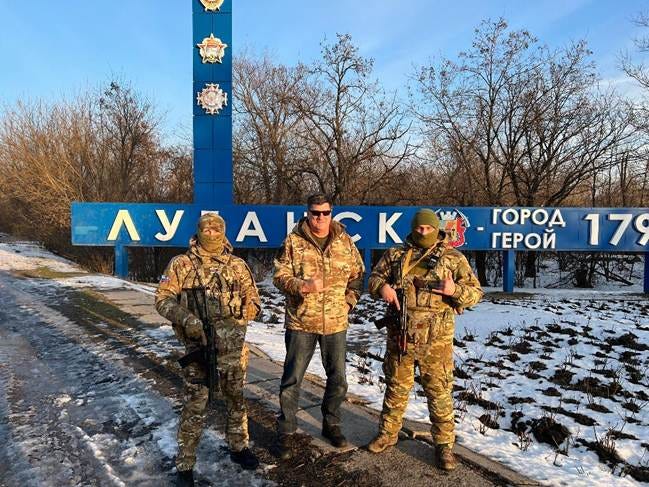
The Author in Lugansk, with his military escort, January 2024
In 2023 and 2024, I was the invited guest of Alexander Zyrionov, a Russian businessman from Novosibirsk. The trips were journalistic in nature, the first being linked to the publication of my book Disarmament in the Time of Perestroika (published by Komsomolskaya Pravda), and the second to a visit I made to Chechnya, Crimea and New Russia (Kherson, Zaporozhia, Donetsk and Lugansk) where I reported on the reality of the war as seen from this perspective.
Nothing illegal there, either.
Sorry Gilbert.
And I have no idea what Gilbert is talking about when he references Alexander Dugi and “extreme nationalists.”
I briefly met Alexander Dugin in the green room of a Russian TV station, where he was scheduled to go on after an interview I gave.
That’s it.
The FBI, it seems, was mostly interested in my relationship with the Russian Embassy, since I had made several visits there to either have lunch with the Russian Ambassador, Anatoly Antonov, or attend celebrations such as Defender of the Fatherland Day, Victory Day, and Russia Day, as a guest.
The FBI was particularly interested in an article I wrote about Russophobia in early 2023 that made use of material written by Ambassador Antonov. This article, the FBI contended, demonstrated that I was taking direction from the Russian government, making me a de facto Russian agent.
The FBI’s case subsequently fell apart.
No trial.
No conviction.
Sorry again, Gilbert.
Since Gilbert couldn’t convict me of FARA-related crimes, today he attacks my sources and methods when it comes to making assessments about Russi and the SMO. Doctorow has singled out my relationship with Lieutenant General Apti Aluudinov. In short, Doctorow has “reasonable doubts about the value of using such back channels as Alaudinov.”
As Doctorow points out, “Back in the days of the battle for Bakhmut, we saw a lot of Alaudinov on the Sixty Minutes news and talk show. Each day presenter Olga Skabeyeva warmly welcomed him on air, and he handled himself very well, speaking optimistically of Russia’s progress but giving no specifics that could be of use to the enemy. In short, his lips were sealed.”
The problem, it seems, isn’t with General Alaudinov, it seems, but the fact that I use him as a source. “I find it hard to believe,” Gilbert opines, “that such a professional soldier and patriot would give anything of use to a foreigner, however friendly he or she might be to the Russian cause.”
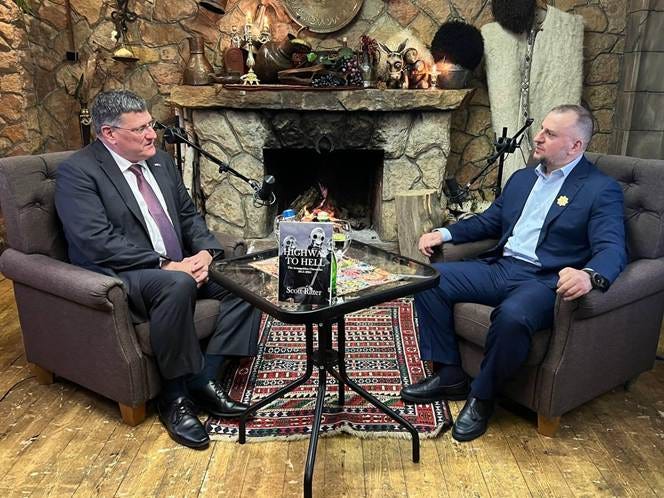
The Author (left) interviews General Apti Alaudinov, August 2025
The thing is, I have done several on-the-record interviews with Apti which I draw upon for my information.
Sorry, Gilbert.
But not to worry—Gilbert has his own sources. “Last night’s edition of the talk show The Great Game gave a very different picture of the state of conflict in Kursk from what my peers are saying and of where this proxy war may be headed NOW, not in some distant future.
The key personality in this discussion was Franz Klintsevich, identified on the video as leader of the Russian Union of Veterans of Afghanistan. His Wikipedia entry further informs us that after serving as a Duma member for many years he is now a Senator, i.e., a member of the upper chamber of Russia’s bicameral legislature. He has represented the city administration of Smolensk in the western part of the Russian Federation, where he is no stranger, having been born just across the border in what is now the independent state of Belarus.
For 22 years ending in 1997, Klintsevich was an officer in Russia’s Armed Forces, serving primarily with the parachutists, meaning that he has guts and knows what it means to face battle. He retired with the rank of colonel, but continued his military education in the Military Academy of the General Staff, graduating in 2004. He also has a Ph.D. in psychology and is a gifted linguist, with command of German, Polish, and Belarussian. He is a member of the steering committee of the ruling United Russia party. I bring this out to make the point that Klintsevich is no garden variety ‘talking head’ but a very authoritative source.
And his testimony on The Great Game is the kind of Open Source on which I rely to say what I do about current Russian affairs.”
Cool deal.
Color me impressed.
Almost…
Maybe this isn’t the time for me to point out that I have been a guest on both Sixty Minutes and The Great Game.
Or that I have met Franz Klinsevitch in person. I’ve interviewed him and have engaged in several in depth conversations with him of both the SMO and the issue of Afghanistan and how Russia treats the veterans of past wars.
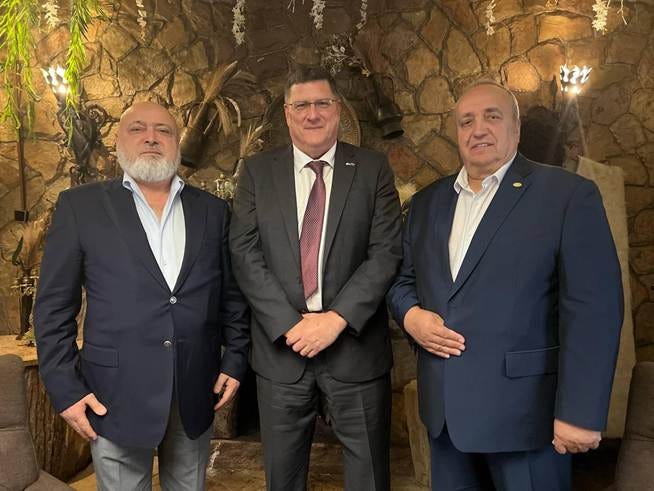
The Author (center) with Franz Klinsevich (right) and Abdullah, a friend from Dagestan (left)
You see, Gilbert, I don’t rely on “Open Sources.”
I rely on my own assessments, drawn from direct access to the sources whom I rely upon to formulate my independent analysis.
Gilbert denigrates my sources as “Russia Today officials, Ministry of Foreign Affairs officials, and retired Russian Generals.”
I mean, I do speak to such people.
But that certainly isn’t the limit to my access.
In August of this year, I conducted nearly 30 separate interviews of key Russian personalities, including retired Colonels and Generals, politicians present and former, journalists, artists, and experts of all stripes.
Just this month, during my 19-day visit, I interviewed another 10 prominent Russians on the record.
I also met with average Russians, in bars, over food and drink, and at their places of work.
I met with the ladies and retired men who volunteer their time and money to provide humanitarian support to frontline troops.
I met the brave men who drive their vehicles to the front line—the red line—to deliver these goods at great risk to themselves.
In short, I met Russia.
Over the course of the dinners hosted by Peter Hanseler at the Cantinetta Antinori restaurant, I discussed my work in Russia.
The source of my pride as a truly independent journalist.
The fact that I operated free of any outside influence, whether it be in terms of finances or direction.
That my work in Russia was produced by a private citizen, Alexandra Madornaya (whom I compensated for her labor), and not some government or non-government entity.
Peter had gathered guests worthy of the occasion—Judge Napolitano, Larry Johnson, Garland Nixon, as well as his own colleagues and acquaintances, including Denis Dobrin, Leonid Soshnikov, and Auguste Maxime. Kiril Sokolov, a volunteer who delivered humanitarian goods to frontline soldiers, also joined us, as did Peter’s wife, Masha, and my producer, Alexandra. And the Iranian specialist, Sayed Mohammad Marandi.
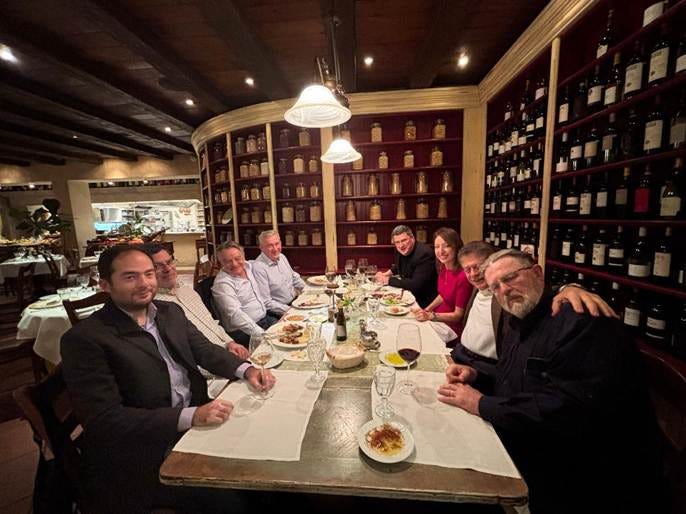
The restaurant Cantinetta Antinori discussion group, circa October 2025: (from left to right): Denis Dobrin, Mohammad Marandi, Peter Hanseler, Leonid Soshnikov, the Author, Masha Hanseler, Judge Napolitano, and Larry Johnson.
The conversations were in-depth, collegial, challenging, and sometimes quasi-confrontational (contrary to popular opinion, we are all not of one mind of every topic!)
We took Russian society apart and put it back together again.
And then did it again.
And again.
We did this in pursuit of the truth, which in Russia is as elusive a goal as anywhere, if for no other reason than there are so many differing opinions on how to interpret a diverse set of facts.
We didn’t agree on everything.
But on one topic we were all of one mind:
That Gilbert Doctorow is problematic.
Or, in Marine speak, a moron who is full of shit.
Oh, the calumny!
I have just returned from travelling 19 days in Russia, conducting interviews of prominent Russians in order to help capture the Russian reality and bring it to an American audience. This article was motivated by this visit, which was mostly funded by the kind donations of you, the reader. If you want to see more articles like this, please subscribe. And if you want to help make possible more trips such as this, please donate (the Author’s next scheduled trip to Russia is in March-April 2026.)
ooooo
@tobararbulu # mmt@tobararbulu
Interview with Alexander Stepanov
In this special edition of The Russia House with Scott Ritter, I am joined by my co-host Garland Nixon in downtown Moscow, where had the pleasure of interviewing Alexander Stepanov, a military expert at the Institute of Law and National Security of the Russian Presidential Academy of National Economy and Public Administration and Senior Researcher at the Institute of Latin America of the Russian Academy of Sciences (ILA RAS).
I asked Alexander a question about Venezuela possibly being used by Russia as a “second front” against the United States. His answer was a tour de force of modern geopolitical analysis that is a must see!
Transkripzioa:
Hello, and welcome to a very special edition of the Russia House with Scott Ritter. I’m here today in downtown Moscow. I’m joined by my special co-host, Garla Nixon, and we have a very special guest, Alexander Stepanov. He is a military specialist with the Presidential Academy, and he specializes in Latin America.
There’s so many topics that we could discuss, but right now the headlines are dominated by one nation in particular when it comes to Latin America, and that’s Venezuela and the possibility of a conflict between the United States and Venezuela. The question I’d like to start with is, as a Russian military specialist,
and keeping in mind some of the statements that have come out of the Russian Duma lately, speculation about the need to transfer Oreshnik missiles to Venezuela, etc. Could Venezuela possibly become a second front in Russia’s ongoing conflict between the United States and the collective West? You know,
the United States and Europe sought to make a second front against Russia and Georgia to create problems there. Could Venezuela be Russia’s second front against the United States?
Well, I’d like to say that the Russian Federation is not viewing Venezuela as a country that can be used to put pressure on anyone. Initially, as we see, Russia is building partnership relations with the countries in Latin America, in the Caribbean. Cuba, Nicaragua and Brazil are our friends. Brazil is the country that has established
BRICS is chairing BRICS this year. We should not look at the situation from the perspective of Venezuela. It is a complicated story. There are other players here, including China. Venezuela has huge explored oil reserves in the world, and China has its own interests there. There are lots of levels for strategic analysis. From the military perspective,
we can look at it as Trump’s doctrine that we’ve been observing since he assumed his office for the second time. And this MAGA motto is not the US. It is the Western Hemisphere, South and North America. There is some logic in developing the Monroe Doctrine, we can call it the Monroe 2.0 doctrine, and it is very systemic.
As we’ve seen, the first documents signed by Donald Trump since he assumed office, they determined the US policy in Latin America. And for that purpose, there was a new term fixed, narco-terrorism or drug terrorism. There used to be drug cartels, drug syndicates or narco-syndicates, but here the threat is defined, narco-terrorism.
And I have this association with the previous stage in the development of the doctrine when international terrorism was used as a term initially. And we can recollect the legalization of interventions and other events. We can be honest and say that this is exactly what happened. Venezuela can be only part of the process. Look at Donald Trump.
He began with Canada. What does it testify to? It is broader. It is the Arctic zone. So it is an ambition that is not hidden. It is a general line. It is a serious and long-term ambition. strategy of the United States to expand its zone of priority interest and it is an
objective interest and what do the State Department and Pentagon, what are they concerned about? When they analyzed the presence in Latin America and when they analyzed China, when they realized that China had become the key business partner for the majority of Latin American nations and China had become a major investor in serious industries, logistics,
port infrastructure and other sectors. And by the way, China is creating new opportunities to control the outer space. Maybe you’ve heard about the base in Argentina that was created by China and controlled by NOAC. And of course, it sounds very serious. When the United States are active in Europe and Middle East, Southeast Asia and Africa,
it means that America has lost control over certain critical aspects. And I believe that the military instrument is acquiring the role of the predominant instrument in the American policy. If we look at Mexico and the and the messages delivered about Colombia and not to say anything about the narco-terrorism and the plans to launch a special military operation.
Speaking about Nigeria, the story is almost the same there. So it is a sign of a serious global policy to restore the global dominance of the United States. And if we look at the narrative that is communicated by the US administration. So when people say that Russia wants to use Venezuela,
wants to turn it into its own tool, Russia doesn’t want it. Russia does not need escalation. Russia has enough problems in its neighboring countries and we have observed a significant military activity of NATO countries and you have heard about the statements made by the Russian President and our Minister of Defense well and if we
look at our neighboring countries and the Dark Eagle hypersonic complex that can to cover the distance to Moscow within six to seven minutes and carrying a special charge. We do not need to explain what kind of special charge we are talking about. And when we talk about these processes, It is not only Latin America or Venezuela,
and these are not Moscow attempts to take advantage of the complicated situation that we are observing now. I understand that the forces that are concentrated in the Caribbean Sea are destructive forces, and Venezuela will not be able to resist And a number of tomahawks in the region, including sea-based and land-based.
And if we look at the flagship that is in the Atlantic Sea, close to the African shore, we understand that the flagship has not crossed the Atlantic Ocean. But that flagship will cover half of the distance of half of the planet for an activity in the Caribbean Sea. And this is the biggest airplane carrier that can…
also carry F-18 and the most advanced missiles, long-distance missiles, and the distance is as long as 900 miles. And it is an opportunity to destroy all air defense systems. and therefore we need to look at things from a different angle. As you know, the Russian Federation signed recently a very serious strategic partnership agreement with Venezuela,
and that agreement has been ratified by the Russian parliament and by the president. The public text of the agreement is one story, but the level of strategic and long-term relations with Venezuela
also contemplates, as we understand, military and technical cooperation and purely military cooperation. And if we look for parallels, we understand that Caracas, the administration led by Maduro, has serious challenges. He was openly declared a criminal, and there are open discussions of his termination. As far as I understand,
Osama bin Laden’s head cost price for his head was cheaper than the price set for Maduro’s head. And there is a future presidential candidate, Karina Machado, a wonderful lady who has a Nobel Prize, and as far as I can see, she was the last nail in the Nobel Prize coffin,
because it is a discreditation of the Nobel Peace Prize. How can someone who has a Nobel Peace Prize actually solicit a military strike against her own country from some other state? Any conflict of such escalation would lead to multiple casualties. There will be hundreds of thousands or even millions of fatalities and there would
be millions if not tens of millions of fatalities. Where will these refugees go? They will use the transparent Brazil frontier and they will migrate to Brazil and Colombia. This will cause a very serious catastrophe in those countries, both social and humanitarian. And we understand that perhaps we have to do our best to prevent the conflict. And again,
when we talk about the supply of weapons and munitions, I understand that there is a very serious calculation of the degree of escalation. And when people start talking about nuclear escalation and I’d like to draw your attention that it was not the Russian side who started playing with this serious term.
I treat all definitions, all words of that. All messages where nuclear weapons are mentioned very seriously. I can tell you that nuclear weapons currently are not a military instrument, a war instrument, but an instrument to prevent a war, to deter a war. But we have observed a number of unfriendly and hostile steps,
including steps made by President Trump. Do you remember two nuclear submarines sent to the shoreline of Russia while a dialogue was being proclaimed? It doesn’t look very nice. The next point, we are fully aware of the fact that in Europe, where there is not a centimeter, an inch of American soil, there are American weapons in Europe.
My native city of St. Petersburg is located at a distance of 200 km from a Ravenel base where F-35 will be deployed. It is a state-of-the-art multifunctional type of fighter jets that are certified carriers of thermonuclear equipment, B-61-13th generation including that. And what does it tell us?
This fighter jet would find it very easy to reach the border of Finland and use that weapon. And we are in a situation where we cannot predict the development of escalation. It is only one example of Finland. If we look at the Baltic states, they actually have high mass supply to Estonia, and these are not defense weapons.
And Poland is turning into a military and technical hub. Why am I talking about the Russian borderline? I’d like to explain that if any U.S. citizens starts analyzing the situation along the same lines and try to think about offensive weapons that are able to deliver nuclear weapons to Florida, offensive weapons in Mexico, that Russian offensive weapons,
if those weapons were there in Mexico and were able to destroy the southern states of the United States, That would be perceived as our aggression. But we do not want to threaten either the US or Florida. We do not want to let Mexico down.
In a situation when we see that our regional allies are about to be exterminated, it is a fact that has already been proclaimed. There are people who are there to kill them. Well, the immobilization reserve is about 2.5 million people in Venezuela. Who are the immobilization reserve? They are common farmers, women and children.
And we understand that they are not the strongest military fighters. and they will be murdered remotely. No one is going to actually cross the Venezuelan border. There will be no troops deployed in Venezuela. We know how the US the type of military or war operations conducted by the US. The United States tried to preserve their people,
and if the entire military infrastructure has been destroyed, then the country can be seized. And this is the way hostilities are conducted these days. But we may have unpredictable consequences in this situation because Venezuela is interacting with other partners, not only Russia. Recently, Venezuela, Caracas, has had China and Chinese corporations as a key military partner.
They supply radio location stations, they supply military weapons, and by the way, those stations are compatible with SU-30MK, which is a very serious type of weapons. large range missiles, anti-marine missiles deployed, that would create threats for the US marine fleet. And how about the United States? Is the country ready for that? and ready to face it.
The next point, Venezuela has been cooperating or talking to Iran, and as far as I understand, there is a company that manufactures drones built in Iran. And actually, Iran has already demonstrated its military capabilities. It is not an attempt to threaten someone. It is an objective analysis of the current situation. Actually,
if we look at the 16,000 people, we are talking about US Marines and other forces in the Caribbean. There is a more serious offensive threat. We are talking about B-52, and they were actually cruising back and forth along the Venezuela shoreline, trying to actually conduct a drill to practice an attack by using long range. equipment.
Maybe it is not in the interests of the United States these days to unleash a military conflict in its own region. But my understanding is, when Russia signs a military and technological cooperation agreement, It has every right to provide support and to cooperate in the military sphere with its foreign partners. And by the way, for example,
we have long-range Iskander M, and that type of weapons can carry different types of missiles who may be equipped with sub-munitions. What are we talking about? If we take Gerald Ford, well, it is just a theoretical discussion. It would be enough to use a cluster munitions to make it unoperational.
So this is just an example of potential reactions. But, of course, we would not like to actually compare our military capabilities and decide who is stronger. If there are political contradictions, it’s one story. But when one side has an obvious military and technological advantage, When there is a plan to violate the norms of territorial integrity and
international norms, actually there may be a very serious counter effect. And as you know, if I’m not mistaken, in the United States there are about 25 or 30% of who are ethnically from Latin America and whose native language is Spanish. Again, I’d like to reiterate that Venezuela is not secluded and Venezuela is a big part of
South America. and refugees from Venezuela would make a serious negative impact on neighboring countries, on Colombia, on other countries. And if we are concerned about human lives, let’s elevate to the humanitarian aspect. Maybe it is the time to save lives. Maybe there are other means to promote ourselves, our nation and our influence.
that there were recent elections in Bolivia and you know what the lithium triangle is. And the next narrative that the Trump administration is pushing forward is domination in the sphere of rare metals. By the way, Venezuela and Venezuela is of key interest in this respect.
This is why when we say that MAGA means resources in the region have to be controlled, this is how real politics works. This is not promoting democracy. This is not promoting humanitarian approaches. This is an attempt to seize control over resources. And we are sitting here today. Actually, there will be other corporations who will
and there will be other corporations who will be controlled by US funds. Let’s go back to China. When we speak about investments, it seems to me that in all likelihood, it was a long-term policy. pursued by the United States when they allegedly did not notice or turned a blind eye on Chinese intervention in the region.
China invested hundreds of billions in the infrastructure in the region, but now there is a de facto attempt to seize control over that infrastructure. This is what happened in Argentina. And again, we need to look at this from a broader perspective, looking at it from the angle of the BRICS bigger picture.
Though we sometimes hear from Washington that BRICS is not an effective structure, it is of no relevance or significance, but if we look at the population, at the gross domestic product, if we look at the domestic markets and if we look at the upside potential of that domestic market,
actually BRICS could be a very serious integration platform whose aim is not to fight with anyone. And this is a secret. And those countries that have already evinced interest find themselves under serious pressure. Bolivia became a BRICS partner in January. If we look at Argentina, for example, when Javier Milley assumed his office,
Argentina was about to enter BRICS and it was taken by the scruff. and taken out of the train by force and many countries are under pressure from politicians and I would not say that it is not an anti-American policy but BRICS is trying to diversify contacts and partners
actually based on the free market principles as declared by the world trade organization but as far as i understand the wto has changed its approaches by establishing sanctions by using financial pressure that the Trump administration is using actively. And we see how this pressure is also exerted against Europe. Therefore, we could say that the American continents
are in a serious turbulence and actually this may be turned into a serious funnel if there is an aggression against Venezuela if it does take place. I do not know how quickly it may happen and what kind of dynamics would be. I know that inside the US there are a lot of opponents to this line.
And as you know, the southern command head will be demoted or will be fired in December. I don’t know what the reasons are, but it looks like he was not dynamic enough today to develop military influence in the region. He recently visited Guyon and Suriname, and there is this view that
There is a certain platform being built around Venezuela for local operations to seize control over the resource base. So what would be the way out from this situation? I think that you have heard of this expression that once you’ve taken your knife out, you have to use it.
The Trump administration is currently in a situation where all Western mainstream media have already declared that Venezuela would be subjected to certain actions. Maybe it is part of political pressure. Maybe it is an attempt to urge the Maduro administration and perhaps make him exit the stage. If it is a media tool, then perhaps it is admissible.
But the way I see it, the processes may actually gain that inertia movement when you would not be able to turn back. And this inertia may lead, again, as I’ve said, may lead to something that is quite the opposite to this goal of integration of Americas under the US aegis. This could be possible using constructive tools.
I’m talking about building a single bi-continental platform that is consistent with those who are ready to push forward single technological development standards. Perspectively, Eurasia together with Africa could actually have an internal and sustainable communication. But the way I see it, there are attempts to sever Europe from Russia long-term wise.
But this is not only the relationship between Europe and Russia. There is China. There is One Belt, One Path project. And this would also overcomplicate logistics. And again, those who control sea logistics, seafaring logistics, he controls the global trade. And we’ve been observing these consistent steps. Let’s recollect the Panama channel.
There was the Hong Kong company Hutchison that controlled and then it sold its assets to BlackRock. And now the Panama Canal is under the US management and control. What is the key port in the Pacific managed by China? It’s the port of Chinkai.
And this port was recently opened by President Xi and it is a key logistical hub. across the Pacific Ocean for China. There were lots of investments made. And most importantly, it is not only a port, but it is a hub, as I said, which connects the transcontinental bio-oceanic corridor. It is an initiative implemented by China.
What was the Latin American key problem? internal logistics, a lack of internal connectivity. All key central economic centers in Latin America are along the shoreline. Therefore, those who control the port infrastructure, and today there is a direct control. Chinese companies have over 30 ports.
We can say that almost all Latin American ports in the Caribbean Sea are controlled by China. Again, those who control sea logistics control global trade. It is a very serious challenge for the United States if we are talking about the United States promoting and protecting its economic interests in the region.
If we look at maps, if we look at statistics, and at statistical data as consolidated, we can take a look at the year of 2025, the map of the US economic presence and China. Here we see the blue color and there we see the red color. There is not a single country in the Latin American continent,
on the continent, that is a key partner to the US, except for Brazil, which continues to be one of the key economic partners. But as we know, the relationship between the US and Brazil has become very sensitive, especially when Trump assumed his office.
Trump has those executive acts as a tool and last January he signed an act on threats posed by the Brazilian government where he justified the record-breaking restrictive duties to be imposed on Brazil and why the sanctions policy would be made tougher. It is a serious political document that defines bilateral relations with the US key
economic partner on the Latin American continent. And when referring to such key partner, you are using the words threat. What is Brazilian response? The previous president, Samara, who was nicknamed the Amazonian Trump, and there were lots of protests and de facto he wanted to actually a coup in the country to seize power.
and there were targeted sanctions imposed by the United States Ministry of Justice. Is it not interference in the domestic processes in a third country, in another country? Well, I think that the mindset of the political and military leadership in the United States has been so much affected that they do not have respect for sovereignty of other states.
And restoring that respect, restoring the respect for the right of any other nation to determine its policy would be crucial. I am confident that the United States has numerous positive tools to use in security, digital technologies, artificial intelligence, outer space, etc. Because in many respects the United States could use its global leadership to make
its image more positive, but it seems that Washington is destroying both of things due to some reason, and many people are looking at the United States as a threat. I’m judging, looking at the actual military and technical situation along our borderlines. We met with Scott on the day when our leaders met in Alaska, in Encourage,
and there was this feeling that perhaps we would be able to go back to the format of a normal dialogue. But I understand that after that summit, Nothing has changed. After the summit there was a statement that tomahawks would be supplied, 4500 missiles. When people say tomahawks are obsolete, no way.
It is an efficient and very good type of missiles. And most importantly, they can be equipped with nuclear warheads as a special charge. And looking at the military and technical component, there is a well-known company, Oshkur, that manufactures different types of assembly units is deploying to manufacturing sites in Europe.
A few weeks ago there was a concept presented that is called XMAF and it is a carrier for tomahawks. The United States has 4,500 tomahawks, and carriers would be manufactured in Europe. Therefore, there is a platform for the supply of different types of weapons. What is the military and industrial complex doing, and Pentagon is doing in particular?
4,500 Tomahawk missiles are indeed obsolete. There’s Dark Eagle, there’s precision strike, high mass, and some more effective and cheaper weapons. And there is a key player that has exited the civil sector. It is the Anduril company that has amazing manufacturing capacities and it has cheapened the production manufacturing life cycle.
and it can scale up manufacturing of various types of weapons, including precision weapons. Therefore, tomahawks are not needed, and those stockpiles have to be cleaned up. And what can be done? Either a lot of money should be paid to dispose of tomahawks, or those tomahawks can be sold to the United States allies in Europe.
What are the targets for such missiles? Let’s be objective. When there was the so-called third anti-air ring built in Europe, in Poland, Romania and the Black Sea, we understood that was built against Russia. And now Tomahawks will be targeting Russian cities. You know Russia, you know that The European part of Russia is densely populated.
Is it not an existential threat and it is happening here and now. And it is no secret. This is something that is done openly and publicly. We see that these processes, there are different forecasts, but if we look at contractual terms and conditions and obligations and the timelines for the delivery of various types of equipment,
including offensive weapons, then the deadline is 2030. By 2030, Europe will be so equipped with high-precision weapons that this will begin to work. And preventive decisions on our part are also possible. We, as part of the dialogue between Moscow and Washington, will have to agree that There is a zone of our influence.
There should be no American weapons or high-precision weapons delivered there. This brings us back to your initial question. Would Russia like to use Venezuela as a platform for pressure? What are our options? We should either protect our allies, by the way. There was a similar situation.
Let’s recollect the Caribbean crisis and the famous operation when there was a plan to deploy high-precision weapons in Cuba, weapons that could carry nuclear warheads. And there were Persians targeting our country, and the time for striking the key centers in Russia were tens of minutes, and those cities would be subjected to total destruction and termination.
And the situation is the same here, but even worse for Russia, because our huge borderline with NATO is already stuffed with NATO weapons, When people say that Finland has purchased a 64 F-35 to protect itself, to protect itself against whom? Has Russia ever threatened Finland? We are told that Finland does not have nuclear weapons.
But let’s count the time needed to deliver B-61 from Germany to Finland by train. After two weeks we’ll have ready-made carriers with nuclear warheads. There is an infrastructure in place and that infrastructure will either have to move back because there is no existential threat for Europe. We know of the prerequisites for the special military operation who equipped
Ukraine and who is supplying weapons By the way, there is a curious piece of information. The territory of Ukraine is a testing and training ground to prepare and train proxies. from narco cartels from Colombia and Mexico. What is happening now? There are mercenaries there, but there are also people who will act as instructors for narco cartels.
These are drone operators. people who are able to use offensive drones and intelligence drones. We know that narco cartels are using various types of drones. And in Colombia, there was a copter that was landed by a drone. And actually, according to our information, the people who actually struck that a helicopter had been trained in Ukraine.
Okay, let’s analyze the situation. The proxies have been created. Let’s say those who created those proxies and have a deep conviction that those proxies were prepared with participation of the United States. We can recollect Mako and Peter Scott, were good at describing how the narco traffic in Afghanistan was created. And we know beneficiaries of those projects,
and there is open source information available that there was a time when actually the shadow operations led by CIA were financed by narco traffic, and so proxies are used. And going back to those militants who were trained, now the United States Going back to the United States statement that there will be military operations against narco-terrorists.
What if those cartel representatives who were trained in Ukraine, what if they start killing Americans in Mexico, in Colombia? I’m talking about this reverse effect. Because when you raise and feed a beast, it does not mean that you will be able to control that beast. The same relates to international terrorist operations. You, as an expert,
will understand that those who do not understand the political background will bear the brunt. So the goal is good. Fighting narco traffic is a wonderful goal, but to be able to tackle the narco traffic goal, Mr. Trump has mistakenly chosen the wrong geography. If we look at the UN data and the UN Drug Department, the data
shows that the lion’s share of drug traffic goes through the Pacific Ocean. Maybe Gerald Ford will cross the Panama Canal and go to the Pacific to destroy those who are engaged in drug trafficking. Do you know the key port for drug trafficking? And these are not boats.
More than 60 civilians killed, nobody checked their documents, nobody inspected them. This is exterritorial jurisdiction, and actually this is a murder of unknown individuals. I know that the Department of Justice has given a green light. to kill those people, but how can we give a green light to kill citizens of another state without any proof?
If we look at Ecuador, there is a huge American presence in Ecuador. There are plans to upgrade the Marine military base there. Ecuador is one of the countries that has this external management by the US and it has a lot of drug trafficking. Why do we have hundreds of tons of cocaine departing Ecuador?
There was a huge heapman that was arrested in the port of Ustluga, close to St. Petersburg. That huge shipment of drugs was from Ecuador. We as Russia can help the United States. We can cut short those drug trafficking routes on our part. But we understand that narco-terrorism is just a lame excuse.
And we understand that the narco trafficking has not been diminished even despite the presence of American military in the region. I believe that the expert community has to get engaged and I’m sure that many U.S. generals understand. The potential consequences of this expansionist and extremely aggressive political line of the United States,
these series of conflicts may cause and drive a turbulence, exponential turbulence, and most importantly, a nation that has all capability to guarantee extermination and if it threatens the use of nuclear weapons. And it is threatened with the use of nuclear weapons when the United States threaten conducting military tests.
None of our politicians has ever said that our weapons are targeting the United States. We use nuclear weapons for deterrence purposes. You have heard about flight terms of reference, and if a ballistic missile is usually targeting specific cities, but we do not have those instructions given They are not targeting US cities.
Maybe we should put a stopper on making statements that could lead to irreversible consequences for our children and grandchildren. Maybe we should go back to being careful with our words. You know, we know the Bible that the word came first. And a word is a serious thing. You know how we respond. We treat all such statements seriously.
And most importantly, we are able to act. We are all sober-minded people. We are reasonable people. And we understand that any such action would not be beneficial to all. Therefore, it is also a reason for a constructive dialogue. And the key task for the Russian Federation is to neutralize threats and to remove
the root causes of the special military operation. There are threats and it is not propaganda. We know minimum in the public space and we know that there is military infrastructure that is being built around our country and it may trigger processes that would actually lead to a situation when the Rubicon is crossed and
when there is point of no return, when the algorithm is activated. You know, there are processes that are irreversible and we are very close to such irreversible processes and again, In my deep conviction is that in the 21st century, nations, other states cannot be destroyed because you are strong and powerful or because those countries have raw resources.
By the way, Venezuela invited Exxon and Chevron, go ahead, keep developing our hydrocarbons. build refineries, refine our minerals. And now pirate tools are used to actually intercept ships that are supplying crude also to China. This is my opinion.
Well, thank you very much for, I mean, an expansive answer. We’re almost out of time, Garland, but if you’d like to add some commentary.
well the only thing i’d like to add is and this is about the venezuela situation and that is you know one of the things that we’ve seen is the u.s has the capability to for long-term strikes but as russia well knows knows in order to um
to complete a military operation it requires a land army it requires a land incursion And, you know, when it comes to Venezuela and many other countries, I think what we’ve seen, Yemen is an example, Afghanistan, we’ve seen the United States capable of long-term strikes and eventually simply leaving and having lost the war. They’ve launched an attack.
But ultimately, to gain control of the territory requires a long-term commitment from the people because there’s going to be significant numbers of casualties. The commitment is not there for these kinds of expeditionary military operations. So I think that my opinion is the United States ultimately can’t be successful in Venezuela and in South America with such an operation.
Well, from your lips to God’s ears, and hopefully there won’t be a war. That’s all the time we have. I want to thank my guest, Alexander Stepanov. Thank you. Military specialist with the Presidential Academy, Garland Nixon, and you, the audience, for joining us in this very special edition of The Rush House with Scott Ritter.
We’re here in Moscow, and we’ll be here all week. So thanks for tuning in, and we’ll talk to you soon.
oooooo
The 2019 Baikal-Alaska Sailing Expedition
In July 2026 an expedition will retrace the Alaska-Siberia air corridor used to send lend-lease aircraft to Russia during WW 2. Here is the story of the expedition that motivated this adventure.
The Baikal-Alaska Sailing Expedition, 2019
In 2019, Anatoly Kazakevich, a Russian entrepreneur, led a daring expedition which saw him and an intrepid crew of like-minded individuals sail a catamaran from Lake Baikal to Sitka, Alaska, in the name of Russian-American friendship. In 2026, Anatoly is leading a new expedition, this one involving seaplanes that will re-trace the route taken by American pilots when flying aircraft to Russia as part of the lend-lease military assistance program. The Alaska-Siberia (ALSIB) air corridor is a symbol of US-Russian friendship dating back to when our two peoples were allied against the evil of Nazi Germany. Today, Anatoly and like-minded Russians and Americans are seeking to resurrect the legendary ALSIB route as a symbol of a new spirit of US-Russian friendship. Anatoly’s book about the 2019 Baikal-Alaska Sailing Expedition is published here so that the audience might better appreciate the work Anatoly and others have done in the cause of bettering Russian-American relations, and support his efforts to continue this important work through the Alaska-Siberia air expedition. I am honored to have been invited to participate in this exciting adventure. Please help support this important cause, either by finding ways to participate, or through donations that will help underwrite the expedition. https://forum.baikal-alaska.ru/en
PDF-n: file:///C:/Users/Personal/Downloads/Baikal_Alaska_English.pdf
oooooo


